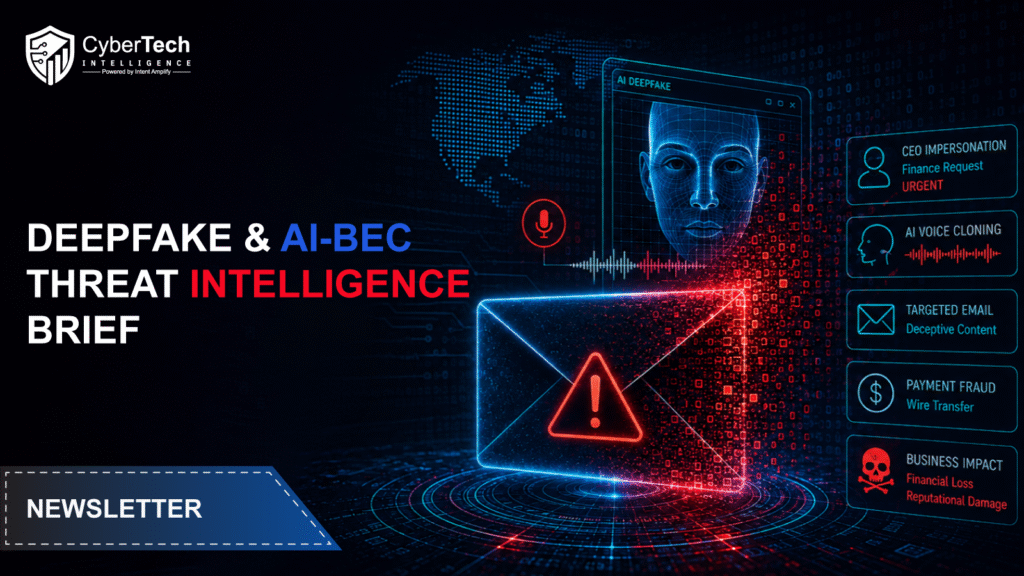
Executive Summary
Synthetic media fraud and AI-enabled business email compromise have quietly moved from experimental attack vectors to frontline financial crime tools. Enterprises that continue to treat deepfake threats as a future-state problem are already operating with blind spots the adversaries are actively exploiting.
The convergence of generative AI, widely accessible voice-cloning APIs, and increasingly sophisticated social engineering playbooks has significantly compressed the time and skill required to run high-yield impersonation attacks.
Security leaders are now contending with fraud scenarios that defeat conventional authentication controls and bypass employee awareness training built around older threat models.
Across sectors ranging from financial services and legal to manufacturing and healthcare, the attack surface tied to human identity verification is widening faster than enterprise defenses are adapting. The following brief maps where that gap is most acute, what adversaries are prioritizing, and where enterprise security programs need to accelerate.
THREAT LANDSCAPE
AI-Generated Fraud Is No Longer an Emerging Risk Category
What security research teams were flagging as early-stage experimentation two years ago has matured into a commoditized attack capability. Generative AI tools capable of cloning audio in under thirty seconds, replicating facial movements from a static image, or drafting contextually accurate executive impersonation emails are now accessible without specialized knowledge or significant financial investment.
Reported incidents of deepfake-based fraud targeting enterprise finance and compliance functions surged throughout 2024 and 2025. In 2023 alone, BEC accounted for over $2.9 billion in reported losses, ranking as the highest-loss cybercrime category in the FBI’s Internet Crime Report. ¹
The pattern is no longer limited to high-profile isolated incidents. Security teams are now documenting repeatable attack playbooks:
- A finance team member receives a video call from someone appearing to be a known executive or external auditor requesting an urgent wire authorization.
- Procurement personnel get a voicemail purporting to be from the supplier regarding updates to their banking account details before the next payment.
- HR personnel conduct numerous remote interviews with the synthetic individual before a background check, revealing discrepancies.
The commonality between the two scenarios above is that the fraud takes advantage of human vulnerability rather than technical vulnerability.
Existing controls built around endpoint security and network monitoring provide little friction to attacks of this type.
BEC EVOLUTION
Business Email Compromise Has Acquired a Generative AI Layer
Traditional BEC attacks relied on low-cost, high-volume phishing campaigns that sacrificed precision for scale. The introduction of large language models into adversarial workflows has changed that calculus.
Attackers now produce highly personalized, grammatically fluent communications that incorporate contextually accurate references to real projects, organizational hierarchies, vendor relationships, and financial processes.
Deepfake-assisted impersonation is accelerating faster than most organizations’ detection capabilities, and AI-enabled social engineering now ranks among the top strategic cybersecurity threats facing enterprises through 2025 and beyond. ²
Several factors are compounding this risk for enterprise security and finance teams:
- Publicly available organizational data on corporate websites, LinkedIn profiles, and press releases gives adversaries sufficient context to construct credible impersonation scenarios.
- LLM-generated emails can adapt to a target’s communication style by analyzing prior correspondence obtained through credential compromise or initial access.
- AI-assisted BEC campaigns are increasingly combining email spoofing with synthesized voice follow-up calls, creating multi-channel pressure that accelerates victim compliance.
The addition of synthetic media components is expected to raise both the average transaction value targeted and the success rate of individual attempts, according to financial crime investigators who have examined recent case patterns.¹
INDUSTRY EXPOSURE
Sectors Carrying the Highest Synthetic Fraud Exposure
Certain enterprise segments face structurally elevated risk given the combination of high transaction volumes, distributed workforce models, and reliance on remote communication as a primary operational channel. Financial services, healthcare, and energy have been flagged as the highest-exposure industries for deepfake-driven social engineering at the enterprise level.³
The following verticals are drawing the most documented adversarial attention:
Financial Services and Corporate Treasury Wire transfer authorization workflows and payment instruction updates remain the primary target.
Treasury and accounts payable functions that rely on voice or email confirmation for large-value transactions are operating with verification processes that were not designed to account for synthetic media.
Legal and Professional Services Firms handling mergers, acquisitions, litigation settlements, and escrow transfers represent attractive targets due to the legitimacy of large, time-sensitive fund movements and the common use of email as the primary transactional channel.
Procurement professionals responsible for supply chain management and researchers involved in the disbursement of grants are becoming increasingly prone to these threats.
Healthcare institutions must also be aware that they may be vulnerable due to synthetic identity fraud committed against the administrative systems used by patients.
Technology and SaaS Companies
Remote onboarding practices and distributed work environments have made organizations more vulnerable to deepfake recruitment fraud and vendor impersonation schemes. ²
Manufacturing and Critical Infrastructure Operational technology environments where supplier communications and procurement approvals flow through relatively small teams with limited dedicated security oversight are showing up in documented incident patterns at a growing rate. ³
DETECTION GAP ANALYSIS
Why Existing Enterprise Controls Are Underperforming
Most enterprise fraud prevention architectures were built around threat models centered on technical exploitation: compromised credentials, network intrusion, and malicious attachments.
Controls such as multi-factor authentication, email filtering, and endpoint detection provide meaningful protection within those threat models. Against synthetic identity fraud, they offer far less coverage.
The core detection gaps that security and finance leaders are encountering include:
- Absence of real-time deepfake detection capability in video conferencing platforms used for executive communication and financial approval workflows
- Employee verification training that does not incorporate synthetic media recognition or provide clear protocols for challenging suspicious communications, regardless of perceived authority
- Payment authorization processes that accept voice or video confirmation as a sufficient second factor without independent channel verification requirements
- Insufficient integration between fraud detection functions in finance and threat intelligence functions in security operations, creating organizational blind spots
- Limited capability to detect LLM-generated email at the content layer, particularly when the underlying sending infrastructure is legitimate or only subtly spoofed
The organizations managing this risk most effectively are those that have treated synthetic fraud as a process and governance challenge rather than purely a technology problem.
REGULATORY AND COMPLIANCE WATCH
Regulatory Scrutiny Around Synthetic Media Fraud Is Building
Regulators across financial services, data protection, and securities enforcement are beginning to engage more directly with the fraud risk surface created by generative AI.
Financial sector regulators in North America, the EU, and Asia-Pacific are beginning to integrate synthetic fraud risk into supervisory examination frameworks, with formal guidance expected from several major regulators within the next twelve to eighteen months.⁴
While comprehensive regulatory frameworks specific to deepfake-enabled financial crime remain in early stages across most jurisdictions, several regulatory signals are relevant for enterprise compliance and risk functions:
- Financial regulators in multiple markets have begun flagging synthetic media fraud explicitly in supervisory guidance on fraud risk management, signaling increased examination scrutiny for institutions without documented mitigation programs
- Data protection authorities are examining the use of biometric voice and facial data in synthetic media creation, with potential liability implications for organizations whose employee data is compromised and subsequently weaponized
- Securities regulators have flagged deepfake-generated communications impersonating executives as a potential market manipulation concern, adding a disclosure and governance dimension for public company security teams
- Procurement and vendor management standards in defense and critical infrastructure sectors are beginning to incorporate requirements around identity verification practices that implicitly address synthetic impersonation risk
Enterprise legal and compliance teams that have not yet assessed their exposure through this regulatory lens are likely to encounter it in upcoming examination cycles or in post-incident review contexts. ⁴
EMERGING TREND WATCH
Attack Sophistication Is Advancing Faster Than Awareness Programs
Security awareness training has been a cornerstone of enterprise human-layer defense for over a decade. The current generation of AI-assisted social engineering attacks is outpacing the threat models that most training programs were built to address.
Several trends are reshaping the threat posture that enterprises need to train against:
Voice Synthesis in Real Time within a Call Session
Initial voice-cloning scams primarily used prerecorded voice samples. Modern attacks now leverage real-time AI voice synthesis, allowing attackers to impersonate victims continuously during live conversations.
Attack Chains Involving Different Mediums
Attackers are increasingly combining synthetic voice calls, fraudulent emails, and AI-generated video messages to create coordinated multi-channel fraud campaigns.
A single-channel fraud attempt is significantly easier to detect and challenge than one executed across multiple communication channels.
OSINT-Fueled Personalization at Scale
The combination of open-source intelligence gathering and large language model drafting has made it practical for adversaries to run highly personalized impersonation campaigns at volumes that were previously achievable only through manual effort against the highest-value targets.
Insider Threat Amplification
Synthetic media is beginning to appear in insider threat scenarios, where disgruntled or recruited insiders use AI-generated communications to provide cover for unauthorized actions or to implicate colleagues in activities they did not perform.
ENTERPRISE RESPONSE FRAMEWORKS
What Effective Enterprise Programs Look Like in Practice
Organizations that have made meaningful progress against synthetic fraud risk share a set of structural characteristics that go beyond technology investment.
The following operational patterns are emerging as distinguishing features of more resilient enterprises:
- Dual-channel verification requirements for payment instruction changes and large-value transfer authorizations, where the confirmation channel is predetermined and independent of the channel on which the request arrived
- Clear organizational escalation protocols that give employees explicit authority to challenge or pause requests from apparent authority figures, without career risk, when synthetic fraud indicators are present
- Integration of deepfake detection tooling into video conferencing workflows used for financial approvals and executive communications, with particular emphasis on the video and audio artifact signatures that current detection models are most reliable at identifying
- Cross-functional fraud intelligence sharing between security operations, financial crime, and human resources functions to ensure that synthetic fraud incidents detected in one area inform defenses across all three
- Regular red team exercises that simulate AI-generated impersonation attacks against finance, HR, and executive assistant functions, using the output to calibrate both technical controls and behavioral response training
- Third-party and vendor risk program updates that require assessment of how suppliers verify the authenticity of communications received from your organization, as well as communications your teams receive from them
WHAT CISOs SHOULD MONITOR
Imminent Enterprise Focus Areas
- Deepfake detection capability in video-based approval and communication workflows
- Payment verification protocol updates for wire transfers and supplier banking changes
- AI-assisted BEC detection at the content and behavioral layer within email security tooling
- Employee training curriculum refresh to incorporate synthetic media recognition
- Cross-functional fraud intelligence integration between security ops, finance, and HR
- Vendor and third-party communication verification standards
- Regulatory examination readiness assessments covering synthetic fraud risk management documentation
- Incident response playbook coverage for confirmed deepfake fraud events
Critical Enterprise Reality
Deepfake and AI-BEC threats are not waiting for enterprises to finish their AI governance frameworks or complete their zero-trust deployments.
The attacks are operational today, the financial losses are documented, and the gap between attacker capability and enterprise readiness is widening.
Security leaders who treat synthetic fraud as a workstream within a broader AI risk initiative are likely to find that the threat is moving faster than the governance process.
The organizations managing this well are treating it as a distinct, active threat program with executive ownership, cross-functional accountability, and a bias toward operational response over policy drafting.
ENTERPRISE INTELLIGENCE OUTLOOK
The synthetic fraud threat surface will continue to expand in proportion to enterprise adoption of remote work models, digital-first financial processes, and AI-driven communication tools.
Adversaries operating in this space are benefiting from the same capability improvements that enterprises are investing in for legitimate productivity purposes.
The coming eighteen months are likely to see deepfake and AI-BEC attacks become a standing category in enterprise fraud loss reporting, increased regulatory prescription around synthetic identity verification requirements, and a market acceleration in purpose-built detection and verification tooling.
For enterprise security leadership, the near-term priority is not to achieve a definitive technical solution to a problem that will continue evolving.
It is to ensure that the human, process, and organizational controls that currently sit at the center of this risk are designed for the threat model that exists today — not the one from three years ago.
Cryptographic trust, verified communication channels, and behavioral controls that remove the pressure to comply without verification are the foundational elements. Enterprises that secure those foundations now will be substantially better positioned as adversary capabilities continue to advance.
References
- FBI Internet Crime Complaint Center (2024) Business Email Compromise: The $55 Billion Scam. Available at: ic3.gov (Accessed: 18 May 2026).
- Gartner (2025) Top Strategic Cybersecurity Trends for 2025: AI-Enabled Attacks and Human Identity. Available at: Gartner (Accessed: 18 May 2026).
- World Economic Forum (2024) Global Cybersecurity Outlook 2024: Deepfakes and AI-Driven Social Engineering. Available at: WEF (Accessed: 18 May 2026).
- FS-ISAC (2025) Navigating Cyber 2025: Synthetic Fraud and the Expanding Attack Surface in Financial Services. Available at: FS-ISAC (Accessed: 18 May 2026).
Read Our Latest eBook: Securing Open Source Dependencies Against Modern Supply Chain Attacks
🔒 Login or Register to continue reading