Introduction
The open source software has played a central role in the current application development by enabling innovation, faster development cycles, and the transformation of businesses into the digital age.
Whether an organization adopts cloud-based applications, enterprise SaaS services, or AI-powered applications, the use of third-party software integration is very common in the current software architecture.
However, the use of open-source software environments has resulted in an unprecedented growth of the enterprise attack surface.
Cybercriminals are exploiting the vulnerabilities associated with software supply chains and attacking them through trusted workflows, hacking open-source software libraries, compromising maintainer accounts, and infiltrating CI/CD pipelines.
Whereas earlier cybersecurity threats were associated with attacking infrastructure assets directly, supply-chain breaches represent a completely different approach.
As dependency ecosystems continue to expand, organizations are facing growing challenges around:
- Dependency visibility
- Software provenance
- Transitive risk management
- Runtime integrity validation
Open-source dependency security is no longer just an issue around vulnerabilities when it concerns CISOs, DevSecOps practitioners, platform security experts, and enterprise architects.
This ebook will reveal to you the threat landscape in 2026, the techniques used for attacks on open source communities, and solutions for improving software supply chain security without sacrificing developer agility.
Why Open-Source Dependencies Are Becoming an Attack Vector
Open-source software has become foundational to enterprise development. The present software development era is highly reliant on open source frameworks, libraries, APIs, and third-party packages.
The software development communities have been utilizing npm, PyPI, Maven Central, GitHub Packages, and other package repositories to expedite development and reduce time-to-market for their products.
In most of the enterprise setups, applications are not created using self-developed code anymore. Rather, applications are being created using a complex dependency tree of third-party components.
Many organizations adopted open-source technologies at a pace that exceeded the maturity of their dependency-governance programs. As a result, development teams often maintain limited visibility into:
- The origin of software packages
- Maintainer trustworthiness
- Transitive dependencies
- Package integrity
- Long-term maintenance status
This visibility gap has become one of the most attractive attack opportunities for modern threat actors.
The Software Trust Model Has Fundamentally Changed
Historical approaches to enterprise security involved the defense of networked and infrastructural assets against external threats.
However, with the advent of software supply chain exploits, organizations now face a different scenario, whereby attackers exploit established software relationships rather than attempting to attack infrastructure itself.
Malicious dependencies in software are typically introduced into enterprise settings using legitimate processes such as:
- Package management systems
- CI/CD workflows
- Software update processes
- Software development toolkits
As a result of this change in approach, software assessment practices must also be rethought.
The core issue is not confined to securing the environment anymore. Enterprises need to ensure that the software elements that enter the environment are reliable, authentic, and trustworthy.
This constitutes a big change in strategy for enterprise security executives.
Dependency Sprawl is Increasing Operational Exposure
Dependency sprawl has become a growing challenge across enterprise software environments.
A single application may contain:
- Direct dependencies
- Transitive packages
- Runtime libraries
- Container images
- External APIs
- Integrated third-party services
Often, companies do not have centralized visibility on the entire chain of dependencies behind their critical business applications.
Such an approach poses a significant risk, since a single compromised or vulnerable component can impact many different services at once.
For instance, if a company uses a development framework with a compromised dependency, it will need to:
- Rebuild its application environment
- Patch several workloads
- Change any exposed credentials
- Ensure the integrity of the software
The operational disruption associated with dependency-based attacks frequently extends far beyond the initial compromise itself.
Modern Supply-Chain Attack Patterns
Attackers are increasingly exploiting software trust relationships
Software chain attacks in today’s world are highly successful due to their reliance on exploiting trust within software development systems.
While exploits can be highly advanced, attackers have found more success by targeting the trust within software to introduce malware into organizational systems.
Dependency confusion and typosquatting, for instance, have been particularly successful in rapidly developing environments where developers often pull packages from public repositories.
Dependency confusion attacks involve adversaries releasing malicious packages with names that closely mirror or exactly copy those used for internal enterprise packages. Package managers like npm, pip, and NuGet normally have certain hierarchies when resolving package dependencies that indicate whether a dependency should be downloaded from private internal enterprise registries or public sources.
In case these priorities are misconfigured, or the package manager is programmed to always use the latest version without considering the location of the package, it is possible that the package manager will automatically download the malicious package in place of the internal enterprise package.
Typosquatting exploits another vulnerability in the development process by relying on small mistakes such as typographical errors, name substitution, and look-alike naming to spoof legitimate software packages.
Compromised maintainer accounts are becoming a major threat vector
The open-source maintainer community has emerged as a valuable target for attackers.
Several popular packages are managed by small teams or even individual developers who might not have the luxury of securing their work environments at an enterprise level. Attackers often leverage this by conducting attacks like:
- Credential stealing
- Phishing operations
- Multi-factor authentication bypasses
- Session hijacking
- Hijacked developer machines
In case the maintainer account is compromised, the attackers can upload their code into the trusted packages used by several organizations.
This attack model is particularly dangerous because:
- The package identity remains legitimate
- Version histories appear authentic
- Automated dependency update mechanisms may rapidly distribute the malicious release
For enterprise security teams, detecting these compromises can be extremely difficult during the early stages of distribution.
CI/CD Pipelines Are Now High-Value Enterprise Targets
CI/CD infrastructure has become one of the most critical components within modern software-delivery environments.
These systems frequently maintain privileged access to:
- Production workloads
- Cloud infrastructure
- Deployment automation
- Signing certificates
- Internal artifact repositories
As a result, attackers increasingly target CI/CD pipelines to compromise software delivery operations upstream.
Common attack paths include:
- Exposed secrets
- Weak IAM configurations
- Insecure GitHub Actions
- Vulnerable self-hosted runners
- Compromised build environments
A successful CI/CD compromise enables attackers to manipulate software artifacts before deployment, significantly increasing downstream impact across enterprise environments.
In the Codecov breach, which took place in 2021, hackers compromised hundreds of restricted accounts belonging to their customers. They worked hard to infiltrate other providers of software development tools, as well as companies that offer IT services to their own customers, such as IBM. 1
AI-Assisted Malicious Package Campaigns Are Expanding
Another emerging concern in 2026 is the growing use of AI-assisted tooling to scale malicious package operations.
Threat actors are increasingly leveraging AI to:
- Generate convincing documentation
- Automate package publication
- Create realistic contributor profiles
- Mimic legitimate developer behavior
The adversaries are also using AI for automating the process of publishing packages, generating large sets of believable code variants for evading signature-based detection, and creating realistic developer identities with fake commit histories and interactions.
This development is especially worrisome since modern-day developer workflows rely heavily on signals such as the quality of documentation, level of repository activity, developer reputation, download counts, and other factors indicating the maturity of maintenance of a project when determining whether to use the third-party package or not.
In addition, threat actors are leveraging AI-based scripting to quickly generate typosquatting packages, dependency confusion attacks, and polymorphic malware that is optimized to operate within various environments, such as npm, PyPI, RubyGems, and Maven Central.
In some of these attacks, the packages were able to evade detection for prolonged periods since the repositories possessed the traits typical of legitimate open-source projects, including documentation, comments on issues, and development activity.
As the sophistication of AI-based supply chain attacks increases, organizations will need robust mechanisms for ensuring software provenance, verifying packages through cryptography, conducting behavior-based analyses of dependencies, and implementing stricter repository trust policies. The traditional trust-based approach will no longer be effective in an environment where attackers can easily automate credible developer behavior.
This significantly lowers the barrier for large-scale software supply-chain abuse and makes malicious repositories more difficult to distinguish from legitimate community projects.
As AI-assisted attacks continue to mature, enterprises will need stronger validation mechanisms around software provenance and dependency trust.
Case Example – What Makes CI/CD Configuration Vulnerabilities Lead to a Software Supply-Chain Attack
An analysis conducted recently by Unit 42 shows how common CI/CD misconfigurations may turn into a threat to the software supply chain. The analysis involved a SaaS company’s DevOps pipeline and sought to uncover potential vulnerabilities that would help an adversary to exploit the software distribution process. 2
Unlike attacks against production environments, this simulated attack was aimed at the company’s DevOps infrastructure. This reflects a trend of cybercriminals turning their attention to software supply chains rather than attacking companies’ production infrastructure directly.
The analysis was an insider threat simulation whose goal was to uncover any misconfigurations that an attacker may exploit to gain access to sensitive development resources or alter the development process.
Impact on U.S. Enterprises
Dependency-based attacks create widespread operational disruption
Software supply-chain attacks can generate extensive operational disruption across enterprise environments because they often affect multiple systems simultaneously.
Unlike isolated endpoint compromises, dependency-based incidents frequently impact:
- Development workflows
- Software delivery operations
- Customer-facing applications
- Cloud workloads
- Business-critical services
Organizations responding to compromised dependencies may need to:
- Suspend deployments
- Rebuild containers
- Rotate credentials
- Conduct forensic investigations
- Coordinate remediation across multiple engineering teams
These operational requirements can rapidly escalate incident-response complexity and recovery timelines.
Software Supply-Chain Risk Has Escalated into a Governance, Regulatory, and Liability Issue
Software supply chain risk is fueled by regulatory pressure, legal exposure, resilience challenges, and rising demands from insurers, auditors, customers, and procurement organizations.
The leaders of today’s enterprises understand that cyber risk associated with modern organizations comes not just from internally built applications, but also from the larger ecosystem of open source dependencies, commercial software providers, cloud providers, SaaS integrations, outsourced developers, and third party components.
The trend gained momentum after several headline-grabbing supply chain attacks, such as the SolarWinds Orion Supply Chain Attack and exploitation campaigns utilizing compromised open source libraries and developer tools.
What these attacks showed was that one compromised dependency or supplier could cause serious consequences on all fronts – operational, financial, regulatory, and reputational.
The EU Cyber Resilience Act (CRA) is raising the bar for software manufacturers and vendors operating in European markets, with new accountability requirements around vulnerability management, secure development lifecycle controls, and product security maintenance.
All of these trends represent steps in an industry-wide evolution toward more formal software attestation processes, in which vendors will have to prove that they meet certain standards for secure development and secure software supply chains prior to selling their products to customers.
Insurers are considering software supply chain risk when underwriting coverage or pricing, especially for organizations that are highly reliant on open source components or third party integrations.
Procurement teams are taking software security considerations into account when choosing software vendors, while legal and compliance teams are looking at software security-related liabilities.
The phenomenon is most notable within highly regulated industries such as finance, healthcare, government, military, and critical infrastructure, where any breach of software dependency could have direct consequences for operational reliability, regulatory compliance, customer confidence, and national security concerns.
Regulatory pressure is accelerating software governance initiatives
Governments and regulatory bodies are increasingly emphasizing software supply-chain security requirements.
Frameworks and initiatives related to:
- SBOM generation
- Secure software development
- Vendor transparency
- Software integrity validation
are becoming more prominent across enterprise governance programs.
Organizations that delay investment in software supply-chain security may face growing operational, regulatory, and reputational challenges over the coming years.
Detection, Visibility, and Tooling
Visibility remains the foundation of software supply-chain security
Many organizations still lack complete visibility into the dependencies operating across their environments.
Without centralized visibility, security teams struggle to:
- Identify vulnerable packages
- Assess downstream exposure
- Prioritize remediation
- Respond effectively during incidents
This is why Software Composition Analysis (SCA) platforms and SBOM initiatives are becoming foundational capabilities within mature DevSecOps environments.
These tools help organizations:
- Inventory software components
- Map transitive dependencies
- Validate package integrity
- Improve incident-response efficiency
Security controls are shifting earlier into development workflows
Modern DevSecOps programs increasingly integrate security validation directly into CI/CD workflows.
Rather than identifying dependency risks after deployment, organizations are enforcing:
- Package verification
- Artifact scanning
- Secret detection
- Policy controls
during the software build process itself.
This approach helps reduce the likelihood of vulnerable or malicious dependencies reaching production environments.
However, successful implementation also requires collaboration between:
- Security teams
- Developers
- Platform engineers
- DevOps operations
Balancing development agility with security enforcement remains a critical operational challenge.
Runtime visibility is becoming increasingly important
Static scanning alone is no longer sufficient for detecting modern software supply-chain threats.
A package that initially appears legitimate may later exhibit:
- Suspicious outbound communication
- Credential harvesting
- Unauthorized process execution
- Anomalous runtime behavior
As a result, runtime monitoring and workload protection capabilities are becoming increasingly important within cloud-native environments.
Organizations are adopting:
- Behavioral analytics
- Container runtime security
- eBPF telemetry
- Workload anomaly detection
to identify malicious dependency activity after deployment
Governance, SBOMs, and Due Diligence
Governance is essential for long-term resilience
Technology controls alone cannot fully address software supply-chain risk.
Organizations also require governance frameworks that define:
- Dependency approval processes
- Package ownership accountability
- Risk-scoring methodologies
- Software integrity requirements
Without governance, dependency-security practices often become fragmented across engineering and operational teams.
SBOMs are improving software transparency
Software Bills of Materials (SBOMs) are becoming increasingly valuable because they provide structured visibility into software composition.
Organizations with mature SBOM programs can:
- Identify affected assets faster
- Accelerate incident response
- Improve vendor transparency
- Strengthen compliance reporting
As software ecosystems grow more complex, SBOM-driven visibility is expected to become a standard requirement across enterprise environments.
Practical Mitigation Roadmap
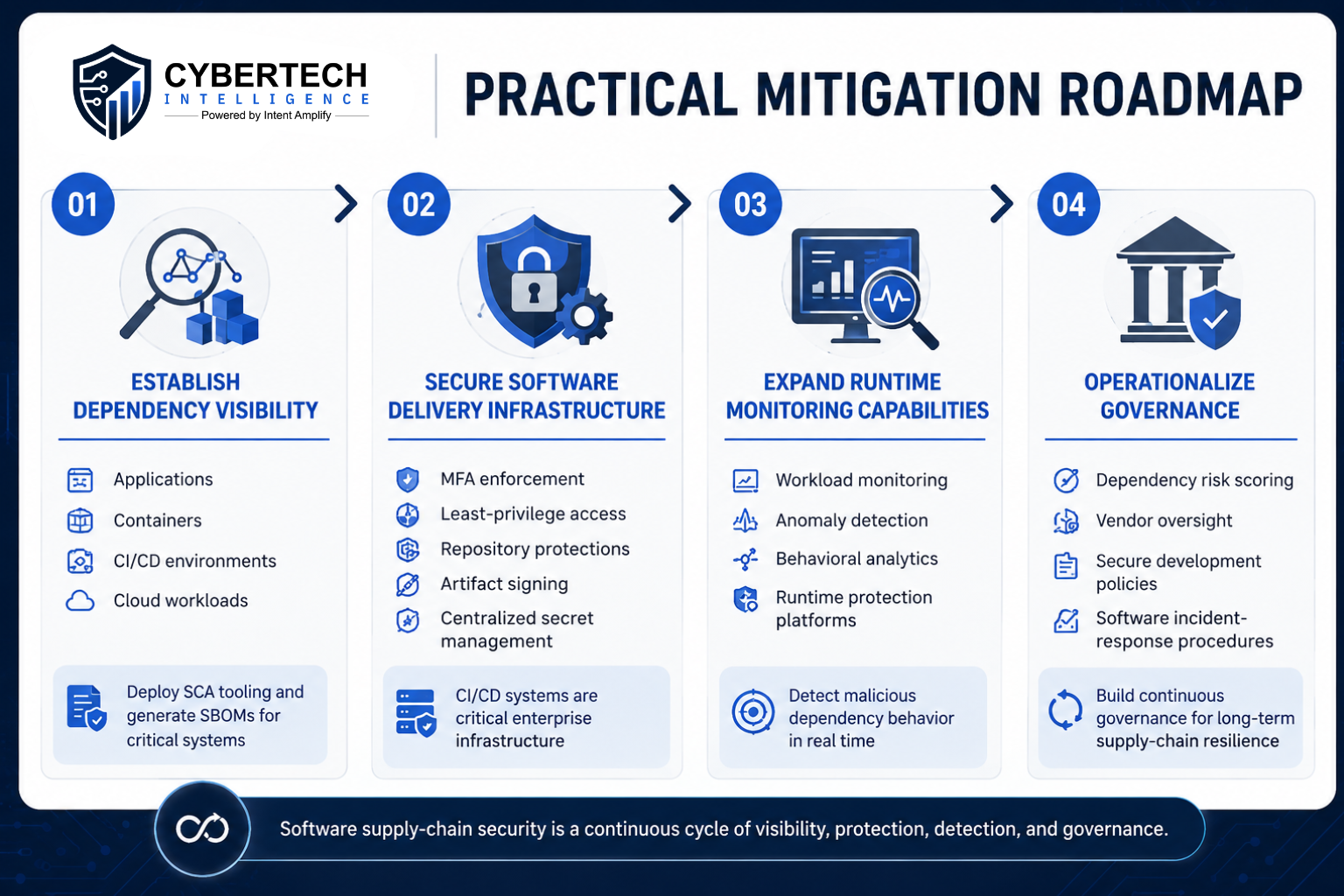
Phase 1. Establish dependency visibility
Organizations should begin by inventorying dependencies across:
- Applications
- Containers
- CI/CD environments
- Cloud workloads
This includes deploying SCA tooling and generating SBOMs for critical systems.
Phase 2. Secure software delivery infrastructure
The next priority should focus on strengthening software delivery pipelines through:
- MFA enforcement
- Least-privilege access
- Repository protections
- Artifact signing
- Centralized secret management
CI/CD systems should be treated as critical enterprise infrastructure.
Phase 3. Expand runtime monitoring capabilities
Runtime visibility enables organizations to detect malicious dependency behavior missed during static analysis.
Key controls include:
- Workload monitoring
- Anomaly detection
- Behavioral analytics
- Runtime protection platforms
Phase 4. Operationalize governance
Long-term resilience requires formal governance processes covering:
- Dependency risk scoring
- Vendor oversight
- Secure development policies
- Software incident-response procedures
Software supply-chain security should operate as a continuous organizational discipline rather than a one-time initiative.
Conclusion
Open-source software will continue to drive innovation across modern enterprise environments, but the trust assumptions surrounding software development are evolving rapidly.
Threat actors increasingly recognize that compromising software dependencies provides scalable access into enterprise ecosystems while bypassing many traditional security controls.
Organizations that strengthen software supply-chain security through:
- Dependency visibility
- Integrated DevSecOps controls
- Runtime monitoring
- Software provenance validation
- Governance maturity
will be significantly better positioned to reduce operational risk and maintain resilient software-delivery operations in 2026 and beyond.
Securing open-source dependencies is no longer optional. It has become a foundational requirement for enterprise cyber resilience, secure software development, and long-term operational trust.
References
- Reuters (2021) ‘Codecov hackers breached hundreds of restricted customer sites: sources’, Reuters, 19 April. Available at: Reuters (Accessed: 18 May 2026).
- Palo Alto Networks (n.d.) ‘Anatomy of a cloud supply pipeline attack’, Palo Alto Networks Cyberpedia. Available at: Palo Alto Networks Cyberpedia (Accessed: 18 May 2026).