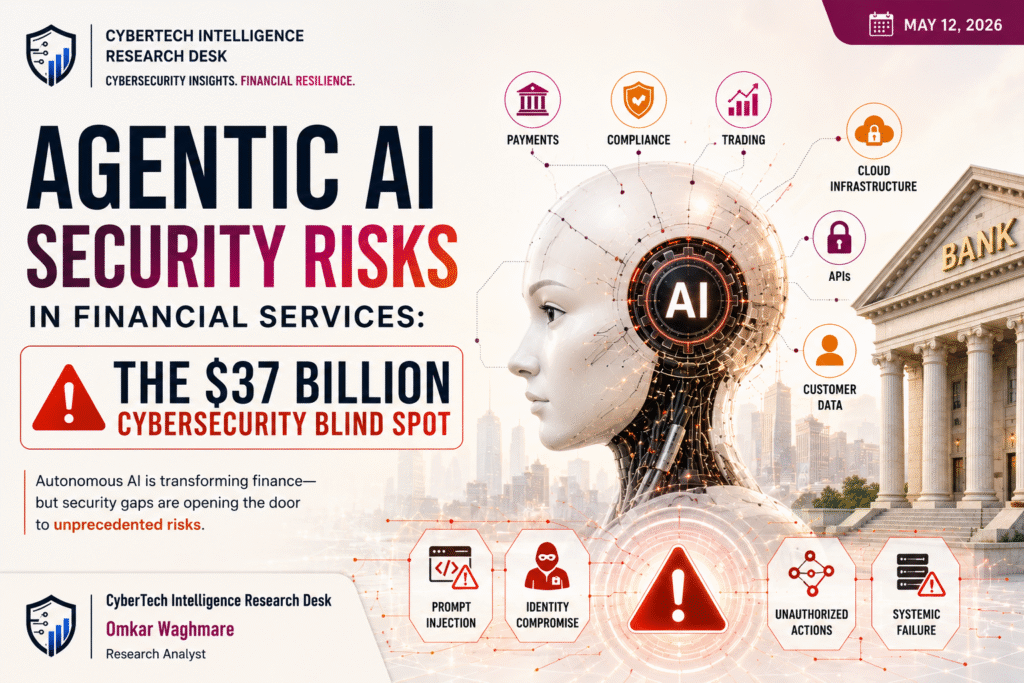
The $37 Billion Cybersecurity Blind Spot
Financial services are entering the fastest AI transformation cycle since the rise of cloud banking. But in 2026, the conversation is no longer about automation alone. It is about autonomous intelligence operating inside critical financial infrastructure.
Banks, insurers, fintech firms, and capital market institutions are increasingly deploying agentic AI systems capable of making decisions, executing workflows, interacting with APIs, and operating with minimal human oversight. These systems are evolving from AI assistants into autonomous operators embedded directly across financial ecosystems. [1]
The investment momentum is accelerating rapidly.
Global enterprise spending on generative and agentic AI surpassed $37 billion in 2025, representing a 3.2x increase from 2024 enterprise AI spending levels. [2] Within financial services specifically, NVIDIA’s 2025 State of AI in Financial Services survey found that 65% of financial institutions in 2025 were actively deploying AI technologies, up from 45% in 2024. Additionally, 42% of firms in 2025 were already evaluating or deploying AI agents, with nearly half of those deployments operational inside live enterprise environments during 2025. [2]
But while AI investments are scaling rapidly, cybersecurity maturity is not.
This is creating one of the largest emerging cyber risk gaps the banking sector has faced in decades.
Autonomous AI Is Expanding the Banking Attack Surface
Traditional enterprise systems operate within predefined logic and predictable rules. Agentic AI fundamentally changes that model.
According to Deloitte’s 2025 banking risk analysis, AI agents can independently determine objectives, select workflows, connect with external tools, and execute actions with limited human involvement. Deloitte’s assessment of the MIT AI Risk Database identified more than 350 autonomous AI-related risks in 2025 directly relevant to banking and financial services environments. [3]
Once connected to banking infrastructure, these systems can access payment systems, treasury platforms, customer financial records, compliance engines, fraud monitoring systems, APIs, and cloud environments.
Unlike human analysts, AI agents can execute thousands of actions continuously without fatigue.
That scale introduces a completely different operational threat model.
Research across enterprise AI deployments during 2025 showed that nearly 80% of organizations in 2025 using autonomous AI systems could not accurately monitor agent behavior in real time. At the same time, 81% of enterprise teams in 2025 had already deployed AI agents, while only 14.4% in 2025 received full security approval before deployment. [2]
For CISOs and banking security leaders, those numbers represent a major governance warning.
Non-Human Identity Risk Is Becoming a Critical Security Gap
One of the fastest-growing risks surrounding agentic AI involves machine identity governance.
Unlike traditional applications, autonomous AI systems require persistent credentials, API permissions, privileged access, and direct connectivity to enterprise systems. According to Aembit’s 2025 research, only 10% of organizations in 2025 possessed mature frameworks capable of managing non-human identities securely. [4]
This creates a rapidly expanding attack surface across financial institutions.
A compromised AI agent connected to treasury operations could trigger unauthorized transactions in real time. A manipulated fraud detection system could silently approve suspicious activity. An autonomous customer servicing platform could unintentionally expose sensitive financial information across customer accounts.
IBM increasingly describes AI agents as “digital insiders” because their access patterns now resemble privileged employees rather than conventional software applications. [5]
This changes how financial institutions must approach cybersecurity architecture.
The attack surface is no longer limited to endpoints and cloud infrastructure. It now includes autonomous reasoning systems capable of independently triggering downstream financial actions.
Prompt Injection and AI Manipulation Risks Are Rising
Agentic AI systems rely heavily on contextual memory, external datasets, reasoning chains, and tool integrations. This creates opportunities for attackers to manipulate AI behavior through poisoned inputs and adversarial instructions.
Deloitte identified prompt injection, opaque reasoning, memory corruption, and runaway autonomous behavior among the most significant AI security risks facing financial institutions in 2025. [3]
Unlike traditional cyberattacks that target infrastructure directly, these attacks target the decision-making process itself.
For example:
- A compliance AI agent processing AML investigations could be manipulated into approving suspicious transactions.
- An autonomous lending system could unintentionally introduce biased credit decisions after ingesting corrupted contextual data.
- A portfolio optimization agent focused purely on returns could gradually move customers into unsuitable high-risk investments.
Research published by arXiv during 2025 also highlighted risks involving runtime supply chain attacks, memory poisoning, unauthorized tool execution, and “viral agent loops” where malicious behaviors spread autonomously between interconnected AI systems. [6]
Systemic AI Risk Is Becoming a Financial Stability Concern
The IMF cautioned in 2025 that advanced AI can lead to “correlated failures” for financial institutions since most financial institutions use common cloud platforms, AI algorithms, and enterprise technology ecosystems. [7]
That is, an AI failure in one institution could affect other institutions using the same cloud, technology stack, or AI algorithm.
Global intelligence agencies are already responding.
The Five Eyes intelligence agencies in 2025 issued a warning regarding the need for layered defenses, proper identity governance, and organizational resiliency in the wake of AI failures and compromises involving autonomously functioning systems disabling enterprise security controls. [8]
Even as organizations implement AI at pace, there remain gaps in AI governance maturity.
AI governance in the enterprise surveys conducted in 2025 revealed that 74% of enterprises would deploy agentic AI in multiple departments over the next two years, but only a few had mature oversight systems to manage the risks of autonomous decision-making. [9]
There was an increase in mentions of risks related to AI from SEC filings by companies from 4% in 2020 to over 43% in 2024 [9]
Key Operational Questions Financial Institutions Must Address Before Deploying Agentic AI
What does the term “agentic AI” mean in banking?
By definition, agentic AI means independent AI systems that have decision-making capabilities, perform workflow tasks, interact with enterprise tools, and operate autonomously with minimal human oversight in a financial environment.
Why should an enterprise worry about agentic AI cybersecurity?
The problem is that independent AI systems could have access to the critical infrastructure, APIs, data, and other financial systems. A compromised system could perform dangerous activities at machine speed without the knowledge of humans.
What would be the biggest risks?
The biggest risks include rapid injection attacks, AI identity compromise, autonomous activity, operational malfunctioning, non-compliance issues, and insider threats through AI.
How do banks protect their agentic AI systems?
Most financial institutions are increasingly deploying zero-trust AI, AI runtime observability platforms, AI identity governance, and AI behavior monitoring solutions.
References
[1] Agentic AI in Financial Services: Ethical Adoption and Governance – IBM – 2025
[2] State of AI in Financial Services Survey – NVIDIA – 2025
[3] Agentic AI Risks in Banking – Deloitte – 2025
[4] Agentic AI Cybersecurity Risks and Security Guide – Aembit – 2025
[5] Agentic AI Security: Managing Autonomous Enterprise Risk – IBM – 2025
[6] Emerging Security Risks in Autonomous AI Agent Systems – arXiv – 2025
[7] IMF Warns AI Could Create Systemic Cyber Risks Across Financial Institutions – Financial Times – 2025
[8] Five Eyes Agencies Warn Against Risky Agentic AI Deployments – IT Pro – 2025
[9] Enterprise AI Governance and Regulatory Risk Exposure – arXiv – 2025
🔒 Login or Register to continue reading