Executive Summary
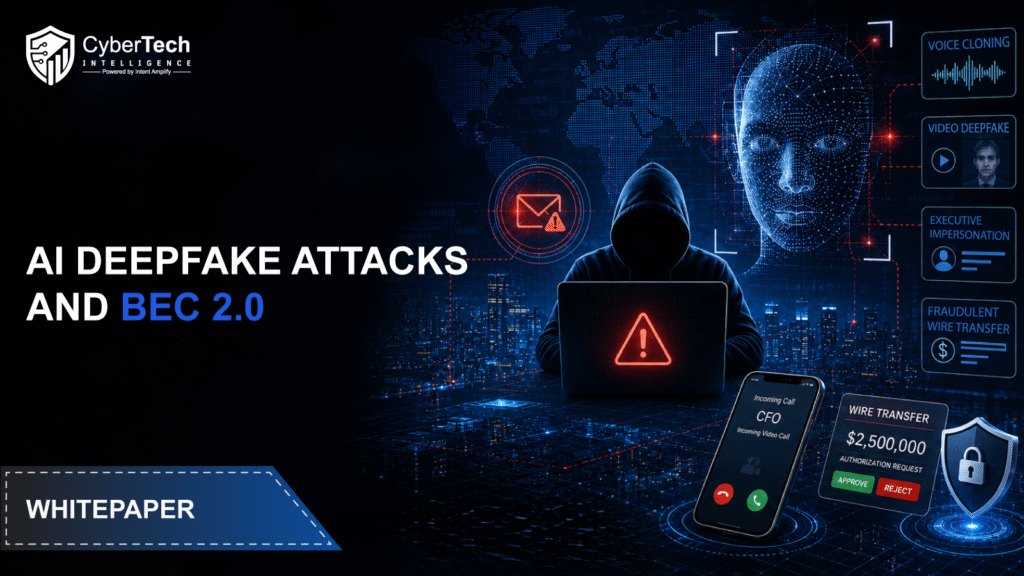
Generative AI has transformed business email compromise from low-cost phishing into highly scalable impersonation fraud capable of bypassing traditional approval and verification processes. These attacks are often referred to as “BEC 2.0” because they use voice cloning, deepfake videos, social engineering automation, and authentication impersonation to conduct business email compromises.
Modern fraud campaigns increasingly rely on synthetic voice, video, and behavioral mimicry rather than malicious links or credential harvesting alone. Threat actors can replicate business relationships so convincingly that traditional human checks can be fooled, especially when done remotely. IBM’s 2026 X-Force findings indicate that cybercriminal groups are increasingly using AI to scale phishing, impersonation, and credential theft campaigns, while more than 300,000 credentials linked to AI platforms and chatbots have reportedly surfaced on dark web marketplaces.1 IBM also reported a 44% increase in exploitation of public-facing applications alongside growing executive impersonation-focused compromise activity targeting multinational firms.2
The financial and operational consequences are escalating rapidly. Deepfake-enabled fraud increasingly targets treasury operations, procurement processes, SaaS finance platforms, and remote approval environments that still depend heavily on executive familiarity and accelerated payment decision-making. Recent industry reporting revealed that a multinational organization lost approximately $25 million after threat actors allegedly used deepfake video conferencing to impersonate senior executives during a fraudulent payment authorization process.3 According to Accenture, only 10% of firms around the world have put in place adequate measures against cyber attacks powered by AI, while 77% do not yet have the capabilities needed to address security and data privacy challenges associated with AI.4
As synthetic media becomes increasingly difficult to distinguish from legitimate executive communication, many long-standing approval assumptions inside treasury and procurement operations are becoming unreliable.
The Rise of BEC 2.0 and Synthetic Social Engineering
In conventional BEC campaigns, threat actors focused mainly on forging email domains, stealing credentials, sending phishing emails, and carrying out impersonation activities. The threat actors were trying to trick the employees into authorizing false wire transfer requests or modifying their banking data.
BEC 2.0 reflects a fundamental operational shift from isolated phishing campaigns toward scalable impersonation-driven fraud
Today’s threat actors integrate generative AI, voice generation technology, deepfake videos, multilingual automation capabilities, and synthetic authorization tools into their operations for creating highly convincing business communications.
Generative AI has dramatically lowered the cost of producing convincing executive impersonation at scale, allowing financially motivated groups to industrialize social engineering in ways traditional phishing operations could not achieve.
IBM’s 2026 threat intelligence reporting indicates threat actors are increasingly automating phishing and impersonation activity using AI-generated communications.1
Treasury infrastructure has become especially vulnerable because approval chains still rely heavily on informal human approval assumptions.
Examples include:
- Executive voice approvals
- Email authorization chains
- Vendor payment confirmations
- Treasury communication workflows
- Video conference approvals
- Procurement verification processes
Many treasury workflows still treat familiar voices, executive mannerisms, and internal terminology as indicators of legitimacy despite generative AI’s growing ability to replicate them convincingly.
As businesses increasingly adopt hybrid work models and cloud-based finance platforms, the opportunity for threat actors to exploit synthetic impersonation continues to grow rapidly.
Why U.S. Businesses Are Prime Targets
U.S. companies represent some of the most valuable targets for financially motivated cybercrime operations.
The exposure is driven less by company size alone and more by how modern U.S. corporate operations handle executive communication, vendor coordination, and financial authorization.
High-Value Financial Operations
The attractiveness of U.S. corporate environments extends beyond financial scale alone. Public executive visibility, globally interconnected payment ecosystems, and heavy reliance on cloud collaboration platforms collectively create highly favorable operating conditions for synthetic impersonation campaigns.
Large multinational firms operate deeply interconnected financial ecosystems spanning ERP environments, supplier payment infrastructure, treasury platforms, procurement systems, and SaaS-based accounting operations. Compromising a single approval chain can now expose treasury operations, procurement systems, and vendor-payment workflows simultaneously, making these environments highly attractive to financially motivated groups.
Public Executive Exposure
Public executive visibility has unintentionally created massive training datasets for voice-cloning systems. Earnings calls, investor briefings, podcasts, webinars, and media interviews collectively provide threat groups with hours of high-quality audio capable of reproducing executive speech patterns with alarming accuracy.
Remote Collaboration Dependency
Hybrid work environments have normalized digital verification interactions through:
- Microsoft Teams
- Zoom
- Slack
- Webex
- Google Meet
Remote collaboration has normalized high-value approvals through messaging platforms and video meetings that were never designed for adversarial user validation.
Deloitte’s analysis suggests generative AI is significantly increasing both the scale and automation potential of modern social engineering campaigns .5
Deepfake Economics: The Financial Impact on Organizations
Deepfake-enabled fraud is rapidly becoming a major operational and financial risk category for multinational firms.
The financial impact extends well beyond fraudulent transfers. Deepfake-enabled incidents can trigger regulatory scrutiny, insurance disputes, shareholder litigation, audit exposure, and long-term reputational damage, particularly in regulated sectors where payment authorization controls are tightly governed.
According to the FBI, BEC continues to be one of the most expensive categories of cybercrimes.
Generative AI is now accelerating those risks significantly.
IBM’s latest threat intelligence reporting suggests that identity campaigns and credential abuse continue to expand as threat actors increasingly target cloud environments and SaaS platforms.6
IBM also identified a significant increase in campaigns against public-facing enterprise applications, indicating that payment infrastructure connected to cloud infrastructure is becoming increasingly exposed.2
For enterprise leaders, the business implications are substantial because financial operations now represent a high-value attack surface for AI-powered fraud campaigns.
Anatomy of AI-Powered Deepfake Attacks
Most AI-enabled fraud campaigns now resemble structured intelligence operations rather than traditional phishing attacks.
Reconnaissance and Executive Profiling
Threat groups typically begin by aggregating publicly available executive, procurement, and organizational data from sources such as:
- SEC filings
- Earnings calls
- Company websites
- Social media profiles
- Public procurement records
Generative AI tools can summarize organizational structures and identify financial decision-makers within minutes.
Synthetic Persona Development
Attackers create realistic impersonation assets, including:
- AI-generated voice clones
- Deepfake video identities
- Fraudulent vendor personas
- Synthetic communication histories
- Fake financial documentation
Financial Manipulation and Approval Abuse
Unlike traditional phishing, BEC 2.0 campaigns often involve ongoing communication designed to build credibility.
Threat actors reference:
- Real projects
- Vendor relationships
- Financial deadlines
- Internal terminology
- Procurement activities
Referencing authentic internal terminology and active business initiatives substantially reduces employee suspicion during payment approval requests.
Financial Manipulation
Threat actors attempt to initiate:
- Wire transfers
- Banking detail modifications
- Vendor payment changes
- Procurement fraud
- Payroll diversion
- Financial credential theft
The use of AI-generated voice and video significantly reduces employee suspicion.
AI Voice Cloning and Executive Impersonation Fraud
AI-generated voice impersonation is rapidly becoming one of the most operationally effective forms of financial fraud targeting treasury teams.
Modern AI models can now replicate executive speech patterns using relatively small audio samples collected from public sources.
Modern models can now replicate executive tone, cadence, emotional inflection, and conversational behavior with high accuracy.
This significantly increases the likelihood of fraudulent approvals inside treasury and finance operations.
Public-facing executive communications now function as large-scale training datasets for commercial voice synthesis platforms.
Recent research demonstrates that many individuals continue to struggle with identifying AI-generated voice content accurately.7
Attackers exploit this gap by impersonating CFOs, CEOs, and finance executives during urgent financial requests.
Common attack scenarios include:
- Emergency wire transfers
- Confidential acquisition payments
- Vendor banking updates
- Executive escalation requests
- Payroll adjustments
Commercial voice synthesis quality is improving faster than most corporate approval models are adapting.
Deepfake Video Attacks Against Treasury and Finance Teams
Deepfake video attacks are now expanding beyond experimental demonstrations into operational fraud campaigns.
Attackers increasingly use AI-generated video during:
- Treasury meetings
- Procurement calls
- Vendor negotiations
- Financial authorization sessions
- Remote executive approvals
The combination of visual and audio impersonation dramatically increases familiarity and legitimacy.
According to industry reporting, deepfake attacks are now occurring at “industrial scale” as generative AI tools become more accessible to cybercriminals.
Researchers also warn that current detection technologies still face major limitations when identifying highly sophisticated synthetic video content.8
Many finance departments now conduct high-value approvals through video collaboration platforms despite the growing difficulty of validating visual authenticity.
Supply Chain, Vendor Fraud, and Third-Party Payment Manipulation
Vendor-payment workflows now provide attackers with one of the lowest-friction paths into treasury operations.
Large-scale financial environments now depend heavily on:
- SaaS providers
- Procurement vendors
- Managed service providers
- Cloud ERP platforms
- Payment processors
- External consultants
According to IBM, supply chain and third-party compromise incidents have nearly quadrupled over the past five years.1
Trusted supplier relationships often receive reduced scrutiny during payment approvals, making vendor ecosystems an efficient entry point for fraud operations.
The most common fraud scenarios involve supplier impersonation, fraudulent invoice submission, banking detail manipulation, and procurement workflow abuse designed to redirect legitimate payments toward attacker-controlled accounts.
Firms with weak vendor governance and payment verification controls face elevated exposure.
Why Traditional Security Awareness Programs Are Failing
Traditional security awareness training programs were designed for older phishing environments.
Most awareness programs were built around detecting obvious phishing indicators that generative AI can now eliminate almost entirely.
Generative AI has largely eliminated those indicators.
Generative AI now produces executive-style communication with enough realism to bypass many conventional employee verification instincts.
IBM’s latest threat analysis suggests institutions must transition toward AI-enabled proactive security models because attackers are already using AI to automate sophisticated phishing and impersonation operations.9
Employees can no longer rely solely on human intuition to validate authorization.
Institutions should instead implement:
- Multi-party approvals
- Out-of-band verification
- Cryptographic validation
- Authentication-based transaction controls
- Adaptive authentication
Synthetic impersonation is ultimately a fraud-governance problem rather than a traditional phishing problem.
Zero-Trust Authorization and Financial Control Integrity
Financial fraud prevention increasingly depends on continuous verification of who is initiating, approving, and modifying sensitive transactions.
As per IBM Security, companies should emphasize access governance and authentication controls that are threat-focused for their defense against advanced attacks.10
Key business controls involve:
Zero-Trust Authorization
Financial approvals should require:
- Multi-factor authentication
- Conditional access validation
- Risk-based verification
- Session monitoring
Multi-Person Approval Policies
No individual employee should independently authorize high-value transactions.
Privileged Access Governance
Companies should continuously monitor privileged accounts associated with:
- Treasury systems
- ERP platforms
- Payment infrastructure
- Vendor management environments
Behavioral Analytics
AI-driven analytics can help identify anomalies involving:
- Transaction behavior
- Login activity
- Access patterns
- Communication deviations
As threat actors operationalize AI-assisted impersonation, companies are increasingly forced to move beyond static authentication and toward continuous behavioral validation. The emergence of AI-assisted impersonation is also creating a new category of delegated identity risk in which employees increasingly trust synthetic representations of executives, vendors, and financial authorities without independently validating authenticity. As AI agents become integrated into communication, scheduling, procurement, and financial workflows, corporate teams will increasingly need to determine whether a financial request originated from a legitimate executive, an approved automated workflow, or a synthetic impersonation attempt.
As synthetic media erodes confidence in verbal and visual verification, approval integrity increasingly depends on behavioral analysis, transaction context, and layered authorization controls rather than human familiarity alone.
AI-Powered Detection and Fraud Prevention Technologies
Defending against synthetic impersonation increasingly requires behavioral, transactional, and communication-aware detection models capable of identifying subtle anomalies across communication, approval, and payment workflows.
Most successful deepfake-enabled fraud campaigns exploit procedural weaknesses rather than technical bypasses alone. As a result, detection tooling is only effective when paired with transaction governance, independent payment validation, behavioral monitoring, and escalation controls capable of interrupting suspicious approval activity before funds are transferred.
Most commercial deepfake detection platforms still struggle in compressed video environments, low-quality conference streams, and multilingual collaboration settings where contextual trust often overrides technical warning indicators. In practice, many finance teams continue approving transactions based on perceived familiarity rather than independently verified authenticity.
Firms must combine:
- Human validation processes
- Governance controls
- Financial segmentation
- Vendor verification
Technology controls alone cannot fully mitigate synthetic fraud exposure without corresponding governance modernization and executive-level accountability.
Governance, Compliance, and Enterprise Risk Management
Synthetic impersonation is rapidly evolving into a board-level business continuity and governance concern rather than a standalone fraud issue.
Boards and executive leadership teams must recognize that AI-powered fraud can impact:
- Financial reporting
- Operational resilience
- Regulatory compliance
- Shareholder confidence
Accenture research further indicates that most firms still lack sufficient governance maturity for AI-driven cyber risk. 4
Operational governance programs should include:
- Deepfake risk assessments
- Executive impersonation exercises
- Treasury fraud simulations
- Vendor payment testing
- AI governance policies
Defending against BEC 2.0 requires layered architectural changes that combine identity assurance, transaction governance, behavioral analytics, and vendor trust validation.
Recommended Identity-Centric Defense Architecture
Most anti-fraud programs were designed around credential theft, phishing, and endpoint compromise rather than synthetic impersonation. As a result, many treasury and procurement environments still operate with fragmented oversight across access management, payment governance, collaboration platforms, and vendor verification processes. Threat groups increasingly exploit these gaps by targeting the disconnect between human approval workflows and technical authentication controls.
Effective mitigation requires more than standalone deepfake detection products. Corporate teams need integrated control models capable of continuously validating transaction legitimacy, executive authorization, behavioral anomalies, and third-party payment activity across hybrid collaboration environments.
In practice, the most resilient environments are shifting toward layered approval architectures that combine privileged access governance, behavioral monitoring, transaction-risk analysis, and independent payment verification controls. High-value financial actions should never rely solely on voice approvals, video meetings, or executive familiarity without secondary validation mechanisms.
Security leaders should also recognize that synthetic impersonation attacks frequently bypass conventional security tooling altogether because the attacker is often abusing legitimate communication channels rather than compromising infrastructure directly. This makes behavioral context, approval integrity, and operational governance significantly more important than traditional perimeter-focused defenses.
Priority defensive areas should include:
- Privileged access governance for treasury and payment platforms
- Dual-authorization controls for high-risk transactions
- Behavioral analytics capable of identifying anomalous approval activity
- Independent vendor and banking verification workflows
- Collaboration-platform monitoring for executive impersonation attempts
- Continuous monitoring of procurement and third-party payment changes
Over time, fraud resilience will increasingly depend on how effectively institutions integrate authentication controls, financial governance, procurement oversight, and behavioral analytics into a unified operational defense strategy rather than treating them as isolated security functions.
Strategic Recommendations for CISOs, CFOs, and Boards
CISOs should prioritize synthetic impersonation readiness as part of broader fraud resilience planning rather than treating deepfake attacks as isolated media-manipulation incidents. Priority areas should include executive impersonation simulations, adaptive authentication controls, privileged access monitoring, and collaboration-platform verification policies. Security teams should also work more closely with treasury, procurement, and finance leadership because many AI-enabled fraud campaigns exploit operational approval weaknesses rather than technical vulnerabilities alone.
For CFOs, the larger challenge involves modernizing financial authorization processes that still rely heavily on executive familiarity, urgency-based approvals, and informal communication patterns. High-value transactions should require layered verification mechanisms that extend beyond voice calls, video meetings, or email approvals. Treasury teams should also regularly test vendor-payment escalation procedures, out-of-band verification workflows, and emergency transaction controls under simulated fraud conditions.
Boards should increasingly evaluate synthetic impersonation risk as a financial resilience and operational governance issue rather than solely a cybersecurity concern. Oversight discussions should include executive approval exposure, third-party payment dependencies, treasury governance maturity, and the organization’s ability to detect and respond to AI-enabled fraud attempts targeting senior leadership communications.
Future Outlook: Autonomous AI Fraud Operations
IBM warns that businesses must transition toward proactive AI-enabled security operations because attackers are already leveraging AI to scale operations faster than traditional defenses can respond.9
Over time, financially motivated groups will likely transition from isolated deepfake incidents toward semi-autonomous fraud ecosystems capable of conducting reconnaissance, impersonation, social manipulation, and payment fraud with minimal human intervention. This evolution could significantly compress the time between initial compromise and financial theft.
Board-Level Financial Exposure and Enterprise Readiness Gaps
One of the most concerning aspects of AI-driven deepfake fraud is that many Fortune 500 firms still underestimate the operational maturity of modern cybercriminal groups. Deepfake-enabled fraud is no longer limited to isolated phishing campaigns or experimental cyber incidents. Fraud operators are increasingly operating with business-like efficiency, automation capabilities, and scalable AI infrastructure that allow them to launch synthetic social engineering campaigns against multiple institutions simultaneously.
According to IBM Security research, fraud operators are rapidly shifting toward cloud-based access and approval ecosystems because corporate environments increasingly depend on cloud authentication, SaaS platforms, federated identities, and remote collaboration workflows. 10
This transition significantly increases operational exposure because payment infrastructure is now deeply interconnected with authentication infrastructure. A compromised executive authorization can potentially provide attackers with access to:
- Treasury systems
- Business banking portals
- ERP environments
- Vendor payment workflows
- Procurement platforms
- Financial reporting systems
- Cloud-based accounting applications
The growing dependence on AI inside corporate environments also introduces additional governance challenges. McKinsey’s latest AI adoption analysis shows that organizations continue to accelerate enterprise AI adoption across business operations, customer engagement, analytics, and automation initiatives.11
While these initiatives improve operational efficiency, they also increase the complexity of corporate approval ecosystems and expand the attack surface available to adversaries.
For example, fraud operators can now use generative AI to:
- Analyze corporate communication styles
- Mimic executive writing behavior
- Create highly personalized phishing content
- Simulate internal terminology
- Generate realistic vendor communication
- Automate multilingual fraud operations
This level of sophistication dramatically increases the probability of successful compromise attempts.
Enterprise boards must also recognize that deepfake attacks create systemic business risk rather than isolated cybersecurity incidents. A successful synthetic impersonation attack can simultaneously impact:
- Financial operations
- Regulatory compliance
- Investor confidence
- Corporate reputation
- Legal exposure
- Cyber insurance coverage
- Third-party relationships
Accenture research indicates that corporate teams that demonstrate higher levels of cyber resilience are significantly better positioned to reduce operational disruption and financial exposure associated with advanced cyber threats.4
Despite this, many corporate teams still lack formal deepfake response procedures, executive impersonation escalation frameworks, and AI-focused fraud governance programs.
To address these gaps, enterprise leaders should prioritize:
- AI-focused cyber resilience programs
- Treasury workflow modernization
- Vendor payment verification controls
- Zero-trust financial authorization models
- Deepfake incident response planning
- Board-level cyber risk oversight
- Continuous fraud simulation exercises
Corporate teams that continue relying on legacy trust assumptions within financial operations will likely face increasing exposure as generative AI capabilities become more accessible and more difficult to detect.
The next phase of treasury defense will depend less on static approval policies and more on continuous verification across payment activity, executive communications, and behavioral anomalies.
Conclusion
BEC 2.0 represents one of the most significant evolutions in enterprise cyber risk in recent years.
Deepfake technology, AI voice cloning, synthetic identities, and generative social engineering are fundamentally changing how cybercriminals target enterprise payment infrastructure.
Traditional verification-based financial workflows are no longer sufficient.
Companies must modernize security architectures around user validation, zero-trust authorization, AI-driven fraud detection, and multi-party financial governance.
For U.S. large-scale environments, the challenge is no longer theoretical.
Hybrid collaboration platforms, cloud-based payment workflows, public executive visibility, and generative AI tooling have collectively created an operating environment where synthetic impersonation can scale rapidly across treasury and procurement functions.
Over the next several years, the primary challenge facing security leaders will not simply be detecting malicious content, but operating securely in environments where voice calls, video meetings, executive communications, and payment approvals can all be artificially manipulated at scale. Companies that modernize executive verification governance, treasury controls, and behavioral verification architectures early will be materially better positioned to withstand the next generation of AI-enabled financial fraud operations.
Security teams now face a more difficult problem: redesigning approval and verification models for environments where human communication itself can be synthetically replicated with high accuracy.
References
- IBM, X-Force Threat Intelligence Index 2026, February 2026
- IBM Newsroom, IBM 2026 X-Force Threat Index: AI-Driven Attacks Are Escalating as Basic Security Gaps Leave Enterprises Exposed, February 2026
- The Guardian, Deepfake Fraud Is Taking Place on an Industrial Scale, February 2026
- Accenture, Only One in 10 Organizations Globally Are Ready to Protect Against AI-Augmented Cyber Threats, October 2025
- Deloitte, Cybersecurity Meets Generative AI, 2025
- IBM, IBM Threat Intelligence Index Report, 2026
- arXiv Research, Humans Versus AI: Detecting Synthetic Audio in Modern Voice Cloning Attacks, 2025
- arXiv Research, Deepfake Video Detection Challenges in Enterprise Environments, 2025
- IBM Think, More 2026 Cyber Threat Trends Organizations Should Watch, 2026
- IBM, IBM Security Solutions and Services, 2026
- McKinsey & Company, The State of AI, 2025
🔒 Login or Register to continue reading