Curated and published for RETHINK Retail, where the world’s most consequential retail leaders find the intelligence, peer perspective, and honest conversation they need to lead what comes next.
1. Executive Summary
Connected store technology has crossed the threshold from strategic experiment to operational imperative. The evidence from the world’s most authoritative IT and cybersecurity enterprises is unambiguous: retailers who have operationalised connected store platforms at enterprise scale are generating compounding returns across inventory performance, workforce productivity, customer engagement, and revenue growth. Those still managing the pilot-to-scale transition are falling behind at an accelerating rate.
Herein lies our new report, “Retail Technology Landscape – 2026,” which provides insight into the most recent findings and information available from Microsoft, IBM, Cisco, Google Cloud, and Palo Alto Networks to provide an answer to the most important question facing today’s retail leaders – not whether to spend money on Connected Store technologies, but how to design the architecture to make that investment worthwhile.
The core finding is straightforward. The retailers capturing the strongest ROI are not the ones with the most technology. They are the ones who have made the clearest platform decisions, embedded security from the first device, built network infrastructure designed for the load, and redesigned the operational model their business runs on. The gap between those organisations and the rest is widening every quarter.
RETHINK Retail publishes this guide as part of its ongoing commitment to giving retail leaders the clearest possible view of where the industry is moving and what it practically takes to stay ahead of it.
2. The State of Connected Store Investment in 2026
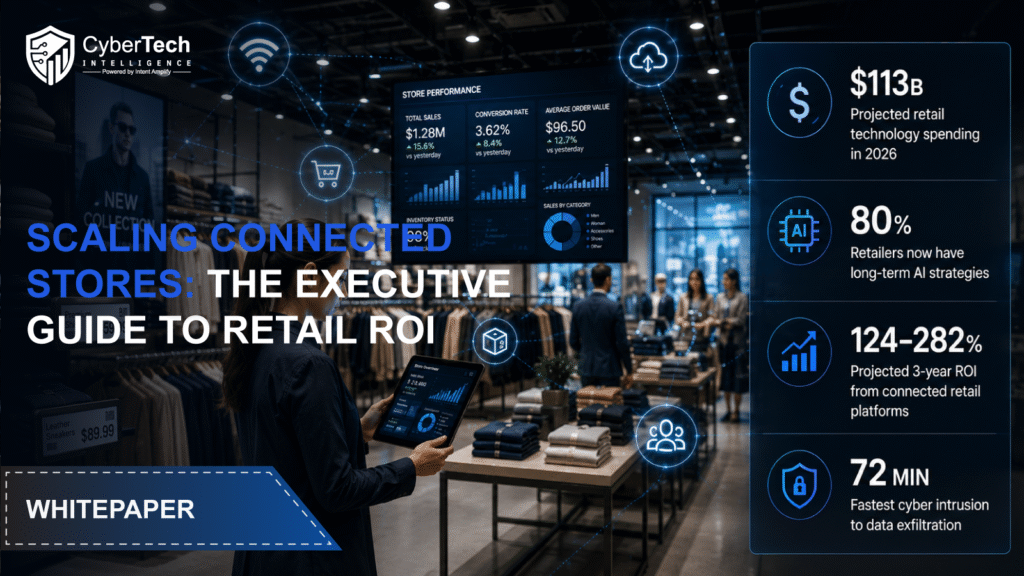
The scale of capital being committed to connected store and retail AI technology in 2026 is unlike anything the industry has seen in a single cycle. Technology budgets across retail and consumer goods are projected to reach $113 billion in 2026, a 6.6% year-on-year increase, with the mandate from the C-suite shifting decisively from exploration to proven ROI. ¹
IBM’s January 2026 Institute for Business Value study found that 80% of retail and consumer products companies now have a long-term AI innovation strategy, confirming the shift from pilot thinking to strategic commitment. ²
Looking ahead, IBM’s global executive study found that 79% of leaders expect AI to significantly contribute to revenue by 2030, up from 40% today, with AI investment forecast to surge 150% over the same period. ³
On the network investment side, Cisco’s inaugural State of Wireless 2026 report, based on interviews with 6,098 wireless decision-makers across 30 markets, found that four out of five organisations increased wireless spending over the past five years, with 82% forecasting continued budget increases in the years ahead. ⁴
The investment signal is not ambiguous. What remains unclear for many organisations is how to translate capital commitment into operational outcomes that compound. That is the gap this white paper addresses.
3. Why Most Connected Store Programmes Stall Before They Scale
The uncomfortable truth running through 2026’s most credible research is that investment and outcomes are not the same thing. IBM’s CEO study, a finding referenced prominently at both IBM Think 2026 and Google Cloud Next 2026, found that only 25% of AI initiatives deliver expected ROI and just 16% have scaled enterprise-wide. ⁵
IBM Chairman and CEO Arvind Krishna articulated the root cause at Think 2026: “The enterprises pulling ahead are not deploying more AI. They are redesigning how their business operates.” ⁵
The failure is not technological. It is architectural and organisational. IBM identifies four primary failure modes that cause AI and connected store initiatives to stall: policy gaps, incomplete data context, orchestration immaturity, and fragmented integration across core business activities.
IBM’s own research found that 83% of CEOs say AI success depends more on adoption than on the technology itself, with AI leaders who achieve scale adoption delivering 10% to 25% EBITDA gains over their peers. The gap between adoption and deployment, between a pilot that works and an organisation that runs it at scale, is where connected store ROI is won or lost. ⁶
For retail executives reading this in 2026, the strategic priority is no longer finding better technology. It is building the organisational model that can absorb, run, and compound what the technology makes possible.
4. The Four Pillars of Connected Store ROI
4.1 Intelligence: What Microsoft’s Platform Economics Reveal
The retailers generating the strongest connected store returns have made a deliberate platform decision: they are not running a collection of point solutions; they are building a unified intelligence operating system that reaches every function of the retail value chain.
Microsoft’s Forrester Total Economic Impact study (April 2026), which interviewed decision-makers and surveyed 134 global retail and consumer goods organisations, projects 124% to 282% ROI over three years, with $7.7M to $17.6M in net present value for a composite $5B enterprise. The value breaks down across three operational areas: marketing, supply chain, and store operations, with total three-year benefits of $14M to $23.9M for retailers that scale across all three. ¹
At the store level, the impact on frontline operations is concrete and measurable. Inventory inaccuracies account for 4% to 8% of lost retail sales, a figure that connected store platforms directly address through AI-driven stock visibility and replenishment. ⁷
Frontline task automation covering price updates, inventory checks, and information lookup delivered 9 to 15 hours of time savings per store per month, translating to thousands of hours reclaimed monthly across a large store estate. ¹
The Forrester study also documents a finding that every retail CTO should carry into their next board presentation: organisational factors drive more than 2x the AI impact of individual capability. The platform decision is critical. The organisational redesign that follows is what determines whether the returns compound or plateau. ¹
4.2 Infrastructure: Why Cisco’s Wireless Data Changes the Conversation
Every connected store runs on a network. Every sensor, smart shelf, camera, RFID reader, and AI workload depends on wireless infrastructure that can carry the load without degradation. In 2026, most retailers are discovering that the network they have is not the network the connected store they are building actually needs.
Cisco’s State of Wireless 2026 report makes the performance case with precision: 84% of retail organisations report improved operational efficiency and 80% report improved employee productivity from strategic wireless investment, while 77% report enhanced customer engagement. ⁸
The ROI multiplier is documented: organisations investing holistically in wireless alongside AI, automation, and security achieve 63% higher average wireless ROI than those that do not. ⁹
The complex picture demands equal attention. 98% of retail organisations report rising operational complexity driven by IT, IoT, and OT workloads, with 39% reporting bandwidth challenges tied specifically to video analytics, digital signage, and streaming content. ⁸
The talent pressure amplifies the risk: 87% of organisations face visibility gaps that impair wireless troubleshooting, and 86% struggle to hire qualified wireless professionals. ⁹
The strategic decision is clear. AI-driven wireless automation reclaims 850+ hours per IT practitioner annually, shifting teams from reactive ticket management to strategic initiatives. ⁴ For retail executives, the network infrastructure investment is not a cost decision. It is the foundation on which every other connected store return depends.
4.3 Security: The Palo Alto Networks Imperative Every Retailer Must Face
Scaling a connected store without a security-first architecture is not a calculated risk. It is an operational liability that grows in direct proportion to the deployment. Every new location, device, and data stream added to the network is an opportunity for a threat actor to find and exploit a gap.
Palo Alto Networks’ Unit 42 Global Incident Response Report 2026, analysing over 750 major cyber incidents across 50 countries between October 2024 and September 2025, documents the threat reality every retail executive needs to internalise. Attacks are now 4x faster than in the previous year, with the fastest intrusions reaching data exfiltration in just 72 minutes, down from 285 minutes the year before. Identity is the primary entry point: 65% of initial access is identity-driven, and 87% of attacks unfolded across multiple attack surfaces simultaneously. ¹⁰
The retail-specific risk is acute. 72% of retailers report being hit by a cyberattack via one or more IoT devices in the past year. ¹¹
Palo Alto Networks’ 2025 Device Security Threat Report, analysing over 27 million connected devices across 1,803 enterprise networks, found that 48.2% of all IoT device connections to company IT systems originate from high-risk devices, and 77.74% of enterprise networks have poor segmentation that allows a compromised edge device to reach systems far beyond the store floor. ¹²
The executive-level conclusion is non-negotiable: in more than 90% of breaches, preventable gaps materially enabled the intrusion. Security is not a post-scale consideration. It is the architectural foundation that makes scale possible, built on Zero Trust from the first device, treating every connected asset as a potential risk with full visibility and enforcement. ¹⁰
4.4 Edge Intelligence: Google Cloud’s Architecture for Real-Time Retail
The connected store generates its value at the store level, in real time, at the moment of decision. That means the intelligence layer must live at the edge, close to the action, not in a distant data centre processing yesterday’s data overnight.
Google Cloud’s agentic retail architecture, anchored in its Distributed Cloud infrastructure, enables retailers to process inventory and customer interaction data locally at each store, ensuring zero latency even when connectivity is unstable, with data federated into a central system for network-wide visibility and analytics. ¹³
At Google Cloud Next 2026 in April, CEO Thomas Kurian described the industry moment: “You have moved beyond the pilot. The experimental phase is behind us. The real challenge now is how to move AI into production across your entire enterprise.” ¹⁴
The retail deployments documented at Next 2026 illustrate what that production reality looks like. The Home Depot, building on a 10-year Google Cloud partnership, is using Gemini Enterprise to deliver product expertise to every customer across every channel at any hour. Walmart has deployed Gemini Enterprise internally to give store and supply chain team leaders faster access to business data. Macy’s built a conversational AI shopping assistant in just four weeks using Google Cloud’s Gemini Enterprise for Customer Experience. ¹⁵
These are not pilots. They are production systems at enterprise scale, generating measurable returns from a platform built to grow.
Google Cloud’s ROI of AI in Retail report, based on 585 senior retail and CPG leaders, confirms the direction: the five proven areas delivering compounding returns in 2026 are personalisation, inventory optimisation, demand forecasting, associate productivity, and operational automation, all enabled by a unified agent architecture that connects intelligence across the store estate. ¹⁶
5. The Governance Gap That Determines Everything
The data from all five of the world’s leading IT and cybersecurity enterprises converges on a single finding that executive teams cannot afford to ignore: the technology is ready, the investment is flowing, and the results are documented. The variable that determines whether a given retailer captures those results is governance.
IBM’s research found that only 29% of executives can confidently measure AI ROI today, despite 79% reporting productivity gains. The gap between operational value and financial measurement is where connected store programmes lose momentum, executive support, and budget. ⁵
IBM identifies five moves for scalable AI in 2026: setting a strong centralised foundation, governing with clear decision rights, connecting AI to core workflows rather than side processes, measuring outcomes against specific KPIs defined before scale, and building shared capabilities that make each new use case faster and cheaper to deliver. ¹⁷
Palo Alto Networks frames the governance imperative from the security dimension: 96% of executives say AI adoption makes a security breach more likely within three years, and organisations without governance frameworks are accumulating financial liability that compounds with every unmonitored model and unowned data flow. ¹⁸
The retailers scaling connected stores successfully have built governance into the architecture from day one. Not as a compliance exercise but as the operating system that allows the technology to do what it promises, consistently, reliably, and across every location.
6. What the Leaders Are Doing Differently
The pattern across the retailers capturing the strongest connected store returns in 2026 is consistent. Four characteristics define them.
First, they have made a deliberate platform decision. They are not adding technology to existing fragmented workflows. Re-engineering their processes with the help of an integrated intelligent ecosystem for merchandising, supply chain, store management, and consumer engagement is what they’re doing now.
Second, they have considered network investments strategically and not just as infrastructure spend. Retailers who have delivered better wireless ROIs have made investments across wireless, AI, automation, and security as an integrated strategy.
Third, they have embedded security from the first device. They treat every connected sensor, shelf, and edge node as a potential risk and have built a Zero Trust architecture into the platform foundation before scaling.
Fourth, they have already figured out their KPIs and organizational structure even before embarking on scale-out. That means, they already have an idea of what constitutes success, how to measure success, and who’s responsible for success.
According to the global survey carried out in June 2025 by IBM, the intention of the executives to be productive through the use of AI is very clear. Almost 83% of the respondents cite process efficiency resulting from the agents of AI. ¹⁹
The retailers converting that ambition into compounding operational advantage are the ones doing these four things consistently, at scale, without waiting for a perfect platform or a perfect moment.
7. The RETHINK Retail Practitioner Advantage
RETHINK Retail is not a media outlet. It is not a vendor platform. It is the trusted intelligence community where the most consequential retail leaders come to think clearly, hear honestly, and act with greater confidence.
The intelligence in this white paper represents the best available evidence from the world’s leading IT and cybersecurity enterprises. It cannot simulate the peer-level knowledge of people who have been involved in setting up stores in a connected manner, dealing with the political aspects of this endeavour, making decisions on the platform to use, and talking frankly about what worked and what didn’t.
That is what RETHINK Retail provides. By virtue of its special webinars, practitioner-research, and executive network, RETHINK Retail brings together retail executives with the individuals and information they require in order to bridge the gap between the promise of connected store technology and their organization’s readiness to capitalize on this promise.
The forthcoming webinar at RETHINK Retail, entitled “The Connected Store at Scale: From Tech Hype to Operational Reality,” hosted by Martin Bailie with Jerome Hamrit and Thaddeus Segura of VusionGroup, is perfectly designed to address the issues discussed in this white paper: Governance, Platform Thinking, Operational Readiness, and those crucial decisions which distinguish retailers multiplying their advantage from those who are still stuck on their two-year-old pilot project.
8. Executive Action Framework
For retail executives using this white paper to shape investment decisions, the following five actions represent the highest-priority moves based on the evidence reviewed.
Audit your platform architecture. Determine whether your connected store investments are accumulating into a unified intelligence platform or a collection of disconnected point solutions. Point solutions plateau. Platforms compound.
Commission a network readiness assessment before your next rollout. Network infrastructure is the single most common silent constraint on connected store scale. Assess it against the load your planned deployment will actually generate, not the load your current deployment runs on.
Embed Zero Trust security before adding the next device. Security retrofitted after deployment is security that arrives too late. Each new IoT gadget, shelf sensor, or edge node that comes onto the network must be managed from day one.
Define the framework of how ROI will be measured before scaling your project. “If you can’t measure it, you can’t manage it” is an important phrase to remember.
Build the peer context your team needs. The decisions described in this white paper are not made in isolation. They are made better, faster, and with greater confidence when retail leaders have access to honest peer-level intelligence from organisations that have navigated the same challenges.
RETHINK Retail exists to provide exactly that.
Join RETHINK Retail’s Connected Store at Scale Webinar: https://intenttechpub.com/webinar/the-connected-store-at-scale-from-tech-hype-to-operational-reality/
Explore more at RETHINK Retail: https://rethink.industries
9. References
- Microsoft Cloud Blog — Agentic AI Is Reshaping Retail and Consumer Goods Economics — 21 May 2026
- IBM Institute for Business Value — The AI Decisions That Will Define Retail for the Next Two Years — 12 January 2026
- IBM Institute for Business Value — IBM Study: AI Poised to Drive Smarter Business Growth Through 2030 — 19 January 2026
- Cisco Newsroom — Cisco Report: Strategic Wireless Investments Are Driving Higher ROI — 2 April 2026
- IBM — How to Maximise AI ROI in 2026 — 19 February 2026
- Bain and Company — IBM Think 2026: From AI Pilots to an Operating Model — May 2026
- Microsoft Cloud Blog — Frontier Transformation in Retail: How Agentic AI Robots Are Redefining Store Experiences — 20 January 2026
- Cisco — 5 Wireless Trends Retail IT Teams Can’t Ignore in 2026 — 15 April 2026
- Cisco — State of Wireless Report 2026 — 2 April 2026
- Palo Alto Networks — 2026 Unit 42 Global Incident Response Report — 17 February 2026
- Palo Alto Networks — IoT Security for the Retail Industry — 2025
- Palo Alto Networks Blog — 2025 Report Exposes Widespread Device Security Risks — 29 October 2025
- Google Cloud Blog — How Inference at the Edge Unlocks New AI Use Cases for Retailers — 13 January 2025
- BizTech Magazine — Google Cloud Next 2026: Businesses Are Moving Into the Agentic Era — 23 April 2026
- Google Cloud — Next 26: Building the Agentic Enterprise — May 2026
- Google Cloud — ROI of AI in Retail and CPG — 2026
- IBM — Scale AI: 5 Moves for Efficiency and Governance — 9 March 2026
- IBM — The Phantom ROI — 21 April 2026
- IBM Newsroom — IBM Study: Businesses View AI Agents as Essential, Not Just Experimental — 10 June 2025
🔒 Login or Register to continue reading