Executive Summary
AI-based ransomware attacks that will become operational in the year 2026 will herald a new era of power.
With the incorporation of AI technology into ransomware, criminals can carry out their reconnaissance work fast, devise strategies on the go as countermeasures against security systems, conduct automated phishing attacks, and target their victims accurately.
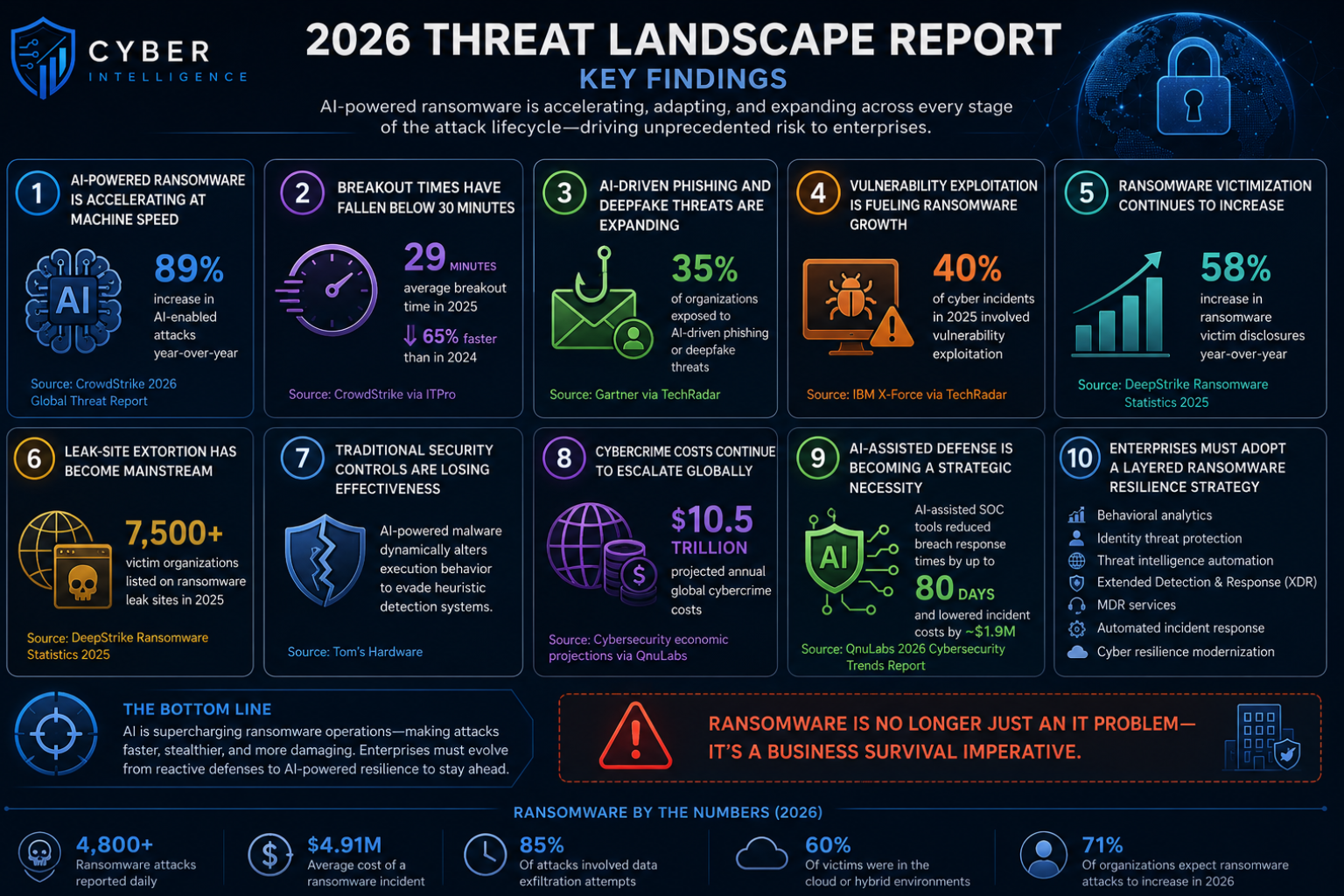
According to the 2026 Global Threat Report by CrowdStrike, there has been an increase in AI attacks by 89% each year. 1
The perpetrators of ransomware attacks have resorted to using large language models, social engineering attacks based on deepfakes, and machine learning techniques in order to guarantee maximum efficiency when conducting such attacks.
The rise of the Ransomware-as-a-Service (RaaS) industry has resulted in cyber criminals utilizing artificial intelligence technology to facilitate such activities.
Key Findings of 2026
AI-Based Ransomware Gaining Momentum at Machine Speeds
AI technology is revolutionizing ransomware operations as it makes possible faster reconnaissance activities, phishing operations, malware attacks, and extortion operations to scale at an unprecedented level.
Criminals are using AI in ransomware at all stages for greater efficiency and reduced manpower.
The 89% increase in attacks enabled by AI was recorded year over year, according to the CrowdStrike 2026 Global Threat Report. 1
Breakout Time Has Fallen Below 30 Minutes
The impact of AI on the success of ransomware attacks has been to shorten breakout times.
The average breakout time decreased to 29 minutes in 2025, according to CrowdStrike’s threat intelligence analysis.
“As AI is embedded into development pipelines, SaaS platforms, and operational workflows, AI systems themselves become part of the attack surface,” said CrowdStrike CEO George Kurtz.
AI-Powered Phishing and Deepfake Attacks
The criminal hacking community has found ways to use generative artificial intelligence to conduct spear phishing attacks, impersonate executives, and execute multi-language social engineering attacks.
AI-based phishing attacks have reached levels of sophistication not previously possible with social engineering schemes.
Yearly Increases in Ransomware Victimizations
The amount of ransomware activity continues to increase annually in industries including health care, finance, manufacturing, governmental entities, and cloud-native businesses.
Victim disclosures for ransomware attacks surged by 58% annually based on ransomware attack statistics. 2
Extortion through Data Leak Sites
In 2025, there were over 7,500 victims who ended up being listed on ransomware data-leak sites. Due to their habit of exfiltrating data before encrypting it, today’s ransomware groups have begun exerting pressure through reputational damage and negotiations. 3
Conventional Security Measures Are Less Effective
Adaptive behaviors and mutations of ransomware enabled by AI make it possible for AI-powered ransomware to evade conventional detection methods based on signatures.
Artificial intelligence-powered malware is increasingly able to mutate their behaviors of its execution so that they cannot be detected by heuristic approaches.
This situation necessitates the need for security measures such as behavioral analysis, AI-enabled security systems, and security that utilizes identities.
The Economic Consequences of Cyber Crime Persist Globally
The economic consequences associated with artificial intelligence-powered cyber attacks are constantly increasing owing to the above aspects.
According to cybersecurity economic forecasts, annual global cybercrime losses will top $10.5 trillion per year. 4
Evolution of AI-Powered Ransomware
Ransomware campaigns have transitioned from sporadic attacks to intelligent business models with a focus on using AI technologies to conduct reconnaissance, phishing emails, and targeted attacks.
The use of AI in ransomware campaigns is becoming increasingly popular because of its potential benefits.
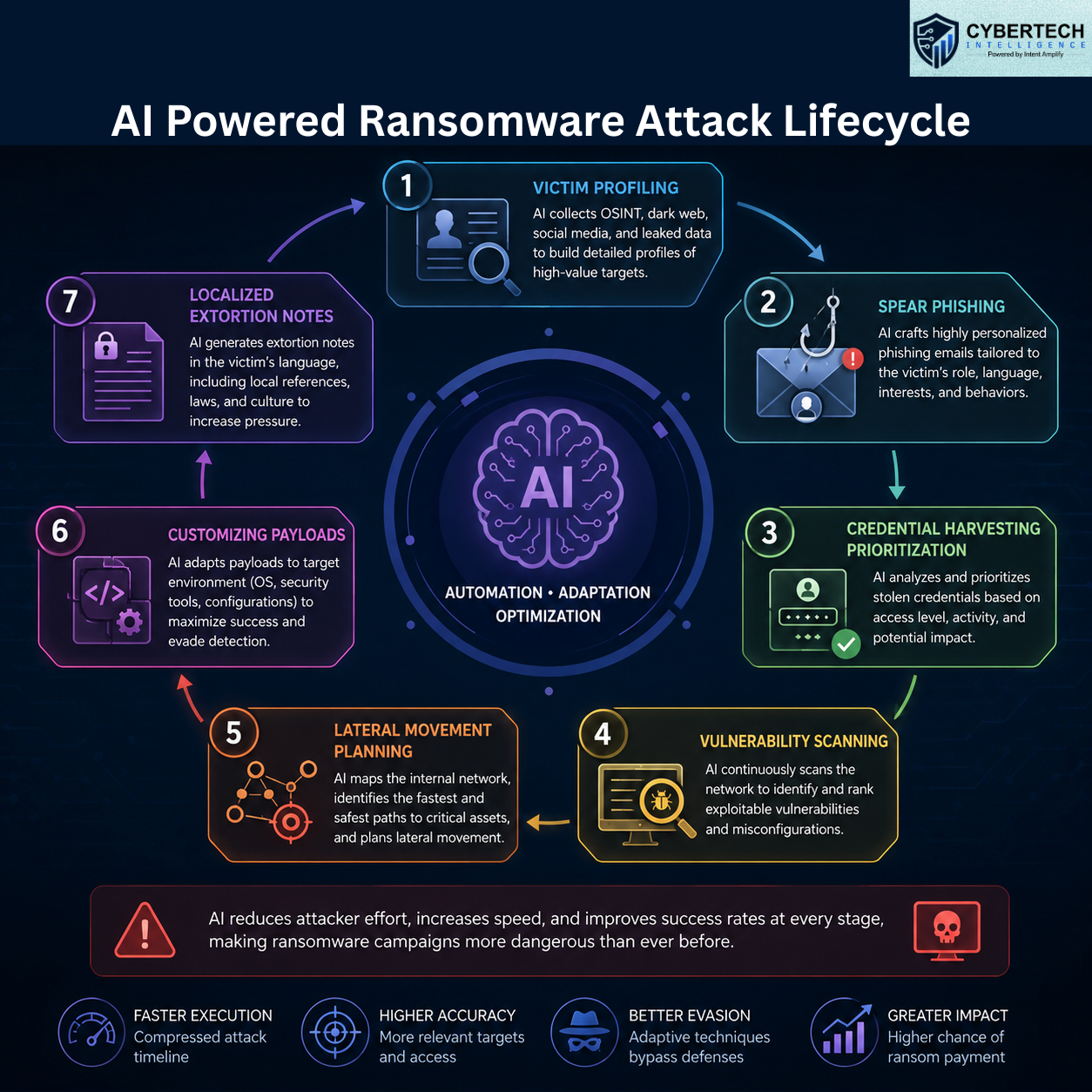
With the help of artificial intelligence, hackers can automate many processes, such as:
- Victim profiling
- Spear phishing
- Credential harvesting prioritization
- Vulnerability scanning
- Lateral movement planning
- Customizing payloads
- Localized extortion notes
Attack Chains Using AI to Compress Enterprise Response Windows
Ransomware attacks that utilize artificial intelligence have greatly reduced the time it takes for these attacks to be carried out due to automation of reconnaissance, customizing phishing attacks, credential selection, and lateral movement. Average breakout time dropped to 29 minutes in 2025, according to CrowdStrike threat intelligence findings. 1
The security operations centers (SOCs) have very little time to detect any breach, investigate it, and stop further attacks before any encryption or exfiltration is done.
Social Engineering Leveraging AI and Deepfake Campaigns
While social engineering is already one of the most effective techniques for distributing ransomware in 2026, the use of artificial intelligence has made the technique much more potent.
Hackers are increasingly utilizing large language models, generative AI technologies, and deepfakes to craft extremely believable spear-phishing and CEO fraud operations.
Today’s phishing campaigns utilizing AI include:
- Real-time language adaptation
- Executive communication imitation
- Context-based phishing baiting
- Voice synthesis to evade MFA
- Tailored targeting via OSINT
- Automated multilingual spear phishing
The use of AI makes phishing attempts more successful as perpetrators are able to customize their messages depending on organizational hierarchies, user behavior, public communications, and data leaks.
Identity and access management (IAM) professionals face new challenges in maintaining credential integrity and robust MFA due to AI-driven phishing campaigns.
Organizations are also being forced to review their financial and helpdesk approval procedures due to impersonation of executive voices through campaigns.
Major Ransomware Attacks and Threat Campaigns Using AI in 2026
The 2026 ransomware environment will be marked by sophisticated cyber threats using AI-driven reconnaissance, phishing attacks, cloud attacks, and identity attacks to augment their operational disruption capabilities.
The rise in ransomware reporting indicates the increasing operational maturity of the AI-powered ransomware ecosystem.
This shortened breakout window creates a much larger workload for enterprise SOC teams because the attackers are able to elevate their privileges and move laterally within just a few minutes after gaining access.
Primary Techniques Used
- Phishing enabled by AI
- Credential abuse
- Privilege escalation
- Fast lateral movement
- Payload execution
Most Attacked Sectors
- Manufacturing
- Healthcare
- Finance
- Government
1. BlackCat (ALPHV) and Cloud-Focused Extortion
The BlackCat ransomware attacks persist in targeting native cloud organizations and hybrid organizations via identity exploitation, virtualization, and SaaS-specific extortion techniques.
80% of enterprises are expected to use generative AI APIs or models by 2026, according to market projections. 6
The rapid adoption of AI-enabled cloud services increases enterprise attack surface complexity and expands opportunities for ransomware operators targeting interconnected infrastructure.
Primary Techniques Used
- Workload compromise within the cloud infrastructure
- APIs attacks
- Credential hijacking
- ESXi attacks
Most Attacked Sectors
- Technology firms
- SaaS businesses
- Banks
- Multi-cloud businesses
-
The LockBit Ransomware
In 2022, LockBit became the most prevalent type of ransomware across the globe, and as of 2024, it has been able to make over 2,000 victims and earn more than $120 million from ransoms. 7
Primary Techniques Used
- Phishing and spear-phishing attacks
- Exploitation of VPN/RDP vulnerabilities
- Credential theft and brute-force attacks
- PowerShell, PsExec, and SMB-based lateral movement
- Privilege escalation using tools like Mimikatz
- Defense evasion and security tool disabling
- Data exfiltration and double extortion
- AES/RSA-based file encryption
Most Attacked Sectors
- Healthcare
- Manufacturing
- Financial Services
- Government and Public Sector
- Education
- Professional Services
- Retail and Wholesale
- Technology and SaaS
3. Cl0p and Supply Chain Exploitation Campaigns
Cl0p ransomware attacks continue to leverage supply chain exploit opportunities by attacking managed file transfer weaknesses and third-party software exploits to compromise multiple organizations.
The IBM X-Force found that ‘vulnerability exploitation’ accounted for around 40% of all cyberattacks in 2025. 8
This example highlights how ransomware gangs are adopting new technologies like AI to automate vulnerability detection during their attack cycles.
Primary Techniques Used
- Attack on the supply chain
- Exploits on mass scales
- Third-party software exploits
- Vulnerability scanning automation
- Stealing data before encryption
Most Attacked Sectors
- Financial Services
- Healthcare
- Manufacturing
- Retail and E-commerce
- Government and Public Sector
- Technology and SaaS Providers
- Transportation and Logistics
- Third-Party Vendors and MSPs
The Impact Across Sectors
According to the ransomware incident tracking study, there has been a 58% rise in ransomware victim disclosures year-over-year. 9
The deployment of artificial intelligence in ransomware attacks has seen an almost universal impact across various key industries because of the interconnectivity between data systems, use of cloud computing, dependency on third parties, and the dependence of operations on real-time computing.
The modern ransomware group has a tendency to target sectors that have a higher degree of susceptibility to extortion through business interruptions, regulatory exposure, and downtime.
Healthcare
The healthcare industry continues to be one of the sectors that is most frequently attacked by ransomware, since such incidents may have direct consequences for patient treatment, emergency, and medical processes.
Key Consequences
- Disruption of the clinical process
- Delaying patient care and response
- Compromising sensitive medical data
- Penalties for regulatory non-compliance
- Increased cost of recovery and downtime
There is an elevated risk of extortion from hospitals and healthcare institutions since operational continuity influences human life safety.
Financial Services
The financial services sector continues experiencing a heightened threat from ransomware attacks, as it involves the compromise of valuable financial information and third-party services.
Key Consequences
- Disruption of transactions
- Compromising customer financial data
- Operational downtime
- Regulatory implications
- Disruption of third-party service
Identity systems, including financial ones, are increasingly becoming targets for threat actors.
Manufacturing
Manufacturing facilities have become highly susceptible due to OT/IT integration, old infrastructure, and dependence on uninterrupted production processes.
Key Consequences
- Halting production
- Disruption of supply chains
- Compromising industrial systems
- Downtime-related revenue losses
- Disrupting logistics processes
Ransomware attacks in manufacturing settings can quickly result in massive operations and supply chain events.
Government and Public Sector
Ransomware continues to affect government organizations because of old systems, financial problems, and the fact that governments provide essential services to citizens.
Key Consequences
- Operational disruptions
- Breach of citizen information
- Disruptions to emergency response efforts
- Operational paralysis
- Exposure to higher geopolitical risks
Public sector entities often face issues of fragmented modernization efforts and varying levels of cybersecurity maturity.
Technology and SaaS Companies
Technology companies and SaaS companies have become a valuable target of ransomware, as compromising the company will allow further penetration into the companies’ customers.
Key Consequences
- Cloud Platform disruptions
- Disruptions in customer service
- Threat propagation through third parties
- Exposure through API
- Organization-wide effects
80% of enterprises are expected to adopt Generative AI APIs or models by 2026, according to Gartner projections mentioned by Accenture.10
With growing adoption of cloud technology and artificial intelligence, the SaaS ecosystem is becoming an attractive target for ransomware attackers.
Retail and E-commerce
Ransomware attacks on retail organizations are common due to the presence of large-scale customer databases, payment infrastructure, and dispersed operations of such organizations.
Key Consequences
- Disruption in payment processing
- Customer database theft
- E-commerce disruption
- Supply chain disruption
- Brand and reputational damage
Seasonal periods of higher transaction volume provide more leverage for ransomware attackers.
Energy and Critical Infrastructure
Energy providers, utilities, and infrastructure operators remain among the highest-risk sectors because disruptions can create widespread societal and economic consequences.
Key Consequences
- Operational technology disruption
- Utility outages
- Industrial control system compromise
- Public safety concerns
- National security implications
The convergence of operational technology and cloud-connected infrastructure continues to the ransomware attack surface.
Education and Research Institutions
Universities and research institutions continue facing elevated ransomware exposure because of decentralized environments, limited budgets, and valuable intellectual property.
Key Consequences
- Research disruption
- Student data exposure
- Learning platform outages
- Intellectual property theft
- Operational downtime
Threat actors increasingly target educational institutions during enrollment and examination periods to maximize disruption.
Cross-Industry Risk Trends
Several ransomware impact patterns are now consistently observed across industries:
- Increased use of double and multi-extortion tactics
- Faster compromise and lateral movement timelines
- Growing cloud and SaaS targeting
- Identity-centric attack chains
- Third-party and supply chain compromise
- Operational disruption beyond encryption alone
Global cybercrime costs are projected to reach $10.5 trillion annually according to cybersecurity economic projections. 11
The economic impact of ransomware now extends far beyond direct ransom payments and increasingly affects operational continuity, customer trust, regulatory exposure, and long-term enterprise resilience across every major industry sector.
References
- CrowdStrike Global Threat Report 2026
CrowdStrike. (2026) 2026 Global Threat Report. Available at: https://www.crowdstrike.com/global-threat-report/ (Accessed: 14 May 2026). - DeepStrike Ransomware Statistics 2025
DeepStrike. (2025) Ransomware Statistics 2025. Available at: https://deepstrike.io/blog/ransomware-statistics-2025 (Accessed: 14 May 2026). - DeepStrike Ransomware Statistics 2025
DeepStrike. (2025) Ransomware Statistics 2025. Available at: https://deepstrike.io/blog/ransomware-statistics-2025 (Accessed: 14 May 2026). - QNu Labs 2026 Cybersecurity Trends Report
QNu Labs. (2026) 2026 Cybersecurity Trends: When Machines Attack at Machine Speed. Available at: https://www.qnulabs.com/whitepaper/2026-cybersecurity-trends-when-machines-attack-at-machine-speed (Accessed: 14 May 2026). - Gartner AI Attack Trends Press Release
Gartner. (2025) Gartner Survey Reveals Generative Artificial Intelligence Attacks Are on the Rise. Available at: https://www.gartner.com/en/newsroom/press-releases/2025-09-22-gartner-survey-reveals-generative-artificial-intelligence-attacks-are-on-the-rise (Accessed: 14 May 2026). - Accenture High Tech Gen AI Opportunity Report
Accenture. (2026) Accenture High Tech Gen AI Opportunity Report. Available at: https://www.accenture.com/content/dam/accenture/final/accenture-com/document-2/Accenture-High-Tech-Gen-AI-Opportunity-Report.pdf (Accessed: 14 May 2026). - Akamai LockBit Ransomware Overview
Akamai. (2026) What Is LockBit Ransomware? Available at: https://www.akamai.com/glossary/what-is-lockbit-ransomware (Accessed: 14 May 2026). - IBM X-Force Threat Intelligence Report
IBM. (2026) IBM X-Force Threat Intelligence Report. Available at: https://www.ibm.com/reports/threat-intelligence (Accessed: 14 May 2026). - DeepStrike Ransomware Statistics 2025
DeepStrike. (2025) Ransomware Statistics 2025. Available at: https://deepstrike.io/blog/ransomware-statistics-2025 (Accessed: 14 May 2026). - Accenture High Tech Gen AI Opportunity Report
Accenture. (2026) Accenture High Tech Gen AI Opportunity Report. Available at: https://www.accenture.com/content/dam/accenture/final/accenture-com/document-2/Accenture-High-Tech-Gen-AI-Opportunity-Report.pdf (Accessed: 14 May 2026). - QNu Labs 2026 Cybersecurity Trends Report
QNu Labs. (2026) 2026 Cybersecurity Trends: When Machines Attack at Machine Speed. Available at: https://www.qnulabs.com/whitepaper/2026-cybersecurity-trends-when-machines-attack-at-machine-speed (Accessed: 14 May 2026).