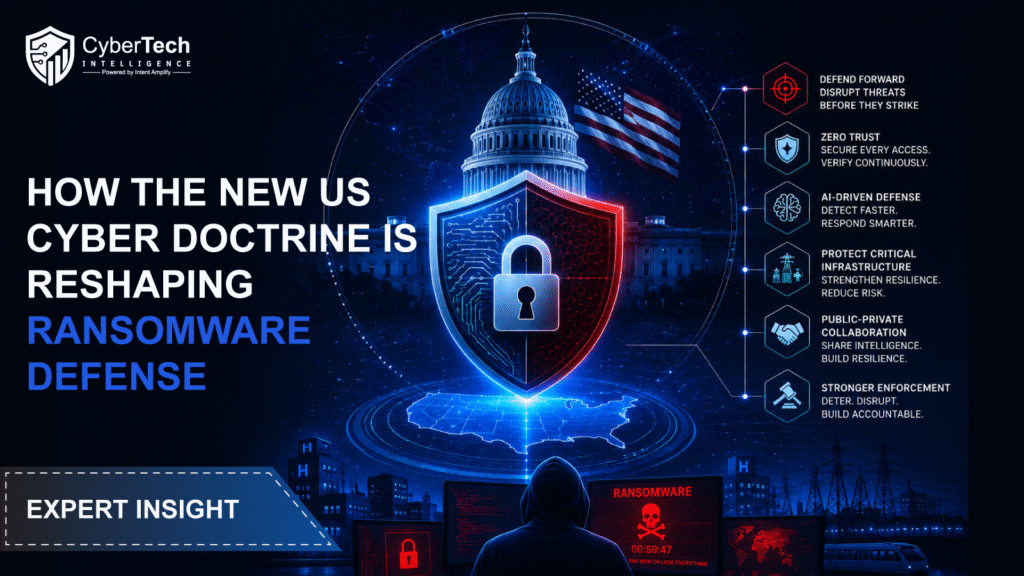
Ransomware is no longer viewed solely as a cybercrime challenge. In 2026, it is increasingly treated as a national security, economic resilience, and critical infrastructure protection issue.
In 2026, the US embraced a much more aggressive cyber strategy that focused on offensive measures, resilience of critical infrastructures, implementation of Zero Trust architecture, use of artificial intelligence-driven defense mechanisms, and collaboration between the public and private sectors. In light of this, it is imperative that the cyber leaders in organizations reevaluate their strategies regarding the protection of their networks from ransomware attacks.
According to Forreste, the cyber strategy endorsed by the White House comprises six pillars that entirely change the way the government and businesses will approach cyber threats.
The White House cyber strategy frames ransomware actors as threats capable of disrupting economic activity, healthcare systems, supply chains, and critical infrastructure.1
The implications for enterprise security leaders are profound.
Ransomware Has Become a National Security Battlefield
The implications for enterprise security leaders are significant.
Ransomware: A National Security Battleground
The contemporary ransomware environment behaves as a multinational corporation. The criminals today utilize artificial intelligence (AI)-based phishing, double extortion, supply chain attacks, and identity attacks to increase disruption and profit maximization.
As stated in Akamai Ransomware Trends 2025, ransomware assaults now concentrate on identity systems, cloud workloads, application programming interfaces (APIs), and hybrid environments instead of the standard endpoint targets. 2
According to industrial statistics, ransomware gangs have shifted their focus to precise attacks against infrastructure environments with high business value instead of opportunistic mass attacks. This development has led companies to adopt cyber resiliency approaches to cybersecurity instead of just preventive measures.
The new US cyber doctrine directly reflects this reality.
Forrester notes that the strategy promotes a more aggressive “defend forward” posture, where US cyber agencies actively disrupt hostile infrastructure before attacks materialize.
The doctrine also encourages deeper collaboration between federal agencies and private-sector organizations in threat intelligence sharing and coordinated response initiatives. 1
The importance of this development lies in the fact that businesses cannot continue to manage their cybersecurity initiatives independently. The doctrine emphasizes coordinated cyber defense involving federal agencies, infrastructure operators, cloud providers, and enterprise security teams.
Zero Trust Becomes the Backbone of Ransomware Protection
Another prominent trend coming out of this strategic guideline is the preference for Zero Trust Architecture (ZTA).
The new American ransomware protection strategy mandates the modernization of security within both the federal government and corporations using zero trust principles, artificial intelligence (AI)-based security technologies, post-quantum cryptography, and continuous verification mechanisms.3
The perpetrators of ransomware are not relying solely on malware anymore. They exploit legitimate credentials, remote access services, unknown identities, cloud configuration errors, and relationships with third parties.
According to industry experts, identity has now become the new attack surface.
Industry and government guidance increasingly identify compromised identities and privileged access abuse as major drivers of ransomware intrusion and lateral movement. 4
The NSA’s Zero Trust implementation guidance reinforces this approach through five pillars:
- Identity
- Devices
- Networks
- Applications
- Data
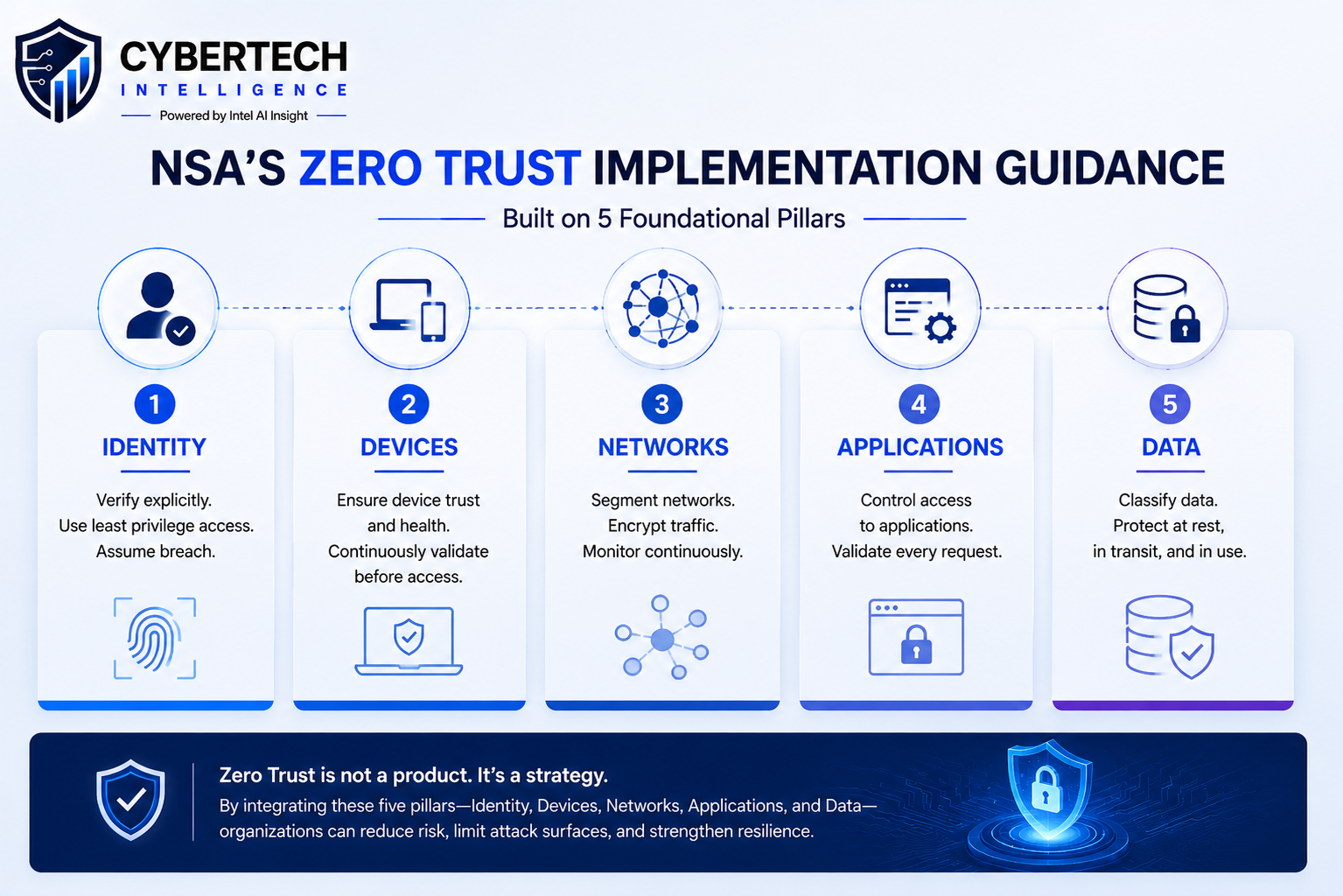
These pillars emphasize continuous monitoring, behavioral analytics, enforceable access controls, and session-based verification. 5
For enterprise leaders, this means ransomware defense is shifting from perimeter security toward identity-centric security operations.
In practical terms, organizations are now prioritizing:
- Multi-factor authentication (MFA)
- Privileged access management (PAM)
- Continuous behavioral monitoring
- Microsegmentation
- Least-privilege access
- Secure cloud identity governance
- AI-driven anomaly detection
The strategic message is clear: if attackers can no longer move laterally across networks using compromised credentials, ransomware campaigns become significantly harder to scale.
Critical Infrastructure Is Under Direct Pressure
The new doctrine places unprecedented emphasis on critical infrastructure security.
According to the White House strategy analysis published by Forrester, organizations operating in critical sectors are expected to inventory and reduce dependency on adversarial technologies while hardening infrastructure resilience.1
Recent industrial cybersecurity reporting highlights sustained pressure against critical infrastructure environments:
- 93% of critical national infrastructure providers have reported a cyberattack in the previous year.
- 82% of cyber-physical attacks were characterized by the presence of exposed remote access technologies like VNC.
- 66% of cyber-physical attacks were accompanied by HMI/SCADA system attacks that compromised the functioning of industrial systems.
(Sources: As per references shown above, Cyber Tech Intelligence Analysis)
This demonstrates why there is a push among governments to move towards resiliency-focused cybersecurity doctrines.
Disruption of operational technology (OT), energy infrastructure, healthcare systems, manufacturing facilities, and transportation systems has an immediate impact on people’s lives. Therefore, ransomware attacks on such infrastructure are becoming common.
Accordingly, the US doctrine prioritizes the integration of national security with enterprise resiliency.
This includes:
- Mandatory modernization of legacy infrastructure
- Increased adoption of Zero Trust for OT environments
- AI-enabled threat monitoring
- Real-time incident reporting
- Supply-chain risk governance
- Greater public-private coordination
For CISOs, the message is no longer about “if” critical infrastructure will be targeted, but how quickly organizations can reduce systemic exposure.
AI Is Accelerating Both Attackers and Defenders
The emergence of artificial intelligence has become one of the key factors in contemporary ransomware attacks.
Security research increasingly documents AI-assisted phishing, automated reconnaissance, and machine-assisted malware development as emerging elements of the ransomware threat landscape. 7
Threat researchers report growing experimentation with AI-assisted malware development and automated social engineering techniques that lower technical barriers for cybercriminal operations.
On the other hand, the newly established US cyber policy encourages the use of AI-fueled defenses.
It urges businesses to deploy cutting-edge AI-based cybersecurity technologies to enhance threat detection, facilitate threat analysis, and accelerate the response process.3
This is indicative of an emerging reality in SOC environments: A human analyst cannot match the speed of machines.
In response to increasingly fast and adaptive ransomware campaigns, businesses are allocating significant funds to:
- AI-powered SIEM platforms
- Autonomous threat detection
- User and entity behavior analytics (UEBA)
- Security orchestration and automated response (SOAR)
- Predictive threat intelligence
- AI-assisted vulnerability prioritization
The financial implications are substantial.
According to Forrester, quantum computing and advanced security expenditures are expected to be more than 5% of total IT security budget expenditures by 2026, indicating the significance of cyber resilience in today’s world.8
“In 2026, the AI hype period ends as the pressure to deliver real, measurable results from secure AI initiatives intensifies,” said Sharyn Leaver, chief research officer at Forrester.
It clearly shows that expenditures on cybersecurity are now being considered as a business investment instead of just IT costs.
Public-Private Collaboration Is Becoming Mandatory
Another major transformation within the new doctrine is the emphasis on coordinated defense between government agencies and the private sector.
According to KPMG’s analysis of the strategy, the doctrine prioritizes:
- Interagency coordination
- Public-private collaboration
- Joint enforcement initiatives
- Shared threat intelligence
- Offensive and defensive cyber operations alignment 3
This represents a significant evolution in ransomware defense philosophy.
In the past, many companies used to see cyber attacks as something happening internally. However, nowadays, ransomware attacks often include organized criminal gangs operating across borders, geopolitical actors, bitcoin laundering rings, and supply chain manipulation.
This means that governments are now expecting enterprises to be part of a collective defense network.
Organizations are now being encouraged to:
- Share threat intelligence rapidly
- Participate in information-sharing alliances
- Improve incident transparency
- Strengthen regulatory reporting capabilities
- Align with national cyber resilience frameworks
This collaborative model is reshaping enterprise expectations around cyber governance and executive accountability.
The Enterprise Leadership Imperative
For enterprise executives, the new US cyber doctrine changes cybersecurity from a purely technical function into a strategic operational discipline.
The ransomware threat is no longer measured only by data loss. It is now measured by:
- Operational disruption
- Supply-chain paralysis
- Regulatory exposure
- Reputational damage
- National infrastructure risk
- Financial resilience
This means boards and executive leadership teams must rethink cybersecurity investment priorities.
The most resilient organizations in 2026 are not simply those with the largest security budgets. They are the enterprises that successfully integrate:
- Zero Trust security models
- Identity-first defense strategies
- AI-enabled detection capabilities
- Cloud resilience frameworks
- Operational Resilience Planning
- Collaboration Across Sectors
The new US cyber doctrine reflects a broader shift toward operational resilience, coordinated defense, and infrastructure modernization as central pillars of ransomware defense.
For business executives, the question is not whether the attacks will become more serious. It is whether security approaches will adapt at the same pace as today’s digital battlefields.
Frequently Asked Questions
1. Why has ransomware become a national security concern?
Ransomware is beyond being a cybercrime issue already, with contemporary variants having seeped into hospitals, power grids, transportation, manufacturing, and even supply chains. With such attacks placing the citizenry, economy, and critical infrastructure at risk, states have elevated those organizations behind ransomware to be a matter of national security rather than mere criminals.
2. What makes Zero Trust a must-have against ransomware attacks?
Securing the perimeter has been the focus of security for a long time, but this breaks down when the attacker has a path, like compromised credentials, cloud accounts etc., with which to take. Zero Trust instead puts user and device re-authentication at the center of security, with restricted access roles and identity-based security.
3. How is artificial intelligence changing the ransomware landscape?
AI is now powering both the forge and the forge. It can be used to automate spear-phishing campaigns, conduct reconnaissance, develop malware, and execute social engineering attacks.
Businesses are utilizing AI-powered detection systems, automated response systems, and behavioral analytics.
4. Why are critical infrastructure organizations under increasing pressure?
High-value businesses, such as healthcare, manufacturing, transportation, and energy, are highly sensitive to disruption, and even brief outages can have significant consequences.
References
- Forrester, White House Announces the 2026 Cyber Strategy for America, 2026.
- Akamai, Ransomware Trends 2025 Report, 2025.
- KPMG, Cybersecurity: New Cyber Strategy, Cybercrime Executive Order & Regulatory Alert, 2026.
- Reddit / Bushey_IT_Change, Cyber Shifts to Identity-First Zero Trust, 2026.
- ITPro, Is Your Zero Trust Model Prepared for Modern Threats?, 2025.
- Reddit / r/cybersecurity, Cybersecurity Statistics of the Week – March 16, 2026.
- Reddit / r/SecOpsDaily, From 36-Day Zero-Days to Vibe-Coded Malware, 2026.