Executive Overview
Indeed, ransomware gangs have evolved into some of the biggest threats to enterprises in the United States, causing significant financial disruption and posing serious dangers due to their activities.
Unlike ransomware groups of the past, which were typically solo hackers, today’s ransomware groups are now organized business models that utilize ransomware-as-a-service (RaaS), artificial intelligence for reconnaissance, identity theft, supply chain attacks, cloud computing, and extortion based on data.
According to Cyber Tech Intelligence Analysis, the approach of the ransomware business model has shifted from opportunistic malware to creating operational disruption, aiming to affect income generation, customer operations, logistics, and management processes simultaneously.
As stated in the IBM X-Force Threat Intelligence Index Report 2025, cyber attackers are increasingly focusing on secret attacks and stealing data rather than relying solely on encryption for extortion.
According to IBM, data theft accounts for about 18% of the goals of attackers, while encryption-based attacks account for 11%.1
The financial consequences of such attacks continue to rise rapidly.
According to IBM’s “Cost of a Data Breach” analysis for 2025, the global average cost of a data breach is approximately $4.88 million.2
For business leaders, ransomware is no longer just a cybersecurity threat.
It has become:
- A business continuity issue
- A shareholder-risk issue
- A regulatory issue
- A board-governance issue
- A supply-chain resilience issue
- An enterprise survivability issue
As reported by Accenture’s State of Cybersecurity Resilience report for 2025, only 10% of companies worldwide can protect themselves from attacks by artificial intelligence-based hackers.
Furthermore, 77% do not have the required skills in terms of data protection and artificial intelligence to counter these attacks.3
This growing resilience gap is changing where cybersecurity investments are prioritized across the United States.
However, those firms that would be capable of addressing all the threats are likely to emerge successful in the coming years.
Rather, it is going to be those enterprises that have enough resilience to cope with the disruptions and implement successful recovery mechanisms that will end up succeeding.
Moreover, enterprise ransomware attacks do not remain confined to the initial window of opportunity.
In fact, their impact has been expanded beyond their initial scope, and recovery from the situation has become quite challenging for enterprises due to the simultaneous attacks on identity systems, cloud infrastructure, backup systems, and even third-party enterprise ecosystems. Based on data from the IBM X-Force Threat Intelligence Index 2025, critical infrastructure enterprises made up almost 70% of the attacks investigated by IBM X-Force throughout 2024 8
Therefore, corporate executives are focusing on investing in cyber resilience strategies such as zero trust architecture, recovery management, cloud security governance, and AI-based threat identification.
The New Economics of Modern Ransomware Operations
Modern ransomware campaigns are increasingly driven by operational economics rather than just technical goals.
Threat actors now prioritize:
- Operational disruption
- Recovery sabotage
- Data theft
- Credential compromise
- Regulatory pressure
- Executive panic
- Supply chain interruption
- Business continuity breakdown
Cyber Tech Intelligence Analysis suggests that ransomware groups increasingly target organizations where estimated downtime costs are higher than the likely ransom amounts.
The ransomware ecosystem has developed into a highly specialized underground economy involving:
- Initial access brokers
- Credential traffickers
- Ransomware affiliates
- Negotiation specialists
- Cloud intrusion operators
- Cryptocurrency laundering networks
- Data-leak operators
IBM X-Force reported that nearly one-third of cyber incidents in 2024 involved credential activities.1
Accenture’s State of Cybersecurity Resilience Report found that ransomware accounted for approximately 91% of incurred cyber losses during the first half of 2025. 4
Cyber Tech Intelligence Analysis suggests that attackers increasingly prefer:
- Identity compromise over malware deployment
- Data extortion over encryption-only attacks
- Cloud exploitation over perimeter intrusion
- Operational disruption over long-term persistence
This shift is reshaping enterprise cyber-risk calculations dramatically.
Why Traditional Security Models Continue to Fail
Many enterprises still operate cybersecurity systems focused on perimeter defense rather than operational survival.
Today’s enterprise environments are dominated by:
- Hybrid cloud infrastructure
- SaaS environments
- API-driven operations
- Remote workforces
- AI-driven automation
- Machine identities
- Multi-cloud environments
- Third-party integrations
Cyber Tech Intelligence Analysis suggests that ransomware resilience failures often stem from architectural fragmentation rather than isolated control issues.
Excessive Trust in Identity Systems
Modern ransomware groups increasingly target:
- Privileged accounts
- Cloud authentication systems
- API tokens
- Federation services
- SaaS credentials
- Machine identities
- VPN access infrastructure
IBM reported an 84% increase in phishing emails delivering infostealers during 2024.1
Security Tool Fragmentation
Large enterprises frequently operate dozens of disconnected security platforms across:
- Endpoint security
- SIEM
- Cloud security
- Email security
- Identity security
- Backup infrastructure
- XDR platforms
- Threat intelligence
Accenture reported that 63% of organizations remain in what it calls the “Exposed Zone,” lacking cohesive resilience strategies and mature operational security capabilities.3
Recovery Underinvestment
Industry reports citing Sophos research found that 94% of ransomware attacks involved attempts to compromise backups.5
Cyber Tech Intelligence Analysis suggests that organizations unable to restore operations quickly face significantly greater:
- Financial damage
- Regulatory pressure
- Brand erosion
- Customer churn
- Executive scrutiny
In addition, legacy cybersecurity strategies continue to be centered around preventive methods that are geared toward static corporate setups, instead of complicated digital networks.
With increasing usage of cloud computing technologies, artificial intelligence, and APIs, today’s security infrastructure is much more sophisticated and difficult to manage in varying business divisions and external partners.
This results in data silos, which are commonly used by hackers when moving laterally within a network and elevating their permissions.
According to the Microsoft report, the number of identity-based attacks, attacks that misuse credentials, and operations aimed at social engineering remains quite high within all types of enterprise environments, especially those based on hybrid cloud infrastructure.7
Cyber Tech Intelligence Analysis indicates that enterprises lacking centralized identity governance, continuous monitoring, and recovery orchestration capabilities often experience:
- Longer recovery timelines
- Higher operational downtime costs
- Increased regulatory exposure
- Greater third-party risk exposure
- Reduced visibility across cloud ecosystems
- Slower incident-response coordination
- Higher cyber insurance scrutiny
- Increased executive and board-level pressure during ransomware incidents
Traditional security models also frequently struggle with:
- Managing machine identities at enterprise scale
- Securing SaaS application sprawl
- Maintaining consistent cloud governance
- Correlating telemetry across fragmented security tools
- Detecting low-noise identity compromise activity
- Protecting backup and recovery infrastructure from targeted attacks
Enterprise Financial Impact and Downtime Economics
The true cost of ransomware extends far beyond ransom payments themselves.
Modern enterprise ransomware events frequently trigger:
- Operational shutdowns
- Supply-chain disruption
- SEC disclosure obligations
- Legal expenses
- Insurance escalation
- Shareholder pressure
- Customer attrition
- Recovery consulting costs
According to IBM’s 2025 Cost of a Data Breach Report, the average cost of an extortion or ransomware incident remained high at approximately $5.08 million, particularly when the incident was disclosed by an attacker 2
Estimated Enterprise Downtime Exposure
Reference Base: IBM’s breach costs for the year 2025, 2 downtime costs from Scale Computing, and Deloitte’s risk model. 6 The objective is to maintain accuracy while retaining the strategic purpose of the table.
Organizations experiencing ransomware claims also frequently encounter:
- Higher cyber insurance premiums
- Reduced policy coverage
- Increased underwriting scrutiny
- Mandatory resilience audits
Cyber Tech Intelligence Analysis suggests that ransomware economics are fundamentally reshaping enterprise cyber-investment priorities.
Identity-Based Attacks and Escalated Threats via AI
Identity systems have become the primary battleground in modern ransomware operations.
Threat actors increasingly target:
- Privileged credentials
- Cloud identities
- SaaS authentication systems
- API tokens
- Session cookies
- Federation infrastructure
- Machine identities
Microsoft 7 and IBM 8 threat intelligence reporting both indicate substantial growth in credential-centric attack activity.
AI-Enhanced Threat Operations
Modern threat actors increasingly leverage AI to:
- Generate realistic phishing campaigns
- Personalize executive-targeted attacks
- Accelerate reconnaissance
- Improve malware variation
- Analyze stolen data rapidly
- Enhance social engineering operations
Accenture reported that 77% of organizations currently lack adequate AI and data-security protections required for modern cyber resilience.3
Cyber Tech Intelligence Analysis indicates that attackers are dramatically compressing operational timelines.
Modern ransomware groups increasingly attempt to:
- Disable security controls rapidly
- Compromise backups immediately
- Escalate privileges early
- Trigger disruption before detection occurs
In addition, enterprise security teams are encountering growing obstacles that come with the fast-paced proliferation of non-human and machine identities in cloud-native systems, application programming interfaces (APIs), automation tools, and AI-powered software programs. With the adoption of generative AI technology and autonomous processes, the volume of machine identities often surpasses that of human identities in an enterprise setting.
Cyber Tech Intelligence Analysis indicates that ransomware operators are increasingly exploiting weak identity governance, excessive access privileges, stolen session tokens, and unmanaged service accounts to move laterally across enterprise networks without triggering traditional security alerts.
One of the leading risks for enterprises in cybersecurity is that identity attacks remain a rapidly growing enterprise cyber risk, especially in hybrid and multi-cloud environments, according to Microsoft’s Digital Defense Report 2025 7.
Additionally, attackers are increasingly using artificial intelligence technology to make phishing more personalized and effective.
As a result, the changing environment is putting even more pressure on enterprises to focus on:
- Continuous identity verification
- Phishing-resistant MFA
- AI-driven behavioral analytics
- Identity threat detection and response (ITDR)
- Machine identity governance
- Real-time access monitoring
- Cloud identity segmentation
- Privileged access lifecycle management
Exposure of Cloud, SaaS, and Hybrid Environments
Cloud transformation has fundamentally expanded ransomware attack surfaces.
Enterprise organizations now operate highly interconnected environments involving:
- Multi-cloud infrastructure
- SaaS ecosystems
- APIs
- Remote endpoints
- Hybrid workloads
- Third-party integrations
- AI platforms
- Automation systems
Cyber Tech Intelligence Analysis indicates that cloud complexity increasingly contributes to:
- Misconfiguration exposure
- Credential sprawl
- Excessive privileges
- Visibility gaps
- Inconsistent recovery controls
- API insecurity
Many enterprises now manage hundreds of SaaS applications simultaneously.
Reference Basis: Microsoft enterprise cloud governance reporting and Deloitte SaaS governance analysis.9
Modern ransomware groups increasingly target:
- Cloud snapshots
- Hypervisors
- Backup systems
- SaaS administrative accounts
- Storage credentials
- Recovery orchestration tools
Zero Trust and Resilience Design at Scale
Zero Trust has evolved beyond access management into a foundational resilience strategy.
Modern resilience-oriented Zero Trust models increasingly focus on:
- Continuous verification
- Identity-centric protection
- Least-privilege access
- Behavioral analytics
- Segmentation
- Adaptive authentication
- Recovery isolation
NIST guidance increasingly emphasizes resilience-oriented architectures capable of maintaining operational continuity during active cyber incidents. 10
Cyber Tech Intelligence Analysis suggests that organizations implementing mature Zero Trust strategies often demonstrate:
- Faster recovery
- Reduced lateral movement
- Improved containment
- Lower operational disruption
- Better identity governance
Architecture of Recovery and Business Continuity
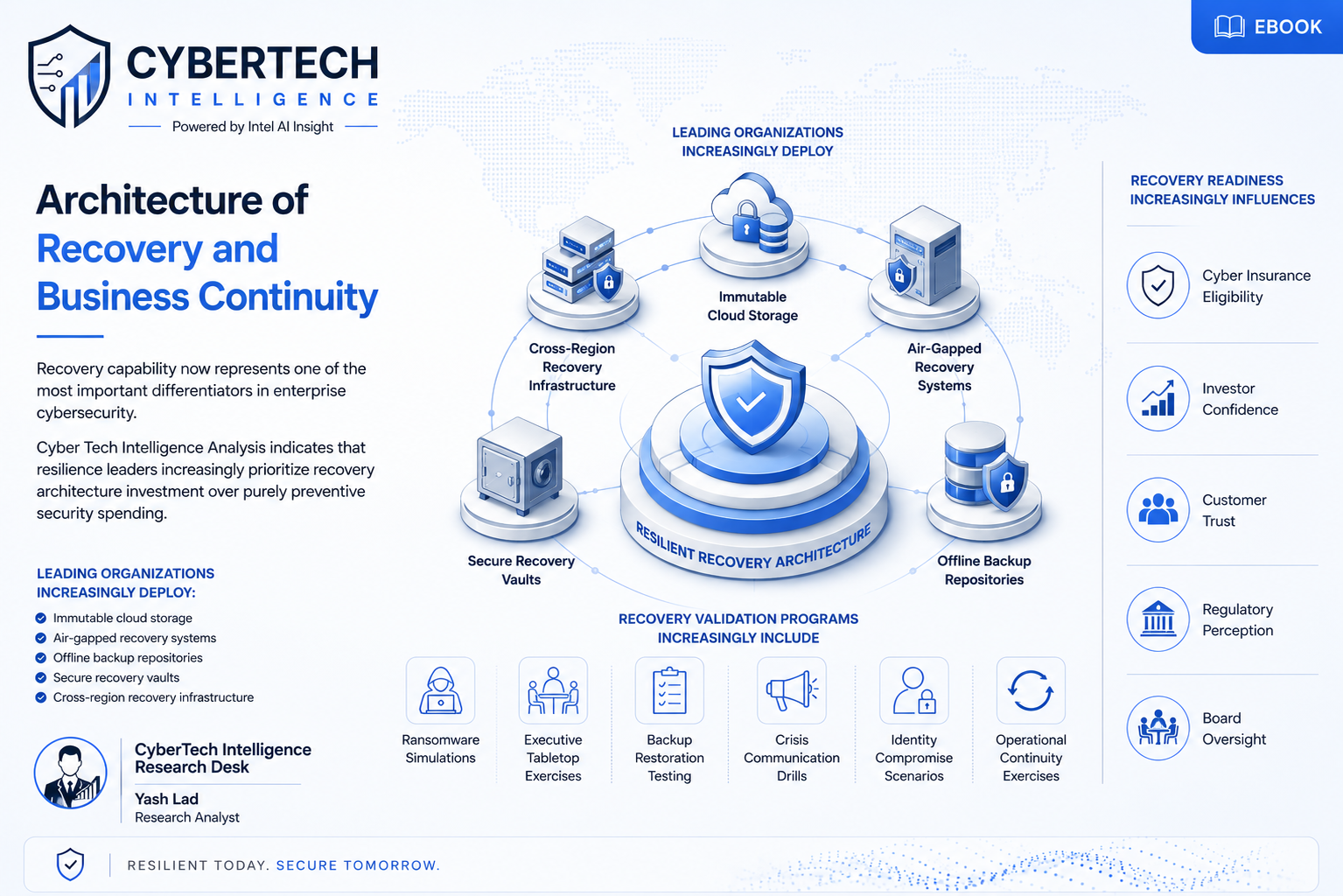
Recovery capability now represents one of the most important differentiators in enterprise cybersecurity.
Cyber Tech Intelligence Analysis indicates that resilience leaders increasingly prioritize recovery architecture investment over purely preventive security spending.
Leading organizations increasingly deploy:
- Immutable cloud storage
- Air-gapped recovery systems
- Offline backup repositories
- Secure recovery vaults
- Cross-region recovery infrastructure
Recovery validation programs increasingly include:
- Ransomware simulations
- Executive tabletop exercises
- Backup restoration testing
- Crisis communication drills
- Identity compromise scenarios
- Operational continuity exercises
Recovery readiness increasingly influences:
- Cyber insurance eligibility
- Investor confidence
- Customer trust
- Regulatory perception
- Board oversight
Modern Security Operations and Protection from Ransomware
Traditional SOC models are increasingly struggling against modern ransomware operations.
Enterprise environments now generate massive telemetry volumes across:
- Cloud systems
- Identity infrastructure
- APIs
- SaaS platforms
- Endpoints
- OT systems
- AI platforms
Cyber Tech Intelligence Analysis indicates that many SOC teams remain overwhelmed by:
- Alert fatigue
- Tool fragmentation
- Incomplete telemetry
- Staffing shortages
- Manual triage processes
Modern SOC transformation increasingly requires:
- AI-assisted analytics
- Behavioral detection
- Threat-intelligence automation
- Extended detection and response (XDR)
- Identity telemetry correlation
- Threat-hunting automation
Accenture and Microsoft expanded their collaboration during 2025 around GenAI-powered cybersecurity modernization initiatives designed to improve resilience operations.3
Governing the Board & SEC-Pressure on Cyber Disclosures
Cyber resilience is now a board-level governance issue.
Public companies increasingly face pressure regarding:
- SEC cyber disclosure obligations
- Shareholder scrutiny
- Operational continuity
- Executive accountability
- Third-party exposure
- Regulatory compliance
Board-Level Questions Enterprise Leaders Should Ask
- Can the organization restore core operations within 72 hours?
- Are recovery environments isolated from identity compromise?
- What percentage of critical systems are protected by immutable backups?
- Has executive leadership participated in ransomware simulations?
- Are machine identities included within Zero Trust governance?
- Does the organization measure recovery confidence continuously?
Cyber Tech Intelligence Analysis suggests that boards increasingly evaluate resilience using operational KPIs rather than purely compliance-based metrics.
Critical Focus Areas for Enterprise Executives
Enterprise executives need to focus on the following strategic efforts over the next 12-24 months.
1. Cyber Resilience as a Corporate Business Unit
Cyber resilience should be integrated into enterprise operational continuity.
2. Prioritize Identity Security
Identity compromise increasingly represents the fastest path to enterprise-wide disruption.
3. Invest in Recovery Architecture
Recovery systems should become:
- Immutable
- Segmented
- Continuously tested
- Operationally resilient
4. Modernize Security Operations
SOC modernization should prioritize:
- AI-assisted analytics
- Threat hunting
- Identity telemetry
- Cloud visibility
5. Expand Zero Trust Enterprise-Wide
Zero Trust must extend into:
- APIs
- SaaS platforms
- Backups
- Machine identities
- Recovery systems
6. Conduct Executive-Level Simulations
Boards and executive teams should participate regularly in ransomware-response exercises.
7. Reduce Operational Complexity
Simplified architectures improve:
- Visibility
- Recovery speed
- Response coordination
- Operational resilience
Future Perspective: Next Generation of Ransomware Campaign
The ransomware ecosystem will likely continue evolving toward:
- Identity-centric attacks
- Data-extortion operations
- AI-enhanced phishing
- Supply-chain compromise
- Encryptionless disruption campaigns
- Cloud-native attacks
- Recovery sabotage
Cyber Tech Intelligence Analysis indicates that the next major ransomware evolution phase will likely focus on identity paralysis and operational disruption rather than encryption alone.
McKinsey analysis suggests that cybersecurity markets are associated with:
- AI governance
- Resilience engineering
- Identity security
- Autonomous threat detection
will continue experiencing substantial enterprise growth.11
Conclusion
Today’s ransomware operations can be viewed as operational resilience issues with the potential to disrupt business continuity, investor confidence, consumer confidence, and even board governance all at once.
Companies that will succeed in the coming five years are not necessarily going to be those that avoid all threats.
Instead, resilient leaders will be organizations capable of:
- Maintaining operational continuity
- Recovering rapidly
- Protecting identities effectively
- Isolating recovery systems
- Coordinating executive response
- Sustaining customer trust during disruption
Cyber Tech Intelligence Analysis indicates that cyber resilience is rapidly becoming one of the defining operational priorities of the modern digital enterprise.
For enterprise leaders in the United States, ransomware resilience is no longer optional.
It is now a core requirement for operational survivability.
Organizations that fail to strengthen resilience capabilities may increasingly face longer recovery timelines, higher financial exposure, and growing regulatory and shareholder pressure. As ransomware operations continue evolving toward identity compromise, cloud disruption, and AI-enabled attack strategies, enterprise resilience readiness will increasingly become a key indicator of long-term operational stability and business continuity maturity.
References
- IBM Newsroom, 2025 IBM X-Force Threat Index: Large-Scale Credential Theft Escalates, Threat Actors Pivot to Stealthier Tactics. April 2025. (IBM Newsroom)
- IBM, Cost of a Data Breach Report 2025. July 2025.
- Accenture Newsroom, Only One in 10 Organizations Globally Are Ready to Protect Against AI-Augmented Cyber Threats. January 2025.
- Accenture, State of Cybersecurity Resilience 2025. 2025.
- Sophos, The State of Ransomware 2025. June 2025.
- Deloitte, Risk Modeling and Operational Resilience Insights. 2025.
- Microsoft, Microsoft Digital Defense Report 2025. October 2025.
- IBM Newsroom, IBM Cybersecurity and Threat Intelligence Newsroom Updates. 2025.
- Microsoft Security, Microsoft Security Intelligence, and Threat Protection Insights. 2025.
- NIST, NIST Cybersecurity Framework 2.0. February 2025.
- McKinsey & Company, Securing the Agentic Enterprise: Opportunities for Cybersecurity Providers. January 2026.