Executive Overview
Ransomware moving into 2026 looks nothing like what companies had to contend with only a few years ago. From merely being a form of encryption software, ransomware has grown into a sophisticated system of criminals that specializes in disrupting operations, stealing identities, stealing data, applying pressure through reputation damage, and exploiting regulatory vulnerabilities.
According to Cyber Tech Intelligence analysis, ransomware organizations are becoming more sophisticated, with affiliate networks, phishing campaigns powered by AI, negotiators, and access brokers.
Their objective is no longer simply encrypting systems. Their objective is to disrupt enterprise continuity itself.
IBM’s 2025 Cost of a Data Breach Report found that the average U.S. data breach cost reached approximately $10.22 million, continuing to rank among the highest globally. Earlier IBM Security research also found that organizations extensively deploying AI and automation across security operations reduced average breach costs by nearly $1.9 million.1
According to Accenture’s report, there is a significant gap in terms of operational preparedness against AI-based cybersecurity attacks due to fragmented identity management processes and differences in governance maturity levels. 2
Some new trends in the ransomware threat scenario for 2026 include:
- Identity compromise is replacing malware execution as the dominant intrusion vector.
- AI-assisted phishing is reducing attacker preparation time.
- Multi-extortion models are amplifying operational and legal pressure.
- Underwriters in cyber insurance have become stricter in their requirements.
- Government departments are stressing Zero Trust and operational resilience
“Ransomware by 2026 is not only a malware issue anymore; it is an operational resilience challenge.”
The Industrialization of Modern Ransomware
Modern ransomware groups increasingly resemble structured business ecosystems.
Their operations commonly include:
- Initial access brokers
- Affiliate operators
- Negotiation specialists
- Data leak teams
- Cryptocurrency laundering operations
- AI-assisted phishing infrastructure
The 2026 Multi-Extortion Pressure Model
Modern ransomware campaigns increasingly apply pressure across five enterprise layers:
- Operational disruption
- Regulatory exposure
- Public disclosure risk
- Supply-chain impact
- Brand and investor trust erosion
IBM Security research found that extortion-related incidents continue generating some of the highest operational recovery costs among major cyberattack categories.1
Why 2026 Marks a Paradigm Change in Enterprise Cyber Risks
For many enterprise cybersecurity professionals, the risk associated with ransomware is no longer measured only by the standard measures of malware prevention.
The context in which the enterprise business operates at the moment has seen remarkable transformations over the past few years. The modern enterprises operate in highly distributed cloud environments, software as a service, telecommuting setups, artificial intelligence-enabled processes, and globally interconnected supply chains.
This interconnected digital expansion has dramatically increased identity dependencies and operational exposure.
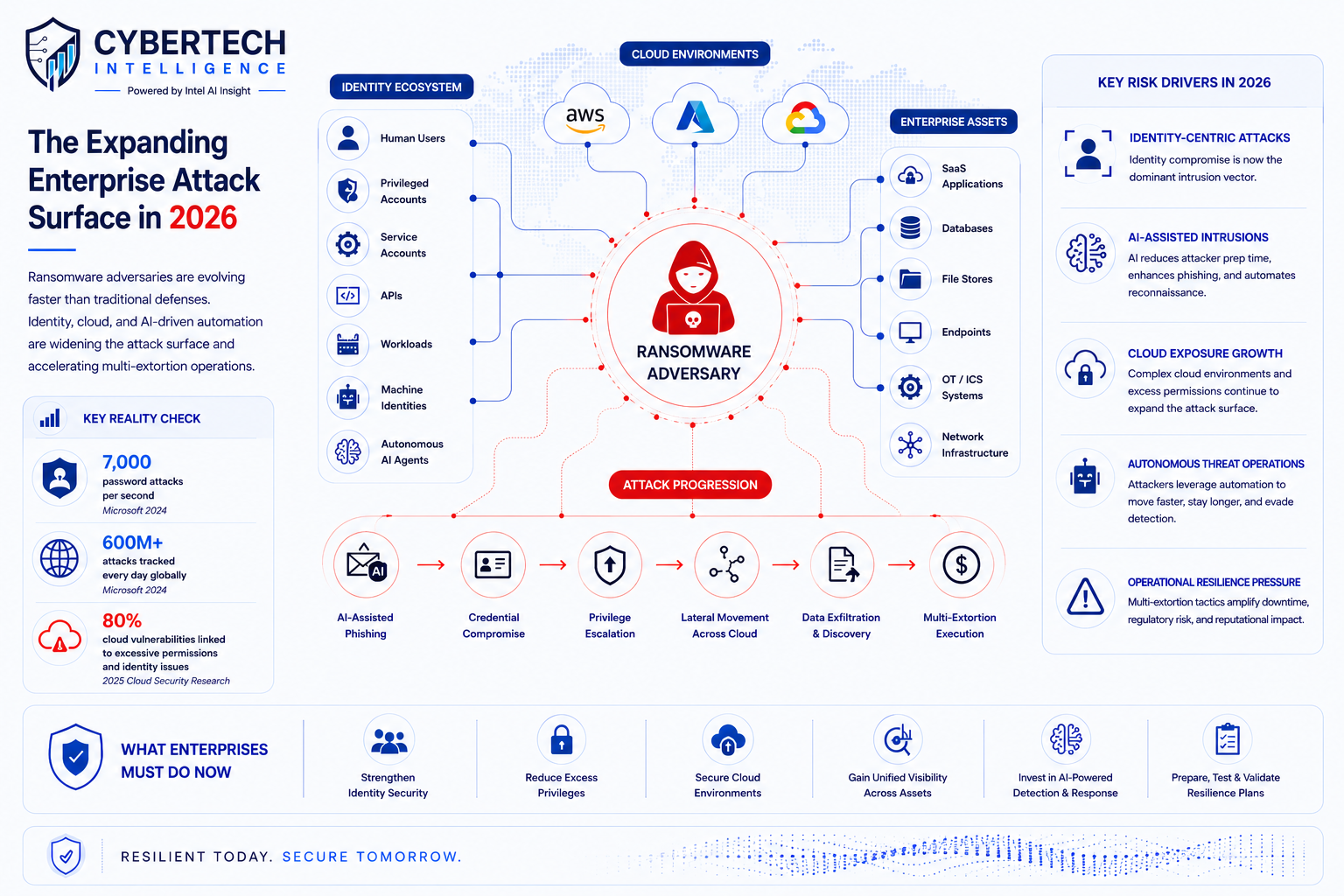
According to Microsoft’s 2024 Threat Intelligence Report, attacks using passwords rose to about 7,000 attacks per second in 2024, while the organization tracked over 600 million cyber attacks globally every day in 2024. These statistics reflect the rising trend of automation of identity-targeted attacks within enterprise settings.3
According to Cyber Tech Intelligence, most enterprises continue to use cybersecurity frameworks based on an earlier perimeter model in the face of a progressively decentralized digital landscape.
This development is contributing to ransomware gangs leveraging weaknesses arising from:
- Fragmented visibility across cloud platforms
- Excessive privileged access exposure
- Weak machine identity governance
- Inconsistent third-party oversight
- Unmanaged AI adoption
- Operational technology legacy environments
Further analysis of enterprise cloud security research revealed that about 80% of cloud security vulnerabilities reported in 2025 were due to excess permissions and identity-related issues, highlighting that identity governance gaps are continually increasing corporate attack surfaces. 4
Such a convergence of risk drivers is radically altering the cyber resilience requirements of enterprises heading into 2026.
Apart from having effective prevention strategies, organizations need to have a continuous functioning process, recoverability, and preparedness to deal with risks.
According to the report of IBM’s investigation on data breaches in 2024, the median duration of a data breach lifecycle stood at 258 days in 2024; hence, the reason for continuity and recovery becoming resilience-related issues in corporate boardrooms.1
The cybersecurity environment going into 2026 is influenced by:
- AI fast adoption
- Hybrid cloud expansion
- Machine identity growth
- Increasing supply-chain exposure
- Autonomous enterprise workflows
Modern ransomware attack chains increasingly follow this progression:
- AI-assisted phishing or impersonation
- Credential compromise
- Privileged access escalation
- Lateral movement across cloud ecosystems
- Sensitive data exfiltration
- Multi-stage extortion execution
CrowdStrike’s 2025 threat intelligence findings showed that adversary breakout times dropped to an average of just 48 minutes in 2025, significantly reducing enterprise response windows during ransomware intrusions and increasing the importance of autonomous detection and response capabilities. 5
“Identity systems have become the new enterprise battlefield for multi-extortion operations.”
The Financial Economics of Multi-Extortion
The economic impact of ransomware now extends far beyond ransom payments.
According to IBM’s 2025 Cost of a Data Breach report: 1
- The average global breach cost reached approximately $4.44 million.
- The average U.S. breach cost reached approximately $10.22 million.
- The average breach lifecycle is extended to roughly 241 days.
- Organizations using AI-driven security automation reduced costs by approximately $1.9 million.
For many enterprises, the largest losses now originate from operational downtime, regulatory exposure, litigation risk, insurance premium increases, and supply-chain interruption.
Executive Anecdote – Board-Level Escalation During Recovery
During a ransomware recovery exercise conducted with a U.S.-based enterprise leadership team earlier this year, executives discovered that legal, operations, and cybersecurity teams were operating under conflicting recovery assumptions.
The technology team prioritized restoration speed, while legal leadership focused on disclosure exposure, and operational leadership prioritized manufacturing continuity. The organization ultimately revised its executive response structure after identifying that coordination delays could materially extend operational downtime during a real-world extortion event.
Cyber Tech Intelligence analysis suggests that organizational alignment failures increasingly represent a major operational risk multiplier during ransomware incidents.
Enterprise Recovery Vignette
A U.S.-based manufacturing organization experienced a ransomware-driven disruption affecting production systems and SaaS identity infrastructure.
Executive recovery analysis showed that automated identity analytics contained privilege escalation within an hour, while segmented recovery environments prevented broader operational shutdown.
Cyber Tech Intelligence analysis suggests that resilience engineering and identity-centric operations increasingly outperform perimeter-focused recovery models.
AI-Driven Threat Escalation
Generative AI and autonomous technologies are becoming major accelerators across the cyber threat landscape.
While previous generations of cyber automation provided some level of acceleration, AI has enabled threat actors to conduct large-scale attacks with less preparation and at a much reduced cost.
Cybercrime communities now rely on AI-enhanced tools to:
- Generate highly convincing phishing content
- Personalize executive impersonation attempts
- Automate reconnaissance against enterprise employees
- Identify vulnerable SaaS exposures
- Produce multilingual social engineering campaigns
- Accelerate credential harvesting operations
This shift is particularly concerning for enterprises operating globally distributed workforces, where identity verification and communication trust models are already under pressure.
Cyber Tech Intelligence analysis suggests that AI-driven cyber operations are compressing the time between reconnaissance, compromise, and extortion faster than many enterprise response programs can operationalize defenses.
For organizations that used to evaluate their incident response readiness in terms of days, it is becoming increasingly necessary for them to begin thinking in terms of hours or even minutes.
Cyber threat actors increasingly deploy AI for:
Threat actors increasingly leverage AI for:
- Phishing generation
- Deepfake impersonation
- Automated reconnaissance
- Credential harvesting
- Social engineering personalization
Accenture Security research emphasized that AI-enabled threats are evolving faster than many traditional security operations programs can operationalize defenses.6
McKinsey additionally noted that cybersecurity architectures are entering an “agentic AI” era where autonomous systems influence detection and response workflows.7
Emerging U.S. Cyber Policy Expectations
Federal agencies are increasingly emphasizing:
- Operational resilience
- Incident disclosure transparency
- Zero Trust implementation
- Identity-centric security
- AI governance accountability
Relevant frameworks shaping enterprise strategy include the NIST Cybersecurity Framework 8 and NIST Zero Trust Architecture Guidance. 9
Regulatory Snapshot — U.S. Enterprise Priorities for 2026
| Framework | Enterprise Expectation | Executive Action |
| SEC Disclosure Expectations | Faster material incident oversight | Establish executive cyber reporting cadence |
| NIST Cybersecurity Framework | Continuous resilience modernization | Align controls to resilience maturity models |
| NIST Zero Trust Guidance | Identity-centric verification | Expand Zero Trust architecture |
| Emerging AI Governance Expectations | AI oversight and accountability | Formalize AI governance programs |
Identity Security and Zero Trust
The infrastructure surrounding identity has emerged as one of the most critical elements in the modern corporate security architecture.
With corporations embracing cloud transformation and AI-driven automation, the number of identities within corporate networks will continue to grow exponentially. Such identities may be classified into:
- Human users
- Privileged administrators
- SaaS service accounts
- APIs
- Workloads
- Machine identities
- Autonomous AI agents
This expansion creates a significantly larger operational attack surface than traditional enterprise models were designed to secure.
Based on Cyber Tech Intelligence analysis, ransomware hackers are placing more emphasis on identity access, as, upon success, this can allow them to breach security protocols without raising an alarm immediately.
They will be able to move across the cloud environment, disable recovery protocols, access confidential repositories, and persist in their presence before finally launching the extortion attacks.
The reason for this trend is that enterprise spending priorities are moving towards:
- Identity governance
- Privileged access management
- Adaptive authentication
- Continuous verification
- Behavioral analytics
- Machine identity lifecycle management
For many organizations, identity security is rapidly becoming the operational foundation of Zero Trust architecture.
Identity systems are among the most highly targeted assets in today’s enterprise ecosystem.
The common means of attack include credential phishing, MFA fatigue attacks, session hijacking, privileged account abuse, and SaaS identity compromise.
The leading enterprises are now paying particular attention to:
- Continuous authentication
- Identity governance
- Privileged access management
- Behavioral analytics
- Machine identity lifecycle management
Cyber Tech Intelligence analysis suggests that identity infrastructure has effectively become the new enterprise security perimeter.3
Enterprise Ransomware Resilience Maturity Model
| Maturity Stage | Enterprise Characteristics |
| Reactive | Fragmented tooling and inconsistent recovery testing |
| Developing | MFA adoption and partial segmentation |
| Managed | Identity governance and structured IR testing |
| Advanced | AI-assisted analytics and automated containment |
| Resilient | Continuous validation and operational resilience engineering |
Quick Action Checklist for Boards and Security Leaders
- Validate privileged SaaS administrative accounts.
- Conduct a ransomware-focused executive tabletop exercise.
- Test segmented recovery environments.
- Expand continuous authentication for high-risk identities.
- Review AI governance exposure.
- Align executive reporting metrics with resilience KPIs.
Security Operations Transformation
The modernization of Security Operations Centers represents one of the most important enterprise cybersecurity initiatives entering 2026.
Traditional SOC environments frequently struggle with:
- Alert fatigue
- Investigation delays
- Tool fragmentation
- Analyst shortages
- Limited cross-platform visibility
- Escalating cloud telemetry complexity
At the same time, ransomware groups are increasingly operating with machine-speed automation and AI-assisted reconnaissance capabilities.
This imbalance is forcing enterprises to redesign cybersecurity operations around automation, unified telemetry, and AI-assisted response orchestration.
Modern security operations strategies increasingly emphasize:
- Behavioral analytics
- Identity-aware detection
- Automated investigation workflows
- Continuous exposure validation
- Real-time prioritization
- Autonomous threat correlation
Cyber Tech Intelligence analysis suggests that future enterprise SOC models will increasingly resemble continuously adaptive cyber resilience platforms rather than traditional alert-response environments.
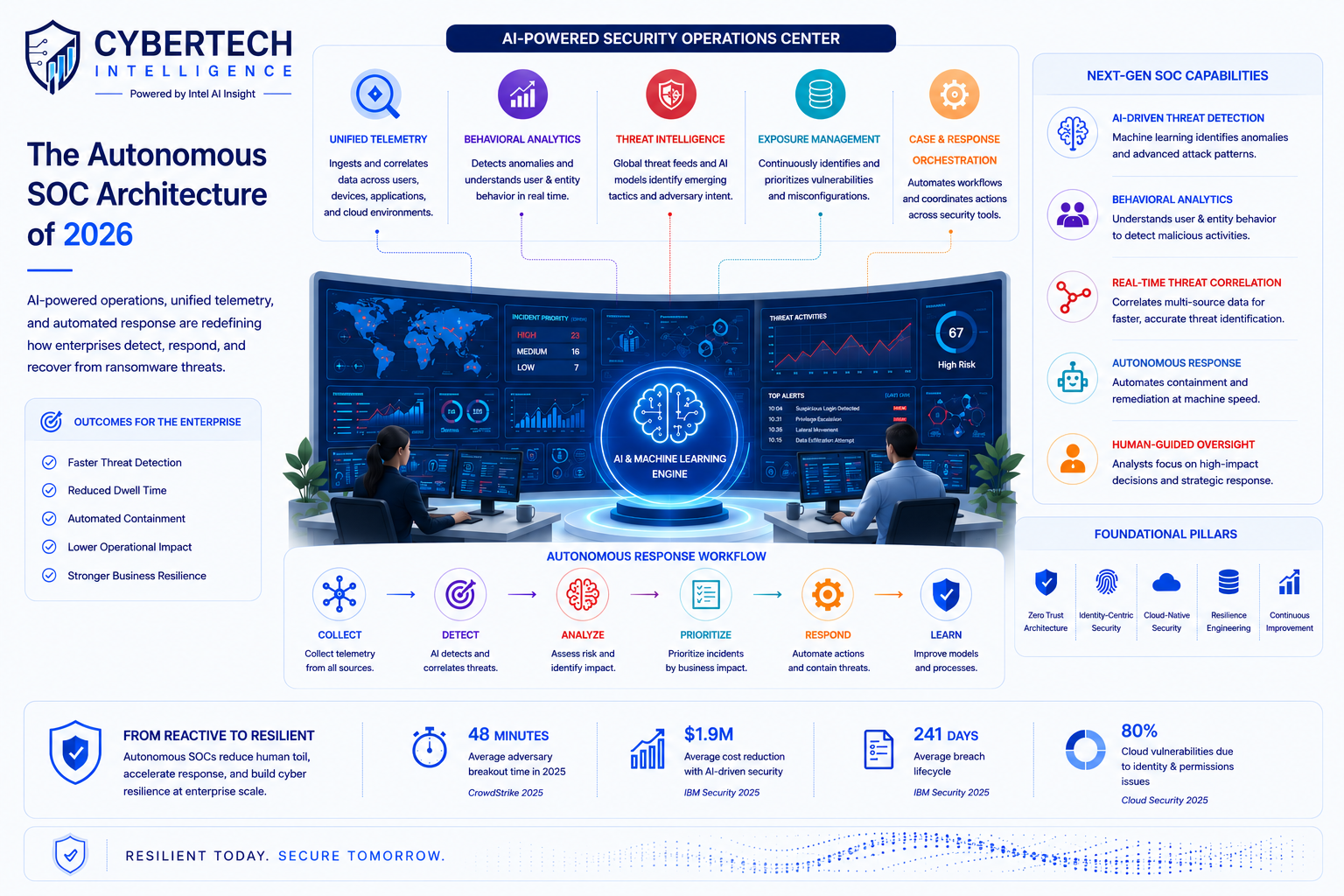
Security Operations Centers are undergoing significant transformation as enterprises adapt to AI-accelerated threat environments.
AI-driven cybersecurity platforms increasingly support:
- Threat detection automation
- Behavioral analytics
- Incident triage
- Investigation acceleration
- Response orchestration
McKinsey research suggests that enterprise cybersecurity architectures are increasingly being redesigned to support autonomous systems and continuous resilience management.4
Sector Risk Outlook
Healthcare
Healthcare organizations remain among the highest-risk ransomware targets due to patient care disruption exposure and sensitive data concentration.
Manufacturing
Manufacturing organizations face increasing exposure from IT and operational technology convergence, making operational shutdowns more disruptive.
Financial Services
Financial institutions continue facing elevated ransomware and identity compromise pressure due to regulatory obligations and sensitive financial data exposure.
Strategic Priorities for Enterprise Leaders
1. Treat Ransomware as a Business Resilience Issue
Cybersecurity leadership should extend beyond IT into executive governance and operational continuity planning.
2. Accelerate Identity Security Modernization
Priority investments should include privileged access management, adaptive authentication, and machine identity security.
3. Establish AI Governance Programs
Organizations should implement AI usage policies, governance controls, and AI risk assessments immediately.
4. Expand Zero Trust Implementation
Continuous verification and identity-centric security models are becoming foundational for resilience.
5. Modernize Recovery Readiness
Organizations should regularly test backup restoration and operational continuity procedures. 10
Enterprise Outlook: 2027–2028
Cyber Tech Intelligence analysis suggests several trends are likely to accelerate:
- AI-assisted extortion operations will become mainstream.
- Machine identities will dramatically outnumber human identities.
- Autonomous SOC operations will become standard enterprise architecture.
- Cyber insurance underwriting will increasingly require measurable resilience validation.
- Regulatory expectations around AI governance will intensify.
Conclusion
Ransomware in 2026 represents a fundamentally different category of enterprise risk than traditional cyber extortion campaigns of the past.
Modern ransomware ecosystems combine AI-enhanced operations, identity compromise, operational disruption, regulatory pressure, and multi-stage extortion.
At the same time, U.S. cyber policy expectations continue evolving toward operational resilience, executive accountability, Zero Trust modernization, and AI governance.
Organizations relying primarily on legacy perimeter-focused security models may struggle against increasingly autonomous and identity-driven threat operations.
For enterprise leaders, cybersecurity is now a strategic business resilience capability directly tied to operational continuity, regulatory trust, investor confidence, and long-term enterprise stability.
References
- IBM, Cost of a Data Breach Report 2024, July 2024
- Accenture, State of Cybersecurity Resilience 2025, 2025
- Microsoft, Microsoft Digital Defense Report 2024, October 2024
- Palo Alto Networks Unit 42, Incident Response Report 2025, 2025
- CrowdStrike, Global Threat Report 2025, February 2025
- Accenture, Cybersecurity Services and Enterprise Resilience Insights, 2025
- McKinsey & Company, Securing the Agentic Enterprise: Opportunities for Cybersecurity Providers, 2025
- NIST, Cybersecurity Framework (CSF) 2.0, 2024
- NIST, Zero Trust Architecture (SP 800-207), Reference Guidance
- PwC, Global Digital Trust Insights 2025, 2025