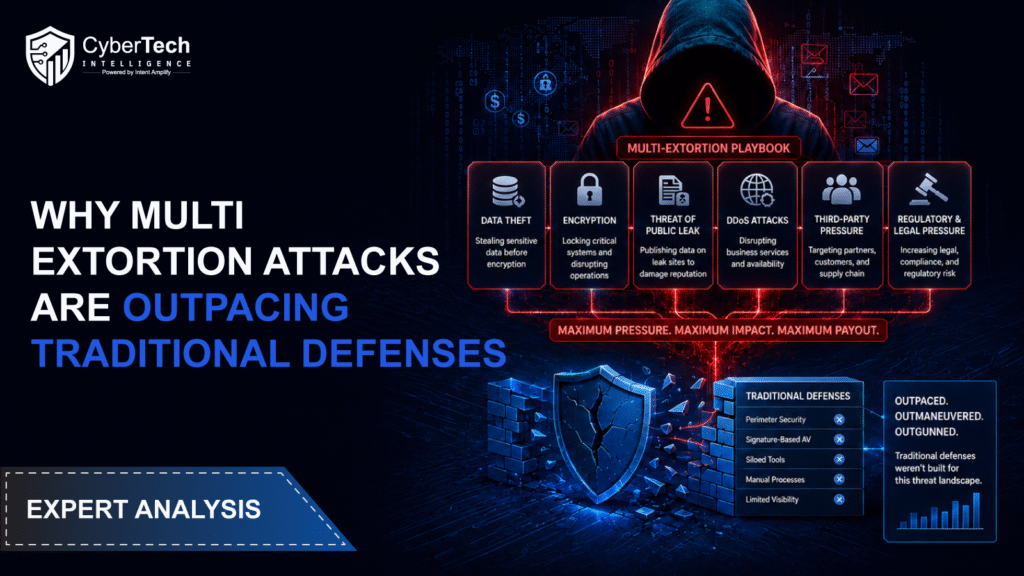
The ransomware model has moved beyond the stage where it consists of simply locking systems and asking for a ransom.
Within recent years, ransomware organizations have developed themselves into a multi-extortion framework that involves data theft, disruption of operations, psychological extortion, reputational extortion, and increasingly intricate social engineering techniques. A cybercrime strategy has developed into a digital extortion economy.
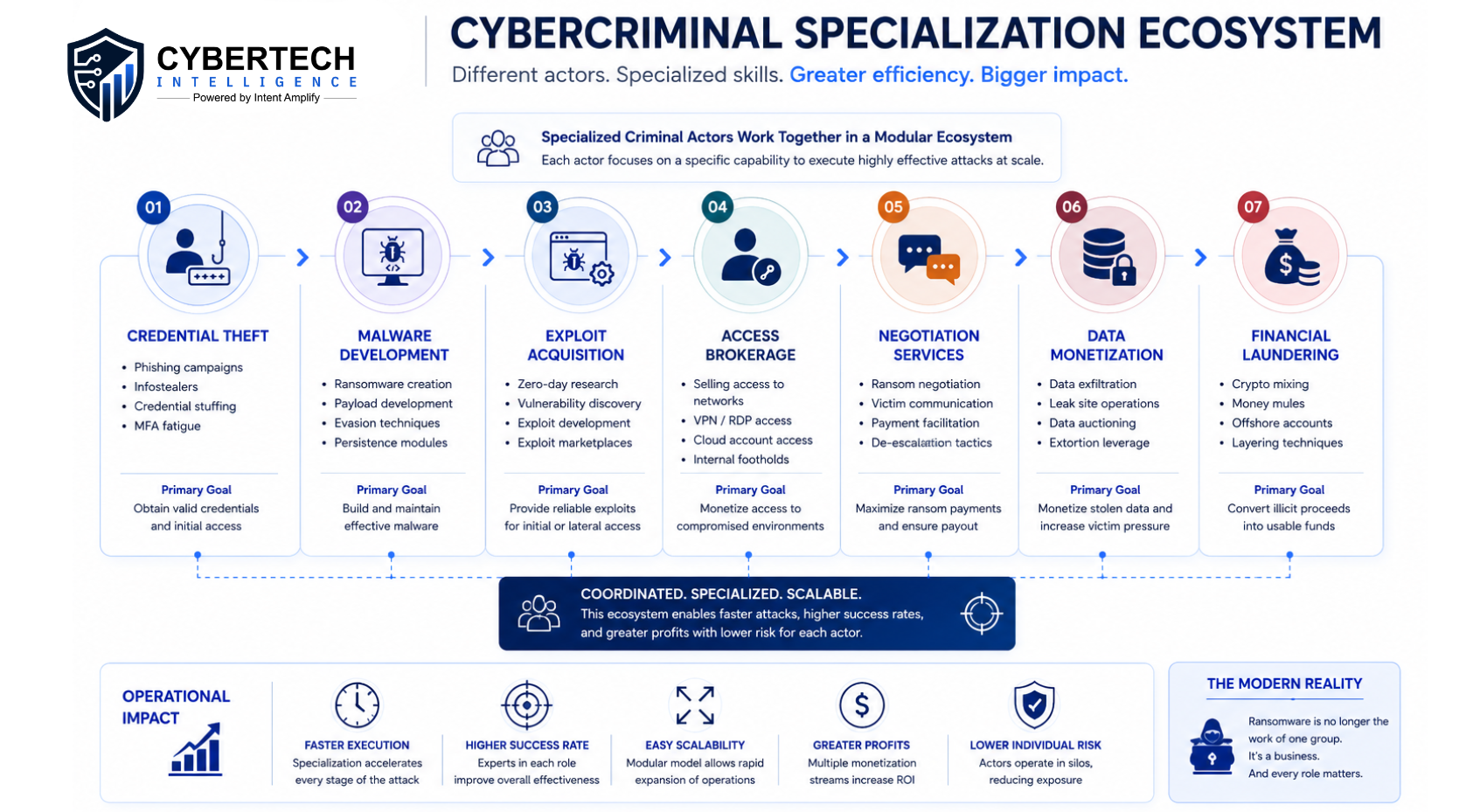
Through the use of affiliates, initial access brokers, credentials markets, malware developers, negotiators, and money laundering structures, ransomware-as-a-service organizations have found ways to industrialize their extortion operation.
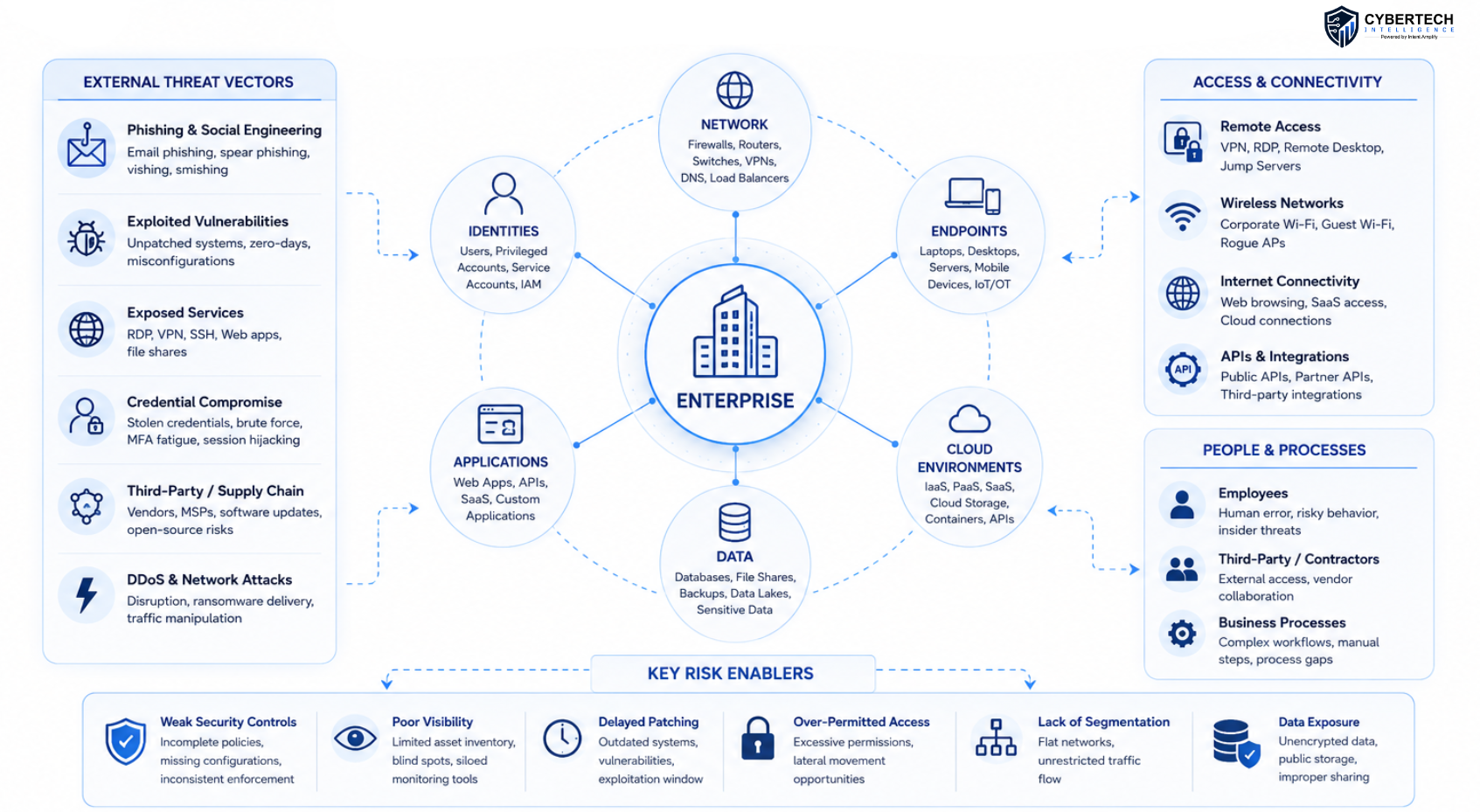
According to industry intelligence provided by companies like CrowdStrike, IBM Security, Palo Alto Networks, Unit 42, Sophos, X-Ops and Verizon DBIR, identity compromise, credential theft, cloud compromise, and exposure of unmanaged attack surfaces continue to provide some of the most reliable entry points into ransomware campaigns.
Perimeter-based defense solutions are proving ineffective at managing attacks involving lateral movement within hybrid infrastructures, compromising identities, and weaponizing exfiltrated information long before any encryption takes place.
Ransomware lifecycles have been extended to include double extortion, triple extortion, extortion DDoS pressure campaigns, use of public leak sites, recruitment of insiders, and leveraging of supply chains.
Multi-Extortion Ransomware Has Become an Enterprise Crisis
More than $724 million worth of cryptocurrency was extorted from the victims associated with the TrickBot malware group, which is utilized by ransomware gangs. The Akamai Hunt Team has seen this malware in association with four suspiciously scheduled tasks on five customer devices. 1
Significantly, close to 50% of the cryptomining attacks that we analyzed were aimed at nonprofits and educational institutions due to their extensive computational power and relative vulnerability compared to other sectors. 1
The advancement of artificial intelligence technology is increasing the level of personalization, reconnaissance, phishing activity, and malware evolution within cyber extortion.
Modern enterprises are no longer defending against isolated malware campaigns. They are defending against entire cyber extortion business ecosystems.
The adoption of identity-centric cybersecurity architecture, Zero Trust, XDR, threat intelligence, network segmentation, testing for resilience, and readiness for incident response is fast becoming a critical foundation instead of lofty goals.
Multi-extortion ransomware attacks are no longer an issue of the future – they are quickly becoming the biggest cybersecurity challenge of today.
Why Are Traditional Security Defenses Failing?
The architecture of many enterprise security solutions is based on a completely different threat landscape. The traditional model presupposed that threats could be prevented at the perimeter via firewalls, antivirus applications, and signature-based security solutions. This is no longer true in today’s world.
Modern ransomware campaigns take advantage of identity systems, cloud infrastructure, API interfaces, unmanaged endpoints, and third parties, which are usually not protected by traditional security solutions.
Credential harvesting is still among the most popular ways for malicious actors to hack into an organization. Infostealers, phishing schemes, credential session hijackers, MFA fatigue attacks, and credential marketplaces are all leveraged to harvest credentials to breach organizations.
With credentials in hand, attackers can easily blend in with regular traffic.
The advent of hybrid working models has increased the attack surface in more ways than one. Modern employees make use of corporate systems using unmanaged networks, personal devices, SaaS apps, and dispersed collaboration tools.
Such practices have resulted in a lot of security visibility gaps for security teams.
Another challenge for many companies is the fragmentation of security tools. Companies end up employing a multitude of redundant products, generating lots of alerts yet not providing much operational insight. Analysts experiencing alert fatigue may overlook lateral movements in network traffic.
Living off the land has now become another popular technique used by threat actors. It is becoming an increasingly common practice to use legitimate tools provided by the system, like PowerShell, remote management, etc., to minimize the presence of malware.
A growing number of cloud misconfigurations present another opportunity for ransomware actors. Inadequate access controls, poor management of storage buckets, insufficient API protection, and insecure identity governance practices are prevalent sources of compromise.
Patching, too, is another area that is not consistent for many businesses. Even though some vulnerabilities can be detected early on, there can be some factors that affect the timeliness of the process.
Some larger organizations that have an old and complicated infrastructure will find it difficult to implement patches without affecting their operations.
Cybercrime Industrialization and the Rise of RaaS
Certainly, one of the biggest changes in ransomware is the rise of cybercrime industrialization.
The advent of Ransomware-as-a-Service has made sophisticated ransomware tools accessible to any would-be affiliate.
Currently, individuals with little technical skill can acquire ransomware kits, use brokered credentials, obtain phishing infrastructure, and launch large-scale campaigns with minimal entry costs.
According to IBM and SentinelOne, ransomware damages are projected to reach $74 billion, whereas 56% of vulnerabilities can be exploited without authentication. 2
Many aspects of the RaaS system mimic legal business software in several ways. Customer support, payment processing platforms, affiliate consoles, leak site infrastructure, and profit-sharing agreements are all common within the ransomware community.
Some groups provide guidance for affiliates concerning targeting methods and negotiation strategies.
As per the Unit 42 2022 Ransomware Threat Report, the ransomware threat is growing rapidly:
The average ransom demanded from victims increased by 144% last year to $2.2 million.
The average amount paid increased by 78% to $541,010. At least 56 active RaaS (Ransomware as a Service) gangs have been identified and monitored by Unit 42®. 3
The new players in this market are known as initial access brokers. These entities penetrate enterprise networks and sell access to ransomware affiliates.
The access package may consist of credentials for the virtual private network, privileged user accounts, remote desktop connections, or cloud administrative tokens.
Complex extortion negotiation strategies have also emerged as common practice. Threat actors frequently investigate victim organizations, assess their cyber-insurance coverage, understand their regulatory exposure, and negotiate ransoms based on the likely impact on business operations.
Communication for such negotiations is often facilitated via organized channels that mirror business support settings.
It remains economically very profitable for threat actors to engage in ransomware attacks. Unlike typical forms of cybercrime, ransomware attacks are scalable and require significantly fewer resources.
AI, Automation, and the New Attack Surface
The evolution of artificial intelligence is revolutionizing the dynamics of offense and defense in cyberattacks. Regrettably, cybercriminals have proven their flexibility when employing AI-supported functionalities.
According to the CrowdStrike Global Threat Report for 2026, AI-enabled attacks increase by 89% while breakout time drops to 29 minutes; AI tools and frameworks are being utilized. 4
AI-supported phishing schemes are becoming proficient at developing personalized messages and impersonating executives in their style of communication, relationships with vendors, and corporate workflow processes.
Additionally, deepfakes are facilitating voice and video-based impersonations for more practical exploitation of business email compromise and executive fraud situations.
Automation is facilitating reconnoiter operations as threat actors are leveraging AI-powered tools to:
- Map visible infrastructure
- Detect susceptible systems
- Examine stolen credentials
- Craft phishing content
- Perform widespread targeting
Threat actors are exploiting machine learning algorithms to maximize social engineering techniques by considering user behavior patterns and the probability of engagement.
Even the process of malware creation is gaining more adaptability. Despite the current lack of completely autonomous AI-generated ransomware, threat actors are already automating malware payloads to alter behavior, evade detection algorithms, and vary code structures.
AI-Driven Credential Harvesting
Credential harvesting campaigns have also become more sophisticated. AI-driven phishing systems can generate customized landing pages and spoofed authentication services, among other things.
With the growing complexity of the business attack surface, the threat landscape is becoming even more dangerous. Businesses must now deal with vast environments that encompass:
- Cloud computing
- Software-as-a-service applications
- Application programming interfaces
- IoT hardware
- Hybrid identities
- Third-party connections
- Remote devices
- Shadow IT infrastructure
Any unsecured identity, vulnerable API endpoint, or cloud-based system becomes an opportunity for exploitation.
Enterprise Risks and Operational Impact
The implications of today’s ransomware attacks are much more extensive than simply technical disruptions.
Cyber insurance premium prices in the United States fell by an average of 5% during the fourth quarter of 2024, which was the first quarter-over-quarter fall since seven years of increasing premiums. 5
Operational disruptions have the potential to devastate manufacturing processes, logistical operations, medical services, and financial operations. For certain organizations, disruptions can create secondary risks and exposures due to supply chain complications.
Damage to reputation is something that lingers even after the restoration of operational capabilities. Leaked information and data breaches can do significant harm to the organization in terms of public perception, consumer confidence, and branding.
Regulation is becoming stricter and stricter in many jurisdictions worldwide. Data protection laws are increasingly requiring faster reporting times as well as fines for poor control measures and delays in breach notification.
The cyber insurance market is also evolving and reforming its requirements. Insurers are beginning to insist upon robust security measures, incident preparedness, MFA, segmentation policies, and more resilient backups prior to granting coverage.
The challenge of recovery has become significantly more complicated due to the multidimensionality of modern attacks. Attackers now attack such dimensions as:
- Active Directory setups
- Backups
- Cloud IDs
- Virtualization technology
- SaaS services
- Endpoint management
The added dimensions make containment difficult and increase recovery times significantly.
There have also been increased internal challenges for security teams. There are still significant staffing gaps in the fields of cybersecurity, specifically in areas such as detection engineers, cloud security specialists, identity governance professionals, and incident responders.
At the board level, there has been an increase in expectations regarding ransomware as an enterprise risk concern, not simply an IT risk concern. Expectations regarding resilience and readiness planning continue to grow.
The Attacks and the Attack Vectors in 2026
By 2026, the threat landscape will be driven by artificial intelligence-enabled automation, with agent-based phishing predicted to surpass 42% of all breaches worldwide and over half of security executives identifying AI attacks as their main problem. 3
The cost of cybercrime is forecast to cross 10.5 trillion dollars, with 87% of attacks using more. 3
Artificial intelligence is fundamentally altering both the offense and defense in cybersecurity operations. The good news is that adversaries have proven themselves adept at employing their newfound abilities powered by artificial intelligence.
Nowadays, AI-enabled spear-phishing attacks create extremely personalized spear-phishing lures mimicking executives’ language style, vendor relationships, and the company’s internal processes.
Attacks involving deepfakes, in turn, are gaining traction, especially in business email compromises and CEO fraud.
In addition, automation is making it easier for cyber adversaries to conduct reconnaissance activities through AI-powered toolkits for:
- Mapping open-source infrastructure
- Identifying vulnerabilities
- Analyzing exposed login information
- Creating customized spear-phishing content
- Running massive-scale targeting operations
The bad guys have begun optimizing their social engineering schemes using machine learning algorithms to exploit user behavior patterns and engagement rates.
In malware development, the adversaries are using automation to vary malicious code, avoid detection signatures, and alter malware behavior. AI-powered ransomware, while still nascent, is on its way.
Strategic Defense Considerations for 2026
Organizations must move away from their dependency on preventive security architectures and focus instead on building resilient security infrastructures through multi-layered, flexible, and identity-based architectures.
The need for Zero Trust-based architectures becomes a basic requirement due to their role in minimizing implied trust within networks, users, devices, and applications. It helps organizations restrict attacker movements after gaining entry into an environment.
Implementing Identity First Architecture becomes another strategic necessity for organizations. Effective governance of identities, phishing-resistant MFA, privileged access management, and continuous authentication monitoring become mandatory measures in mitigating identity-based attacks.
Extended Detection and Response solutions have gained relevance because of their capability to correlate signals within endpoints, identities, cloud infrastructure, networks, and SaaS solutions.
Organizations that leverage managed detection and response services may also overcome staffing challenges while enhancing their threat visibility.
It becomes imperative for organizations to integrate their threat intelligence capabilities. Security analysts need contextual information about ransomware groups, TTPs, exposed credentials, and ongoing exploit campaigns.
Frequently Asked Questions
1. Why are multi-extortion ransomware attacks more dangerous than traditional ransomware?
Traditional ransomware mainly focused on encrypting files and demanding payment for decryption. Multi-extortion attacks go much further. Attackers now steal sensitive data before encryption, threaten public leaks, pressure customers or partners, and sometimes launch DDoS attacks simultaneously.
2. Why are traditional cybersecurity defenses struggling against modern ransomware groups?
Most legacy security architectures were built around perimeter protection and malware detection. Modern ransomware operators increasingly exploit identities, cloud services, APIs, third-party access, and legitimate administrative tools that often bypass traditional defenses.
3. How is artificial intelligence changing ransomware attacks?
AI is helping cybercriminals automate reconnaissance, personalize phishing emails, generate convincing fake login pages, and improve social engineering campaigns. Some groups are also experimenting with AI-assisted malware adaptation and deepfake-based fraud.
4. Which industries are most frequently targeted by multi-extortion ransomware groups?
Healthcare, manufacturing, financial services, education, government agencies, and critical infrastructure organizations remain among the most targeted sectors.
5. What should enterprises prioritize to reduce ransomware risk in 2026?
Organizations should focus on identity-first security, Zero Trust architecture, phishing-resistant MFA, network segmentation, threat intelligence integration, backup resilience, and incident response preparedness.
References
- Akamai, 2025. Ransomware trends 2025. Available at: Akamai [Accessed 14 May 2026].
- CrowdStrike, 2026. 2026 CrowdStrike Global Threat Report. Available at: https://www.crowdstrike.com/en-us/press-releases/2026-crowdstrike-global-threat-report/ [Accessed 14 May 2026].
- Palo Alto Networks, n.d. What is ransomware-as-a-service (RaaS)?Available at: https://www.paloaltonetworks.com/cyberpedia/what-is-ransomware-as-a-service [Accessed 14 May 2026].
- SentinelOne, 2026. Cyber security statistics. Available at: https://www.sentinelone.com/cybersecurity-101/cybersecurity/cyber-security-statistics/ [Accessed 14 May 2026].