Executive Summary
Business email compromise was already one of the most financially damaging categories of cybercrime before generative AI entered the picture.
The FBI’s Internet Crime Complaint Center recorded $3.046 billion in BEC-related losses in 2025 alone placing it second only to investment fraud in terms of total reported damage to U.S. victims. 1
Those numbers reflect complaints that were actually filed. The real figure is almost certainly higher.
What has changed in the past eighteen months is not the fundamental nature of the scam it is the technology enabling it. Attackers are no longer limited to spoofed email addresses and urgency-laden text.
They now deploy synthetic voice, AI-generated video, and contextually precise written impersonation that draws on publicly available executive content. The result is a fraud capability that is faster to deploy, harder to detect, and significantly more convincing than anything defenders were trained to recognize.
Deloitte’s Center for Financial Services has projected that generative AI will push total U.S. fraud losses from $12.3 billion in 2023 to $40 billion by 2027 a compound annual growth rate of 32 percent. 2
That is not a distant forecast. The infrastructure driving that trajectory is operational right now, available to any threat actor willing to spend less than the cost of a monthly gym membership.
This report maps the current state of AI-driven BEC, quantifies its financial impact, and gives security leaders a concrete, sequenced plan for reducing their exposure. The window for getting ahead of this threat is narrowing. Organizations that treat it as an emerging risk rather than a present one are already behind.
Section 1: The Rise of Synthetic Deception in 2026
Three years ago, AI-generated content played a negligible role in business email compromise. By the first quarter of 2026, that share had climbed to 40% of all BEC attacks a shift driven by falling tool costs, improving synthesis quality, and a growing body of attacker-accessible training data in the form of executive public appearances. 3
This is not a gradual evolution. It is a structural change in how these campaigns are built and executed.
The practical consequence for defenders is significant. The detection signals that security awareness programs spent years teaching employees to recognize grammatical inconsistencies, generic sender addresses, implausible urgency have been effectively engineered out of modern BEC attempts.
AI-generated content does not make those mistakes. It writes the way your CFO writes, references the projects your CFO would reference, and arrives at a time of day your CFO would plausibly send an email.
Consider the exposure curve. An organization that faced one AI-enabled fraud attempt per month in early 2023 now statistically faces twelve or more.
Most of those attempts will look entirely routine to the finance employee receiving them a wire transfer request that fits the context of an ongoing project, confirmed by a follow-up call from a voice that sounds exactly right.
The human layer is the target, not the technical one. AI-BEC is not designed to defeat your email gateway. It is designed to get a real person to authorize a real transaction. Training programs that have not been updated to account for synthetic voice and video are leaving that layer undefended.
The question security leaders need to answer is no longer whether AI-enabled BEC is a real threat. It is whether their current controls would catch one.
Section 2: How AI Deepfakes Are Rewriting BEC Tactics
The Multimodal Attack Architecture
The attack template that defined BEC for most of the last decade was straightforward: craft a convincing email, impersonate an authority figure, create urgency, request a wire transfer. That template still exists, but it has been substantially upgraded.
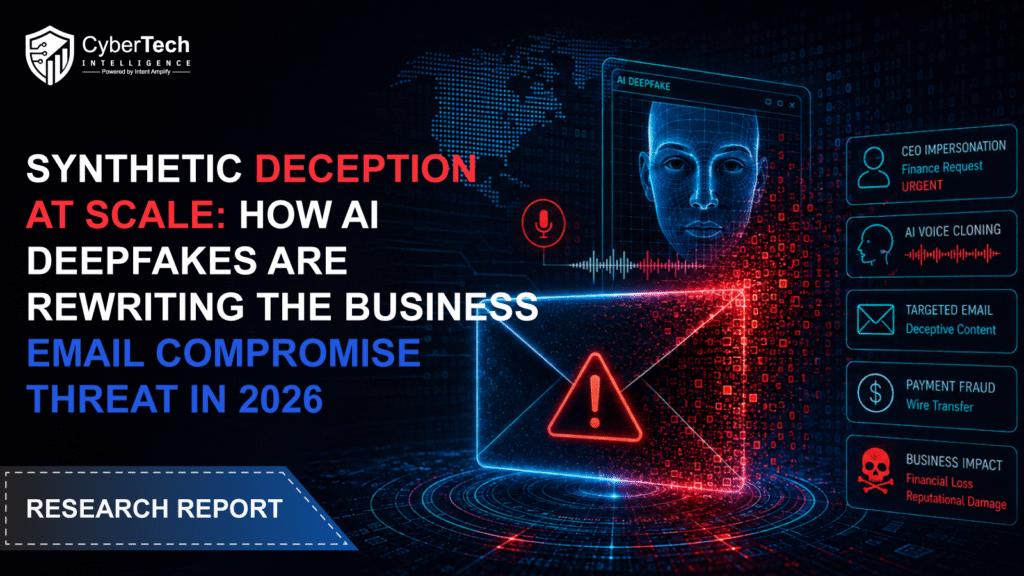
Modern AI-BEC campaigns are multimodal by design. The sequence typically begins with a contextually rich email written in the target executive’s style, referencing real projects, using accurate internal terminology.
That email is then reinforced by a follow-up call using a cloned version of the executive’s voice. In high-value cases, the sequence culminates in a video conference where every visible participant is AI-generated, synchronized in real time, and indistinguishable from a legitimate call. 2
A widely documented 2024 case involved a finance professional who processed fifteen separate transactions totaling $25.6 million after participating in what appeared to be a legitimate video call with company leadership.
Every person on that call was synthetic. The fraud was only discovered when the employee independently contacted corporate headquarters through a separate channel, not the one used to set up the call.
The scale of AI content in email-based fraud is already substantial. Analysis from KnowBe4 and SlashNext found that 82.6% of phishing emails now contain some degree of AI-generated content, while research from Hoxhunt placed the share of BEC emails that are primarily AI-generated at 40 percent. 5
The distinction between partially and fully AI-generated matters less than the combined implication: the emails landing in your finance team’s inbox today are overwhelmingly unlikely to contain the detection signals your training program taught people to look for.
What makes AI-augmented campaigns particularly effective is their specificity. Attackers harvest public-facing content LinkedIn profiles, earnings call recordings, conference presentations, investor communications and use it to build impersonations that are contextually accurate in ways that generic phishing never was.
The right project name, the right tone, the right level of familiarity. That degree of personalization is what converts an attempt into a completed fraud.
Section 3: Technical Feasibility and Attacker Tooling
The Economics of Synthetic Fraud
One of the most important things security leaders can internalize about the current threat environment is that capability no longer correlates with resources. The tools required to execute a convincing AI-BEC campaign are cheap, widely available, and increasingly packaged as services that require minimal technical knowledge to operate.
Group-IB’s threat intelligence research documented synthetic identity kits priced at approximately five dollars on dark web markets, with dark LLM subscriptions purpose-built language models with safety restrictions removed available for between thirty and two hundred dollars per month.
By the end of 2025, researchers estimated that roughly eight million deepfakes existed online, compared to approximately 500,000 in 2023. That represents growth of around 900% in two years.
Voice cloning sits at the center of the most effective AI-BEC attacks, and the barrier to entry is lower than most security teams appreciate. Research has found that a usable voice clone with an 85% acoustic match to the original speaker can be generated from as little as three seconds of source audio. 6
Every public appearance your executive team has made every earnings call, keynote, podcast, or recorded webinar constitutes source material. It is sitting on publicly accessible platforms right now, and any motivated threat actor can use it.
The speed advantage also belongs to the attacker. IBM security researchers ran a controlled experiment in which an AI system was tasked with building a phishing campaign from scratch. Using five prompts, the AI produced a campaign of equivalent effectiveness to one built by a team of human experts in five minutes, compared to sixteen hours for the human team. The time-and-resource asymmetry that framing describes is not a distant projection. It is the current operating reality.
What has emerged from this commoditization is a service economy around synthetic fraud. Attack capabilities are packaged, sold, and rented in the same way legitimate SaaS products are.
Cyber insurers have begun responding to this reality by adding AI-deepfake-specific exclusions and sublimits to commercial crime policies a market signal worth taking seriously. When underwriters start carving out categories, it typically means the loss data has already convinced them the exposure is real.
Section 4: Impact on Enterprises and Financial Risk
What These Attacks Actually Cost
The financial picture associated with AI-driven BEC is deteriorating on multiple dimensions simultaneously per-incident cost, total losses, and recovery rates are all moving in the wrong direction.
CrowdStrike’s 2025 threat research found that 76% of organizations globally reported difficulty keeping pace with AI-based attacks, with 89% identifying AI-driven security capabilities as critical to bridging the gap. 8
That is not a technology adoption question. It is a risk exposure acknowledgment from the majority of the organizations running security programs right now.
The detection timeline compounds the financial damage. The median time between the initiation of a BEC attack and its discovery sits at 308 hours just under thirteen days. [9] Wire transfers typically settle within hours of being sent. The FBI’s Financial Fraud Kill Chain process, which offers the most viable mechanism for recovering fraudulent transfers, operates on a window of twenty-four to seventy-two hours.
The arithmetic is straightforward: in most cases, the fraud is complete and the funds are unrecoverable long before anyone realizes something has gone wrong. The wire transfer recovery rate in 2025 stood at 23%, down from 29% in 2023, as attackers increasingly route funds through cryptocurrency and overseas accounts specifically to defeat recovery mechanisms.
The aggregate loss data tells the same story at scale. Between January and September 2025, AI-driven deepfake fraud caused over three billion dollars in losses across the United States. Deepfake-specific fraud losses for the full year reached $1.1 billion three times the $360 million recorded in 2024.
A category that tripled in a single year, and is projected to continue growing at 32% annually, cannot reasonably be treated as a tail risk. It belongs in the enterprise risk register alongside ransomware and supply chain compromise, because it is already operating at comparable scale.
Section 5: Detection, Visibility, and Tooling
The Gap Between Threat Evolution and Detection Maturity
The honest assessment of where most enterprise detection capabilities sit in 2026 is that they were built for a different threat. Email gateways, DMARC enforcement, and link-analysis tooling address the text channel. They do nothing to detect a cloned voice on a phone call or a synthetic executive on a video conference.
The organizations that invested heavily in email security over the past decade have a well-defended perimeter around an attack surface that sophisticated threat actors are increasingly bypassing entirely.
The gap is architectural, not just a tooling deficit. Voice and video channels have received a fraction of the security investment that email has, despite being the channels where synthetic impersonation is now most effective.
Caller ID verification still used as a de facto confirmation mechanism in many organizations is trivially spoofed using tools that are free and require no technical knowledge. Email confirmation of a verbal instruction provides no protection if the email account is compromised or if a lookalike domain survives casual inspection.
AI-based deepfake detection tools are improving. Current commercial solutions flag between 85 and 93% of deepfake attempts, and AI-powered transaction monitoring systems can identify anomalous financial behavior with precision above 95% while reducing false positives by up to 80%.
Gartner has projected that by 2026, 30% of enterprises will no longer treat standalone identity verification solutions as reliable in isolation.11
That is a significant statement from an advisory firm whose recommendations shape security budgets across the Fortune 500. The implication is not that identity verification is obsolete it is that any single-channel verification approach is now insufficient, and layered controls are the baseline.
The FBI’s own guidance reflects this shift. Callbacks to known numbers and voice-based recognition are no longer reliable verification signals when voice cloning is a standard component of the attack. The agency has directed organizations to evaluate voice biometric verification tools, deepfake detection capabilities, and out-of-band confirmation workflows for high-value financial requests as the appropriate response to this changed environment.
Section 6: Policies, Governance, and Human Controls
The Training Gap and the Verification Imperative
Deloitte’s Center for Financial Services has projected that generative AI-enabled email fraud losses will reach $11.5 billion by 2027. 2
The scale of that projection is a direct reflection of how wide the gap currently is between the threat and the organizational controls meant to counter it. If training programs and approval workflows were keeping pace, the loss trajectory would not look like this.
The core problem with most enterprise security awareness programs is not that they are poorly designed it is that they are calibrated to a version of the threat that has been superseded.
Teaching employees to flag grammatical errors, suspicious sender addresses, and implausible urgency made sense when those were reliable indicators of a fraudulent request. They are not reliable indicators anymore. AI-generated content eliminates them. The training has not been updated to reflect that.
Behavioral architecture matters more than training events. A finance employee who has attended a phishing awareness session will not necessarily pause to verify a wire request when under time pressure from what sounds like the CFO on the phone. The research is clear on this: under pressure, people default to established patterns of behavior.
That means the verification step cannot be optional it has to be embedded in the workflow itself, so that a high-value wire transfer cannot be approved without completing a secondary channel confirmation, regardless of how convincing the request appears.
The FBI’s 2025 Internet Crime Report explicitly identified voice cloning as a growing component of BEC attacks, with cloned CFO and CEO voices used to reinforce written wire transfer instructions delivered by email.
Organizations that have not established code-phrase protocols or pre-verified secondary confirmation channels for executive financial requests have no effective human-layer defense against this attack pattern.
C-suite awareness is not optional in this environment. Executive leaders need to understand that their own public presence accumulated across years of recorded calls, conference appearances, and media interviews constitutes source material for attacks targeting their own employees.
That understanding needs to translate into organizational policy: how financial approvals are requested, through which channels, and what deviations from those protocols should trigger regardless of how legitimate the request appears. The governance response has three components.
First, training programs need to be updated to include realistic simulated deepfake scenarios across voice and video not just conceptual explanations of the technology.
Second, formal dual-approval workflows for wire transfers above a defined threshold need to require out-of-band verification through a pre-established non-email channel.
Third, explicit policies need to define the approved request pathway for financial approvals, so that any deviation from that pathway is itself a detection signal.
Section 7: Roadmap and KPIs for AI-Aware BEC Defense
A Realistic Implementation Sequence
The organizations that have meaningfully reduced their AI-BEC exposure share a common characteristic: they did not wait for a loss event to justify action. They assessed the threat as current, not emerging, and they sequenced their controls in order of deployment speed and impact per dollar spent.
The wire transfer approval workflow is the right place to start. Every completed AI-BEC fraud passes through that workflow. Strengthening it is both faster to implement and more immediately impactful than deploying new detection technology, because it reduces the probability of completion even when an attack has already reached the target.
Days 1 to 30 Immediate controls
Implement mandatory out-of-band verification for all wire transfers above a defined threshold. The verification channel must be pre-established, must not rely on email, and must use a contact number confirmed through a prior verified interaction not the number in the executive’s email signature.
Establish code-phrase protocols for any executive financial request. Audit which members of your leadership team have significant publicly accessible voice and video content and brief them on what that means as an attack surface. Update your incident response runbook to include a dedicated AI-BEC track with escalation pathways that do not depend on email communications.
Days 31 to 60 Detection layer
Evaluate and deploy behavioral anomaly detection on your financial workflow approval chains. The objective is not to flag every unusual request it is to build a detection surface around deviations from established patterns: atypical transfer destinations, compressed approval timelines, requests arriving outside normal working hours, amounts that fall outside historical norms.
Assess voice authentication tools for high-value call verification. Begin evaluating deepfake detection capabilities for the video conferencing platforms your organization uses for executive communications.
Days 61 to 90 Training and governance
Roll out updated security awareness training built around live simulated deepfake scenarios. Employees who have experienced a realistic simulation a convincing cloned voice, a synthetic video call respond measurably differently than those who have only read about the technique.
Formalize governance at the board level: a documented briefing on synthetic fraud risk, a written policy on wire transfer approval protocols, and explicit contract language with vendors establishing verification requirements for any payment change request.
KPIs That Signal Progress
Operational metrics, not conceptual ones, are what matter here.
Track the percentage of high-value wire transfers that have documented out-of-band verification completed before approval the target is 100%, with no exceptions. Track mean time to detect anomalous financial workflow requests the target is under 48 hours, against a current industry median of 308 hours.
Track the percentage of finance and executive-adjacent employees who have completed a deepfake simulation exercise the target is 100% within 90 days of program launch.
Track the percentage of wire transfer requests that arrive through non-policy channels and are escalated rather than approved the target is zero non-escalated approvals, meaning every out-of-policy request triggers a review regardless of how legitimate it appears.
Deloitte’s research is unambiguous about the trajectory: generative AI will continue to expand the fraud loss landscape, and organizations that are not actively building defenses now will be responding to incidents rather than preventing them. 2
The policy environment is moving in the right direction, but regulation will not close the gap between the current threat and current controls. That work falls to the organizations themselves, and it starts with the 90-day sequence outlined above.
References
- Federal Bureau of Investigation (2025) Internet Crime Report 2025. Internet Crime Complaint Center. Available at: https://www.ic3.gov/AnnualReport
- Deloitte (2024) Deepfake banking fraud risk on the rise. Deloitte Center for Financial Services. Available at: https://www.deloitte.com/us/en/insights/industry/financial-services/deepfake-banking-fraud-risk-on-the-rise.html
- Digital Applied (2026) AI deepfake attacks surge in BEC campaigns. Available at: https://www.digitalapplied.com/blog/ai-deepfake-attacks-surge
- Keepnet Labs (2025) AI voice cloning and deepfake fraud statistics 2025. Available at: https://keepnetlabs.com/blog/ai-voice-cloning-and-deepfake-fraud-statistics
- KnowBe4 (2024) New KnowBe4 report reveals a spike in ransomware payloads and AI-powered polymorphic phishing campaigns. Available at: https://www.knowbe4.com/press/new-knowbe4-report-reveals-a-spike-in-ransomware-payloads-and-ai-powered-polymorphic-phishing-campaigns
- DeepStrike (2025) Voice cloning threat intelligence report 2025. Available at: https://www.deepstrike.io
- CrowdStrike (2025) Ransomware report: AI attacks outpacing defenses. Available at: https://www.crowdstrike.com/en-us/press-releases/ransomware-report-ai-attacks-outpacing-defenses/
- Medhacloud (2025) BEC detection and wire transfer recovery statistics. Available at: https://www.medhacloud.com
- Keepnet Labs (2025) Deepfake fraud losses in the United States: 2024–2025 analysis. Available at: https://keepnetlabs.com
- Infosys BPM (2025) Reduce false positives with AI fraud detection. Available at: https://www.infosysbpm.com/blogs/financial-services/reduce-false-positives-with-ai-fraud-detection.html
- Gartner (2024) Identity verification and authentication reliability forecast 2026. Available at: https://www.gartner.com/en/documents/7358330
- Fortinet (2024) Business email compromise: Definition, attack types and prevention. Available at: https://www.fortinet.com/resources/cyberglossary/business-email-compromise
🔒 Login or Register to continue reading