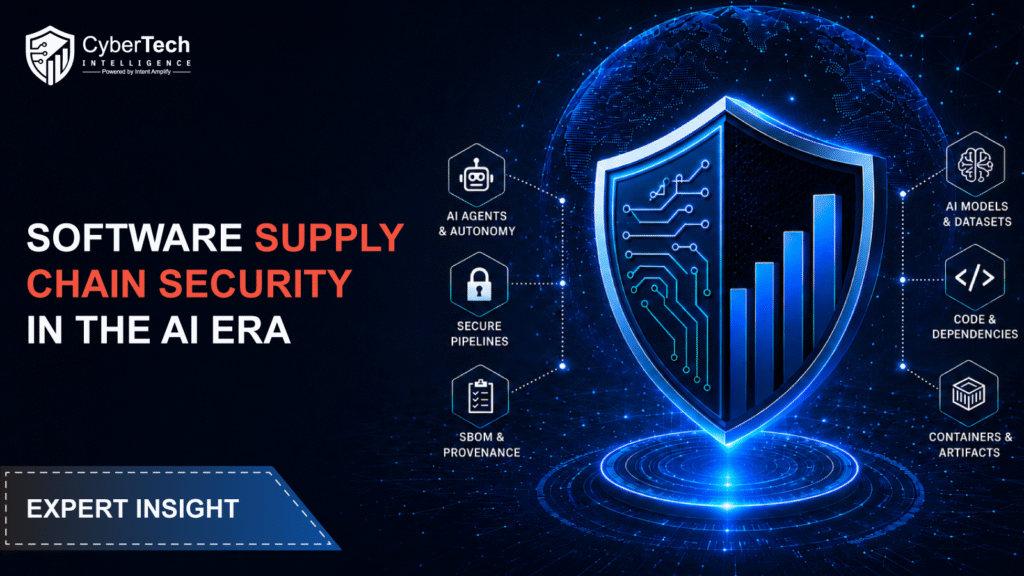
Enterprise software supply chains are experiencing the greatest shift since the inception of cloud computing. The application of artificial intelligence has extended beyond just accelerating software delivery. It has transformed the way companies create, deploy, secure, and manage their software ecosystems.
Protecting software supply chains for organizations in 2026 will not only be a matter of ensuring the protection of code and fixing vulnerability problems with dependencies.
Organizations must take care to protect artificial intelligence models, their pipeline processes, machine learning models, autonomous AI agents, application programming interfaces, containers, and third-party ecosystems, among other elements.
Software Bills of Materials, which were previously considered revolutionary in terms of increasing transparency, have been found to be inadequate for today’s world, where dependencies change hourly, and autonomous systems operate at machine speeds.
The Growing Scale of Supply Chain Attacks
The industry has officially moved from the “visibility era” into the “governance era,” where AI agents are treated as active participants in the software supply chain rather than passive tools.
This evolution is occurring against a backdrop of rapidly escalating attacks. IBM reports that software supply chain attacks are becoming easier, faster, and more widespread due to the increasing accessibility of open-source ecosystems and automated attack tooling.
One of the most alarming findings highlighted by IBM is a 1,300% increase in threats originating from open-source package repositories in recent years. 1
For enterprise leaders, that number represents more than a cybersecurity statistic; it signals a structural risk to digital business operations.
The AI acceleration problem is intensifying this exposure. Enterprise apps nowadays have thousands of software dependencies, integration into cloud services, APIs, and AI capabilities.
Why AI Is Increasing the Attack Surface
According to Cloudsmith’s 2026 Artifact Management, the average application stack consists of more than 1,200 software dependencies, and 93% of the surveyed companies have been hit by at least one threat associated with their dependencies. 2
Given the scale of interdependent software modules, even a single vulnerability in the software stack will propagate across the entire world’s enterprise environment within minutes.
Enterprises are accelerating generative AI adoption. The developers are increasingly relying on AI-powered technologies, open-source models, and autonomous agents.
This could mean that they are outrunning their own governance systems. According to Blackduck, 95% of enterprises are already using generative AI development tools. 3
This imbalance between AI adoption and security maturity is creating what many experts now describe as the “AI supply chain crisis.” Unlike traditional software libraries, AI models introduce entirely new categories of risk.
One of the most important trends in 2026 will be the emergence of MLSecOps – the use of DevSecOps practices in the machine learning ecosystem. MLSecOps focuses on securing ML training, ML deployments, inference architecture, and AI governance.
The importance of MLSecOps will increase due to the fact that AI itself may become an attack vector. Malicious model weights, poisoned datasets, insecure serialization formats, and manipulated inference layers are all becoming viable attack techniques.
Google’s guidance on AI supply chain security reinforces this concern by highlighting that AI ecosystems are fundamentally different from traditional software ecosystems because they involve dynamic learning systems, data pipelines, external model repositories, and autonomous decision-making layers.
One of the most important catalysts for enterprise spending on software supply chain security is regulatory momentum. Regulatory authorities across the globe consider software integrity a matter of national security.
According to IBM, various efforts aimed at fostering secure software development practices, including the Secure by Design initiative, CISA recommendations, SBOM requirements, and the SLSA framework, have begun to influence corporate practices when it comes to software governance.
More emphasis should be placed on the SLSA framework since it presents a systemic approach to confirming the provenance of software artifacts and ensuring their tamper-resistant builds.
As enterprises adopt more mature SLSA levels, they will be able to establish chains of custody for software assets, thereby minimizing the possibility of compromise in their development workflows.
According to IBM, fragmented software governance leads to visibility holes that cybercriminals increasingly exploit. The issue is often exacerbated by the adoption of AI since different teams use AI technologies independently.
This is driving organizations to adopt integrated governance systems that can consolidate artifact management, dependency analysis, compliance monitoring, AI model governance, and policy enforcement within a unified operational framework.
The increasingly pervasive use of AI across infrastructure, healthcare, financial services, defense, and manufacturing implies that attacks against the software supply chain have economic ramifications.
AI-Enabled Remediation and Security Automation
As the use of AI agents increases, there is an additional challenge of non-human identities. Traditionally, security administrators would deal with human identities and privileged access accounts. But with AI-enabled enterprises, the agents themselves can now request packages, invoke APIs, alter source code, provision infrastructure, and launch workflows.
Cloudsmith warns that organizations must govern AI agents as “first-class citizens” within the software supply chain and maintain audit visibility into every package pull, dependency interaction, and model query executed by these systems.
This shift toward agentic governance is happening rapidly. Industry analysts increasingly believe that autonomous remediation systems will become standard across enterprise security operations.
Agentic remediation refers to AI-driven systems capable of identifying vulnerabilities, testing fixes, opening pull requests, and automating remediation workflows without direct human intervention. According to IEEE, 96% of global technologists expect continued growth in agentic AI systems during 2026. 4
The paradox for the enterprise C-suite becomes evident in light of this phenomenon. While artificial intelligence will significantly enhance detection and mitigation capabilities, it will also hasten exploitation windows. During the 2026 RSA Conference, cybersecurity professionals issued warnings that artificial intelligence will be accelerating the process of discovering and exploiting vulnerabilities.
Enterprises that continue using manual patch management and piecemeal governance will struggle to keep up.
Beyond Traditional SBOMs
The increasing importance of Software Bills of Materials (SBOMs) is a defining trend in software supply chain security.
However, the industry is rapidly evolving beyond static SBOMs toward continuous, enriched, and operationalized software inventories. Traditional SBOMs often function as compliance documents generated once and ignored afterward.
In response to these pressures, AI-oriented SBOM standards have recently been recommended by governments and regulators. New guidelines were issued by worldwide cybersecurity bodies in May 2026 concerning minimum AI SBOM standards.
This effort was led by the G7 Cybersecurity Working Group in an attempt to enhance transparency within the AI supply chain and to create uniform expectations regarding AI product governance among AI producers and consumers.
Next-Gen Software Security
The three principles that will shape software supply chain security in the age of AI are:
visibility, autonomy, and cryptography.
Businesses that persist with legacy models of periodic compliance audits and post-breach remediation strategies will find it increasingly difficult to protect themselves against emerging AI-based threats.
In the age of AI, software supply chain security is becoming a board-level resilience requirement.
AI leadership will be measured not only by innovation, but by the strength of governance behind it. Organizations that build trust into AI will shape the future.
FAQs
1. Why are software supply chain attacks becoming such an important problem in 2026?
Modern enterprise apps use thousands of dependencies, APIs, cloud-based services, and AI modules. These elements provide attackers with multiple potential vectors for exploitation.
2. How does the application of artificial intelligence change software supply chain security?
The role of AI has expanded from assisting developers in writing code to taking an active part in the software lifecycle. Thus, now companies should protect AI models, training data, inference pipelines, and autonomous AI-based agents.
3. Why are traditional SBOMs not adequate for current software supply chains?
Unlike modern enterprise systems that evolve constantly, the traditional concept of SBOMs was developed for static environments in which dependencies could be changed only sporadically.
4. What is MLSecOps, and why do businesses apply it?
MLSecOps is an implementation of DevSecOps practices in machine learning environments, including protecting AI models, training, deployment pipelines, and inference infrastructure.
5. Why is software supply chain security viewed as a resilience challenge?
In addition to affecting only internal resources, software supply chain attacks may disrupt production processes, leak sensitive data, stop cloud services, damage a company’s reputation, and lower investor confidence.
References
- IBM (2026) 4 Trends in Software Supply Chain Security.
- Cloudsmith (2026). The 2026 Artifact Management Report.
- Black Duck (2026) Navigating Software Supply Chain Risk in a Rapid Release World.
- IEEE (2025) Agentic AI Adoption.
🔒 Login or Register to continue reading