Executive Overview
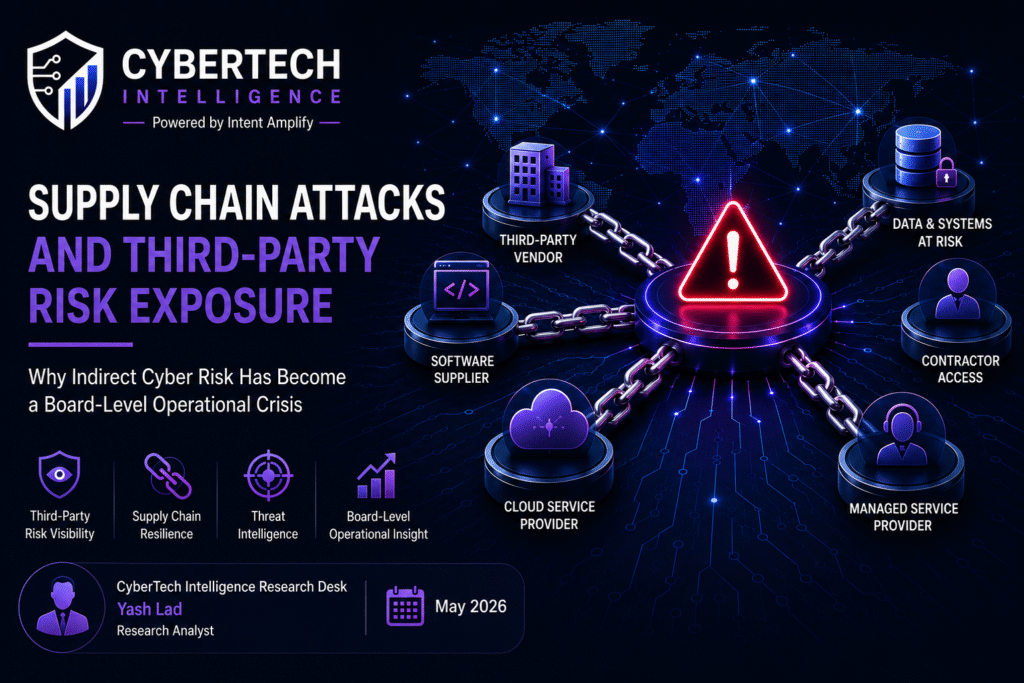
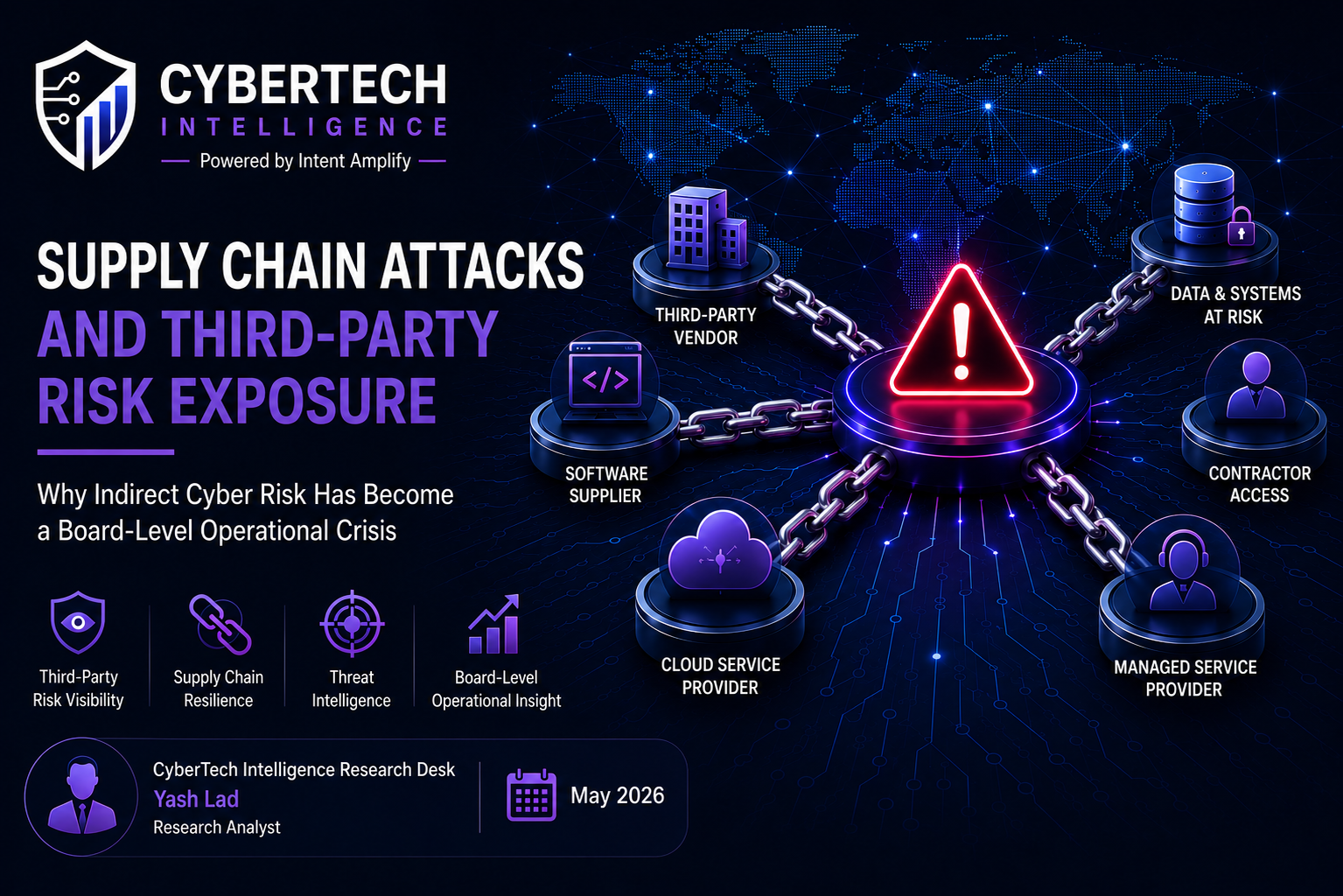
The threat that supply chain attacks pose is one of the most dangerous and expensive risks that enterprises face today. Instead of hacking into the secured enterprise environment directly, malicious entities are hacking into third parties who form an integral part of the supply chain, like software vendors, cloud computing services, SaaS, managed service providers, and OT suppliers.
This paradigm shift is completely changing the face of industrial cyber risk. Enterprises are no longer securing isolated networks but complex digital ecosystems comprising of:
- third-party APIs
- cloud-native infrastructure
- software dependencies
- federated identities
- AI-enabled platforms
- external operational service providers
As enterprise dependency on external technology ecosystems accelerates, supply chain compromise has emerged as a board-level operational resilience issue with direct implications for:
- revenue continuity
- regulatory exposure
- cyber insurance economics
- shareholder confidence
- operational continuity
- enterprise valuation
According to the 2025 IBM X-Force Threat Intelligence Index, Infostealer phishing campaigns saw an increase of about 84% in 2024, and almost 50% of all attacks were related to credential theft or sensitive information exposure.1
According to the IBM Cost of a Data Breach Report:
- The average cost of a U.S. data breach reached approximately $10.22 million
- Organizations extensively deploying AI and automation reduced breach costs by approximately $1.88 million compared with organizations lacking mature automation capabilities.2
Enterprise threat modeling indicates that supply chain compromise is increasingly capable of generating cascading downstream disruption across thousands of interconnected enterprise systems simultaneously, making third-party cyber exposure one of the highest-magnitude operational risks facing Fortune 500 firms.
Industry-Specific Enterprise Exposure
Fortune 500 Manufacturing Enterprises
Manufacturing regulated sectors face elevated supply chain exposure because of:
- Industrial IoT ecosystems
- ERP platform dependency
- Remote maintenance providers
- Shared supplier infrastructure
- OT cloud integration
According to IBM X-Force operational threat reporting:
- Researchers identified approximately 670 OT-related vulnerabilities during the first half of 2025.
- Approximately 11%were classified as critical severity vulnerabilities.3
Tier-1 Healthcare Systems
Healthcare organizations face elevated third-party cyber exposure through:
- Clinical SaaS ecosystems
- Revenue-cycle vendors
- Medical device platforms
- Cloud-hosted patient systems
- Outsourced IT support providers
According to Deloitte, healthcare industrial operators continue experiencing elevated operational exposure because of rapid digital ecosystem expansion and interconnected vendor dependency.4
Current operational exposure analysis indicates that healthcare remains one of the highest-risk sectors for cascading third-party compromise because operational urgency often overrides downtime tolerance.
Why Supply Chain Attacks Have Escalated Across U.S. Enterprises
In the past decade, enterprise operating models have grown to be highly reliant on interconnected SaaS ecosystems, cloud-native infrastructures, API-driven business services, outsourced development platforms, and third-party technology integration solutions. Whereas such ecosystems have contributed greatly towards operational efficiency and digital transformation, they have also resulted in an increased exposure to indirect cyber threats for organizations.
Key Drivers Behind Escalating Supply Chain Exposure
- SaaS ecosystem expansion
- AI-enabled operational workflows
- Open-source software dependency
- Third-party identity federation
- Cloud-native infrastructure complexity
According to Accenture, approximately 90% of organizations reportedly lack sufficient cybersecurity maturity to defend effectively against AI-enabled threats.5
Industry threat intelligence observations suggest that attackers increasingly prefer indirect compromise because it enables:
- Lower resistance pathways
- Faster privilege escalation
- Reduced detection probability
- Multi-victim operational disruption
- Greater ransomware leverage
According to McKinsey & Company, large-scale enterprises accelerating AI adoption without corresponding security modernization may significantly increase operational and data exposure risk.6
The Financial Reality of Supply Chain Cyber Incidents
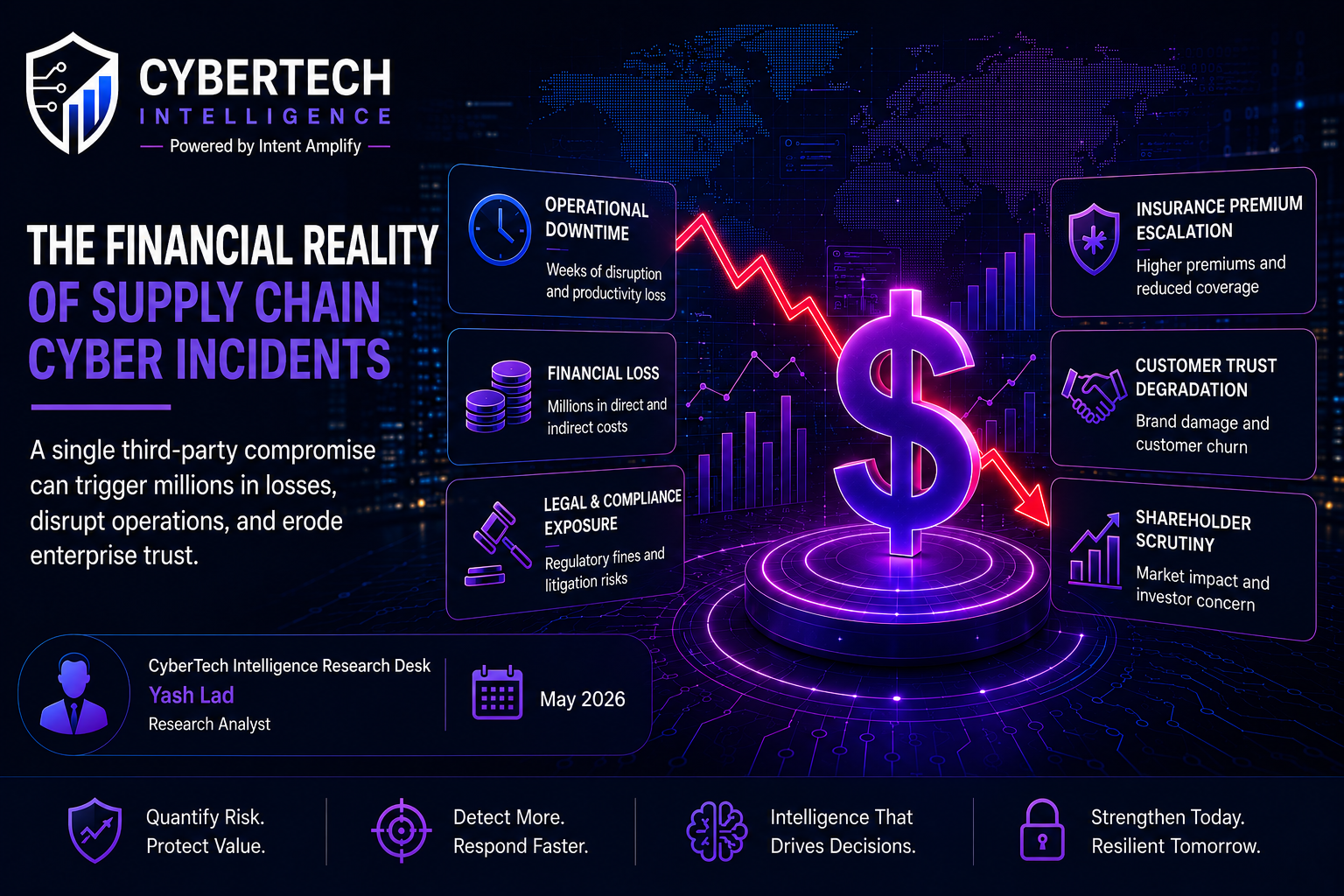
Supply chain cyber incidents now generate disproportionate business impact because a single third-party compromise can affect multiple downstream organizations simultaneously.
According to IBM:
- On average, the cost of a data breach globally amounted to $4.88 million.
- Data breaches affecting critical infrastructure organizations averaged around $5.35 million. 2
According to Deloitte’s cyber risk analysis:
- Operational resilience failures tied to third-party compromise are becoming major board-level governance concerns because of their ability to interrupt revenue generation and critical business operations.7
Enterprise risk modeling increasingly shows that large-scale supply chain attacks generate:
- Multi-week operational recovery timelines
- Significant legal exposure
- Insurance premium escalation
- Customer trust degradation
- Shareholder scrutiny
Apart from the cost of remediation, cyber attacks on the supply chain are likely to lead to other significant financial implications as a result of business interruption, erosion of trust within the ecosystem, and regulatory scrutiny. A massive breach involving a third party may disrupt manufacturing activities, logistics, healthcare scheduling, and customer-facing services.
Current operational risk analysis shows that prolonged recovery timelines following supply chain compromise frequently produce financial exposure exceeding the initial incident-response costs themselves. Additional downstream impacts increasingly include:
- elevated cyber insurance renewal pressure
- regulatory reporting obligations
- legal and compliance exposure
- customer retention challenges
- shareholder scrutiny
- reputational degradation
With enterprises becoming more dependent on interconnected vendor ecosystems, there is a growing recognition that operational resilience breakdowns resulting from third-party compromises need to be treated as critical business continuity risks as opposed to cybersecurity incidents alone.
Software Supply Chain Risk Examples in U.S. Enterprises
Software supply chain security has emerged as one of the most urgent enterprise cybersecurity priorities.
Modern enterprise applications frequently contain:
- Thousands of open-source components
- Shared APIs
- Third-party libraries
- Cloud-native dependencies
- Externally maintained packages
Many industrial operators still lack:
- Software Bills of Materials (SBOMs)
- Dependency visibility
- Secure build verification
- Package authenticity validation
- Provenance governance controls
According to NIST guidance associated with Executive Order 14028:
- Software supply chain integrity remains central to U.S. cybersecurity modernization efforts. 8
According to Gartner’s cybersecurity research coverage:
- Software supply chain attacks remain among the fastest-growing categories of enterprise cyber risk because of cloud-native complexity and dependency expansion.9
CyberTech Intelligence analysis indicates that attackers increasingly target:
- CI/CD pipelines
- Artifact repositories
- Source-code repositories
- Developer identities
- Package managers
How Vendor Credential Theft Impacts Enterprise Security
Compromise driven by identity is becoming one of the hallmarks of today’s supply chain attacks.
One of the key features that has defined modern-day supply chain attacks is identity-based compromise. This involves using the identities of contractors, federated identity, vendor accounts, and SaaS tokens instead of focusing only on software vulnerabilities to gain entry into organizational ecosystems.
According to the IBM X-Force Threat Intelligence Index for 2025:
- Almost 50% of detected cyberevents included credential theft and data leakage.1
Current market intelligence suggests that uncontrolled vendor identities have emerged as one of the biggest sources of silent attack vectors within corporate infrastructure.
large-scale enterprises often understate:
- Dormant contractor accounts
- Excessive privileges
- Shared administrative identities
- Weak MFA enforcement
- Legacy vendor access pathways
AI-Driven Supply Chain Attack Trends
Artificial intelligence is rapidly transforming enterprise cyber risk.
Generative AI now enables attackers to:
- Produce highly convincing phishing campaigns
- Automate reconnaissance
- Generate synthetic identities
- Clone executive voices
- Scale social engineering attacks
- Automate malware adaptation
According to Accenture:
- Approximately 36%of security and technology executives acknowledged that AI is advancing faster than their current cybersecurity capabilities.5
Enterprise resilience analysis indicates that AI-enhanced attacks may become substantially harder to detect because malicious activity increasingly resembles legitimate operational behavior.
Emerging enterprise concerns now include:
- AI plugin compromise
- AI supply chain poisoning
- External model integrity risk
- AI-generated phishing
- AI-enhanced vendor impersonation
Operational Technology and Critical Infrastructure Exposure
Operational technology environments are increasingly exposed through third-party ecosystems.
Industrial systems now depend heavily on:
- Remote maintenance vendors
- External monitoring platforms
- Third-party OT software
- Cloud-connected industrial devices
- Managed industrial services
According to IBM X-Force operational threat analysis:
- Approximately 11% of identified OT vulnerabilities during the first half of 2025 were classified as critical severity.3
According to CyberTech Intelligence’s resilience models for OT, the downtime of OT is among the most expensive operational risk factors facing industrial firms due to the extended periods required for recovery when compared to standard IT environments.
While standard enterprise IT infrastructures benefit from relatively modern and advanced infrastructure, regular patching opportunities, and sufficient downtime for maintenance purposes, the opposite applies to many OTs. In addition, attackers know that disrupting manufacturing facilities, energy companies, logistic chains, and transportation infrastructures will exert pressure on the management of enterprise firms.
Many industrial organizations still maintain persistent vendor connectivity into critical operational systems without fully segmented Zero Trust controls, increasing the potential for lateral movement during third-party compromise scenarios.
As information technology environments continue to converge with operations technology environments, new enterprise attack surfaces are being created, especially in light of increased investments in smart-factory technology, IIoT, and operational analytics in the cloud.
Enterprise Outcome Comparison: Ignore vs Modernize
|
Scenario |
Organizations That Ignore Supply Chain Risk | Organizations That Modernize Third-Party Security |
|
Vendor Compromise |
Multi-system disruption | Segmented containment |
|
Ransomware Recovery |
Extended downtime | Faster recovery |
|
Regulatory Exposure |
Increased scrutiny |
Stronger governance posture |
| Cyber Insurance | Rising premiums |
Improved underwriting position |
| Customer Trust | Elevated reputational damage |
Increased enterprise credibility |
| Board Confidence | Reduced operational trust |
Increased resilience confidence |
Operational resilience analysis indicates that business leaders modernizing identity-centric security and vendor governance controls may significantly reduce downstream operational exposure during large-scale supply chain incidents.
Strategic Recommendations for CISOs and Boards
Continuous Third-Party Visibility and Risk Intelligence
Industrial operators should implement:
- Continuous vendor posture monitoring
- Credential exposure intelligence
- External attack surface analysis
- Third-party breach monitoring
Identity-Centric Security Modernization
Prioritize:
- Zero Trust architectures
- Vendor MFA enforcement
- Identity segmentation
- Privileged access management
- Conditional access policies
Software Supply Chain Assurance
Large businesses should establish:
- SBOM governance
- Dependency verification
- Secure CI/CD validation
- Code-signing enforcement
- Software provenance controls
Board-Level Operational Resilience Governance
Boards increasingly require:
- Vendor concentration visibility
- Recovery exposure analysis
- Third-party resilience scoring
- Operational dependency mapping
Enterprise Incident Briefs
Case Study 1 – Ransomware Attack on Change Healthcare and Healthcare Disruptions by Third Party
One of the most disruptive attacks by a third party on the U.S. healthcare system was the ransomware attack carried out in 2024 on Change Healthcare, in which cybercriminal groups reportedly used access through stolen credentials to disrupt payment services in the healthcare sector.
Enterprise Impact
- Nationwide prescription processing disruption
- Delayed insurance claims and healthcare reimbursements
- Financial strain across hospitals and healthcare providers
- Elevated regulatory and congressional scrutiny
- Emergency operational continuity measures across healthcare networks
Strategic threat analysis highlights how third-party platform concentration risk can create cascading operational disruption across entire industry sectors when a single trusted provider experiences compromise. 10
Case Study 2 — MGM Resorts International Social Engineering and Vendor Identity Exposure
MGM Resorts International suffered a significant cyber attack in 2023 that was attributed to the social engineering of vendor identities. The perpetrators managed to interfere with the hotel’s hospitality processes, bookings, and online portals.
Enterprise Impact
- Hotel and casino operational disruption
- Reservation platform outages
- Customer service interruption
- Significant financial and reputational impact
- Increased executive and board-level cybersecurity review
Current enterprise threat modeling suggests assessment suggests that identity-centric compromise pathways involving contractors, support vendors, and external service ecosystems are becoming one of the fastest-growing operational threats facing large enterprises. 11
Case Study 3 — CDK Global Software Supply Chain and Operation Interference
CDK Global was subject to a cyberattack in 2024, which led to operational interference among dealerships in the American automotive industry. This is due to the fact that dealerships were highly dependent on the software supply chain from the company.
Enterprise Impact
- Vehicle sales disruption across dealerships
- Financing and inventory management delays
- Customer service interruption
- Multi-day operational outages
- Increased third-party risk reassessment across automotive enterprises
Current market intelligence suggests SaaS dependency is increasingly amplifying systemic enterprise risk because the compromise of a single provider can affect thousands of downstream organizations simultaneously.12
Conclusion
Supply chain attacks have emerged as one of the foremost issues that modern Fortune 500 firms face from a cybersecurity and resilience perspective.
Business leaders must navigate complex ecosystems, including:
- SaaS platforms
- Cloud providers
- APIs
- AI systems
- Software suppliers
- Operational technology vendors
- Contractors
- Managed service providers
This interconnectedness creates extraordinary operational efficiency — but also unprecedented cyber exposure.
CyberTech Intelligence analysis indicates that the future of enterprise cybersecurity will increasingly depend on:
- Identity-centric defense
- Vendor governance maturity
- Software supply chain integrity
- AI-aware cyber defense
- Operational resilience planning
Threat actors increasingly exploit trust relationships rather than technology vulnerabilities alone. As a result, traditional perimeter-focused cybersecurity strategies are becoming insufficient against modern supply chain attack models.
For U.S. enterprise leaders, supply chain cybersecurity is now:
- A governance responsibility
- A business continuity issue
- A financial resilience concern
- A board-level operational risk
- A competitive trust challenge
Regulated sectors that fail to modernize third-party risk governance may face substantially higher operational, regulatory, and financial exposure over the coming years.
References
- IBM, 2025 IBM X-Force Threat Intelligence Index – Large-Scale Credential Theft Escalates, Threat Actors Pivot to Stealthier Tactics, April 17, 2025
- IBM, Cost of a Data Breach Report, 2025
- IBM, The Operational Technology Threat Landscape: Insights From X-Force, 2025
- Deloitte, Deloitte Cyber Industry Insights – Enterprise Cyber Risk and Operational Resilience Research, 2025
- Accenture, State of Cybersecurity Resilience 2025, 2025
- McKinsey & Company, AI Is the Greatest Threat and Defense in Cybersecurity Today, 2025
- Deloitte, Growing Importance of Third-Party Risk Management for Managing Cyber Risk, 2024
- NIST, Software Security Supply Chains Guidance – Executive Order 14028, 2025
- Gartner, Cybersecurity Research and Strategic Insights, 2025
- UnitedHealth Group, UnitedHealth Group Updates on Change Healthcare Cyberattack, April 22, 2024
- MGM Resorts International, Current Report Pursuant to Section 13 or 15(d) of the Securities Exchange Act of 1934 (Cybersecurity Incident Disclosure), September 2023
- CDK Global, CDK Global Cyber Incident Updates, 2024