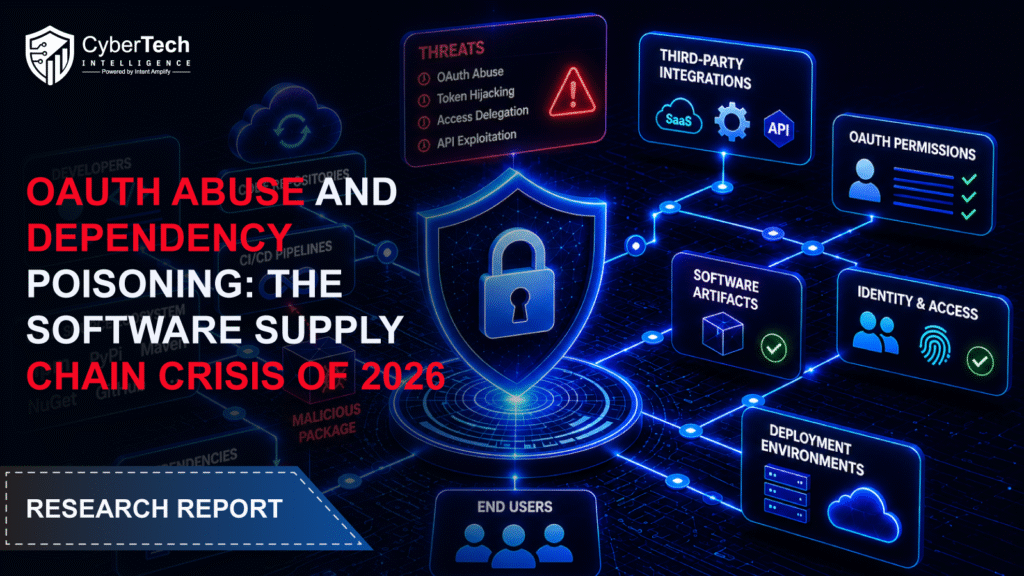
Executive Overview
The software supply chain attack vector has evolved into the most strategic attack vector in enterprise cybersecurity in 2026. Over the past nine months, cybercrime syndicates, nation-state threat actors, and financially motivated adversaries have begun moving away from direct attacks on infrastructure and have instead moved to exploiting software ecosystems, OAuth authorization protocols, SaaS integrations, CI/CD workflows, open source libraries, and API trust vectors.
It is a significant departure from enterprise cyber risk management strategies.
Instead of penetrating highly secured enterprise IT networks, today’s cyber adversaries are increasingly exploiting the software and identity trust vectors that are now built into modern enterprise architecture.
This involves using legitimate software relationships, OAuth delegations, third-party integrations, and open-source library dependencies to bypass security measures while establishing persistence in enterprise cloud computing infrastructures.
The magnitude of enterprise exposure is staggering.
Modern-day enterprises typically use:
- More than 1,000 SaaS applications
- Tens of thousands of OAuth permissions
- Millions of API transactions daily
- Many thousands of open source libraries
- High levels of automation in the CI/CD process
- AI-supported software development
The estimated cost of a data breach in the US, as highlighted by IBM Security, stood at about $10.22 million, which is the highest in the world, whereas the estimated worldwide cost was about $4.88 million.
As reported by IBM, companies utilizing AI and automation saw their breach cost reduced by about $1.9 million, with the duration cut down by almost 80 days.1
IBM further identified several alarming trends directly relevant to software supply chain compromise:
- Average breach lifecycle: approximately 241 days
- Average ransomware/extortion cost: approximately $5.08 million
- Additional cost imposed by shadow AI: about $670,000
- Close to 63% of companies lacked any AI governance policy at all
- Close to 97% of companies encountering problems with AI failed to enforce adequate AI access control measures
These statistics show how these three elements have become intertwined in the modern world.
On another note, Accenture Cybersecurity announced back in 2025 that almost 90% of the global companies are not ready to deal with the cyber attacks that leverage AI technologies, while about 63% find themselves in Accenture’s so-called “Exposed Zone” without having a solid security plan and cybersecurity maturity level.2
On the other hand, Gartner predicted that the cybersecurity of the software supply chain has now become one of the most urgent cybersecurity issues for enterprises. 3
The operational implications are severe.
OAuth abuse and dependency poisoning are no longer isolated technical risks. They now represent enterprise-wide operational resilience challenges affecting:
- Financial stability
- Regulatory exposure
- Business continuity
- Cyber insurance eligibility
- Executive governance
- Enterprise trust
- Customer retention
- Brand reputation
For American business executives, the software supply chain challenge is no longer an abstract concept. It is concrete, actionable, monetarily relevant, and growing swiftly.
The 2026 Software Supply Chain Threat Landscape
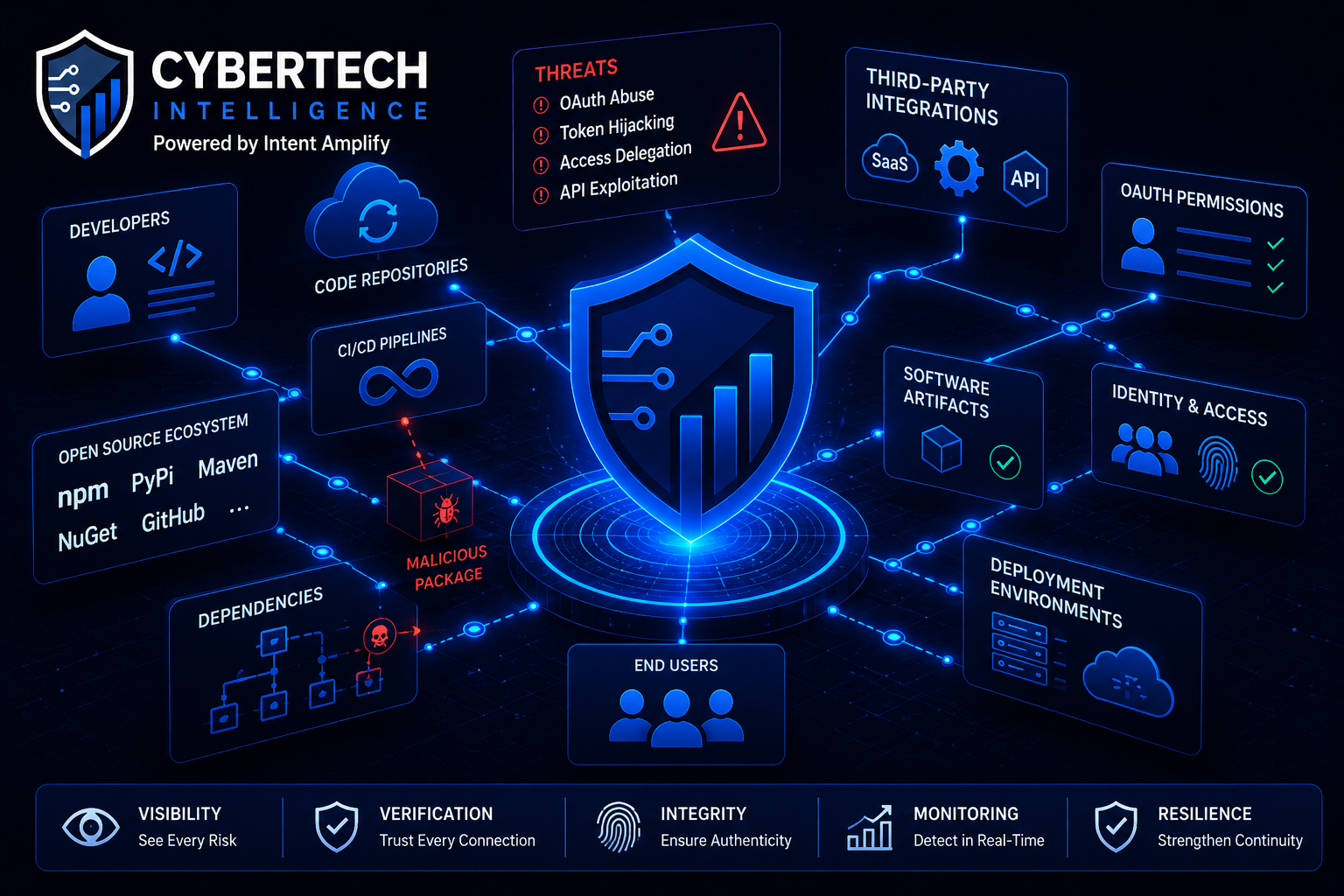
Enterprise software ecosystems have become deeply interconnected over the last decade.
Modern companies increasingly depend on:
- Open-source software
- Cloud-native APIs
- SaaS ecosystems
- AI-assisted development tools
- Third-party integrations
- Automated CI/CD pipelines
- Containerized infrastructure
- Identity federation platforms
- Low-code automation tools
This interconnected architecture has created a massive trust-based attack surface.
According to McKinsey & Company, digital acceleration and generative AI adoption are rapidly increasing software complexity, dependency interconnectivity, and cyber operational exposure across enterprise environments.4
This complexity creates systemic risk because attackers no longer need to breach enterprise infrastructure directly. Instead, they can compromise trusted dependencies already integrated into enterprise environments.
NIST warned in its Secure Software Development Framework (SSDF) guidance that software supply chain attacks can compromise:
- Software updates
- Dependency ecosystems
- Build pipelines
- Source code repositories
- Software provenance
- Development environments
- Trusted software distribution mechanisms 5
The attack surface is rapidly growing since the speed at which enterprises develop is increasing day by day. With modern DevOps teams deploying software on a continuous basis with automation, the security coverage does not often match up with deployment speed.
According to Google Cloud Security, securing cloud-native software ecosystems now requires protection not only for applications themselves but also for APIs, build systems, dependency chains, developer environments, and software artifacts.6
The outcome is a rapidly growing software trust crisis.
OAuth Abuse: The Identity Layer Crisis
The exploitation of OAuth has become one of the most practical attack vectors within corporate SaaS ecosystems over the years 2025 and 2026.
Phishing attacks in the past always targeted credentials. However, modern-day attacks on OAuth target authorization flows through the delegation of trust.
This distinction fundamentally changes enterprise identity risk.
Attackers increasingly abuse:
- OAuth consent grants
- Device code authentication flows
- Refresh token persistence
- Delegated API permissions
- SaaS application integrations
- OAuth redirection mechanisms
- Third-party connector ecosystems
According to Microsoft Security, attackers are increasingly weaponizing OAuth authorization abuse to bypass conventional authentication protections and maintain persistence inside enterprise cloud environments. 7
This is particularly concerning since OAuth exploitation usually circumvents any multi-factor authentication mechanisms while also seeming to operate in an entirely acceptable manner.
Even after changing passwords, unauthorized refresh tokens could still persist unless appropriate token revocation mechanisms are put into place by the companies.
Enterprise exposure has increased dramatically due to SaaS adoption.
Large companies commonly operate:
- Hundreds to thousands of SaaS applications
- Tens of thousands of delegated API permissions
- Cross-platform identity federation workflows
- Automated workflow orchestration tools
- Third-Party SaaS Connectors
Centralized visibility into OAuth permissions, delegated scopes, or refresh token usage has not yet been achieved by most enterprises.
Okta noted that identity has become the new security perimeter for enterprises as they evolve towards cloud-native and SaaS-operating models. 8
On the other hand, according to Unit 42 from Palo Alto Networks, the number of attacks based on identity continues to rise due to scalable access across the enterprise cloud ecosystem.9
The problem is critical because misuse of OAuth often goes undetected, as it hides within legitimate telemetry of enterprise operations.
Dependency Poisoning and Open-Source Weaponization
Dependency poisoning has become one of the fastest-growing software supply chain threats in enterprise environments.
Modern enterprise applications rely extensively on open-source ecosystems, including:
- npm
- PyPI
- Maven
- NuGet
- Docker Hub
- GitHub repositories
- Kubernetes package ecosystems
Threat actors increasingly exploit this trust model by:
- Publishing malicious packages
- Hijacking repositories
- Exploiting typosquatting
- Injecting malware into software updates
- Compromising package maintainers
- Manipulating CI/CD pipelines
- Exploiting AI-generated dependencies
According to GitHub Security Lab, dependency confusion and package injection attacks continue expanding across open-source ecosystems.10
The magnitude of dependency vulnerabilities is enormous.
Enterprise-level software applications have thousands of direct and indirect dependencies that are not well-documented or monitored.
It poses a significant challenge for governance.
CrowdStrike indicated that hackers are targeting software development processes more often than before, since hacking into an existing dependency allows them to hack into different systems at once. 11
There is an increased risk with artificial intelligence-based development.
AI-powered coding assistants are recommending third-party packages without verifying their integrity and security measures.
It has opened new channels for enterprise-level risk due to prioritization of deployment velocity.
SaaS Ecosystem Risk and Trusted Integration Exploitation
The rapid expansion of SaaS ecosystems has dramatically increased software supply chain risk.
Large enterprises now depend heavily on interconnected SaaS platforms, including:
- Microsoft 365
- Salesforce
- ServiceNow
- Slack
- GitHub
- Zoom
- Atlassian
- AWS
- Google Workspace
- Okta
These platforms rely heavily on OAuth authorization, delegated API access, and trusted integration frameworks.
It is becoming common for attackers to go after the trust relationships involved, instead of attacking the hardened infrastructure itself.
The researchers at Cisco Talos believe that attacks on trust workflows are rising because SaaS API activities are difficult to distinguish from regular enterprise workflows.12
Furthermore, Salesforce Security pointed out that governance and identity security were becoming vital parts of cybersecurity strategies.13
Trusted integration abuse is especially dangerous because:
- API activity appears legitimate
- OAuth tokens persist across sessions
- SaaS-to-SaaS lateral movement is difficult to detect
- Excessive delegated permissions are common
- Conventional endpoint tools often lack SaaS visibility
Zscaler ThreatLabz reported continued increases in cloud application compromise and identity-driven attacks across enterprise environments. 14
The outcome is a rapidly expanding enterprise identity trust crisis.
Enterprise Financial Exposure and Operational Impact
The financial impact of software supply chain compromise continues to increase substantially across the United States.
According to IBM Security:
- Average global breach cost: approximately $4.88 million
- Average U.S. breach cost: approximately $10.22 million
- Average ransomware/extortion incident cost: approximately $5.08 million
- Average breach lifecycle: approximately 241 days
- AI security automation reduced breach costs by approximately $1.9 million1
The operational consequences extend far beyond direct breach costs.
Enterprise organizations frequently experience:
- Business interruption
- Operational downtime
- Regulatory penalties
- Legal liabilities
- Customer attrition
- Revenue disruption
- Insurance premium escalation
- Intellectual property theft
- Brand reputation damage
Cybersecurity and Privacy at PwC found that the boardroom is recognizing cybersecurity less as an IT issue and more as a key element in enterprise resilience.15
Cybersecurity at Accenture highlighted that cyber resilience issues often affect key business processes and customer activities. 16
Software supply chain security has therefore evolved into a major financial governance issue for enterprise leadership teams.
Why Traditional Enterprise Security Models Are Failing
Many enterprise cybersecurity programs remain architecturally misaligned against modern software supply chain threats.
Traditional enterprise security strategies primarily focused on:
- Networks
- Endpoints
- Infrastructure
- User credentials
Modern attackers increasingly target:
- Identity trust relationships
- OAuth workflows
- SaaS ecosystems
- APIs
- CI/CD pipelines
- Dependency chains
- Developer environments
This results in large-scale operational detection gaps.
As noted by Accenture Cybersecurity:
- About 90% of businesses are not adequately ready for AI-powered cyber threats.
- About 77% are missing key AI and data security capabilities.
- About 63% are still exposed operationally due to poor cybersecurity maturity
Many enterprises still lack:
- Centralized OAuth governance
- Real-time SBOM visibility
- SaaS posture management
- API threat analytics
- Dependency integrity validation
- Continuous trust verification
The disparity between enterprise digital complexity and cybersecurity maturity is growing ever wider.
Regulatory, Insurance, and Governance Pressure in the United States
Governmental oversight on software supply chain security is escalating in the United States.
Agencies are now more concerned with:
- Software development security
- Vendor risk management
- Zero Trust architecture
- SBOM transparency
- Identity governance
- Software provenance validation
- Third-party cyber resilience
NIST continues expanding enterprise guidance surrounding secure software development through the SSDF initiative.5
On the other hand, regulations concerning cybersecurity disclosures by the SEC are making corporate executives more accountable in relation to material cybersecurity breaches.
According to Deloitte Cyber Risk Services, boards and executive teams are under increasing pressure to demonstrate enterprise‑level cybersecurity resilience within the third‑party ecosystem and digital supply chain. 16
Cyber insurance providers are also tightening underwriting standards surrounding:
- MFA enforcement
- Identity governance
- SaaS visibility
- OAuth controls
- Vendor risk management
- Incident response readiness
These groups lacking mature supply chain security programs will likely face escalating regulatory and financial pressure throughout 2026 and beyond.
Strategic Recommendations for Enterprise Leaders
1. Establish Centralized OAuth Governance
Organizations should maintain centralized visibility into:
- OAuth applications
- Consent grants
- Refresh tokens
- Delegated permissions
- Third-party integrations
- API trust relationships
2. Implement Real-Time SBOM Visibility
Security teams should maintain:
- Continuous dependency inventories
- Package provenance validation
- Dependency signing enforcement
- Transitive dependency monitoring
- Build integrity verification
3. Secure CI/CD Pipelines
Modern build environments require:
- Segmented infrastructure
- Code signing
- Artifact validation
- Runtime integrity analytics
- Behavioral monitoring
- Least-privilege access enforcement
4. Expand Identity Threat Detection
Security operations teams should prioritize:
- OAuth anomaly detection
- API threat analytics
- Token misuse monitoring
- SaaS behavioral analytics
- Identity telemetry correlation
- Impossible travel analysis
5. Elevate Supply Chain Security to Board-Level Governance
Software supply chain security should become integrated into:
- Enterprise risk management
- Financial governance
- Cyber insurance strategy
- Vendor oversight
- M&A due diligence
- Regulatory compliance programs
Future Outlook: AI-Driven Supply Chain Warfare
The software supply chain threat landscape is expected to intensify significantly throughout 2026 and beyond.
Emerging risks include:
- AI-generated malicious packages
- Autonomous phishing campaigns
- AI-assisted dependency poisoning
- Synthetic identity attacks
- SaaS-to-SaaS compromise chains
- Machine-speed OAuth abuse
- AI-powered social engineering
According to McKinsey & Company, generative AI adoption is dramatically increasing enterprise digital complexity while simultaneously accelerating cyber operational risk.17
Future enterprise security architectures will increasingly require:
- Continuous trust validation
- Identity-centric security models
- AI-assisted detection
- Real-time dependency intelligence
- SaaS posture management
- Autonomous anomaly analytics
Organizations failing to modernize software supply chain governance will likely face escalating operational and financial exposure over the next several years.
Conclusion
OAuth abuse and dependency poisoning have become the defining cybersecurity threats of 2026.
Attackers are increasingly exploiting trusted software relationships, SaaS integrations, delegated identity permissions, dependency ecosystems, and CI/CD pipelines rather than relying solely on traditional infrastructure compromise.
This transformation has fundamentally changed enterprise cyber risk.
For U.S. enterprises, the software supply chain crisis is operational, measurable, financially significant, and strategically critical.
Companies that prioritize identity governance, SaaS visibility, dependency integrity, and software supply chain resilience will be significantly better positioned to withstand the next generation of AI-driven cyber threats.
References
- IBM Security, Cost of a Data Breach Report 2025, 2025.
- Accenture, Only One in 10 Organizations Globally Are Ready to Protect Against AI-Augmented Cyber Threats, 2025.
- Gartner, Cybersecurity Research and Software Supply Chain Security Insights, 2025–2026.
- McKinsey & Company, Risk & Resilience Cybersecurity Insights, 2025–2026.
- NIST, Secure Software Development Framework (SSDF), 2025–2026.
- Google Cloud Security, Identity Security, and Cloud Protection Insights, 2025–2026.
- Microsoft Security, Microsoft Security Blog – Identity and OAuth Threat Intelligence, 2025–2026.
- Okta, Getting Started with Zero Trust Access Management: Trust Begins with Secure Identity, 2025–2026.
- Palo Alto Networks Unit 42, Threat Intelligence and Cloud Identity Attack Research, 2025–2026.
- GitHub Well-Architected, Managing Dependency Threats, 2025–2026.
- CrowdStrike, Supply Chain Attack Overview and Enterprise Threat Analysis, 2025–2026.
- Cisco Talos, Cisco Talos Threat Intelligence Blog, 2025–2026.
- Salesforce Security, Salesforce Security and Trust Insights, 2025–2026.
- Zscaler ThreatLabz, AI Is Now the Default Enterprise Accelerator: ThreatLabz 2026 AI Security Takeaways, 2026.
- PwC, Global Digital Trust Insights 2026, 2026.
- Deloitte, The technology risk landscape – considerations for boards, 22 Jan 2026.
- McKinsey & Company, The State of AI, 2025.