Only on RETHINK Retail, the site where top retail executives worldwide get their essential intelligence, peer perspective, and genuine conversation to plan their next step.
The key to making a marketing dollar, a merchandise investment, or a customer experience strategy profitable is to reach the moment of truth. Nowadays, it is becoming rather hard to discover this gold in 2026.
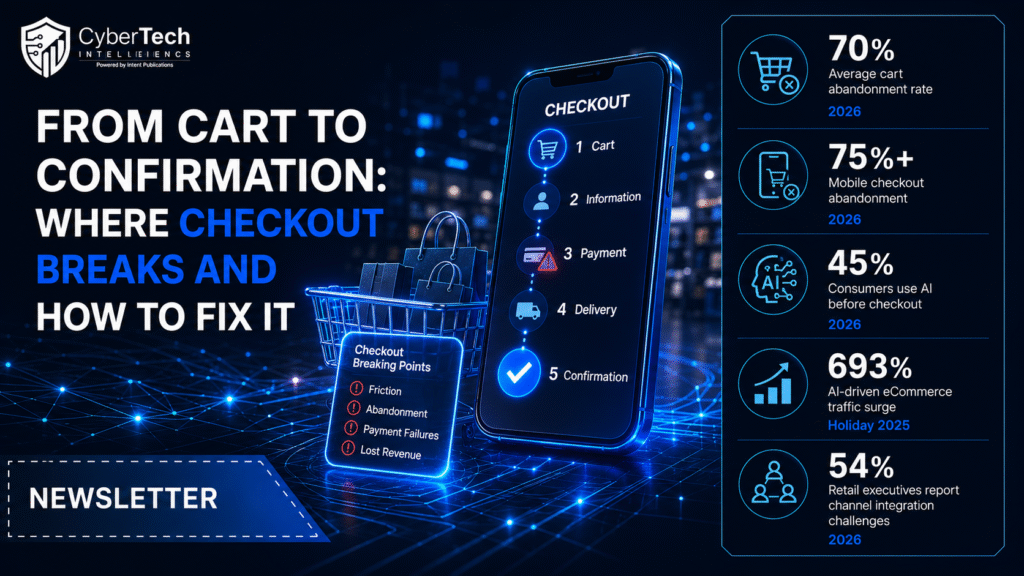
The average cart abandonment rate is 70%, rising to more than 75% on mobile devices, with checkout friction identified as a primary driver of lost revenue at the moment of highest purchase intent. ¹
These are not digital experience metrics. These are immediate and quantifiable losses happening thousands of times a day through all retail channels at the exact point in time when a customer decides to make a purchase.
In the exclusive webinar, “Where Checkout Still Breaks & How Retailers Are Fixing It,” you’ll learn how today’s leaders are closing the gaps in their checkout performance, where there is still room for improvement in this area, and how to take your point-of-sale platform from a final transaction point to a quantifiable revenue driver.
Webinar registrants will also receive a complimentary copy of The Checkout Performance Gap research report.
The Consumer Arriving at Checkout Has Already Made a Decision. Friction Reverses It.
Shoppers reaching checkout in 2026 have already done the research, formed the intent, and done it with AI. They have already done the research. They have already formed the intent. And they have done it with AI.
A worldwide survey conducted by IBM in association with the National Retail Federation (January 2026) revealed that almost 45% of buyers currently make use of AI technologies within their purchasing processes and come to the checkout counter with increased purposefulness, enriched product information, and reduced patience for an experience that does not meet the same level of sophistication as was encountered throughout the process.
This means that they are making use of AI to do product research (41%), understand reviews (33%), and look for deals (31%). Whether checkout confirms that intent or collapses it is the only question that matters at that moment. ²
IBM identifies the specific gap enabling that collapse: 54% of retail executives report persistent data integration challenges across channels and systems. That is not a technology problem. It is a prioritization problem, and in 2026, it has a measurable cost at the point of sale. ²
IBM’s IBV further documents that eliminating multisite checkout friction directly drives increased conversion rates, average order value, and cross-sell performance. These are not experienced outcomes. They are P&L outcomes. ³
KEY FIGURES AT A GLANCE
70% average cart abandonment rate, rising to 75%+ on mobile (Retail Technology Innovation Hub — April 2026) ¹
45% of consumers now use AI during their buying journeys before reaching checkout (IBM / NRF Global Study — January 2026) ²
693% surge in AI-driven ecommerce traffic during the 2025 holiday season (Microsoft / Adobe — January 2026) ⁴
72% of merchants report higher failed payment rates for overseas transactions versus domestic (Retail Technology Innovation Hub — April 2026) ¹
54% of retail executives report persistent data integration challenges across channels (IBM / NRF — January 2026) ²
RETHINK Retail: The Community That Makes This Conversation Possible
Checkout performance sits at an uncomfortable intersection. But it is too much of an operational discussion for marketing, too much of a commercial discussion for information technology, and too important for anyone to leave it up to one of the two alone. This is precisely the type of cross-disciplinary discussion that the RETHINK Retail model was designed for.
RETHINK Retail is the proven forum where those individuals involved in ensuring the success of retail are gathered in order to see clearly, engage in honest discussion, and walk away with a more precise viewpoint that only peer-based intelligence can provide. It is not a product showcase.
It is a practitioner-led examination of where checkout is still breaking, backed by the data, shaped by real operational experience, and anchored in the specific decisions that separate retailers closing the checkout performance gap from those continuing to absorb avoidable revenue loss at the point of sale.
Registrants receive a complimentary copy of The Checkout Performance Gap — a research foundation to carry directly into their own organizations, and the webinar conversation gives them the peer context to act on it.
Ingenico: Checkout as Revenue Architecture, Not a Payment Endpoint
Ingenico’s partnership with RETHINK Retail for this webinar reflects a conviction that defines Ingenico’s platform direction in 2026: checkout is not where the retail journey ends. It is where the entire investment in the customer relationship either converts or collapses.
Retailers closing this gap are making a fundamentally different architectural decision. They are treating checkout as revenue architecture, a system designed from the payment layer up to maximize conversion, minimize friction, support payment flexibility across every channel and market, and generate the operational intelligence that makes continuous improvement possible.
Ingenico’s platform enables exactly that model, connecting payment capability to operational performance in a way that gives retailers the data, flexibility, and speed to turn checkout from a cost center into a competitive advantage.
The RETHINK Retail webinar makes that architecture concrete, through practitioners who have built it in live environments, sharing what the metrics look like, what the operational decisions required, and what they would do differently with the benefit of hindsight.
Microsoft: Frictionless Checkout Is Where Conversion Is Won or Lost
Microsoft’s January 2026 NRF announcement placed checkout modernization at the center of its retail AI strategy for a direct reason. A single data point made it impossible to ignore.
E-commerce traffic driven by AI rose 693% during the holiday period in 2025, which means that more people than ever before are coming to make payments via AI-generated paths, influenced by an efficient discovery process. When the checkout does not match that standard, abandonment is immediate. ⁴
Microsoft’s Copilot Checkout, launched in January 2026, was designed around one insight: connecting authentic brand engagement with frictionless checkout helps retailers capture value at the exact moment of intent. ⁴
No redirect. No friction. Conversations are converted into confirmations instantly. Microsoft’s May 2026 Forrester TEI study reinforces the commercial logic: retailers unifying commerce and operations intelligence are generating 124% to 282% ROI over three years, with checkout modernization organization as part of a unified commerce platform decision, not an isolated payment infrastructure upgrade. ⁵
The Microsoft evidence is one data point in a richer conversation the webinar is designed to complete: what does this mean for your specific store estate, your customer base, and your technology architecture?
Cisco: The Network Behind Checkout Is a Performance and Security Decision
Any checkout process using a POS in a store, at a self-checkout kiosk, through a mobile app, or in an online cart involves technology that requires proper network infrastructure for it to operate effectively and safely. Any failure in this area results in poor customer experience, poor transactions, and ultimately poor financial results.
According to Cisco’s 2026 State of Wireless report, which involved the opinion of 6,098 wireless decision-makers in 30 markets (April 2026), mobile POS and faster checkout benefit directly from wireless investments, together with dynamic digital signage and real-time inventory management. ⁷
The situation regarding security is equally concerning: about 54% of retail businesses lose money due to wireless security breaches, with almost 45% losing over $1 million each year. A network failure at the point of sale is not an IT incident. It is a direct revenue event.⁶
Cisco’s research establishes the performance upside of getting this right. organizations addressing complexity, security, and talent together achieve 63% higher average wireless ROI ⁷, and 77% of retail IT leaders report enhanced customer engagement from wireless investments. ⁶
Cisco’s Full-Stack Observability solutions further enable retailers to monitor POS payment processing systems in real time, detect and redact sensitive data from vulnerable transactions, and ensure checkout runs without the latency or failure that customers interpret as friction. ⁸
Palo Alto Networks: The Checkout System Is a High-Value Target
Point of sale and payment infrastructure sit among the most consistently targeted systems in retail cybersecurity. The 2026 threat data from Palo Alto Networks makes the risk quantifiable and the stakes clear.
Palo Alto Networks’ Unit 42 Global Incident Response Report 2026, drawing on over 750 major incidents across 50 countries between October 2024 and September 2025, found that 84% of major cyber incidents resulted in operational downtime, reputational damage, or financial loss. ⁹
For a retailer whose checkout system is compromised mid-trading day, that downtime is not an IT metric. It is a direct revenue loss event affecting every customer in every queue at the moment of purchase.
99% of organizations experienced at least one attack on their AI systems in the past year. APIs and SaaS integrations, the same interfaces modern checkout platforms depend on, are now the fastest-expanding attack surface in enterprise retail. That number is not a warning about future risk. It is a description of current reality. ¹⁰
Ingenico’s platform approach, treating payment security and checkout performance as a unified architecture decision, reflects exactly the security-by-design principle the 2026 threat environment demands.
The Conversation That Changes What Checkout Delivers
Checkout is the only moment in retail where every prior investment, in brand, in marketing, in merchandising, in the customer experience, either pays off or disappears. Most organizations already know their checkout has gaps. What they do not know is which gaps are costing the most, what the retailers who fixed them actually changed at the architecture level, and whether their current platform is capable of supporting that fix without expanding their security exposure in the process.
The retailers pulling ahead in 2026 did not get there by running better pilots or allocating larger technology budgets. They made a specific decision earlier than their competitors: to treat checkout as a revenue system rather than a transaction endpoint, and to build the infrastructure that decision requires before an incident or a competitor forced them to.
That decision is available to every retailer in this conversation. The webinar on June 10 is built around what it looks like in practice, with the data, the operational examples, and the peer perspective to make it actionable before the next peak trading period. Registrants also receive a free copy of The Checkout Performance Gap on registration.
Register Now: Where Checkout Still Breaks and How Retailers Are Fixing It Presented on behalf of Ingenico | Hosted by RETHINK Retail
Register Here
References
- Retail Technology Innovation Hub — The Hidden Cost of Checkout Friction — 20 April 2026
- IBM Newsroom / NRF — Brands and Retailers Navigate a New Reality as AI Shapes Consumer Decisions Before Shopping Begins — 7 January 2026
- IBM Institute for Business Value — Agentic Commerce Research — May 2025
- Microsoft — Microsoft Propels Retail Forward with Agentic AI Capabilities — 8 January 2026
- Microsoft Cloud Blog — Agentic AI Is Reshaping Retail and Consumer Goods Economics — 21 May 2026
- Cisco Blogs — 5 Wireless Trends Retail IT Teams Can’t Ignore in 2026 — 15 April 2026
- Cisco — State of Wireless Report 2026 — 2 April 2026
- Cisco Blogs — Navigating Retail Disruption: Maximize Customer Centricity with Observability — March 2025
- Palo Alto Networks — 2026 Unit 42 Global Incident Response Report — 17 February 2026
- Palo Alto Networks Blog — Where Cloud Security Stands Today and Where AI Breaks It — December 2025
🔒 Login or Register to continue reading