Executive Summary
Retail executives have poured billions into loyalty ecosystems, personalization engines, and fulfillment modernization. Yet for most U.S. retailers, the single most expensive moment in the entire purchase journey remains the one they have invested in the least: checkout.
McKinsey research shows that when shoppers encounter delivery uncertainty or unexpected cost disclosures during checkout, approximately 46% abandon before completing the transaction. 1 For big U.S. retailers, this amounts to hundreds of millions of dollars lost each year.
Checkout failure in 2026 is no longer simply a user experience problem. It has become a measurable operational performance issue tied directly to mobile optimization maturity, payment orchestration architecture, fraud governance, authentication workflows, and customer trust.
The most successful retail organizations are increasingly treating checkout as strategic revenue infrastructure rather than a transactional endpoint. Every delay in wallet rendering, payment authentication, shipping visibility, or form completion introduces measurable conversion risk precisely at the moment customer acquisition spending is expected to monetize.
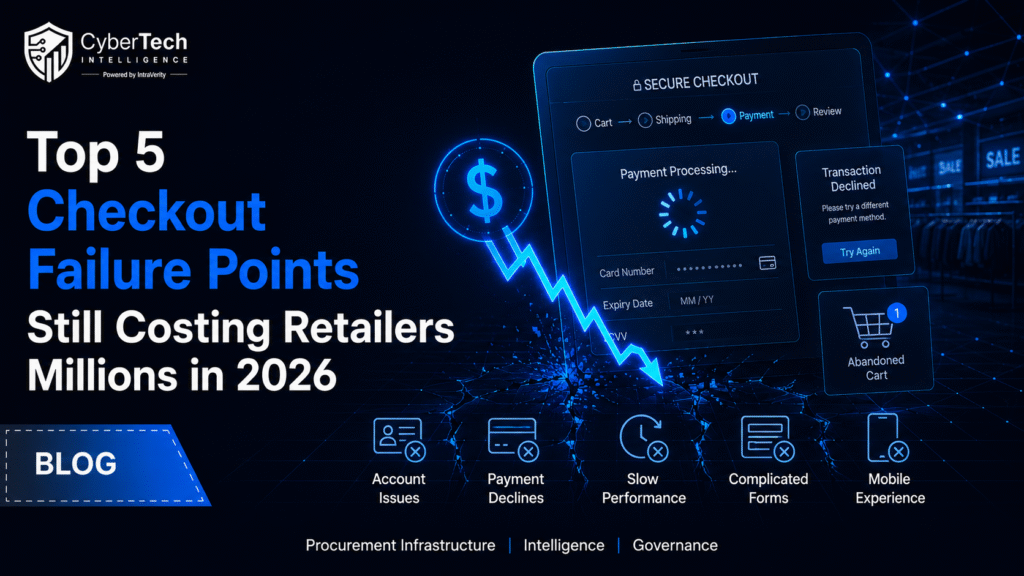
This analysis identifies five checkout failure points that continue draining millions from retail revenue in 2026, and examines what the highest-performing commerce organizations are doing differently to close the gap without inflating customer acquisition costs.
Failure Point 1: Hidden Costs That Surface Too Late
Unexpected fees that appear only at the final stage of checkout remain one of the most preventable conversion killers in U.S. e-commerce.
McKinsey’s 2025 consumer delivery research found that more than 90% of U.S. online shoppers are likely to abandon a cart when confronted with high shipping costs for standard items. 2
That sensitivity has only deepened in 2026 as inflationary pressure and cautious discretionary spending continue shaping how U.S. consumers evaluate every purchase decision.
The larger issue is not necessarily the fee itself. It is when the fee appears. Shoppers who have already committed time to browsing, entering details, and selecting a payment method rarely absorb a surprise charge at the end. Most simply leave.
McKinsey’s omnichannel delivery analysis further confirmed that roughly half of all U.S. consumers are unwilling to pay anything for shipping, regardless of how fast the delivery arrives. Transparent cost disclosure is therefore a conversion requirement, not a customer experience enhancement. 2
Many enterprise retail environments surface shipping and surcharge calculations only at the order review stage because their e-commerce systems remain disconnected across inventory, logistics, fulfillment, and pricing platforms. That separation erodes buyer confidence at the exact moment purchasing intent peaks.
The operational fix is architectural. Retailers that surface total landed cost at the product detail page stage, before the shopper enters the checkout flow, eliminate the primary trigger for last-minute abandonment. Ingenico’s transaction optimization framework is among the platforms enabling this earlier cost disclosure as part of a connected commerce infrastructure.
Retailers that move cost transparency upstream, not deeper into the funnel, are recovering conversion that their competitors are still losing.
Failure Point 2: Decision Fatigue and Friction Before Purchase Completion
Purchase abandonment is increasingly driven by cognitive overload as much as by pricing friction.
Accenture’s Consumer Research 2024 found that 74% of consumers walked away from purchases simply because they felt overwhelmed by the volume of choices, content, and effort required. Despite years of customer-centricity investment, 71% of those same consumers reported no improvement in the time or effort needed to complete a purchase. 3
Decision fatigue hits hardest at checkout, where cognitive overload accumulated during browsing collides directly with unclear form fields, multi-step transaction flows, forced account creation, and mobile usability gaps.
Accenture’s 2024 Holiday Shopping Survey reinforced the scale of this problem, finding that 82% of consumers said they would abandon a purchase due to frustration or indecision during checkout, with nearly one in three saying they would move directly to a competing retailer. 4
One unanswered question at checkout can undo everything a retailer did right before it.
Operationally, the friction points compounding this problem are well documented: repetitive form entry, poor autofill support, app-to-browser payment redirects, slow identity verification, and disconnected authentication workflows. Each adds seconds and cognitive cost to a process shoppers expect to be instantaneous.
Even minor disruptions, such as biometric session expiry or a delayed wallet render, measurably drop completion rates in high-intent purchase scenarios.
The retailers recovering the most from this failure point share a common approach: they default to guest checkout, minimize required fields to the absolute transaction essentials, and deploy intelligent form completion that anticipates rather than interrogates the buyer. Simplifying checkout structure consistently ranks among the highest-ROI conversion investments available to enterprise retail organizations today.
Failure Point 3: Payment Method Gaps and Silent Transaction Failures
Retailers running on legacy payment systems face a compounding problem: shoppers expect flexibility at the point of payment, while authorization environments are growing more complex by the quarter.
Accenture’s payments research found that more than half of consumers actively use digital wallets, with biometric payment adoption accelerating across U.S. markets. Retailers that cannot support these instruments at checkout are not simply missing a preference. They are handing completed sales to competitors who can. 5
The more dangerous problem is the one that never appears on an executive dashboard. Revenue leakage driven by silent authorization failures, false fraud declines, and inconsistent wallet integrations is invisible by definition. Shoppers who hit a declined transaction or an authentication error rarely report it. They simply abandon.
Accenture’s Payments Technology Reinvention research found that leading financial institutions have already automated approximately 40% of manual payment operations tasks, while merchant-side payment modernization continues lagging significantly behind. 6
As buy-now-pay-later instruments, embedded finance platforms, and token wallets multiply, optimizing transaction approval across all of them simultaneously has become one of the most technically demanding challenges in retail operations.
Meanwhile, the payments infrastructure continues to represent another emerging cybersecurity risk vector.
Based on the IBM 2025 Cost of a Data Breach Report, the cost of a data breach within the USA has grown to reach the amount of $10.22 million, setting the highest record among other countries due to continued exposure of the retail industry to threats from phishing schemes and vulnerabilities through third parties in the payment industry. 7
AI-driven fraud automation, synthetic identity exploitation, and autonomous bot purchasing are now active threats in U.S. retail payment environments. Leading retailers are responding by treating payment infrastructure modernization as a revenue protection strategy, not just a technical refresh. Ingenico’s payment orchestration capabilities are among the frameworks enabling retailers to route transactions intelligently, reduce false declines, and maintain conversion without compromising fraud defense.
Failure Point 4: Checkout UX Complexity and Mobile Performance Gaps
Mobile commerce now drives the majority of U.S. e-commerce traffic. Mobile checkout, however, continues to be where that traffic is lost.
McKinsey’s omnichannel retail research found that consumers engaging across multiple channels generate at least 1.25 times greater lifetime value than single-channel shoppers. The gap between that potential and what most retailers actually deliver at mobile checkout remains significant.
Gartner’s 2025 CIO Agenda for Retail identified unified commerce execution as foundational for competitive differentiation, meaning transaction continuity across mobile applications, e-commerce platforms, physical stores, and digital wallets must now be treated as core infrastructure rather than an optional enhancement. 8
The failure modes are consistent across U.S. retail: fragmented payment redirects that break session continuity, delayed API responses that stall rendering, excessive transaction steps designed for desktop navigation, unreliable autofill, and biometric authentication that expires mid-session. Each compounds the others.
A one-second delay in tokenization or wallet rendering measurably increases abandonment in high-intent purchase scenarios, at precisely the moment where every prior marketing dollar was supposed to convert.
The retailers closing this gap fastest are those that have rebuilt mobile checkout from scratch rather than adapting desktop flows for smaller screens. Ingenico’s low-latency mobile transaction infrastructure is one example of how purpose-built mobile payment architecture differs fundamentally from retrofitted desktop checkout. Leading retail organizations now treat mobile checkout performance as an engineering discipline, measured in milliseconds and abandonment deltas, not as a design problem measured in aesthetics.
Target’s investment in persistent cart and one-tap Wallet integration within its mobile app offers a documented example of how purpose-built mobile checkout redesign translates into measurable session completion improvements at scale. The lesson is not platform-specific. Retailers that rebuild mobile checkout around how thumbs actually navigate, rather than how mice do, recover sessions that retrofitted flows consistently lose.
Failure Point 5: Trust Deficits and Security Perception at Payment
Some of the most expensive checkout abandonments have nothing to do with price or process. They happen because the shopper does not trust the payment environment.
IBM’s 2025 Cost of a Data Breach Report found that 13% of organizations globally experienced security compromises involving AI models or applications, and 97% of those organizations lacked proper AI access controls at the time of the breach. 9
As AI-driven fraud scoring, dynamic pricing, and embedded finance tools become standard in checkout infrastructure, the governance maturity of those systems is now directly tied to whether shoppers complete a transaction or abandon it.
IBM’s research confirmed that the average U.S. data breach cost reached $10.22 million in 2025, the highest of any country measured globally, with retail consistently identified as a high-exposure sector through phishing and third-party payment layer vulnerabilities.7
Trust perception at checkout now depends on a specific set of visible signals: PCI compliance indicators, recognizable payment credentials, biometric authentication that feels familiar rather than intrusive, consistent transaction behavior across sessions, and clear data-use disclosures. When any of these are absent or inconsistent, abandonment follows.
McKinsey’s study on personalization discovered that customers feeling that the firm treats their data correctly are much more likely to finalize a sale and build a lasting relationship with it, resulting in increased profits in the range of 10%-30%.10
Ingenico’s adaptive authentication and AI-driven risk orchestration capabilities reflect how leading payment platforms are responding to this trust gap, embedding security signals directly into the transaction experience rather than treating them as a compliance layer applied after the fact. Retailers that invest in visible, consistent trust signals at checkout are recovering conversion that their competitors attribute to pricing or product issues. The real cause, in many cases, is simply that shoppers did not feel safe enough to complete the purchase.
The Strategic Imperative
Checkout failure is not a single-system problem. It is the cumulative result of disconnected payment infrastructure, undertested mobile flows, weak fraud governance, and organizational decisions that have historically prioritized data capture over transaction completion.
Deloitte’s 2026 Retail Industry Outlook, which surveyed 330 executives at retailers generating at least $1 billion in annual revenue, identified friction reduction at the point of payment as a top-three operational priority for U.S. enterprise retailers this year. 11
The retailers seeing the fastest checkout conversion gains in 2026 are not those adding payment methods. They are those removing steps. Every additional field, redirect, or confirmation screen added to protect the business from edge cases costs more in abandonment than the edge case ever would.
That prioritization reflects a fundamental shift in how retail leadership now understands checkout. It is not the last step in a transaction. It is the moment where every prior investment in marketing, personalization, and inventory either converts into revenue or disappears entirely.
It is no coincidence that the retail brands out in front for 2026 are those that have ceased to think of checkout as merely an offering and begun to view it as critical infrastructure just like supply chain, cybersecurity, and data management.
As autonomous buying assistants, embedded finance, and artificial intelligence-driven personalization transform shopping for the American consumer, checkout performance will become ever more crucial in determining whether digital retail brands grow profitably or hemorrhage even more money through their last conversion point.
To explore how leading U.S. retailers are closing the checkout performance gap right now, join the live executive webinar hosted by Intent Technology Publications alongside Ingenico: REGISTER NOW
Download the complimentary executive whitepaper, “The Checkout Performance Gap,” and explore the operational frameworks shaping next-generation retail.
References
- McKinsey & Company, “The Five Zeros Transforming Retail,” 2022.
- McKinsey & Company, “What Do US Consumers Want From E-Commerce Deliveries,” February 2025.
- Accenture, “The Empowered Consumer,” Consumer Research 2024.
- Accenture, “18th Annual Holiday Shopping Survey,” 2024.
- Accenture, “Slow Adoption of Next Generation Payment Solutions Could Put Up To $89 Billion In Bank Revenues At Risk By 2025,” Payments Gets Personal Report, 2022.
- Accenture, “Unlocking the Value of Generative AI in Commercial Payments,” May 2025.
- IBM, “Cost of a Data Breach Report 2025,” July 2025.
- Gartner, “2025 CIO Agenda: Top Priorities and Technology Plans for Retail,” 2025.
- IBM Newsroom, “13% Of Organizations Reported Breaches Of AI Models Or Applications, 97% Lacked Proper AI Access Controls,” July 2025.
- McKinsey & Company, “The Value of Getting Personalization Right or Wrong Is Multiplying,” 2025.
- Deloitte, “2026 Retail Industry Global Outlook,” March 2026.
🔒 Login or Register to continue reading