GEP and Supply Chain Now bring this intelligence to enterprise technology leaders through Cyber Technology Intelligence, where CIOs and CISOs find the data, analysis, and peer perspective they need to make consequential decisions.
More than half of supply chain leaders are running AI experiments right now. Fewer than one in ten have successfully scaled them across operations. That gap is not a technology problem. It is not a budget problem. It is the most consequential operational challenge facing supply chain leadership in 2026, and the organizations on the wrong side of it are accumulating a competitive disadvantage that compounds every quarter. ¹
The question every CIO and CSCO should be asking right now is not whether their AI investment is working in the pilot environment. It is whether their organization has built the foundation, governance, and operational discipline to take it from the controlled environment of a proof of concept into the complex, unpredictable reality of enterprise-wide supply chain operations.
GEP, in partnership with UVA Darden, has surveyed approximately 200 supply chain executives to understand exactly what separates the organizations scaling agentic AI successfully from those stuck in what the industry is now openly calling pilot purgatory. The findings are the foundation of Supply Chain Now’s upcoming exclusive webinar, From AI Pilots to Performance: How Supply Chain Leaders Are Scaling Agentic AI, on Wednesday, June 10 at 12 noon ET.
This is the session built for the enterprise technology leaders who are under pressure to turn AI investment into measurable supply chain performance, and need a clear, evidence-based path to get there.
The Pilot Trap Is Real, and the Data on It Is Unambiguous
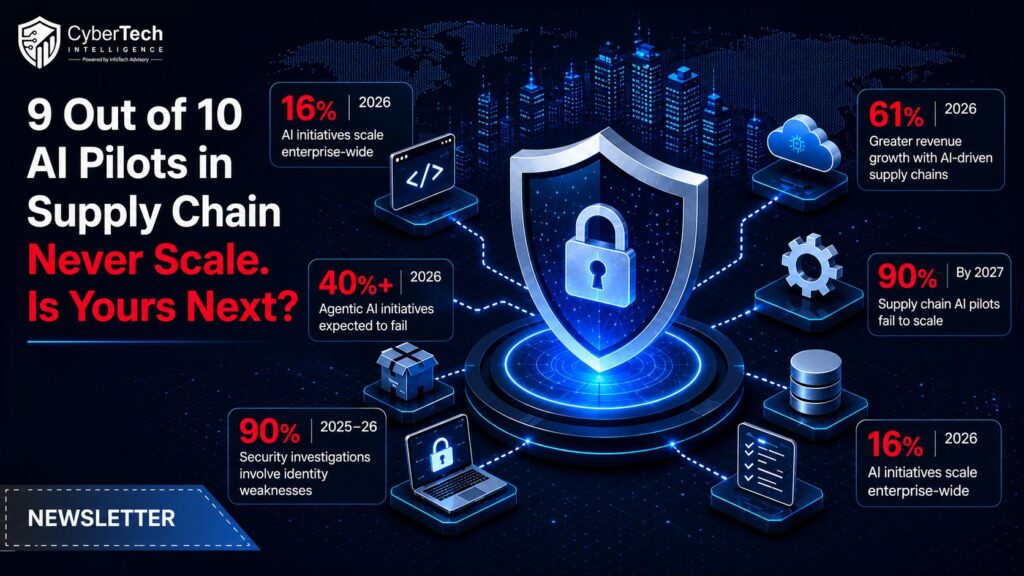
The research on why AI pilots fail to scale has reached a level of precision that supply chain leaders can no longer attribute to their own unique circumstances. IBM’s analysis of enterprise AI initiatives (April 2026) is direct: Gartner predicts that by 2027, over 40% of agentic AI initiatives will fail, with the primary failure modes being high costs, unclear value definition, and weak risk controls rather than technology inadequacy. ²
IBM’s own CEO study, referenced at Think 2026 in May, found that only 25% of AI initiatives deliver expected ROI and just 16% scale enterprise-wide. ³
The failure pattern is consistent: the pilot runs in a curated environment with dedicated resources, generates compelling results, and then encounters the real enterprise, with fragmented data, legacy system dependencies, governance requirements, and operational complexity that the pilot was never designed to handle.
IBM’s Chief Data Officer at Think 2026 named the two failure modes that appear most consistently: data that is too fragmented and siloed to feed AI at enterprise speed, and governance that is bolted on too late to matter. ⁴
For supply chain leaders, both of these failure modes are structural, which means they cannot be resolved by running a better pilot. They require a fundamentally different approach to how AI is deployed from the first day of investment.
KEY FIGURES AT A GLANCE
Fewer than 1 in 10 supply chain leaders have successfully scaled AI across operations (GEP / UVA Darden Research — June 2026) ¹
Only 16% of AI initiatives have scaled enterprise-wide (IBM CEO Study — May 2026) ³
61% greater revenue growth reported by organizations with higher AI-driven supply chain investment (IBM — January 2026) ⁵
What GEP’s Research Reveals About the Performance Elite
GEP’s research with UVA Darden, conducted across approximately 200 supply chain executives, identifies a specific group the study calls the Performance Elite: the small percentage of organizations that have moved beyond AI pilots to deliver real, enterprise-level impact, doubling productivity, reducing errors, and accelerating decision-making at scale.
What separates the Performance Elite from the rest is not the sophistication of their AI models. It is the operational discipline with which they have redesigned supply chain workflows around what GEP calls Intelligent Value Streams, end-to-end process architectures that connect AI capability to business outcomes across the entire supply chain, rather than deploying AI as a point solution within a single function.
GEP’s platform is built precisely to enable this model. GEP SMART and GEP NEXXE are not AI tools added to existing supply chain processes. They are the native intelligence infrastructure that allows organizations to run procurement, sourcing, planning, and logistics as a connected, continuously intelligent system where AI agents can reason over real data, take action across workflows, and deliver measurable outcomes without the manual reconciliation that defeats most pilot-to-scale transitions.
The webinar on June 10 makes this framework concrete. Attendees leave with the specific operational blueprint that the Performance Elite have used to move from experimentation to execution, structured around the practical decisions that CIOs and CSOCs need to make in the next 90 days.
IBM: The organizations That Scale Have Redesigned How Work Gets Done
IBM’s analysis of the pilot-to-scale challenge (April 2026) frames the solution with precision that maps directly onto GEP’s research findings. IBM’s Agentic AI Governance Playbook states explicitly: scaling agentic AI requires aligning value, governance, architecture and people in a single operating model. ²
organizations that treat these four dimensions separately, deploying AI into existing workflows without redesigning the workflows themselves, consistently hit the same scale ceiling.
IBM’s data on supply chain AI performance reinforces the return that awaits organizations that crack the scaling problem. organizations with higher investment in AI-driven supply chain operations reported revenue growth 61% greater than their peers, and 62% of supply chain leaders recognise that AI agents embedded into operational workflows accelerate speed to action, hastening decision-making, recommendations, and cross-functional response. ⁵
The gap between that 61% revenue advantage and a stalled pilot is entirely determined by whether the organization made the operating model changes that IBM, GEP, and every credible research organization in 2026 identified as the prerequisite for scale.
Microsoft: Frontier Firms Are Moving Beyond Isolated Use Cases
Microsoft’s Dynamics 365 research (May 2026) identifies the specific operational shift that characterises the organizations scaling supply chain AI successfully. Frontier firms, as Microsoft describes them, are moving beyond isolated AI use cases and focusing on how decisions and actions connect and orchestrate across end-to-end processes, with real-time signals enabling proactive risk management before disruptions impact orders, production, or customer commitments. ⁶
Gartner predicts that 60% of supply chain disruptions will be resolved without human intervention by 2031, but the organizations that capture that capability are exclusively those who have made the platform and workflow redesign decisions now. ⁶
Microsoft’s own Supply Chain 2.0 deployment data documents what that looks like in practice: Uniper automated material and service procurement with proactive agentic workflows that ensure timely material availability, while a global pharmaceutical company unified fragmented logistics data into an agentic return process, unlocking multi-million euro annual productivity gains. Neither result came from a better pilot. Both came from an end-to-end redesign of how the supply chain operates. ⁷
GEP’s platform connects to enterprise architectures like these, providing the unified procurement and supply chain intelligence layer that makes agentic orchestration possible across the full scope of direct and indirect spend.
Cisco: Scaling AI Requires Governing What You Cannot Yet See
For CIOs managing the technology architecture that supply chain AI scale depends on, Cisco’s February 2026 research on agentic AI security surfaces a challenge that most organizations encounter only after they have already committed to scaling.
Cisco’s State of AI Security 2026 report identifies the defining risk of rapid AI deployment without governance architecture: supply chains are growing in complexity, often without proper controls and governance, and autonomous AI agents are proliferating across critical workflows, often without accountability being ensured. ⁸
Cisco’s AI Defence platform, expanded in February 2026 with its largest-ever update, introduces AI Bill of Materials capability, providing centralised visibility and governance over every AI asset across the enterprise, covering what it is, where it came from, and how it behaves as it interacts with enterprise systems and third-party services. ⁹
The supply chain AI programmes that have scaled successfully in 2026 are the ones that embedded governance into the deployment architecture from the first agent. Those that bolt governance on after scaling discover that the cost of retrofitting accountability into a live, autonomous system is significantly higher than the cost of building it in from the start.
Palo Alto Networks: The Attack Surface Scales With Every Agent You Deploy
The security dimension of the supply chain AI scale is documented with unusual precision by Palo Alto Networks’ Unit 42 Global Incident Response Report 2026, drawing on over 750 major incidents across 50 countries between October 2024 and September 2025.
The report identifies software supply chain risk as a defining force of 2026: attackers are exploiting SaaS integrations, vendor tools, and application dependencies to bypass enterprise perimeters at scale, with identity weaknesses factoring into nearly 90% of Unit 42 investigations. With attacks now 4x faster, reaching data exfiltration in just 72 minutes, the window for detecting a breach through a supply chain system integration is narrower than most security teams can currently match. ¹⁰
Separately, Palo Alto Networks’ State of Cloud Security Report 2025 (December 2025) found that 99% of organizations experienced at least one attack on their AI systems within the past year, with tool sprawl creating fragmented data and context gaps that directly slow incident response. ¹¹
Every supply chain AI agent added to the enterprise environment without a governed security architecture is an exposure that scales with the deployment. The organizations scaling successfully have treated this as a first-principle design decision, not an afterthought.
What the June 10 Webinar Delivers
GEP and Supply Chain Now designed this webinar for the supply chain and enterprise technology leaders who have moved past the question of whether to invest in AI and are now facing the harder question of how to make it actually work across their organizations.
The session, will be hosted by Scott Luton and Karin Bursa with GEP and UVA Darden researchers, delivers the specific findings from 200 supply chain executives on why most AI initiatives stall, the operational discipline the Performance Elite have applied to break out of pilot purgatory, where AI is actually working in supply chain today and where it continues to fail, and the practical blueprint for moving from experimentation to execution at scale using GEP’s Intelligent Value Stream framework.
Nine out of ten AI pilots in the supply chain never scale. The webinar on June 10 is built to make sure yours is the exception.
Register Now: From AI Pilots to Performance: How Supply Chain Leaders Are Scaling Agentic AI Presented by GEP | Hosted by Supply Chain Now | Wednesday, June 10, 12 Noon ET
Register Here
References
- Supply Chain Now / IntentTechInsights — From AI Pilots to Performance: How Supply Chain Leaders Are Scaling Agentic AI — June 2026
- IBM — Agentic AI Governance Playbook — 6 April 2026
- IBM — Why Most Enterprise AI Projects Stall Before They Scale — 9 April 2026
- IBM Think 2026 — Shaping the Next Era of Agentic AI — May 2026
- IBM — AI Agents in Supply Chain — 30 January 2026
- Microsoft Dynamics 365 Blog — From Intelligence to Impact: How Agentic AI Is Reshaping Today’s Supply Chain — 4 May 2026
- Microsoft Cloud Blog — Supply Chain 2.0: How Microsoft Is Powering Simulations, AI Agents, and Physical AI — 24 March 2026
- Cisco Blogs — Cisco State of AI Security 2026 Report — 19 February 2026
- Cisco Newsroom — Cisco Redefines Security for the Agentic Era with AI Defense Expansion and AI-Aware SASE — 10 February 2026
- Palo Alto Networks — 2026 Unit 42 Global Incident Response Report — 17 February 2026
- Palo Alto Networks — State of Cloud Security Report 2025 — 16 December 2025
🔒 Login or Register to continue reading