Published for RETHINK Retail, where the world’s most consequential retail leaders come to think clearly, act decisively, and stay ahead of what is coming next.
Inventory problems are not new to retail. Out-of-stocks, overstock write-offs, inaccurate shelf counts, and slow replenishment cycles have cost retailers margin for decades. What is new in 2026 is the scale of the gap opening up between the retailers who have operationalized connected store technology and those still managing inventory the same way they did ten years ago.
RETHINK Retail tracks this gap closely. Through its webinars, research curation, and practitioner community, RETHINK Retail gives retail leaders the clearest possible view of where the industry is moving and what it actually takes to move with it. The evidence from the world’s most authoritative IT and cybersecurity enterprises is unambiguous: connected stores that get inventory right are outperforming those that do not, and the distance between the two is compounding every quarter.
Inventory Inaccuracy Is Bleeding Margin Every Day
Before understanding how connected stores solve the inventory problem, it helps to understand how severe it actually is.
Microsoft’s Cloud Blog (January 2026) puts a direct number on the cost: inventory inaccuracies account for 4% to 8% of lost sales across frontline retail environments. For a $500 million retailer, that is up to $40 million in annual revenue disappearing, not because of demand failure, but because the store did not know what it had, where it was, or when to replenish it. ¹
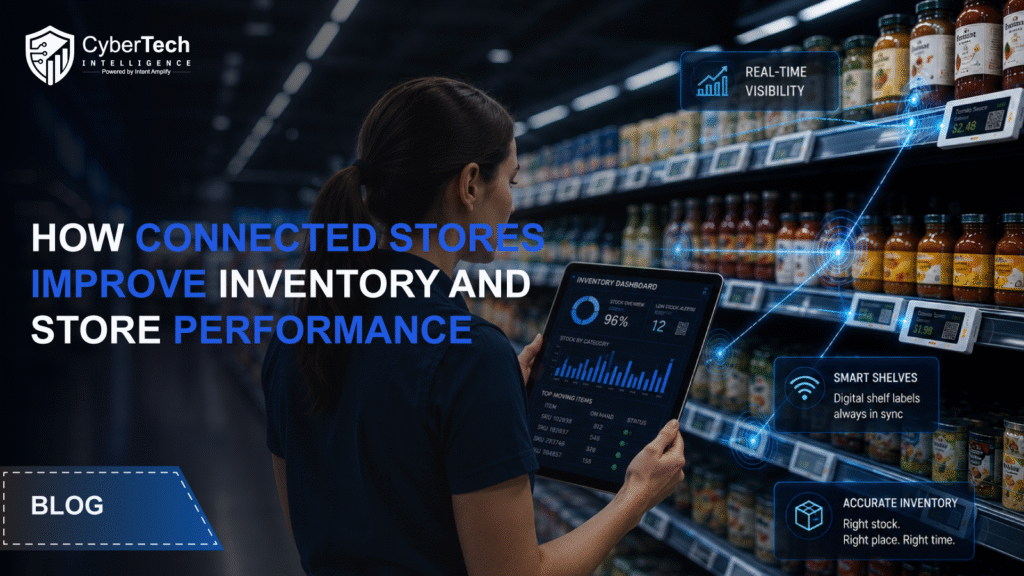
IBM’s AI in Retail insight (November 2025) describes the mechanism: IoT sensors and cameras can detect stock levels in real time, alerting staff when products need replenishment and removing the lag between an empty shelf and a restocked one. ²
When that loop closes from hours to minutes, the impact compounds across every category, every aisle, and every store in the network.
This is precisely the kind of intelligence RETHINK Retail surfaces for its community. Not what connected stores could theoretically do, but what they are measurably delivering right now, in live retail environments, documented by the enterprises building and operating them.
Microsoft: Frontline Task Automation Reclaims Hours Per Store
The time frontline retail associates spend on repetitive, low-value inventory tasks, manual stock checks, policy lookups, and replenishment scheduling is time not spent serving customers. Connected store platforms change that calculation directly.
Microsoft’s Forrester Total Economic Impact study (May 2026) found that frontline task automation covering price updates, inventory checks, and information lookup delivered 9 to 15 hours of time savings per store per month. Across a network of 300 stores, that is between 2,700 and 4,500 hours reclaimed every month, redirected from manual processes to customer-facing work. ³
The same study projects that AI-driven demand forecasting and inventory optimisation delivered $3M to $6.3M in three-year benefits, driven by higher forecast accuracy, better buying decisions, and earlier detection of demand shifts. ³ These are not aspirational projections. They are Forrester-verified outcomes from retailers already running these systems at scale.
Microsoft’s store operations agent template, now in public preview, gives store associates natural-language access to inventory data, policies, and operational insights, recommending next-best actions based on real-time signals including weather, local events, and sales trends. ⁴ The store does not just react to what is happening. It anticipates what is coming.
RETHINK Retail members engage with these outcomes directly, through peer conversations with retail leaders who have deployed agentic AI into live store operations and can speak honestly about what the numbers look like in practice, not just in a vendor study.
Google Cloud: Real-Time Inventory Visibility From the Shelf to the Back Office
Inventory intelligence is only as good as the speed at which it travels. A nightly batch update of stock levels tells you what the store looked like at midnight. A real-time connected shelf tells you what it looks like right now.
Google Cloud’s Agentic Commerce Era report (January 2026) documents Honeywell’s Smart Shopping Platform, built in partnership with Google Cloud and powered by Gemini, which transforms the physical store into an intelligent environment, providing retailers with real-time insights into in-store compliance, inventory accuracy, and associate productivity. ⁵
The platform bridges the data gap between the shelf and the back office, allowing stores to operate with the same inventory precision that online channels have delivered for years.
Google Cloud’s edge AI infrastructure enables retailers to process inventory data locally at the store level, ensuring zero latency even when store connectivity is unstable, with data federated into a central system for network-wide visibility. ⁶
That local processing capability is what makes real-time inventory monitoring operationally reliable in the environment of a busy retail store, not just in a controlled pilot.
Understanding how to make this architecture work across a large and varied store estate is the kind of question RETHINK Retail’s practitioner community is built to answer, from leaders who have made these infrastructure decisions and can explain what held up under pressure and what did not.
Cisco: The Network That Keeps Inventory Systems Running Under Pressure
Every connected inventory system depends on a network layer that can carry the load. Sensors, smart shelves, RFID readers, cameras, and AI workloads all compete for bandwidth. When the network slows, inventory intelligence slows with it.
Cisco’s State of Wireless 2026 report, based on interviews with 6,098 wireless decision-makers across 30 markets (April 2026), found that 84% of retail organisations report improved operational efficiency and 80% report improved employee productivity from wireless investment. Organisations that address complexity, security, and talent together achieve 4x stronger wireless ROI, and AI-driven automation reclaims 850+ hours per IT practitioner annually. ⁷
97% of retail organisations report rising operational complexity driven by IoT, IT, and OT workloads. ⁷ Connected inventory systems add meaningfully to that complexity. The network infrastructure decision and the inventory platform decision are not separate choices. They are the same choice, and retailers who treat them as such see compounding returns. The retailers who treat them separately keep paying integration costs without building a structural advantage.
Palo Alto Networks: Securing the Inventory Data That Drives Every Decision
Connected inventory systems generate and transmit sensitive operational data continuously. That data, stock levels, replenishment triggers, pricing signals, and supplier feeds, is high-value and exposed.
Palo Alto Networks’ 2025 Device Security Threat Report, based on telemetry from over 27 million connected devices across 1,803 enterprise networks, found that 48.2% of all IoT device connections to company IT systems originate from high-risk devices. Additionally, 77.74% of enterprise networks have poor segmentation, meaning a compromised shelf sensor can potentially reach systems far beyond the store floor. ⁸
For retail specifically, 72% of retailers report being hit by a cyberattack via one or more IoT devices in the past year. ⁹
An inventory system that can be compromised is not an efficient asset. It is a liability. Zero Trust device security, treating every connected sensor and shelf as a potential risk with full visibility and enforcement, is the foundation that makes connected inventory operationally trustworthy at scale.
What This Means for Retail Leaders Right Now
Connected stores improve inventory and store performance by closing the gap between what is on the shelf and what the system knows, in real time, across every location. The technology to do this is mature. The evidence that it works is well-documented and growing more compelling every quarter.
What separates the retailers capturing these benefits from those still chasing them is not access to better tools. It is platform thinking, operational readiness, and security architecture. It is also the quality of the conversations retail leaders are having, the peers they are learning from, and the intelligence they are working with.
That is the role RETHINK Retail plays for its community. Not a vendor showcase. Not a media outlet. A trusted destination where retail leaders get honest, practitioner-driven intelligence on what is working, what the data actually says, and where to focus investment to build the kind of operational advantage that compounds over time.
Inventory performance is not a technology problem. It is a leadership and execution problem. RETHINK Retail exists to help leaders solve it.
Explore more at RETHINK Retail: https://rethink.industries
References
- Microsoft Cloud Blog — Frontier Transformation in Retail: How Agentic AI Robots Are Redefining Store Experiences — 20 January 2026
- IBM — AI Inventory Management — January 2026
- Microsoft Cloud Blog — Agentic AI Is Reshaping Retail and Consumer Goods Economics — 21 May 2026
- Microsoft — Microsoft Propels Retail Forward with Agentic AI Capabilities — 8 January 2026
- Google Cloud — A New Era of Agentic Commerce Is Here — 11 January 2026
- Google Cloud Blog — How Inference at the Edge Unlocks New AI Use Cases for Retailers — 13 January 2025
- Cisco — 5 Wireless Trends Retail IT Teams Can’t Ignore in 2026 — 15 April 2026
- Palo Alto Networks Blog — 2025 Report Exposes Widespread Device Security Risks — 29 October 2025
- Palo Alto Networks — IoT Security for the Retail Industry — 2025
🔒 Login or Register to continue reading