Curated exclusively for RETHINK Retail, where the world’s most consequential retail leaders find the intelligence, peer perspective, and honest conversation they need to lead what comes next.
There is a version of the connected store conversation that stays safely abstract. Technology roadmaps. Integration diagrams. ROI projections that look compelling in a slide deck and considerably less compelling eighteen months into a rollout that never quite hit its stride.
There is then the dialogue that retail executives are engaged in, the discussion which RETHINK Retail seeks to uncover and make public in 2026. It is more focused, more blunt, and significantly more valuable. It is one where the dialogue begins from not what the technology could achieve, but rather what the companies implementing it at scale have learned, and what others who haven’t yet figured out the key have been missing.
This expert insights piece draws on the most current thinking from the leaders of Microsoft, IBM, Cisco, Google Cloud, and Palo Alto Networks to distil what successful retail leaders already know about connected store success, and what the rest of the industry still needs to hear.
The Technology Is Ready. The Organisation Is the Variable.
The most important thing successful retail leaders know about connected store success is that the gap between a working pilot and a scaled platform is rarely a technology problem. It is an organisational one.
IBM Chairman and CEO Arvind Krishna made this point with characteristic directness at IBM Think 2026 in May: “The enterprises pulling ahead are not deploying more AI. They are remaking the way their business works.” ¹
This is an important point to make in relation to the retail sector, because the impact of connecting retail stores permeates all areas of business at once: retail operations, logistics, merchandising, people management, and customer engagement. The difference between the two approaches is that the former has remodelled their business processes around the technology, while the latter has just added new technology to existing processes.
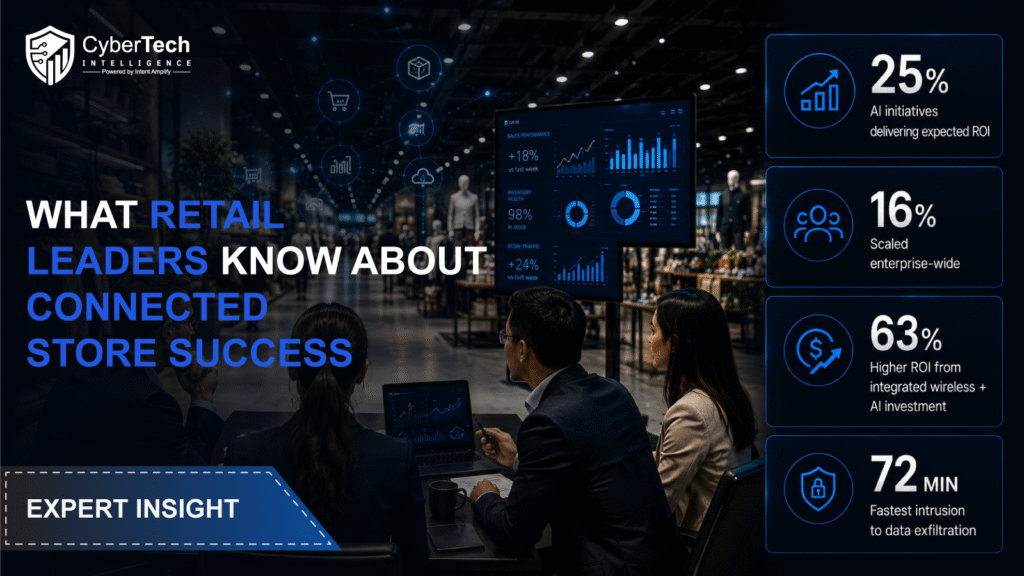
IBM’s own CEO study confirms how rare that operating model discipline actually is: only 25% of AI initiatives deliver expected ROI, and just 16% have scaled enterprise-wide. ²
That is not a technology failure rate. It is a leadership and governance failure rate. The successful retail leaders know this, which is why their first conversation about connected store investment is about organisational readiness, not vendor selection.
“Intelligence That Reaches Every Corner of the Value Chain”
At NRF 2026 in January, Kathleen Mitford, Corporate Vice President of Global Industry at Microsoft, articulated the connected store success thesis in terms that every retail leader should carry into their next planning cycle: “The retailers that thrive will be the ones that unify their business with intelligence that reaches every corner of the value chain.” ³
That word, unify, is doing significant work. The retailers who are generating the strongest connected store returns in 2026 are not running more technology than their competitors. They are running more coherent technology, platforms rather than point solutions, architectures built to compound rather than accumulate. Microsoft’s Forrester Total Economic Impact study (April 2026) documented what that coherence delivers: 124% to 282% ROI over three years, with $14M to $23.9M in total three-year benefits for retailers scaling across marketing, supply chain, and store operations together. ⁴
The study also surfaced a finding that retail executives rarely talk about openly, but that successful leaders have clearly internalised: organisational factors drive more than 2x the AI impact of individual capability. The platform decision matters. The operating model decision matters more. ⁴
Retail executives who attended NRF 2026 heard this theme echoed across the industry. As one retail executive quoted in Microsoft’s industry blog put it: “AI tools can free up front-line employees to prioritise tasks that require a human touch, such as engaging with customers and designing stores.” ⁵
The connected store, in other words, is not a technology replacement programme. It is a workforce transformation programme enabled by technology, and the leaders who understand that distinction are the ones generating the returns.
“You Have Moved Beyond the Pilot”
At Google Cloud Next 2026 in April, CEO Thomas Kurian opened the conference with a statement that defined where the industry’s leading organisations now stand: “You have moved beyond the pilot. The experimental phase is behind us. And now the real challenge begins: how do you move AI into production across your entire enterprise?” ⁶
That framing is instructive precisely because of what it does not say. It does not ask whether to invest in connected store technology. It assumes that a decision has been made. It asks, instead, what it takes to run it at enterprise scale, reliably, across every location, under the operational pressure of real store environments.
The retailers who have answered that question on Google Cloud’s platform are visible, and their results are documented. The Home Depot, building on a decade-long partnership with Google Cloud, is using Gemini Enterprise to deliver product expertise to every customer across every channel at any hour. Walmart has deployed Gemini Enterprise internally to help store and supply chain team leaders access business data faster. Macy’s built a conversational AI shopping assistant in just four weeks. These are not proof-of-concept deployments. They are production systems generating operational returns at enterprise scale. ⁷
Google Cloud’s 2026 ROI of AI in Retail report, based on 585 senior retail and CPG leaders, confirms where compounding returns are being found: personalisation, inventory optimisation, demand forecasting, associate productivity, and operational automation, all connected through a unified agent architecture that processes intelligence where retail actually happens, at the store level, in real time. ⁸
The Network Multiplier That Most Retailers Are Still Underestimating
Successful retail leaders know something that organisations still running legacy network infrastructure are still discovering at cost: the wireless network is not a utility layer. It is a strategic asset, and the retailers treating it as one are generating measurably stronger connected store returns than those that are not.
Cisco‘s State of Wireless 2026 report, based on interviews with 6,098 wireless decision-makers across 30 markets (April 2, 2026), quantifies the multiplier effect with precision. Organisations investing holistically in wireless alongside AI, automation, and security achieve 63% higher average ROI than those that do not. ⁹
84% of retail organisations report improved operational efficiency, and 80% report improved employee productivity from strategic wireless investment. ¹⁰
The Cisco data also surfaces a warning that retail IT leaders need to carry directly into their next infrastructure conversation. 98% of retail organisations report rising operational complexity driven by IoT, IT, and OT workloads. ¹⁰
87% face visibility gaps that impair wireless troubleshooting. And 58% have already incurred financial losses from wireless security incidents, with more than half of those losses exceeding $1 million annually. ⁹
The lesson successful retail leaders have drawn from this data is straightforward. The network investment decision and the connected store investment decision are not sequential. They are simultaneous. You cannot scale a connected store on infrastructure that was designed for a simpler operational environment.
“Security Is Solvable. But Only If You Treat It That Way From Day One.”
Wendi Whitmore, Chief Security Intelligence Officer at Palo Alto Networks, framed the 2026 security challenge for retail leaders clearly: “While attackers utilise AI to scale and accelerate threats across a hybrid workforce, defenders must counter that speed with intelligent defence.” ¹¹
That asymmetry is what makes security the pillar that most connected store programmes underestimate until they cannot afford to. Every device added to a connected store estate expands the attack surface. Every new IoT sensor, smart shelf, and edge node is an opportunity for a threat actor to find a gap that was not designed out of the architecture.
According to Unit 42 Global Incident Response Report 2026, produced by Palo Alto Networks, looking at more than 750 incidents spanning 50 nations from October 2024 to September 2025, the risk is turning into reality very quickly. Incidents have increased four times from the previous year, with the quickest taking only 72 minutes to reach data exfiltration. 65% of initial access is identity-driven. 87% of attacks unfold across multiple attack surfaces simultaneously. ¹²
The most important insight from the Unit 42 team’s 2026 research is one that the retail leaders scaling connected stores most successfully have already acted on: in more than 90% of breaches, preventable gaps materially enabled the intrusion. ¹²
As the Palo Alto Networks Unit 42 team puts it directly in the report: “Security is solvable.” The organisations that treat security as an architectural foundation rather than a retrofit are the ones that scale without incident. The ones that treat it as an afterthought are the ones generating the data points in next year’s incident response report.
For retail leaders, 72% of whom report being hit by a cyberattack via IoT devices in the past year ¹³, the lesson is direct: Zero Trust device security is not a future goal. It is the current baseline for any connected store programme that expects to scale safely.
What the Leaders Know That the Rest Are Still Learning
Bringing together the expert perspective from Microsoft, IBM, Cisco, Google Cloud, and Palo Alto Networks, a clear picture emerges of what the retail leaders who have cracked connected store success at scale know that the rest of the industry is still learning.
They know that the platform decision is more important than the technology decision. They know that the network investment is not a cost to be minimised but a multiplier to be maximised. They know that security architecture built before the first device is deployed is orders of magnitude cheaper than security retrofitted after the second breach. They know that governance and operating model redesign determine whether AI returns compound or plateau. And they know that 83% of CEOs confirm AI success depends more on adoption than on the technology itself. ¹⁴
Above all, they understand that success for connected stores is not a one-person show. The insights provided above will be made much more effectively, efficiently, and with more confidence by retail executives who are privy to honest peer-level insights from organizations that have faced the same obstacles and have no trouble articulating what succeeded and what didn’t.
This is the essence of RETHINK Retail. By providing unique insights through its webinars, community, and intelligence services, RETHINK Retail provides the peer-level insights that enable retail executives to translate good intentions into practice.
Explore more at RETHINK Retail: https://rethink.industries
Join RETHINK Retail’s Connected Store at Scale Webinar: https://intenttechpub.com/webinar/the-connected-store-at-scale-from-tech-hype-to-operational-reality/
References
- theCUBE Research — IBM Think 2026: Arvind Krishna’s Keynote — 5 May 2026
- IBM — How to Maximize AI ROI in 2026 — 19 February 2026
- Microsoft — Microsoft Propels Retail Forward with Agentic AI Capabilities — 8 January 2026
- Microsoft Cloud Blog — Agentic AI Is Reshaping Retail and Consumer Goods Economics — 21 May 2026
- Microsoft Industry Blog — Return on Intelligence: The Human Edge in an Agentic Era — 8 January 2026
- BizTech Magazine — Google Cloud Next 2026: Businesses Are Moving Into the Agentic Era — 23 April 2026
- Google Cloud — Next 26: Building the Agentic Enterprise — May 2026
- Google Cloud — ROI of AI in Retail and CPG — 2026
- Cisco — State of Wireless Report 2026 — 2 April 2026
- Cisco — 5 Wireless Trends Retail IT Teams Can’t Ignore in 2026 — 15 April 2026
- Cyber Magazine — Palo Alto Networks: The New Rules of Cybersecurity in 2026 — 7 January 2026
- Palo Alto Networks — 2026 Unit 42 Global Incident Response Report — 17 February 2026 https://www.paloaltonetworks.com/blog/2026/02/unit-42-global-ir-report/
- Palo Alto Networks — IoT Security for the Retail Industry — 2025
- IBM Newsroom — IBM Study: Businesses View AI Agents as Essential, Not Just Experimental — 10 June 2025
🔒 Login or Register to continue reading