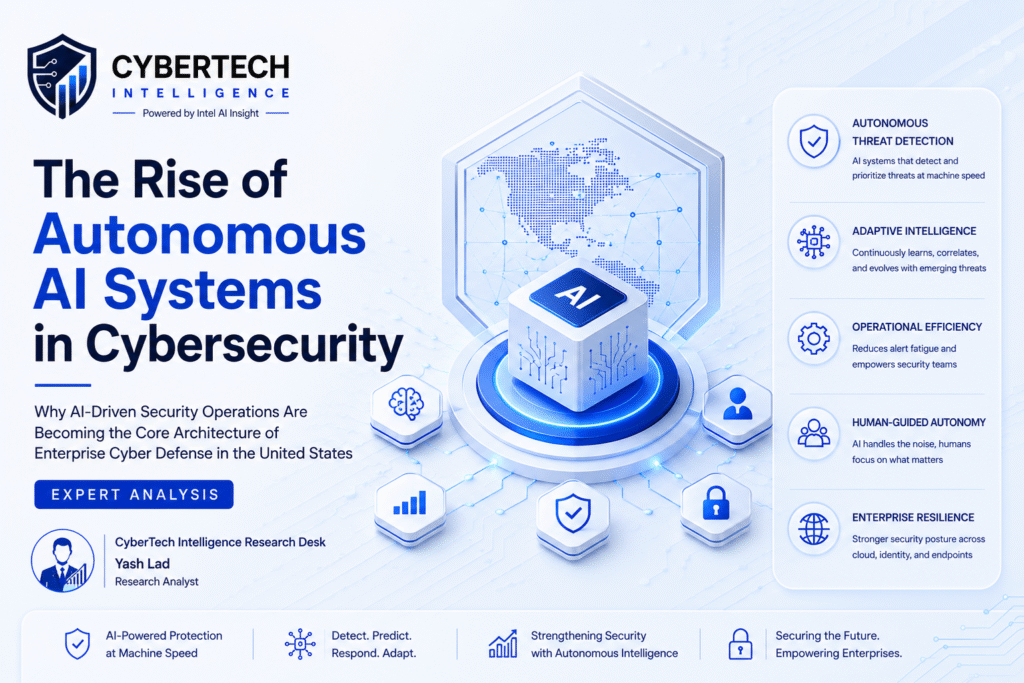
Why AI-Driven Security Operations Are Becoming the Core Architecture of Enterprise Cyber Defense in the United States
Enterprise-level cybersecurity is entering a fundamental transition due to advances in AI, operational stress, and increasingly identity-based threats. Over the past nine months, U.S. enterprises have significantly increased spending on self-driving AI cybersecurity tools to address limitations of legacy Security Operations Centers.
This shift is no longer theoretical.
As pointed out by Microsoft in its Digital Defense report for 2024, the company has started dealing with more than 78 trillion security alerts each day while tracking over 600 million cyber attacks on a daily basis worldwide. The latest cyber defense statistics released by Microsoft in 2024 indicate that there are about 7,000 attacks against passwords every second.1
Enterprise cybersecurity teams face several operational implications in relation to the findings.
Conventional SOC designs assumed a world where alerts were manually analyzed, incidents correlated, and remediation steps coordinated using disparate security applications. That operating model is rapidly becoming unsustainable in AI-driven threat environments where attacks increasingly operate at machine speed.
Autonomous AI systems have become a key enterprise solution for this disparity.
Unlike conventional automation, autonomous AI can analyze telemetry data, prioritize threats, correlate attack patterns, suggest and execute defenses with minimal human involvement.
In essence, the transition from conventional to autonomous AI systems is revolutionizing cybersecurity approaches in American businesses.
Enterprise SOCs Are Approaching Operational Saturation
Modern enterprise environments now consist of highly distributed digital ecosystems spanning:
- Multi-cloud infrastructure
- SaaS platforms
- Hybrid workforces
- APIs and microservices
- Machine identities
- Operational technology (OT)
- IoT-connected systems
- AI-enabled enterprise applications
Each environment continuously generates massive amounts of telemetry that security teams must monitor and interpret in near real time.
Consequently, the effect is an immense amount of operational pressure within the enterprise SOCs. According to the latest 2025 research on enterprise cyber resilience, over 50% of security professionals believe alert fatigue to be one of their primary operational issues, whereas around 60% of businesses state that fragmented security solutions have a considerable negative impact on the performance of the SOCs. In addition, more than 55% of the cybersecurity personnel still struggle with understaffing.2
At the same time, the financial impact of cyber incidents continues to rise sharply.
IBM’s 2024 breach analysis found that:
- The mean cost for a data breach in the United States in 2024 was $9.36 million, the highest globally
- The mean cost for a global data breach increased to $4.88 million in 2024
- Companies making extensive use of automation reduced the mean cost of a breach by $2.22 million in 2024
- Security resource shortages added approximately $1.76 million to the mean cost of a data breach in 2024
- The mean data breach lifecycle was 258 days in 2024.3
Healthcare breach costs have once again surpassed the $10 million mark for the 14th consecutive year, further highlighting the connection between operational problems and enterprise risks.
It appears that enterprise executives will be forced to rethink the economics of their cybersecurity operations.
Autonomous AI Is Redefining Security Operations Architecture
Cybersecurity automation has been around for some time now. Security Orchestration, Automation, and Response (SOAR) solutions and scripting have been utilized for many years. Traditional automation technologies continue to rely heavily on preprogrammed rules and human intervention.
Self-governing AI systems operate on an entirely different paradigm.
AI-enabled cybersecurity solutions today increasingly integrate:
- Large Language Models (LLMs)
- Behavioral analytics
- Reinforcement learning
- Graph intelligence
- Threat intelligence correlation
- Generative AI copilots
- Continuous telemetry reasoning engines
They can dynamically understand the context of enterprise security and change their approach in almost real-time.
In Accenture’s study on the state of cybersecurity resilience by 2025, only 10% of firms in 2025 can showcase their preparedness for using AI-based cybersecurity services. On the other hand, 63% of organizations in 2025 are vulnerable to AI-enabled cyberattacks due to shortcomings in modernization and resilience. In addition, 77% of firms in 2025 fail to have enough AI governance and data security maturity models. 4
In the same study conducted by Accenture, organizations that had developed mature AI-powered cybersecurity strategies faced a 69% lower chance of cyberattacks in 2025 when compared to immature companies.
The significance of these results goes beyond efficiency.
AI-driven cybersecurity is increasingly becoming a resilience differentiator capable of influencing regulatory readiness, cyber insurance posture, business continuity, and enterprise trust.
Identity Security Has Become the Central AI Battlefield
Identity compromise is now the dominant attack vector across enterprise environments.
Microsoft’s 2024 threat intelligence findings revealed that more than 99% of enterprise identity attacks in 2024 remained password-based, while cloud identity targeting continued increasing sharply across ransomware and nation-state campaigns throughout 2024.5
This shift is redefining enterprise defense priorities.
Autonomous AI systems are particularly effective in identity-centric environments because they continuously analyse:
- Authentication patterns
- Device trust signals
- Behavioral anomalies
- API activity
- Privilege escalation
- Lateral movement indicators
- Access deviation patterns
As seen from the recent Unit 42 cloud threat intelligence reports, almost 80% of all cloud security vulnerabilities detected in 2025 were due to permission problems or identity flaws, while over 45% of all cloud attacks analyzed in 2025 had compromised credentials. Another trend noted in 2025 was the increased use of AI in phishing attacks on enterprises.6
This explains why identity security is rapidly becoming one of the most strategically important areas in autonomous cybersecurity investment.
As zero-trust architectures mature, AI-driven identity protection is increasingly evolving into the primary operational control plane for enterprise cyber defense.
The Economic Case for Autonomous Cybersecurity Is Becoming Overwhelming
The rapid rise of autonomous cybersecurity systems is being driven not only by threat escalation but also by operational economics.
Enterprise security leaders are now balancing:
- Rising cyberattack volumes
- Expanding compliance obligations
- Cyber insurance scrutiny
- Persistent cybersecurity talent shortages
- Board-level pressure for operational efficiency
- Increasing expectations around resilience maturity
Traditional SOC expansion models are becoming financially difficult to sustain.
Autonomous AI systems offer enterprises a mechanism for scaling defense capabilities without proportionally increasing operational headcount.
Generative AI and autonomy have been identified among the fastest-growing sectors for enterprises to invest in during 2025. Presently, enterprise estimates suggest that the contributions made by generative AI to the global economy can amount to anywhere from USD 2.6 trillion to USD 4.4 trillion every year up to 2030.7
Cybersecurity represents an application of AI with extremely high value due to its impact on:
- Protection of finances
- Continuity of business
- Compliance resilience
- Scalability of operations
- Trust in enterprises
Additional enterprise threat intelligence research reinforces this shift.
As per CrowdStrike’s findings for the year 2025, cloud-aware threat activities have seen a rise of 26%, while the time taken for adversaries to break out from their systems has been reduced to just 48 minutes on average. Additionally, there have been several identity-based attacks as well as social engineering attacks using AI within enterprises.8
However, recent intelligence reports by Google Cloud and Mandiant show that the use of artificial intelligence-based reconnaissance and credential exploitation is increasing in the cloud-native enterprise world. 9
It is one of the biggest catalysts for machine-speed cybersecurity investments.
The Future SOC Will Operate Through Human-Guided Autonomy
Despite growing automation, autonomous cybersecurity does not eliminate human analysts.
Instead, it transforms their role.
Enterprise cybersecurity is increasingly evolving toward a “human-guided autonomy” model where:
- AI systems manage high-volume telemetry analysis
- Analysts supervise autonomous workflows
- Humans validate remediation decisions
- Security teams focus on strategic investigations
- Analysts manage governance, escalation, and resilience oversight
AI-assisted SOC environments are already improving:
- Investigation speed
- Threat prioritisation
- Operational efficiency
- Analyst productivity
- Incident response scalability 10
Future SOC teams are expected to focus increasingly on:
- Adversarial simulation
- Threat modeling
- AI governance
- Resilience engineering
- Executive cyber advisory
- Strategic risk management
This evolution is likely to become one of the defining workforce shifts in enterprise cybersecurity over the next decade.
Autonomous AI Systems Also Create New Enterprise Risk Categories
While autonomous AI systems improve scalability and operational speed, they also introduce new categories of enterprise cyber risk.
Threat actors are increasingly experimenting with:
- Prompt injection attacks
- Model poisoning
- AI evasion techniques
- Autonomous malware adaptation
- Generative phishing campaigns
- AI-assisted reconnaissance
This creates a dual-use security environment where AI simultaneously becomes both a defensive capability and a new attack surface.
Federal AI governance guidance now emphasises the importance of:
- Explainability
- Auditability
- Transparency
- Human oversight
- AI validation
- Operational accountability11
AI governance has now become a mandatory tool for securing critical infrastructure, building resiliency, and building organizational trust.
On the other hand, the new SEC cybersecurity disclosure requirements, critical infrastructure protection measures, and government-led AI governance programs are leading to increased expectations around organizational cyber resiliency and transparency.
As a result, autonomous cybersecurity is moving up the corporate ladder from being a technology-driven effort to a governance-oriented one.
Autonomous Cybersecurity Is Becoming Core Enterprise Infrastructure
Cybersecurity discussions are increasingly moving beyond technical teams into executive strategy and board governance conversations.
Over 75% of executives are planning on increasing their spending on cybersecurity initiatives, and modernizing cybersecurity using AI remains one of the top enterprise resiliency initiatives for large enterprises. Enterprises that are making substantial investments in cyber resiliency initiatives also have greater assurance in operational resiliency and regulatory preparedness.12
This is just another facet of enterprise operations.
Cybersecurity systems with autonomy are becoming critical infrastructure components for:
- Operational Resilience
- Digital Trust
- Regulatory Preparedness
- Cloud Security
- Identity Governance
- Enterprise Continuity
The conversation is no longer whether AI will transform cybersecurity operations.
This brings us to the critical question of how soon organizations will be able to deploy autonomous defense models before their SOC infrastructure is rendered obsolete by the shift.
Conclusion
The advent of autonomous AI solutions is arguably one of the most profound structural transformations in modern cybersecurity.
The inability to cope with:
- AI-powered adversaries
- Expanding cloud ecosystems
- Identity-centric attacks
- Operational overload
- Machine-speed threat activity
Autonomous AI systems offer enterprises a fundamentally different cybersecurity model built around:
- Adaptive intelligence
- Continuous learning
- Contextual threat analysis
- Real-time operational reasoning
- Machine-speed response
- Scalable resilience
However, the future of cybersecurity will not be fully autonomous nor fully human-driven.
Instead, enterprise defense will increasingly depend on collaborative intelligence where autonomous AI systems and human expertise operate together to manage highly complex digital environments.
The organisations that establish this balance early will likely gain significant advantages in:
- Cyber resilience
- Operational scalability
- Regulatory readiness
- Incident response maturity
- Enterprise trust positioning
- Long-term competitive resilience
References
- Microsoft, Microsoft Digital Defense Report 2024, October 2024
Official Source - Accenture, State of Cybersecurity Resilience 2025, 2025
Official Source - IBM, Cost of a Data Breach Report 2024, July 2024
Official Source - Accenture, State of Cybersecurity Resilience 2025, 2025
Official Source - Microsoft, Identity and Threat Intelligence Findings – Microsoft Digital Defense Report 2024, October 2024
Official Source - Palo Alto Networks Unit 42, Cloud Threat Report 2025, 2025
Official Source - McKinsey & Company, Technology Trends Outlook 2025, 2025
Official Source - CrowdStrike, Global Threat Report 2025, February 2025
Official Source - Google Cloud & Mandiant, Threat Intelligence Resources, 2025
Official Source - Deloitte, Insights on AI and Cybersecurity, 2025
Official Source - NIST, Artificial Intelligence Risk Management Framework (AI RMF 1.0), 2024–2025 Reference Guidance
Official Source - PwC, Global Digital Trust Insights 2025, 2025
Official Source
🔒 Login or Register to continue reading