In today’s fast-paced digital landscape of cybersecurity, data processing has become an essential part of work. The ability to process data in real-time is no longer a luxury—it’s a necessity. As organizations work to unleash the power of their data, Functions as a Service (FaaS) emerges as a crucial option, enabling smooth integration of event-driven architectures (EDA) for effective data handling.
In the digital landscape, FaaS is increasingly recognized for its capability to handle real-time data processing through EDA. FaaS allows developers to execute code in response to specific events without the overhead of managing server infrastructure, making it an ideal choice for real-time data processing. Whether it’s analyzing user interactions, processing Internet of Things (IoT) sensor data, or detecting anomalies in financial transactions, FaaS empowers organizations to respond swiftly to changing conditions and optimize their operations effectively.
In this article, we are exploring various aspects of FaaS, such as how it leverages event-driven models to facilitate rapid data analysis and decision-making.
Overview of FaaS in Real-Time Data Processing
Function as a Service, or FaaS, is a serverless cloud computing model that facilitates the execution of code in response to events. This makes it especially useful for processing data in real-time. FaaS architecture allows developers to develop applications that respond dynamically to incoming data streams, enabling rapid and scalable responses to varying workloads. This makes it ideal for various use cases, such as real-time analytics, automated workflows, and IoT applications.
Recommended: Cybersecurity Simplified: What is Cybersecurity in 2025?
Key Features of FaaS for Real-Time Data Processing
1. Event-Driven Architecture (EDA)
FaaS operates on an event-driven model, where functions are triggered by specific events such as HTTP (Hypertext Transfer Protocol) requests, message queue events, or database changes. This model supports the creation of loosely coupled components that can independently process events, enhancing modularity and scalability. Moreover, this capability enhances workflow automation and responsiveness to real-time events.
2. Cost Efficiency
FaaS provides a cost-effective solution for developers, which works on a pay-per-user model that allows organizations to only pay for the compute time utilized during function execution. This approach is particularly beneficial for applications with irregular workloads, as it eliminates high costs associated with idle resources.
3. Real-Time Data Processing Capabilities
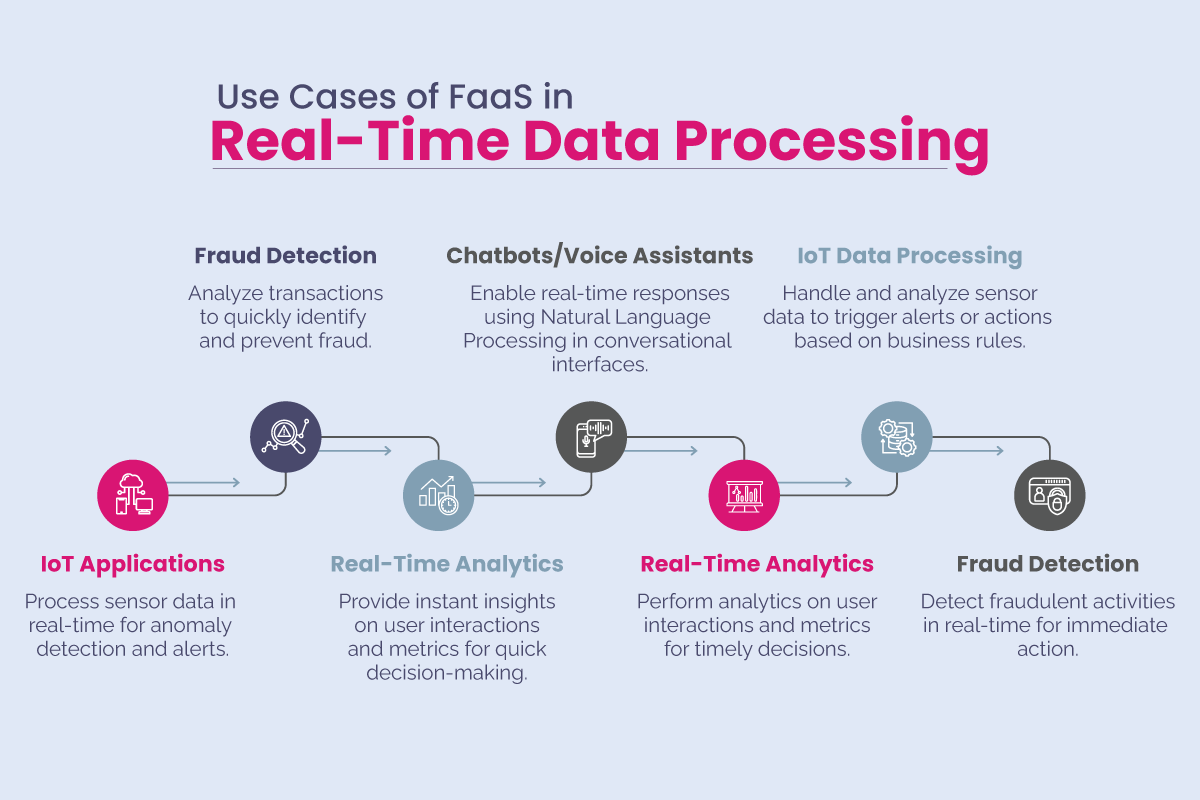
FaaS platforms are designed to efficiently read, analyze, and act on streaming data in real-time. It is highly effective at processing real-time data streams from various sources, such as IoT devices and event-driven applications. It analyzes incoming data, triggers alerts based on specific patterns, and performs necessary transformations or aggregations.
4. Scalability and Flexibility
FaaS allows automatic scalability to meet varying workloads without human intervention. In this, functions are invoked only when needed, allowing the platform to handle fluctuations in traffic efficiently. This implies that the platform can effectively manage the additional load by dynamically allocating resources at peak periods, such as periods of heavy traffic or spikes in sensor data. This dynamic scaling ensures optimal performance, eliminating the need for manual resource management.
5. Simplified Development and Maintenance
FaaS significantly simplifies the development and maintenance of applications by allowing developers to focus on coding instead of managing servers. This led to fast development and made app maintenance easier by abstracting infrastructure management without affecting the whole system. This leads to quicker and smoother development cycles and easier maintenance, as functions can be updated independently without impacting the entire system.
Recommended: ClickHouse partners with AWS to boost real-time AI analytics
Benefits of Using FaaS for Event-Driven Architectures (EDA)
Using FaaS within EDA offers multiple benefits that enhance application development, performance, and maintenance.
Here are the key benefits of FaaS for EDA:
1. Automatic Scalability
FaaS platforms automatically scale functions in response to incoming events, ensuring that resources are allocated dynamically based on real-time demand. This auto-scaling feature enables applications to effectively manage varying workloads, accommodating everything from minor spikes to significant surges in traffic, all without the need for manual intervention.
2. Cost Efficiency
FaaS operates on a pay-per-use model, where users are billed only for the compute resources consumed during function execution. This contrasts with traditional models where resources are provisioned continuously, leading to potential cost savings, especially for applications with unpredictable traffic patterns.
3. Simplified Development and Maintenance
FaaS eliminates the need to manage the underlying infrastructure, enabling developers to concentrate exclusively on writing code without the concerns of server management or scaling issues. This abstraction reduces operational overhead and accelerates application time to market.
4. Enhanced Modularity
FaaS encourages the development of loosely coupled functions, each responsible for specific tasks or event handling. This modular approach simplifies both development and maintenance, making it easier to update or scale individual components of the application independently.
5. Rapid Deployment
The ease of deploying functions in a FaaS environment allows for quicker iterations and faster deployment cycles. This agility is particularly beneficial in environments that require rapid application development and frequent updates.
6. Support for Diverse Use Cases
FaaS is ideally suited for a range of applications, including real-time data processing, microservice architectures, IoT systems, and event-driven backends. Its flexibility enables developers to create sophisticated applications that can seamlessly react to events from multiple sources.
7. Improved Resource Utilization
Since FaaS functions are stateless and only run when triggered by events, resource utilization is maximized. Idle resources do not incur costs, making FaaS a more efficient option compared to always-on server models.
8. Integration with Event Streaming
FaaS plays a crucial role in EDA. It integrates effectively with event streaming platforms like Apache Kafka, allowing for robust systems where events trigger corresponding functions. This synergy enhances the responsiveness and scalability of applications by allowing them to react to real-time events efficiently. Moreover, it maintains a comprehensive record of system activities.
Recommended: Cybersecurity Simplified: Ransomware-as-a-Service (RaaS)
Benefits of Using FaaS for Fraud Detection
FaaS offers numerous significant benefits for fraud detection, particularly in the context of real-time monitoring and response that enhance the ability of organizations to identify and mitigate fraudulent activities in real-time.
Here are the key benefits of using FaaS for fraud detection:
1. Real-Time Processing
FaaS allows user actions and transactions to be processed instantly as they happen. This feature is essential for fraud detection as it enables systems to instantly examine data and spot suspicious patterns or anomalies, giving criminals a much smaller window of opportunity.
2. Scalability and Flexibility
FaaS platforms automatically scale in response to demand, so even during periods of high transaction volume, the system can manage higher loads without a decline in performance. This scalability ensures that fraud detection mechanisms remain effective even under high traffic conditions.
3. Cost Efficiency
FaaS allows organizations to only pay for the computational resources required when a function is being executed. This pay-per-use model is particularly advantageous for fraud detection systems that may experience variable workloads, allowing businesses to optimize costs while maintaining robust security measures.
4. Advanced Analytics with AI and Machine Learning
FaaS can leverage Artificial Intelligence (AI) and machine learning algorithms to enhance fraud detection capabilities. These technologies analyze large volumes of transaction data to uncover complex patterns indicative of fraudulent behavior, adapting in real-time to evolving tactics used by fraudsters. This proactive strategy enables organizations to anticipate and mitigate potential threats effectively.
5. Integration with Existing Systems
FaaS can be easily integrated with various data sources and systems, including payment gateways, databases, and other security tools. This flexibility enables organizations to create a comprehensive fraud detection strategy that utilizes data from multiple channels for more accurate assessments.
6. Reduced Time to Market
Developing and deploying fraud detection solutions using FaaS can be faster than traditional methods since developers can focus on writing code without managing infrastructure. This rapid deployment capability allows businesses to implement new fraud prevention strategies quickly as threats emerge.
7. Enhanced Customization
FaaS solutions can be tailored to meet specific business needs, allowing organizations to implement unique fraud detection rules and algorithms that reflect their risk profiles and operational contexts. This customization helps in effectively identifying targeted attacks that may otherwise go unnoticed.
8. Continuous Learning and Adaptability
The nature of FaaS allows for continuous updates and improvements to fraud detection algorithms based on new data and emerging threats. As the landscape of cybercrime evolves, FaaS solutions can adapt quickly, ensuring ongoing protection against sophisticated fraud schemes.
Recommended: Top 10 Emerging Cybersecurity Technologies for 2025
Summary
FaaS plays a vital role in real-time data processing, enabling the rapid and scalable handling of events in response to data streams. It represents a powerful paradigm for real-time data processing within EDA. FaaS is ideally suited for modern applications needing agility and responsiveness in managing dynamic data demands because it facilitates rapid event responses, autonomous scalability, and cost-effectiveness.
FaaS provides significant advantages for EDA by enabling simplified development processes, automatic scalability, cost efficiency, and modularity while supporting a wide range of use cases in modern application development. As industries continue to adopt this technology, its potential for transforming operational efficiency will likely expand further.
Incorporating FaaS into EDA simplifies development procedures, increases application robustness, and improves scalability and cost-effectiveness. Due to these advantages, FaaS is a desirable choice for organizations looking to build flexible and responsive systems in the ever-changing digital world of today.
Further, organizations can improve their ability to respond to fraudulent activity quickly and efficiently while maximizing costs and resources by utilizing FaaS for fraud detection. This capacity is crucial in the rapidly changing digital world of today, where threats are ever-changing.
To share your insights, please write to us at news@intentamplify.com