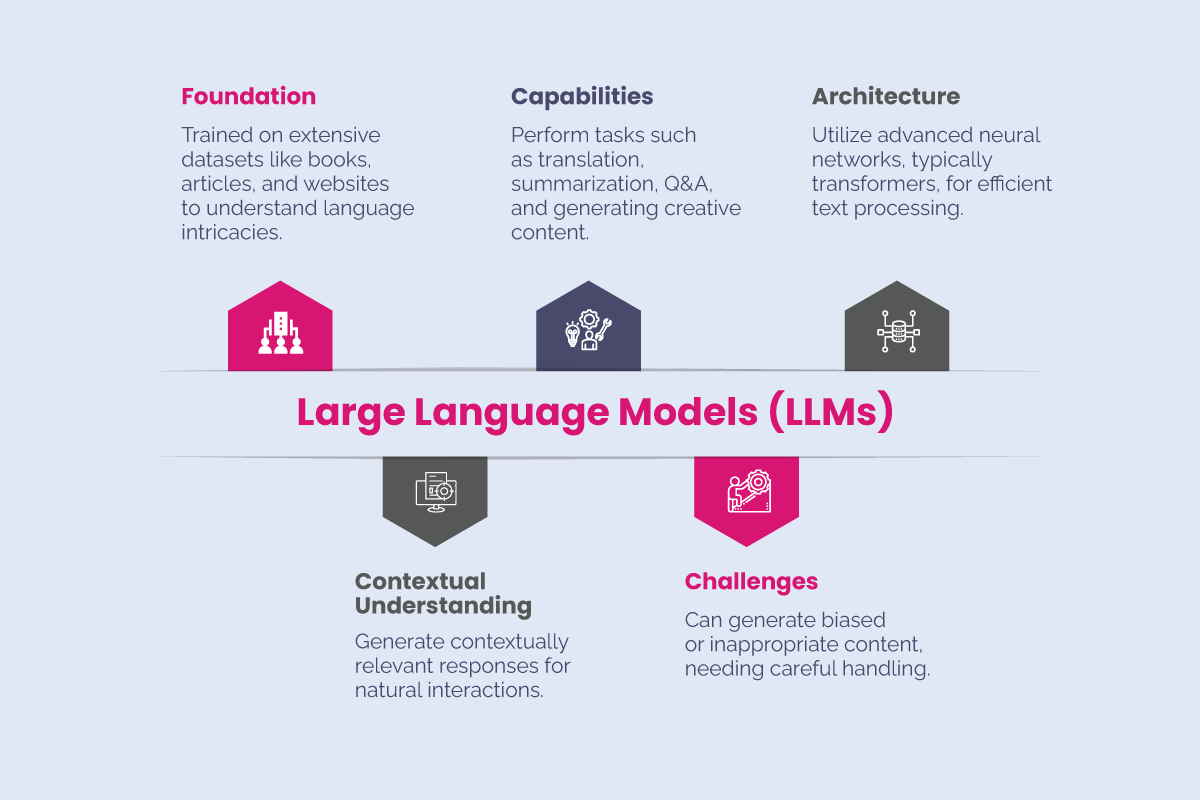
The year 2025 will be crucial in the field of cybersecurity, particularly Artificial Intelligence (AI), due to rapid advancement in the technologies across the domain. There is no doubt that the technology is evolving in the backdrop of AI, making cybersecurity measures advance as well as cyber threats. Large Language Models (LLMs) are advanced AI systems designed to understand, generate, and process human language and text using deep learning techniques and vast datasets.
LLMs offer enormous potential in the world of security; however, they also present novel obstacles. The integration of LLMs into cybersecurity presents a complex landscape characterized by both opportunities and threats. As these models evolve, they demonstrate remarkable capabilities in processing and generating human-like text, making them invaluable for enhancing cyber defense strategies. However, their sophistication also attracts malicious actors who exploit these tools for cyberattacks.
This article explores five common links between LLMs and cyberattacks, highlighting how attackers can leverage LLMs to automate attacks, execute social engineering schemes, and generate malware. Additionally, it emphasizes the dual-edged nature of LLMs in cybersecurity, showcasing their potential to bolster defenses while simultaneously posing new risks. Understanding these links is critical for firms seeking to effectively handle the challenges presented by the expanding cyber threat scenario.
Here are five common links between LLMs and cyberattacks:
Recommended: Cybersecurity Simplified: LLMjacking Attacks
1. Automation of Attacks
LLMs are increasingly utilized to automate various cyberattack techniques, including privilege escalation and vulnerability discovery, significantly enhancing the efficiency and effectiveness of malicious operations. Moreover, LLMs can assist attackers in identifying weaknesses in a target system by analyzing system information, allowing them to devise feasible attack methods. This capability allows even less skilled cybercriminals to execute sophisticated attacks that were previously the domain of expert hackers.
LLMs can process vast amounts of data and recognize patterns that indicate potential vulnerabilities, streamlining the reconnaissance phase of an attack. Once vulnerabilities are identified, these models can generate specific commands or scripts to exploit them, effectively automating the exploitation process. The transition to automation transforms organizational attacks from rare, expert-led occurrences to routine processes requiring little knowledge. As a result, the barrier to entry for conducting impactful cyberattacks is significantly lowered, posing substantial risks to cybersecurity. Organizations must remain vigilant and enhance their defenses to counteract this evolving threat landscape, recognizing that LLMs can serve both offensive and defensive roles in cybersecurity.
2. Prompt Injection Vulnerabilities
LLMs are prompt injection, a form of cyberattack in which attackers manipulate the model’s input to execute unintended actions. This vulnerability arises from the way LLMs process user inputs alongside system prompts, making it difficult for the models to distinguish between legitimate commands and malicious instructions. Attackers could deceive LLMs into producing unauthorized outputs by creating false inputs that mimic system prompts. This can have serious repercussions, including data exfiltration or the execution of destructive instructions.
Prompt injection attacks exploit the inherent trust that systems place in user inputs, similar to server-side request forgery (SSRF) vulnerabilities. Once an attacker successfully injects a malicious prompt, the LLM may inadvertently perform actions outside its intended scope, which can include leaking sensitive information or executing dangerous commands. Strong defenses against such vulnerabilities are crucial, as the possibility of prompt injection leading to data breaches and system compromises is highlighted by the growing integration of LLMs into applications that handle sensitive data.
Recommended: Data Quality: The Unseen Barrier to AI’s ROI and Sustainability in 2025
3. Malware Generation
LLMs possess advanced programming capabilities that can significantly aid in the generation of malware. While these models are generally equipped with security measures to prevent the direct creation of malicious software, they can still analyze software functions and generate code snippets that may be assembled into complete malicious programs, such as ransomware. LLMs can be used by cybercriminals to generate templates for different kinds of malware, which enables them to alter pre-existing code or construct brand-new variations that avoid detection by conventional security technologies.
The ability of LLMs to understand and generate code lowers the barrier for less technically skilled attackers, enabling them to craft sophisticated malware without deep programming knowledge. Additionally, LLMs can assist in obfuscating code, making it more challenging for antivirus software to identify malicious activities. As a result, the use of LLMs in malware development not only increases the effectiveness of cybercriminals’ activities but also makes cybersecurity more complex, requiring sophisticated detection and mitigation techniques to combat these new threats.
4. Phishing and Social Engineering
LLMs’ ability to generate realistic and contextually relevant text makes them effective instruments for social engineering attacks, particularly phishing. Attackers can employ LLMs to create highly convincing emails and messages that resemble authentic correspondence, tricking users into disclosing sensitive information or clicking on dangerous links. The sophistication of LLMs allows them to analyze language patterns and adapt their messaging to resonate with specific target audiences, increasing the likelihood of success.
Recommended: Top 10 Emerging Cybersecurity Technologies for 2025
Research indicates that LLMs can simulate humanlike responses, making it easier for attackers to exploit psychological vulnerabilities. For instance, they can generate messages tailored to individual characteristics, enhancing their persuasive power. This capability not only facilitates traditional phishing schemes but also enables more complex social engineering tactics that transcend conventional methods. As a result, organizations must remain vigilant and implement robust security measures to counteract these evolving threats, recognizing that the very technologies designed to enhance communication can also be weaponized in the hands of cybercriminals.
5. Exploitation of API Access
There are serious security risks for organizations that integrate LLMs, especially when it comes to data access and API exploitation. These models can be used by attackers to extract private data that the LLM can access or to initiate malicious operations via APIs. For instance, prompt injection attacks can manipulate the model into executing unauthorized commands or disclosing sensitive information, thereby compromising security.
These vulnerabilities illustrate the dual nature of LLMs in cybersecurity, showing that while they offer powerful tools for protection, they also present significant risks that can be exploited by attackers. While they provide enhanced capabilities for boosting security measures and operational efficiency, they also open up new attack channels for hackers. Understanding and mitigating these risks is essential as businesses become more reliant on LLMs. As the landscape of cyber threats evolves, organizations must implement robust security frameworks and continuous monitoring to mitigate these risks effectively while harnessing the benefits of LLM technology. This will ensure that LLMs serve to enhance security without exposing organizations to new vulnerabilities in the ever-evolving landscape of cyber threats.
Recommended: Cybersecurity Simplified: What is Cybersecurity in 2025?
Conclusion
The convergence of LLMs and cyberattacks reveals a multifaceted landscape characterized by both innovative possibilities and substantial risks. As organizations increasingly adopt LLMs for various applications, they inadvertently expose themselves to vulnerabilities that attackers can exploit. LLMs’ ability to automate cyberattack techniques, such as privilege escalation and vulnerability discovery, enhances the efficiency of malicious operations. Additionally, prompt injection attacks demonstrate how adversaries can manipulate model inputs to execute harmful commands or exfiltrate sensitive data.
Moreover, LLMs can assist in generating realistic phishing messages, making social engineering attacks more effective. While LLMs hold promise for improving cybersecurity defenses—such as threat detection and incident response—they also serve as powerful tools for cybercriminals. This dual-edged nature of LLMs necessitates a proactive approach from organizations, emphasizing the importance of robust security measures and continuous monitoring. As the cyber threat landscape evolves, understanding the common links between LLMs and cyberattacks is critical for designing effective measures to protect digital assets and sustain organizational resilience.
To share your insights, please write to us at news@intentamplify.com