We live in an era where technology plays a crucial role in our daily lives as well as businesses. Particularly, automation technology has changed security, productivity, efficiency, and various other processes in 2024, and this trend is likely to continue in 2025 with a focus on artificial intelligence (AI) and machine learning (ML).
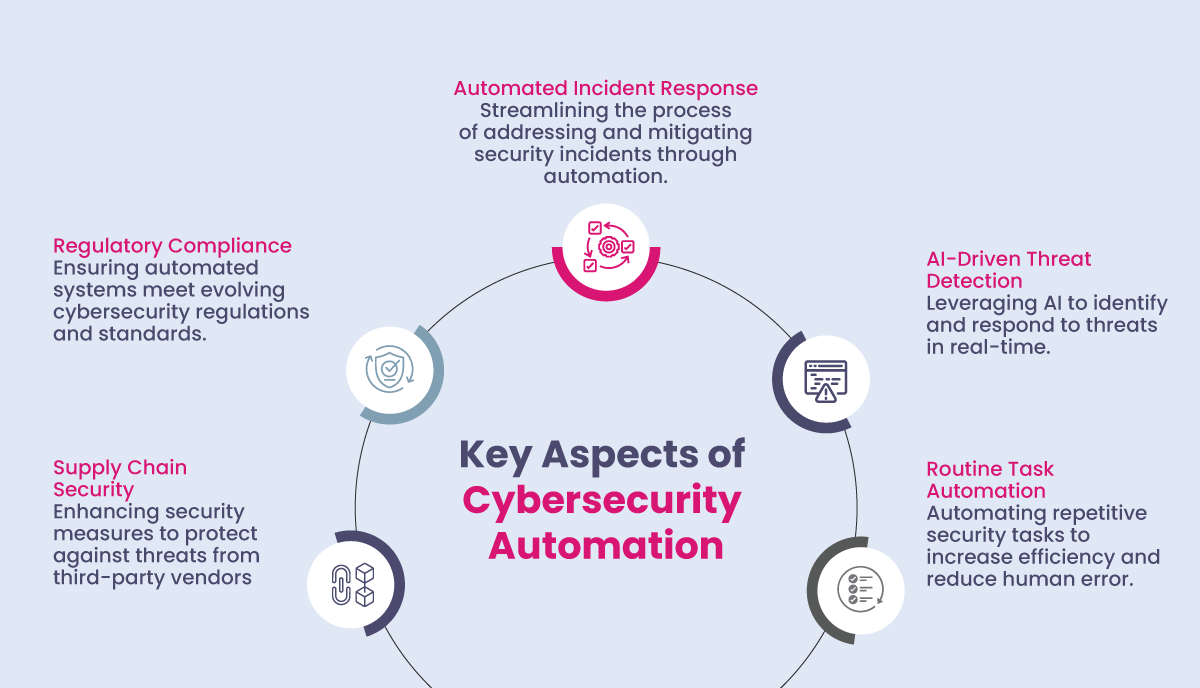
Cybersecurity automation is one of the various processes that got major traction in recent times due to advancements in automation technology. As a result, cybersecurity automation tools have become a critical component of effective security strategies. Moreover, cybersecurity automation tools play a crucial role in enhancing the efficiency and effectiveness of security operations by speeding up threat detection, reducing manual intervention, and improving response times.
Cybersecurity automation leverages advanced technologies such as AI, ML, and Robotic Process Automation (RPA) to handle time-consuming tasks that traditionally require manual intervention. Cybersecurity automation enables security teams to focus on higher-priority tasks as well as minimizes response times and human error and enhances overall operational efficiency.
In this blog, we will explore the top 10 cybersecurity automation tools that are widely recognized in the cybersecurity industry.
Top 10 Cybersecurity Automation Tools
1. Fortinet FortiSOAR
Overview: Fortinet FortiSOAR is a Security Orchestration, Automation, and Response (SOAR) solution designed to enhance the efficiency and effectiveness of security operations. It addresses the challenges faced by security teams, such as managing multiple vendors, handling an overwhelming number of alerts, and coping with a shortage of skilled personnel.
Recommended: Cybersecurity Simplified: LLMjacking Attacks
Function: SOAR by providing a unified interface for incident management.
Features: FortiSOAR is a SOAR solution provider designed to streamline and automate security operations, enabling teams to respond faster to threats. It includes pre-built playbooks, orchestration capabilities, and integration with other Fortinet products. It addresses challenges faced by security teams, such as alert overload, vendor management complexities, and resource shortages.
2. Palo Alto Networks Cortex XSOAR
Overview: Cortex XSOAR, formerly known as Demisto, is a SOAR platform. It allows for the automation of workflows, incident management, and response actions.
Function: SOAR
Features: Cortex XSOAR automates incident response through playbooks, resulting in reduced operations. Furthermore, it works with a number of technologies to improve response times and effectively manage complicated security systems. It helps security teams respond faster to incidents and manage complex environments.
3. CrowdStrike Falcon
Overview: CrowdStrike Falcon is a leading cybersecurity automation tool designed to defend against a wide range of cyber threats. It integrates endpoint protection, threat intelligence, and incident response capabilities into a single platform offering a comprehensive cybersecurity automation tool experience.
Function: Endpoint Protection and Threat Intelligence
Features: Falcon utilizes AI and machine learning to automate endpoint protection, threat detection, and response to incidents. It provides comprehensive visibility into endpoint activities along with automated threat-hunting capabilities. Its advanced features are designed to enhance security operations, streamline workflows, and improve overall incident response times.
4. Tenable
Overview: Tenable is a leading provider of cybersecurity solutions, particularly known for its vulnerability management solution that automates vulnerability scanning and assessment for IT environments.
Function: Vulnerability Management
Features: Tenable streamlines vulnerability management, reporting, and scanning. In order to find and fix vulnerabilities in real-time, it continuously evaluates network infrastructure. It helps organizations identify and remediate vulnerabilities in real-time by continuously assessing their network infrastructure.
Recommended: Cybersecurity Simplified: What is Cybersecurity in 2025?
5. Microsoft Sentinel
Overview: Microsoft Sentinel, formerly known as Azure Sentinel, is a cloud-native Security Information and Event Management (SIEM) platform that offers a comprehensive and intelligent solution for SOAR and SIEM. It assists security teams with threat detection, investigation, and response by utilizing AI and automation.
Function: It enables threat collection and detection, investigation, automated response, and proactive hunting across your enterprise.
Features: It offers automated incident response, real-time analytics, threat intelligence integration, customizable dashboards, custom analytics rules, and proactive hunting capabilities to enhance security operations. Its comprehensive features enable security teams to enhance their operational efficiency while maintaining a robust defense against modern cyber threats.
6. IBM QRadar
Overview: IBM QRadar is a comprehensive SIEM solution that provides real-time threat detection and response. It plays a crucial role in enhancing an organization’s cybersecurity posture through advanced analytics and automation. It is designed to collect, analyze, and correlate security data from various sources across an organization’s IT infrastructure.
Function: SIEM
Features: QRadar automates the collection, normalization, and correlation of security data. It helps in threat detection, incident response, and compliance reporting. The platform also integrates with various third-party tools for improved automation.
7. Zscaler
Overview: Zscaler is a cloud-based security platform that provides individuals, networks, and apps with automatic protection. Moreover, it provides secure internet and application access to organizations. It is intended to secure organizations adopting cloud-first strategies by offering a comprehensive suite of services that protect against various cyber threats.
Recommended: Cyber Insurance: Risks and Trends 2025
Function: Cloud Security Platform
Features: It provides automated traffic inspection, data loss prevention, and secure access to cloud-based services to protect sensitive data from unauthorized access or exfiltration. The cloud firewall offers advanced threat protection by filtering internet traffic and enforcing security policies, while secure access to cloud services provides Zero Trust Network Access (ZTNA) and Secure Web Gateways (SWG) to ensure safe access to applications without exposing them to the public internet.
8. Darktrace
Overview: Darktrace is an AI-driven cybersecurity platform that utilizes ML to enhance threat detection and response capabilities across an organization’s network.
Function: AI-driven cybersecurity platform
Features: The real-time threat detection feature utilizes ML to establish a “pattern of life” for users and devices, identifying anomalies that indicate potential threats. With self-learning capabilities, it continuously adapts to new threats, while the autonomous response features enable automatic mitigation of risks in real-time without human intervention.
9. Tanium
Overview: Tanium offers real-time visibility and control over endpoints within a company’s network and is a complete endpoint management and threat detection solution.
Function: Endpoint Management and Threat Detection
Features: Tanium provides real-time endpoint monitoring and an automated threat detection process, facilitating rapid investigation, response to security incidents, and vulnerability management. It enables rapid investigation and response to security incidents with a focus on endpoint security and vulnerability management. With vulnerability management, it helps organizations identify and remediate vulnerabilities quickly, ensuring endpoints are secure.
10. Splunk
Overview: Splunk is a powerful data analytics platform that helps automate the monitoring, investigation, and response to security threats. It aggregates and visualizes machine data to provide actionable insights into security events.
Function: SIEM and log management.
Features: Offers real-time monitoring, data aggregation, and analysis. Automates threat detection, incident response, real-time monitoring, data aggregation and analysis, and reporting through its Security Operations Suite (SOS) and is highly customizable with extensive integration capabilities. It allows users to create customized dashboards for monitoring key metrics and trends related to security incidents.
Recommended: Data Quality: The Unseen Barrier to AI’s ROI and Sustainability in 2025
In Summary
Cybersecurity automation is today’s reality that is growing rapidly as technology advances. The significance of cybersecurity automation cannot be overstated in today’s digital landscape. The cybersecurity automation tools, when effectively configured, enhance an organization’s capacity to detect, respond to, and mitigate cyber threats in real-time, making them indispensable for today’s cybersecurity teams. The functions offered by these tools, which range from SIEM systems to SOAR platforms, are designed to enhance threat management capabilities and streamline security processes.
As cyber threats become more complex and frequent, organizations must adopt automated tools to streamline their security operations, enhance threat detection, and accelerate response times. These technologies enable enterprises to stay ahead of any assaults by automatically identifying, looking into, and resolving threats. This overview of various tools clarifies each tool’s purpose, functionality, and key features, helping readers understand their critical role in cybersecurity automation.
To share your insights, please write to us at news@intentamplify.com