In a digital-first era where cyber threats are increasingly becoming more sophisticated, the need for robust security measures has never been more critical. Safeguarding the sensitive information and data stored in a secure vault or a system has taken center stage with every cyber threat. Multi-Factor Authentication (MFA) has emerged as a vital strategy to safeguard sensitive information and user accounts by requiring multiple forms of verification before granting access. This approach goes beyond conventional password-only systems, which are susceptible to a number of threats, such as credential stuffing and phishing.
MFA encompasses various methods, each with its own unique strengths and weaknesses. Among the most prevalent are SMS (Short Message Service)-based authentication, Time-based One-Time Passwords (TOTP), push notifications, and biometric verification. Organizations looking to improve their security posture while balancing user convenience must comprehend the subtleties of these techniques. In order to help identify the best choice for various situations, this comparison will examine each MFA technique, assessing its security levels, user experiences, and potential flaws.
Recommended: Cyber Insurance: Risks and Trends 2025
What is MFA? How Does it Help in Enhancing the Authentication Process?
MFA is a security mechanism designed to enhance the authentication process by requiring users to provide two or more verification factors to gain access to an application, network, or account. MFA adds layers of security by combining additional elements, such as something the user knows, such as a password; something the user has, such as a mobile device or security token; and something the user is, such as biometric data, which can include fingerprints or facial recognition data. Unlike traditional authentication methods, which only require a username and password, MFA methods require an additional security element to grant access.
The primary goal of MFA is to create a robust defense against unauthorized access. MFA significantly reduces the likelihood of carrying out cyberattacks, including credential theft or phishing efforts, by seeking multiple forms of authentication. Attackers still have to overcome additional obstacles to obtain access, even if one component is compromised, strengthening the entire security posture of both people and organizations.
Implementing MFA has become crucial for safeguarding private and sensitive data and upholding confidence in digital interactions as cyber threats continue to evolve. In addition to protecting sensitive information, this multi-layered security strategy strengthens organizational defenses against more sophisticated threats.
Key Types of Authentication Methods
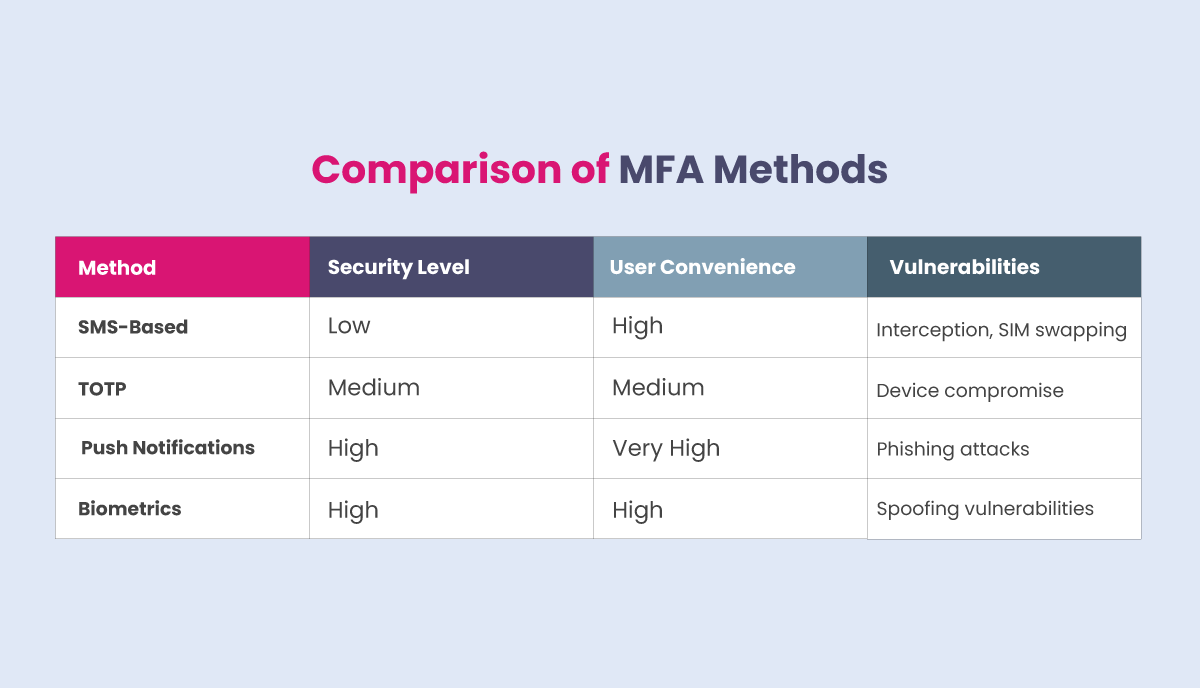
MFA enhances security by requiring multiple forms of verification before granting access. There are multiple types of authentication methods used by various industries, organizations, and other institutions to grant access to their customers or employees within the system or to provide them access to their sensitive data. Each method has distinct characteristics regarding security strength, user convenience, and potential vulnerabilities. This comparison focuses on four common MFA methods: SMS-based authentication, TOTP, push notifications, and biometrics.
Recommended: Cybersecurity Simplified: What is Cloud Infrastructure Security?
1. SMS-Based Authentication
- Security: SMS-based MFA adds an extra degree of security when gaining access to accounts by sending a one-time code to the user’s phone number. Although convenient, it is seen as less secure because of flaws including message interception and SIM swapping.
- User Convenience: Users find SMS easy to use since it requires no additional apps or devices. SMS-based MFA is easy to use, as users simply receive a text message with a code that they can enter to verify their identity. However, it can be slower due to the need to enter a code manually and create friction during account access.
- Vulnerabilities: Despite its convenience, the SMS-based MFA method has several critical vulnerabilities, such as it can be intercepted, cloned, SMS swapped, network outages, and social engineering risks. These vulnerabilities make it susceptible to attacks. This method is often viewed as the weakest form of MFA.
2. Time-Based One-Time Passwords (TOTP)
- Security: TOTP enhances security by generating a unique code every 30 seconds using an authenticator app. This method is significantly more secure than SMS-based authentication because the codes are not transmitted over potentially insecure channels. The unique code generated every 30 seconds ensures that even if they are intercepted, they become useless due to a short period.
- User Convenience: TOTP is slightly more user-friendly than SMS as it does not rely on network connectivity. It allows users to generate the code offline using an authenticator app, which ensures that access is available even in areas with poor connectivity.
- Vulnerabilities: Although TOTP is generally considered secure, despite this, it possesses some serious vulnerabilities in the case the device running the authenticator app is compromised or if users fail to keep their devices secure. Additionally, it can pose serious vulnerability in case of user negligence.
3. Push Notifications
- Security: Push notifications for MFA provide a robust security mechanism by sending approval requests directly to the user’s device via an app. This method offers a strong security level similar to TOTP but relies on a secure connection between the device and the service.
- User Convenience: Users can save time and effort throughout the authentication process by just tapping “approve” or “deny” instead of entering codes, making push notifications incredibly user-friendly. This smooth interaction improves the user experience overall and makes it simpler for people to swiftly and effectively confirm their identification.
- Vulnerabilities: Push notification authentication enhances security and convenience; however, it possesses significant risk. The main risk involves phishing attacks, in which users might inadvertently approve unauthorized access requests. Apart from this, it is also vulnerable to MFA fatigue attacks, device security risks, and internal dependency. However, this risk can be mitigated with proper user education and awareness.
Recommended: Cyber Threat Intelligence: How to Predict and Prevent Cyberattacks?
3. Biometrics
- Security: Biometric authentication uses unique physical traits, such as fingerprints, facial recognition, and iris patterns, to verify user identity. When implemented correctly, biometric authentication provides a robust level of security that is difficult to replicate. However, depending on the technology employed, it can have weaknesses.
- User Convenience: Biometrics authentication is designed to be quick and intuitive, allowing users to authenticate with a simple scan or recognition process. However, they may require additional hardware or software, such as fingerprint scanners or facial recognition cameras, which add additional cost and setup time.
- Vulnerabilities: While biometrics can provide high security, they are not foolproof. It comes with plenty of vulnerabilities, which include spoofing risks, false acceptance and rejection rates, privacy concerns, device security risks, system failures, and data breaches.
Conclusion
The comparison of MFA techniques, including biometrics, push notifications, TOTP, and SMS-based authentication, demonstrates the wide range of security options available to improve user authentication procedures. Each method has distinct advantages and disadvantages that address various security requirements and user preferences. In addition, each method contributes to enhancing cybersecurity measures.
Recommended: Top AI Security Tools for Financial Services Industry
SMS is simple to use, but compared to biometrics, push notifications, and TOTP, it poses serious security vulnerabilities. On the other hand, TOTP offers a more secure option than SMS; however, it necessitates that users maintain a separate application for code generation. Although push notifications retain a high-security posture and greatly expedite the authentication process, they are not immune to social engineering attacks. Despite their inherent difficulties, such as the possibility of spoofing, biometrics offer the highest level of security through distinctive personal identification. Combining different authentication methods can significantly improve security and satisfy user preferences.
Organizations must carefully consider their unique demands, including security requirements, user comfort, and potential weaknesses, before choosing an MFA technique. In an increasingly digital environment, a multi-layered strategy that incorporates several authentication elements can offer a strong barrier against unwanted access, guaranteeing that private data is kept safe. Adopting an appropriate MFA strategy will be essential for preserving confidence and protecting data integrity as cyber threats change.
To share your insights, please write to us at news@intentamplify.com