As we move forward with advanced technologies and operations in 2025, operational resilience has emerged as a crucial area of concern for businesses looking to endure disruptions and preserve continuity in today’s rapidly evolving business environment. The increasing frequency of cyber threats necessitates robust strategies that leverage advanced technologies. Artificial Intelligence (AI) plays a pivotal role in enhancing operational resilience by enabling organizations to anticipate risks, streamline processes, and respond dynamically to unforeseen challenges. Businesses can efficiently evaluate vulnerabilities, automate repetitive operations, and put preventative steps in place to lessen potential interruptions by utilizing AI-driven insights.
AI tools such as analytics, natural language processing (NLP), and predictive anomaly detection enable businesses to make well-informed decisions quickly. In addition to improving risk management, these tools make it easier to allocate resources and conduct real-time monitoring during emergencies. Additionally, incorporating AI into current operational frameworks enables ongoing learning and adaptation, guaranteeing that businesses may modify their resilience plans in reaction to new risks. Leveraging AI will become crucial for creating a resilient future that can handle the complexity of modern challenges as companies work to safeguard their operations and assets. Furthermore, organizations can use a range of strategies and technologies that improve their capacity to tolerate and react to disruptions to successfully develop operational resilience with AI. There are a number of AI solutions that can be used to improve and accelerate operational resilience.
Key Applications of AI for Operational Resilience
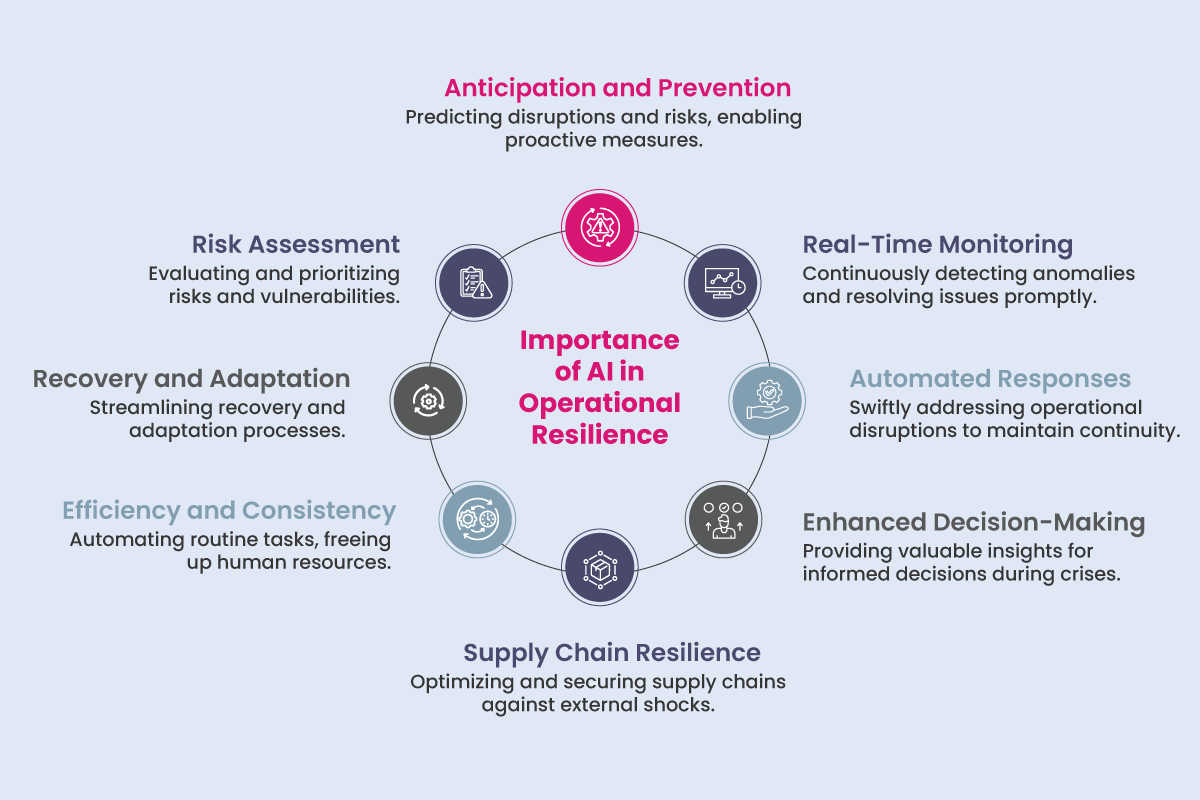
AI improves operational resilience in a number of ways, such as automated workflows to expedite incident management, anomaly detection to spot abnormalities, and predictive analytics for risk assessment. These technologies enable organizations to optimize resource allocation, anticipate disruptions, and ensure timely responses during crises.
Here we highlight a few applications of AI for operational resilience; these are:
1. Risk Assessment through Predictive Analytics
AI can analyze huge amounts of historical data to discover potential high-risk areas, helping organizations take preventive actions before the crisis begins. This enables organizations to implement proactive measures that mitigate risks before they escalate into crises, significantly enhancing overall preparedness and response capabilities.
Recommended: Top 10 Emerging Cybersecurity Technologies for 2025
2. Prediction & Analysis
AI algorithms can analyze data from social media, news feeds, and other sources to identify potential crises or irregularities that may indicate potential failures or security breaches. This strategy enables organizations to prepare for a timely incident response. By addressing issues before they become critical, this technology facilitates early intervention, reduces downtime, and maintains operational continuity.
3. Real-time Monitoring
AI systems such as chatbots and virtual assistants help in continuously monitoring best practices in operations and for any irregularities that can cause harm to the organization in terms of system failures or cyberattacks, giving organizations a more proactive approach towards better organizational practices. This strategy enhances communication efficiency, ensuring stakeholders have quick access to critical information, which aids effective decision-making during emergencies.
4. Automated Workflows
By leveraging AI techniques, organizations can design and implement automated workflows that ensure critical tasks are executed swiftly and efficiently. Moreover, this maximizes incident management and business continuity procedures and guarantees their prompt execution during emergencies. This capability allows for rapid response to incidents, minimizing delays and reducing the potential for human error. It streamlines operations, reduces human error, and ensures consistent execution of response plans during disruptions, leading to improved operational efficiency.
5. Data-Driven Insights
AI tools help management make informed decisions by providing accurate and timely information. In particular, these tools analyze diverse data sources, including news feeds and social media, to detect early warning signs of potential disruptions. This strategy provides organizations with timely insights that enable them to prepare for and respond effectively to emerging threats. Management should be able to identify alternative suppliers in the event of supply chain disruptions.
Recommended: Data Quality: The Unseen Barrier to AI’s ROI and Sustainability in 2025
6. Simulation and Testing
AI can simulate various disaster scenarios to test business continuity management plans, helping organizations identify weaknesses and improve preparedness. Moreover, AI allows the generation of detailed reports, simulations, and operational documentation based on real-time data analysis. This enhances knowledge management by providing operators with up-to-date information for troubleshooting and decision-making, thereby improving operational resilience.
7. Employee Empowerment
Automating routine tasks with AI allows employees to concentrate on higher-value activities, resulting in job satisfaction and responsive action on unforeseen problems. AI assists management in making informed decisions by analyzing data trends and providing actionable insights.
It benefits organizations as it improves the speed and accuracy of decision-making during crises, ensuring that organizations can adapt quickly to changing circumstances while minimizing disruption impacts.
Capabilities of AI in Business Continuity Planning
AI can significantly enhance business continuity planning by providing a range of capabilities that improve preparedness and response strategies; however, it cannot fully automate all aspects of the process. AI’s integration into business continuity planning offers organizations a powerful toolset to disrupt and maintain continuity in an increasingly complex environment.
Here are some key capabilities of AI in business continuity planning:
1. Risk Assessment and Prediction: AI excels at analyzing vast datasets to identify potential risks and vulnerabilities, allowing organizations to anticipate disruptions before they occur.
2. Automated Communication: AI can streamline communication processes, ensuring that employees, customers, and stakeholders are promptly informed during a crisis.
3. Incident Response Automation: AI-driven systems can automate routine tasks related to incident management, enabling faster response times and reducing human error.
4. Real-time Monitoring: AI tools provide continuous monitoring of various data sources, offering early warnings of potential threats and facilitating proactive risk management.
5. Scenario Simulation: AI can simulate different crisis scenarios to refine business continuity plans, helping organizations prepare for various potential disruptions.
Although AI can improve many aspects of business continuity planning by automating tasks and analyzing data, a hybrid strategy that blends AI’s capabilities with human judgment is necessary for overall resilience. Organizations should focus on integrating AI where it excels while ensuring that human expertise remains central to the decision-making process.
Recommended: Cyber Insurance: Risks and Trends 2025
Challenges in Implementing AI
Implementing AI in business continuity planning presents several challenges that organizations must navigate to ensure effective integration and utilization. While embedding AI in operational resilience strategies provides substantial advantages, organizations need to keep possible challenges in mind before going forward with implementing AI.
Here are the key challenges of AI in implementing AI:
1. Biased Predictions: Improperly managed AI systems may result in prediction bias.
2. Skill Gap: Not enough qualified professionals understand how to interpret the data produced by AI systems, which can hinder effective implementation.
3. Integration complexity: Integrating multiple AI solutions effectively requires proper preparation and alignment with the business requirements.
Despite all these challenges, AI is powerful enough to disrupt business operations; however, it cannot replace human judgment and intuition entirely. Certain aspects of business continuity planning require human creativity, oversight, and ethical decision-making that AI cannot replicate.
Recommended: Cybersecurity Simplified: LLMjacking Attacks
Conclusion
Incorporating AI into operational resilience strategies is essential for organizations aiming to thrive amid uncertainty, disruption, and cybersecurity. Predictive analytics, real-time monitoring, automated workflows, and improved decision-making skills are all components of the multi-dimensional strategy used to leverage AI for operational resilience that can enhance businesses’ ability to anticipate risks and respond effectively to challenges. These tools enable real-time monitoring and data-driven decision-making, allowing organizations to streamline processes and improve communication during crises. Organizations can greatly increase their resilience against unanticipated interruptions by tackling related issues. Furthermore, AI facilitates automated workflows that reduce human error and ensure consistency in incident management.
AI technologies are advancing year-on-year and sector-on-sector with rapid implementation and integration into operations. AI technology can help organizations become more operationally resilient, enabling them to manage disruptions more adeptly while maintaining business continuity. Integrating AI not only strengthens their capacity to withstand disruptions but also fosters a culture of continuous learning and adaptation. Ultimately, by embracing AI, organizations can build a robust framework for operational resilience that enhances their agility, protects their assets, and ensures sustained business continuity in an ever-evolving landscape. When handling sensitive data, organizations need to make sure AI operations adhere to local data protection regulations to avoid legal repercussions and maintain stakeholder trust.
To share your insights, please write to us at news@intentamplify.com