Published on Cyber Technology Intelligence, the trusted destination for CIOs, CISOs, and enterprise technology leaders navigating the evolving landscape of cybertech, AI, and operational security.
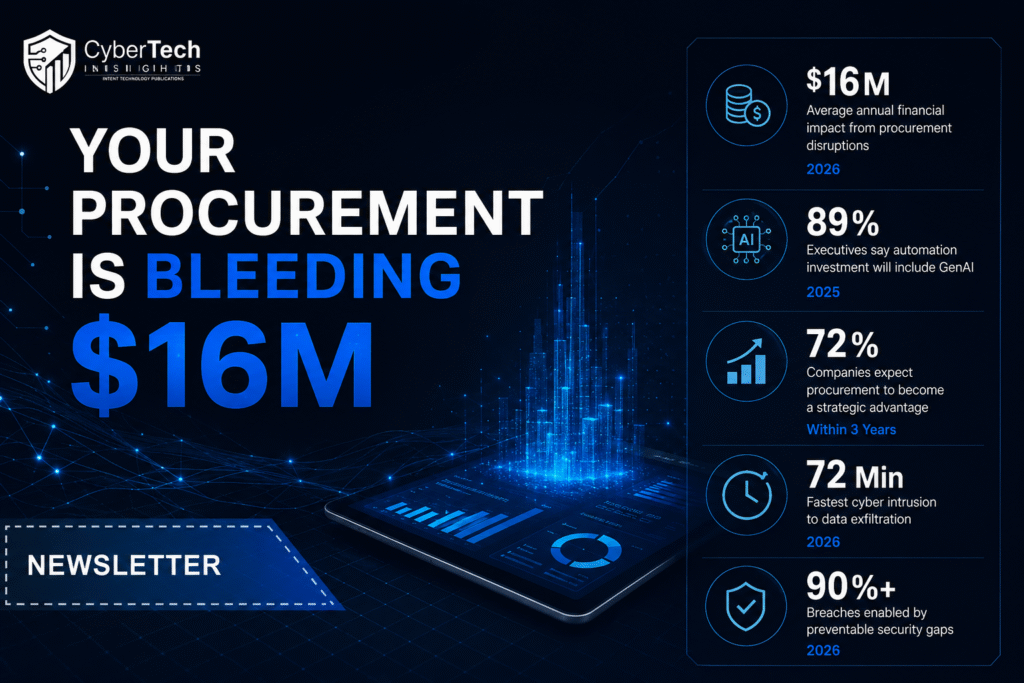
There is a number that most enterprise technology leaders have not seen in a security briefing, a board presentation, or a vendor conversation, but should have. It is $16 million. That is the documented average annual financial impact organisations absorb from procurement-related disruptions. ¹
It does not appear on a threat dashboard. It rarely makes it into a CISO’s incident log. But it is bleeding from enterprise operations every quarter, through missed production windows, emergency supplier switches, contract penalties, and the cascading cost of teams operating without real-time visibility into what is actually happening across their direct materials supply base.
For CIOs and CISOs reading this, the implication is direct. Direct procurement is not a back-office problem. It is an infrastructure problem, a data problem, and increasingly, a security problem. The organisations closing that $16 million gap are not throwing more technology at it. They are rebuilding procurement as native, core business infrastructure, with automated visibility, continuous intelligence, and the cross-functional governance that modern enterprise risk demands.
Supply Chain Now’s upcoming exclusive webinar, The Infrastructure Gap: Why Direct Procurement Is at a Breaking Point, hosted by Scott Luton and Karin Bursa and featuring Mark Schenecker with Coupa, is built for the enterprise leaders who are ready to treat procurement infrastructure with the same rigour they bring to every other critical business system.
The Infrastructure Gap Is a Technology Leadership Problem
The gap between procurement ambition and procurement capability is not a procurement team problem. It is a technology leadership problem, and the data from the world’s most authoritative enterprise technology research organisations confirms it.
IBM’s Institute for Business Value supply chain research found that 89% of surveyed executives report that key investments in automation will include generative AI capabilities, and 9 in 10 executives say their organisation’s workflows will be digitised with intelligent automation and AI assistants by 2026. ²
The investment intention is there. The delivery is not keeping up. IBM’s own supply chain transformation reduced costs by $160 million by replacing fragmented, disconnected data streams with unified, AI-driven intelligence across suppliers, inventory, and logistics, and maintaining a 100% order fulfilment rate even through the peak of global supply chain disruption. ³
That result did not come from adding more tools to broken infrastructure. It came from IBM rebuilding how procurement data flows through the organisation at an architectural level. That is precisely the shift Coupa enables for the enterprise organisations in its platform ecosystem, and precisely the lens the Supply Chain Now webinar explores.
KEY FIGURES AT A GLANCE
$16M average annual financial impact from procurement-related disruptions per organisation (Supply Chain Now / Coupa Webinar — June 2026) ¹
89% of executives say key automation investments will include generative AI capabilities (IBM Institute for Business Value — 2025) ²
72% of companies expect procurement to become a strategic competitive advantage within three years (Supply Chain Now / Coupa Webinar — June 2026) ¹
Coupa: Building Procurement as Business Infrastructure, Not a Software Layer
For CIOs and CISOs evaluating how procurement fits into the enterprise technology architecture, Coupa’s platform proposition is worth understanding clearly. Coupa does not sell procurement software as a point solution.
It builds the native business infrastructure that enables organisations to run procurement as a continuous intelligence engine, connected to finance, supply chain, and enterprise risk in real time.
That distinction matters enormously in the context of the $16 million problem. The organisations absorbing that cost are not doing so because they lack procurement software.
They are doing so because their procurement systems are not architected to deliver automated visibility, continuous spend intelligence, or the cross-functional influence needed to act on supply disruptions before they become financial events.
The three-pillar framework that Coupa and Supply Chain Now explore in this webinar, Infrastructure, Intelligence, and Influence, maps directly onto the technology architecture priorities that CIOs are already managing across the enterprise. Infrastructure is the data foundation that makes procurement decisions possible.
Intelligence is the continuous, AI-driven insight layer that converts that data into action. Influence is the cross-functional connectivity that ensures procurement decisions reach finance, operations, and risk teams before a disruption becomes a line item. This is the operating model that separates organisations accelerating their own inefficiencies from those building compounding structural advantage.
Microsoft: Agentic AI Is Closing the Procurement Execution Gap
For enterprise technology leaders who track the direction of AI investment in operational workflows, Microsoft’s 2026 supply chain and procurement developments signal where the market is headed, and how fast.
Microsoft’s Supply Chain 2.0 blog (March 2026) documents Uniper automating material and service procurement using Celonis and Microsoft, with Copilot in Teams and Power Automate orchestrating approvals, SAP actions, and replacing manual component planning with proactive agentic workflows that ensure timely material availability.
A global pharmaceutical company unified fragmented logistics data on Microsoft’s agentic architecture, enabling real-time identification of supply exceptions and unlocking multi-million euro annual productivity gains. ⁴
Microsoft’s Dynamics 365 Supplier Communications Agent, launched in February 2026, automates routine procurement vendor communications, including purchase order follow-ups and change confirmations, freeing procurement teams from administrative overhead and directing their capacity toward strategic supplier risk management. ⁵
For CIOs building enterprise automation strategy, these deployments demonstrate what Coupa’s platform vision makes possible at the business architecture level: procurement that senses, decides, and acts without waiting for manual reconciliation cycles.
Google Cloud: Visibility That Reaches the Disruption Before It Reaches the P&L
The most expensive moment in direct procurement is the one where a supply disruption that was visible in the data three days ago finally becomes visible to a human being. By that point, the financial damage is already in motion. Google Cloud’s supply chain and logistics architecture is built to close that gap.
Google Cloud’s real-world generative AI deployments (April 2026) document Chorus, built on the Gemini Enterprise Agent Platform, providing granular asset-level visibility, temperature intelligence, and dynamic delivery estimates across mission-critical supply chains in real time.
Domina, a logistics company managing over 20 million annual shipments, used Vertex AI and Gemini to improve real-time data access by 80% and eliminate the manual reporting cycles that were obscuring supply exceptions until they became crises. ⁶
Google Cloud’s supply chain platform enables organisations to ingest large volumes of supplier and logistics data, identify disruption signals across demand drivers including freight, commodity pricing, and geopolitical events, and act on those signals before they cascade into operational loss. ⁷
For the CIO audience reading this, the architecture principle is familiar: real-time data federation, edge intelligence, and continuous monitoring. What is new is that it is being applied to procurement supply chains with the same rigour previously reserved for network security operations.
Palo Alto Networks: Why Procurement Is Now a Cybersecurity Problem
This is where the Cyber Technology Intelligence audience needs to pay close attention, because the threat intelligence coming out of Palo Alto Networks’ Unit 42 team in 2026 has direct implications for how CISOs should be thinking about procurement infrastructure.
Palo Alto Networks’ Unit 42 Global Incident Response Report 2026, analysing over 750 major cyber incidents across 50 countries between October 2024 and September 2025, identifies software supply chain risk as one of four forces defining the 2026 threat landscape. The finding is precise and uncomfortable: attackers are exploiting SaaS integrations, vendor tools, and application dependencies to bypass enterprise perimeters at scale, shifting the impact from isolated compromise to widespread operational disruption. ⁸
The speed at which this happens has undergone a fundamental change. Attacks are now 4x faster, with the fastest intrusions reaching data exfiltration in just 72 minutes, down from 285 minutes the previous year. Identity weaknesses factored into nearly 90% of Unit 42 investigations in 2025, with attackers exploiting SaaS integrations and vendor access to escalate privileges and move laterally across enterprise environments. And critically, in more than 90% of breaches, preventable gaps materially enabled the intrusion, including excessive identity trust and inconsistently applied vendor access controls. ⁸
Palo Alto Networks’ supply chain risk assessment framework makes the enterprise implication explicit: vendor and supplier integrations introduce cybersecurity vulnerabilities that can leave organisations susceptible to operational compromise, and those risks scale directly with the number of procurement system integrations, supplier portals, and SaaS dependencies in the environment. ⁹
For CISOs, this is the conversation that connects the $16 million procurement disruption number to the security architecture decisions they are already responsible for. Procurement infrastructure that is not built with Zero Trust vendor access governance, continuous supplier identity monitoring, and tightly controlled SaaS integration policies is vulnerable to exposure. Coupa’s platform, built as native enterprise infrastructure rather than a collection of third-party integrations, is architecturally positioned to support the kind of controlled, governed, continuously monitored procurement environment that the 2026 threat landscape demands.
What the Webinar Delivers for Technology Leaders
The Supply Chain Now webinar featuring Coupa is not a procurement operations session. It is an enterprise technology leadership conversation about why procurement infrastructure has become a CIO and CISO priority, and what the organisations solving it at scale have built differently.
The three-pillar framework of Infrastructure, Intelligence, and Influence maps precisely onto the technology architecture, data governance, and cross-functional risk decisions that enterprise technology leaders are already navigating. The $16 million cost of getting it wrong is no longer a procurement metric. It is an enterprise risk metric, and it belongs in the same conversation as cybersecurity posture, AI readiness, and operational resilience.
Cyber Technology Intelligence covers this intersection because our audience, the CIOs, CISOs, and enterprise technology leaders who read this platform, are the people responsible for the infrastructure decisions that determine whether procurement becomes a strategic competitive advantage or a continuing operational liability.
Register Now: The Infrastructure Gap: Why Direct Procurement Is at a Breaking Point Hosted by Supply Chain Now | Featuring Mark Schenecker, Coupa
Register Here
References
- Supply Chain Now / IntentTech Insights — The Infrastructure Gap: Why Direct Procurement Is at a Breaking Point — June 2026
- IBM — What Is AI in Supply Chain? — April 2026
- IBM Case Study — IBM Builds Its First Cognitive Supply Chain — 2025
- Microsoft Cloud Blog — Supply Chain 2.0: How Microsoft Is Powering Simulations, AI Agents, and Physical AI — 24 March 2026
- Microsoft Dynamics 365 Blog — Agentic AI for Inventory to Deliver: From Procurement to Fulfilment — 2 February 2026
- Google Cloud Blog — Real-World Gen AI Use Cases from the World’s Leading Organisations — 22 April 2026
- Google Cloud — Supply Chain and Logistics Solutions — 2026
- Palo Alto Networks — 2026 Unit 42 Global Incident Response Report — 17 February 2026
- Palo Alto Networks Unit 42 — Supply Chain Risk Assessment — 2026
🔒 Login or Register to continue reading