GEP and Supply Chain Now bring this intelligence to enterprise technology leaders through Cyber Technology Intelligence, where CIOs and CISOs find the data, analysis, and peer perspective they need to make consequential decisions.
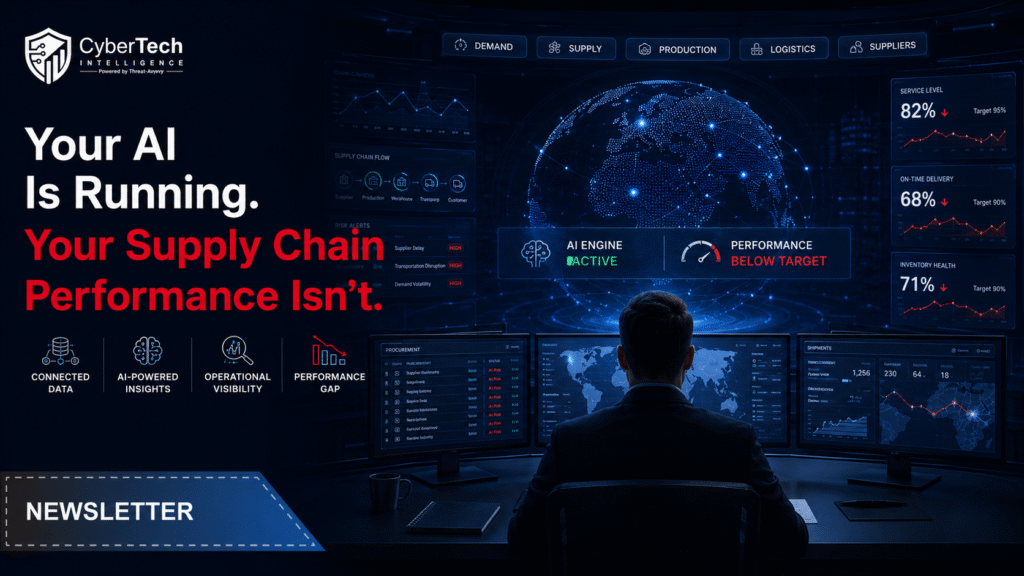
There is a version of the 2026 supply chain AI story that looks successful from the outside. Investment is flowing. Dashboards are populated. Agents are active. However, when we look at the supply chain operation itself, its performance, delivery performance, inventory control, efficiency, and supplier reliability, we notice that things are not progressing as expected after this artificial intelligence expenditure.
This is the term’s introduction. It is the distance between AI activity and AI outcomes — and where most supply chain AI programmes quietly live in 2026. 97% of executives report benefits from AI. Only 29% see significant ROI from generative AI, and just 23% from AI agents. That gap between benefit and return is not closing. Without the right operational architecture, governance, and workflow redesign, it widens.¹
GEP exists to close it. Supply Chain Now’s upcoming exclusive webinar, From AI Pilots to Performance: How Supply Chain Leaders Are Scaling Agentic AI, on Wednesday, June 10 at 12 noon ET, is the session built for leaders who are done explaining why AI is running and ready to understand why performance is not.
The Numbers Explain the Gap
The research on this execution gap in 2026 is precise enough to be uncomfortable. It points not at technology failure but at a specific set of decisions organizations either made or did not make before they deployed their AI.
IBM’s February 2026 AI ROI research documents the core problem: only 29% of organizations can confidently measure AI ROI today, despite 79% reporting productivity gains. ²
Productivity gains and supply chain performance gains are not the same thing — an AI that speeds up an individual task is not the same as one that makes the supply chain more resilient or cost-efficient. Most organizations have achieved the former and are measuring it as if it were the latter.
IBM’s broader CEO study sharpens the picture: only 25% of AI initiatives deliver expected ROI, and just 16% scale enterprise-wide. ²
IBM’s January 2026 goals for AI and technology leaders identify the root cause: every agentic AI programme should attach to clear KPIs and a defensible ROI model before scaling, and the era of AI investment justified solely by its innovative potential is ending. IBM further warns that 25% of planned AI spend will be deferred by 2027 due to ROI concerns.³
For supply chain leaders whose AI programmes cannot demonstrate performance impact, deferral is the next budget cycle.
KEY FIGURES AT A GLANCE
97% of executives report AI benefits, but only 29% see significant ROI from generative AI and 23% from AI agents (IBM / Writer Enterprise AI Survey — May 2026)¹
Only 16% of AI initiatives have scaled enterprise-wide (IBM CEO Study — February 2026)²
61% greater revenue growth for organizations with higher AI-driven supply chain investment versus peers (IBM — January 2026)⁴
More than 100% ROI over three years from unified supply chain AI platform deployment (Microsoft / Forrester TEI — February 2026)⁵
800+ AI agents deployed by GE Appliances across manufacturing, logistics, and supply chain (Google Cloud Next 2026 — April 2026)⁶
What GEP Does That Closes the Execution Gap
GEP, in partnership with UVA Darden, has researched approximately 200 supply chain executives to map precisely what separates organizations generating supply chain performance from AI from those generating supply chain activity from AI. The findings power the June 10 webinar, and they are consistent with what GEP’s platform has been built to address.
The organizations delivering real performance from supply chain AI have made three decisions; the majority have not. They have connected AI to end-to-end operational workflows rather than isolated functions. They have built data governance that allows agents to reason over real, current, reliable operational data. And they have attached their AI programme to operational KPIs that directly measure supply chain performance rather than AI adoption metrics that measure AI activity.
GEP SMART and GEP NEXXE are built for exactly this model. They are the native intelligence infrastructure that makes it possible for AI to operate across sourcing, procurement, planning, and logistics as a single, continuously intelligent system, connected to real operational data, governed for reliability, and measured against the performance outcomes the supply chain is actually judged on.
GEP calls this operating through Intelligent Value Streams. Where most AI deployments generate intelligence within a function, GEP’s platform generates intelligence across the end-to-end value chain, from supplier signal to purchasing decision to inventory position to delivery execution, in real time, without the manual handoffs and data reconciliation that break the connection between AI output and operational outcome. That connection is what converts AI activity into supply chain performance. That is what GEP builds.
Microsoft: Performance Starts With a Unified Data Estate
Microsoft’s Supply Chain 2.0 research (March 2026) documents the specific shift that separates AI-active organizations from AI-performing ones. The organizations showing measurable supply chain performance made a data unification decision first. AI in logistics is saving Microsoft’s own teams hundreds of hours each month, but only because unifying the data estate was treated as the prerequisite for everything that came after.⁷
Microsoft’s February 2026 Forrester TEI study projects more than 100% ROI over three years for enterprises consolidating finance and supply chain operations into a unified platform with AI embedded at the data layer.⁵
The study identifies faster and more confident decision-making enabled by unified financial and supply chain data as the primary driver of that ROI, not AI capability in isolation, but AI capability on a foundation that gives it reliable context to act on.
That is the platform principle GEP operates on. Performance from AI starts with the data architecture it runs on, not the sophistication of the model itself.
Google Cloud: Intelligence Must Scale Exponentially, Not Linearly
Google Cloud’s March 2026 logistics research surfaces the performance mechanism that distinguishes organizations generating real supply chain outcomes: when revenue grows, but margins remain stagnant, it is because the business is scaling linearly. To truly break away, intelligence must scale exponentially, not just through headcount.⁸
Linear scaling is what AI activity looks like when it is not connected to performance architecture. Exponential scaling is what GEP’s platform enables, where AI intelligence compounds across every transaction, every supplier interaction, and every demand signal without requiring proportional increases in human intervention to convert intelligence into operational outcome.
Google Cloud’s Next 2026 documentation shows what exponential scaling looks like in production. GE Appliances deployed more than 800 AI agents across manufacturing, logistics, and supply chain, replacing reactive workflows with a unified digital thread synchronizing operations in real time. Macquarie Bank reclaimed more than 100,000 hours of team members’ time through enterprise-wide agent deployment.⁶
Both results came from a platform decision that connected AI to performance architecture, not from deploying more AI tools into fragmented workflows.
Palo Alto Networks: Performance Gaps and Security Gaps Are the Same Gap
For CISOs reading this, this operational disconnect has a security dimension that most operational conversations miss. The same data fragmentation and workflow disconnection that prevent AI from generating supply chain performance create security exposure as AI scale increases.
Palo Alto Networks‘ Unit 42 Global Incident Response Report 2026, drawing on over 750 major incidents across 50 countries between October 2024 and September 2025, documents the threat environment supply chain AI operates within: identity weaknesses factored into nearly 90% of Unit 42 investigations, with attackers exploiting fragmented identity estates and SaaS integrations at speeds that now reach data exfiltration in under 72 minutes, a pace 4x faster than the previous year.⁹
The performance implication is direct. 84% of major cyber incidents investigated by Unit 42 resulted in operational downtime, reputational damage, or financial loss, with supply chain vulnerabilities driving the most severe enterprise-wide disruptions.¹⁰
A supply chain AI programme that generates a security incident does not just create a security problem. It destroys the operational continuity that the AI investment was supposed to protect.
GEP’s platform addresses both dimensions from a single architecture. Unified data governance that enables supply chain performance also creates an auditable, consistently controlled integration environment that reduces security exposure. For CISOs and CIOs evaluating supply chain AI architecture together, that convergence is a design principle, not a coincidence.
Cisco: Governance That Enables Performance Also Enables Security
Cisco‘s State of AI Security 2026 report (February 2026) frames the governance dimension precisely: supply chains are growing in complexity, often without proper controls and governance, and autonomous AI agents are proliferating across critical workflows, often without accountability being ensured.¹¹
Cisco’s AI Defence platform, in its largest-ever February 2026 expansion, introduces AI Bill of Materials capability, providing centralized visibility and governance over every AI asset in the enterprise, tracking what it is, where it came from, and how it behaves across third-party interactions.¹²
organizations that cannot govern their supply chain, AI cannot secure it, and organizations that cannot secure it cannot trust it at the operational scale that performance requires. GEP’s unified platform creates the governance foundation that enables both simultaneously, from the same architecture, without the fragmentation and exposure that separate security and operational systems introduce.
What GEP and Supply Chain Will Deliver on June 10, 2026
The gap between AI activity and real operational outcomes is not inevitable. The organizations on the right side of it in 2026 did not get there by running more AI. They got there by making the architectural, governance, and operational decisions that connect AI to performance from day one, across the full scope of supply chain operations.
GEP and UVA Darden share research from approximately 200 supply chain executives on June 10, covering why AI is running but performance is not moving, what the Performance Elite did differently, where supply chain AI is actually delivering outcomes versus generating activity, and the practical blueprint to rebuild the connection between AI investment and supply chain performance using Intelligent Value Streams.
Your AI is running. GEP makes sure your supply chain performance runs with it.
Register Now: From AI Pilots to Performance: How Supply Chain Leaders Are Scaling Agentic AI Presented by GEP | Hosted by Supply Chain Now | Wednesday, June 10, 12 Noon ET
References
- Orbilon Technology — AI Automation Stats 2026: 25 Powerful Numbers Reshaping Business History — 05 May 2026
- IBM — How to Maximize AI ROI in 2026 — 19 February 2026
- IBM — 2026 Goals for AI and Technology Leaders — 14 January 2026
- IBM — AI Agents in Supply Chain — 30 January 2026
- Microsoft Dynamics 365 Blog — Forrester Studies Project More Than 100% ROI for Enterprises Using Dynamics 365 ERP — 26 February 2026
- Google Cloud Blog — Next 26: Building the Agentic Enterprise — April 2026
- Microsoft Cloud Blog — Supply Chain 2.0: How Microsoft Is Powering Simulations, AI Agents, and Physical AI — 24 March 2026
- Google Cloud Blog — How Agentic AI Is Rewriting the Rules for Logistics Providers — 19 March 2026
- Palo Alto Networks — 2026 Unit 42 Global Incident Response Report — 17 February 2026
- Palo Alto Networks — 6 Predictions for the AI Economy: 2026’s New Rules of Cybersecurity — 18 November 2025
- Cisco Blogs — Cisco State of AI Security 2026 Report — 19 February 2026
- Cisco Newsroom — Cisco Redefines Security for the Agentic Era with AI Defense Expansion and AI-Aware SASE — 10 February 2026
🔒 Login or Register to continue reading