In a world increasingly driven by real-time data, every millisecond counts. There has never been a greater need for ultra-low latency and flawless response, from self-driving cars navigating metropolitan streets to smart factories optimizing production lines. But what if, instead of sending all that data to the cloud, the solution is to process it all at the network’s edge? That’s where Function-as-a-Service (FaaS) for Edge Computing comes in—the innovative combination that brings serverless computing’s power closer to the action.
FaaS is enhancing serverless architectures to the edge of networks, revolutionizing the cloud computing environment. This method enables a highly modular approach to application development by allowing developers to run discrete, short portions of code in response to particular circumstances. Development cycles are sped up and agility is increased when FaaS removes the requirement to manage the underlying infrastructure, freeing developers to concentrate only on writing and distributing code.
FaaS provides application capabilities to manage tasks closer to the data source, significantly lowering latency and enhancing performance as they rely increasingly on real-time data processing. FaaS is enhanced by the emergence of edge computing, which solves problems with latency and bandwidth constraints that traditional cloud models present.
In this article, we have explored FaaS for Edge Computing, highlighting FaaS for Edge Computing, its key benefits, framework and tools, and challenges it possesses.
Overview of FaaS for Edge Computing
FaaS is an emerging cloud computing method that provides various advantages for edge computing through the introduction of an abstraction layer that streamlines the administration of distributed resources. This innovative approach enables developers to execute code in response to predefined events without having to worry about maintaining the underlying infrastructure. Additionally, the construction of modular, event-driven systems that scale efficiently and economically is made possible by this serverless architecture.
Moreover, this approach enables organizations to ensure that their apps respond swiftly to user inputs and Internet of Things (IoT) device inputs by implementing functions at the edge. In addition to increasing operational efficiency, this synergy reduces data transit to centralized systems, improving security and privacy. The future of application development will be greatly influenced by FaaS as companies continue to use this cutting-edge strategy, making it an essential field of study for both developers and corporations.
Recommended: Cybersecurity Simplified: What is Cloud Infrastructure Security?
Key Benefits of Using FaaS for Edge Computing
FaaS holds high potential for transforming edge computing by addressing key challenges such as latency, security, and resource management. The use of FaaS in edge computing offers several significant benefits that enhance the performance and efficiency of applications deployed at the network’s edge.
Here are the main advantages:
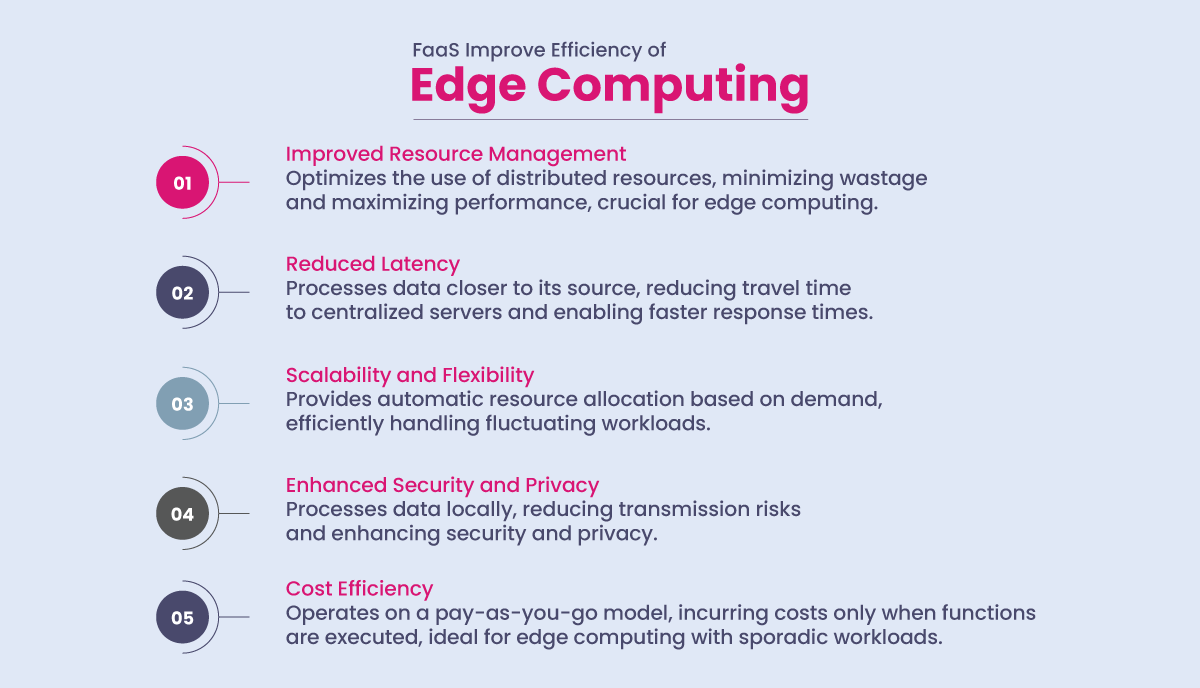
- Reduced Latency: FaaS processes data closer to where it is generated, minimizing the time taken for data to travel to centralized cloud servers. This is especially helpful for applications that need answers right away.
- Improved Privacy and Security: By isolating functions within their own execution environments, FaaS enhances data security. Sensitive information can be processed locally on edge devices, reducing the risk of data breaches associated with transferring data to the cloud.
- Higher Reliability: FaaS employs function-based sandboxes that contain failures within individual functions, thereby improving overall system reliability. This is crucial for edge devices that interact continuously with the physical environment and may be more prone to failure.
- Cost Efficiency: FaaS reduces operating expenses and improves resource use at the edge by eliminating the need for substantial cloud infrastructure. It optimizes resource consumption at the edge and reduces dependency on cloud services, which helps in reducing operating expenses. Local execution of functions reduces the requirement for costly and vast cloud infrastructure.
- Enhanced Resource Utilization: FaaS effectively leverages the many resources that are accessible at edge locations, enabling improved performance optimization based on particular workloads.
- Faster Development Cycles: Developers can focus on writing and deploying individual functions without needing to manage the underlying infrastructure, which accelerates application development and deployment.
- Function Reusability: Functions can be reused across different applications, which not only saves initialization time but also enhances efficiency by avoiding redundant processing tasks.
These benefits position FaaS as a powerful enabler of efficient edge computing architectures, addressing key challenges posed by traditional cloud computing models while leveraging the unique capabilities of edge environments.
Frameworks and Tools
FaaS integration with edge computing has sparked the creation of a number of frameworks and technologies intended to improve performance, optimize resource management, and expedite application deployment. A number of frameworks have been put forth to improve the way FaaS and edge computing are integrated.
Recommended: Top AI Security Tools for Financial Services Industry
Here are some notable frameworks:
- EdgeFaaS: This framework facilitates the adaptable utilization of dispersed resources in cloud, edge, and IoT systems. Function scheduling and data placement are optimized based on privacy and performance requirements.
- FaaS-Sim: A simulation framework designed to evaluate serverless edge computing platforms. This helps researchers and developers design and optimize resource management techniques tailored for edge scenarios.
- Decentralized FaaS: This strategy improves system resilience and efficiency by distributing functions over numerous nodes, which improves deployment and responsiveness in federated edge computing environments.
As technology advances and productivity demands increase, the role of edge computing will further enhance and become increasingly vital. Frameworks like EdgeFaaS and tools like FaaS-Sim will be essential in optimizing the deployment of serverless architectures at the network’s edge as research continues to evolve in this field.
Challenges
Despite its advantages, challenges remain, such as managing function chaining and balancing performance with isolation. To fully realize FaaS’s promise in edge computing, these issues must be resolved.
Implementing FaaS in edge computing presents the following challenges:
- Heterogeneity of Resources: The diverse nature of edge devices requires sophisticated management strategies to effectively utilize available computational resources.
- Lack of Standardization: There is a need for standardized benchmarks and reference architectures to facilitate the development and optimization of serverless edge computing systems.
To unlock FaaS’s full potential in edge computing, addressing challenges such as resource heterogeneity and standardization gaps is crucial for optimizing performance, scalability, and interoperability across diverse edge environments.
Recommended: McAfee Introduces Cutting-Edge AI Scam Detector to Shield Users from Digital Deception
Conclusion
FaaS’s integration with edge computing represents a substantial improvement in the creation and distribution of applications over remote networks. FaaS reduces latency, which is essential for real-time applications that require prompt replies, by processing data closer to its source. This proximity not only enhances performance but also improves privacy and security, as sensitive data can be processed locally rather than transmitted to centralized cloud servers. Furthermore, by enabling function isolation, which permits individual functions to fail without affecting the system as a whole, FaaS fosters greater reliability.
The scalability of FaaS allows for dynamic adaptation to changing workloads, ensuring steady performance even during peak traffic without the need for manual intervention. Faster deployment cycles and easier management also help developers, freeing them up to concentrate on creating apps rather than maintaining infrastructure. When taken collectively, FaaS for Edge Computing has a number of benefits, which make it a game-changing model to solve the problems with conventional cloud computing and leverage the special potential of edge environments. Overall, FaaS is a powerful enabler for effective edge designs, satisfying the needs of modern applications while utilizing the special potential of edge settings.
To share your insights, please write to us at news@intentamplify.com