In today’s digital landscape, where cyber threats are increasingly sophisticated and cybercriminals advance, Multi-Factor Authentication (MFA) has emerged as a critical security measure for protecting sensitive information. MFA enhances traditional password-based systems by requiring users to provide two or more verification factors before granting access to accounts or resources. MFA’s multi-layered method significantly minimizes the chance of unwanted access, even if the user’s password has been hacked. MFA protects against cyberattacks by combining something the user knows (for example, a password) with other elements such as a mobile device or biometric data.
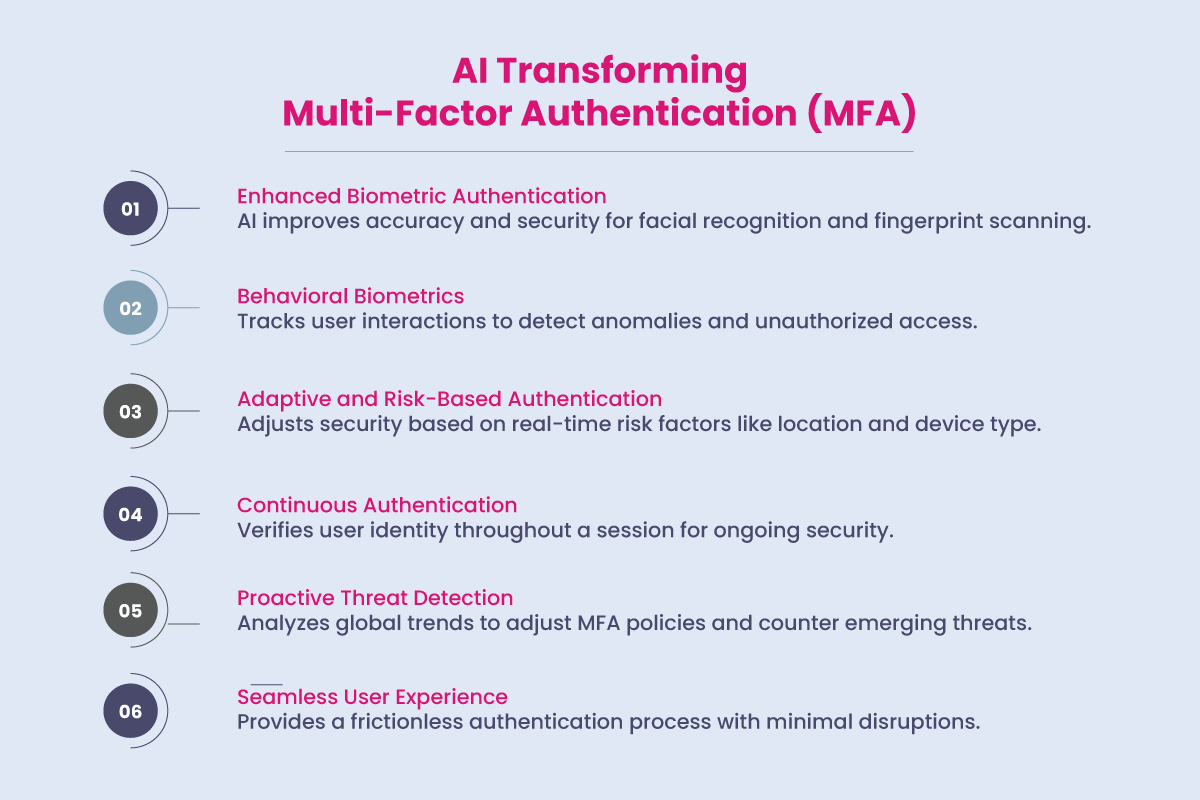
As organizations work to protect their data and meet legal standards, integrating MFA has become critical for improving security and promoting user trust and confidence in digital transactions. Furthermore, as technology progresses, Artificial Intelligence (AI) has become a driving force in MFA, improving usability, security, and adaptability while balancing robust security with user ease. In this overview, we will look at the key advantages and features of MFA in the context of modern cybersecurity procedures.
Here’s a simplified overview of MFA, its types, how it works, its benefits, and key trends in its technology.
What is Multi-Factor Authentication (MFA)?
MFA is a security mechanism or an authentication method that requires users to provide two or more distinct forms of verification to confirm their identity. It is a vital security mechanism that enhances the security of user accounts and sensitive data by ensuring that even if one factor, like a password, is compromised, unauthorized access is still prevented due to the need for additional verification steps. MFA is a sophisticated authentication technique that increases security. Unlike traditional single-factor authentication, which relies solely on a username and password, MFA makes unauthorized access significantly more difficult.
Recommended: Cybersecurity Simplified: LLMjacking Attacks
Types of Authentication Factors
MFA involves various authentication factors to enhance security by requiring users to provide multiple forms of verification. MFA typically involves five categories of factors for enhanced security mechanisms.
These five factors are as follows:
1. Knowledge Factors: This includes information that only the user knows.
Examples: Passwords, Personal Identification Numbers (PINs), Answers to Security Questions
2. Possession Factors: Physical items or devices that the user must possess to gain access
Examples: Mobile devices, Security tokens, USB security keys, and Smart cards.
3. Inherence Factors: Unique biological traits of the user that can be used for verification.
Examples: Fingerprints, Voice recognition, Facial recognition, Iris scans
4. Location-Based Factors: This involves authentication based on the user’s geographical location.
Example: The user’s IP address or geolocation is verified to ensure they are accessing from an authorized location.
5. Behavior-Based Factors: It is an advanced authentication factor that involves analyzing patterns in user behavior for authentication purposes.
Examples: Typing speed, mouse movement, usage patterns on device
MFA ensures that unauthorized access is denied even if one of these factors is compromised by requiring a combination of them. Organizations can implement robust MFA systems that significantly enhance security against unauthorized access by combining these authentication factors.
Knowledge factors, possession factors, and inherence factors are the key authentication factors of MFA.
How Does MFA Work?
MFA integrates knowledge, possession, and inheritance factors, along with location-based and behavior-based factors in selective cases, to enhance security by making unauthorized access more difficult.
When attempting to log in, a user must enter several credentials from several categories. For instance, to finish the login procedure, a user might input their password (knowledge factor) and then get a one-time code over SMS (possession factor). This multi-layered strategy serves as a strong defense against a range of attack techniques, such as credential theft and phishing.
Recommended: Cyber Insurance: Risks and Trends 2025
MFA works on a security mechanism where a user is required to authenticate themselves with multiple forms of identification from different categories before granting access to data or sensitive systems. This approach adds an advanced security layer and makes it hard for hackers to get unauthorized access to the system or sensitive data. If one factor is compromised (e.g., a password is stolen), the attacker still faces additional hurdles, such as needing the physical device or biometric data before accessing the account.
Key Benefits of Implementing MFA
MFA is an advanced security mechanism that requires users to go through multiple verification factors in order to access the resources, improving the protection of data, systems, and accounts. Implementing MFA provides numerous advantages to the users’ data and system that significantly enhance security and user trust.
Here are the key benefits of implementing MFA:
1. Enhanced Security
MFA technology significantly enhances security mechanisms by creating multiple layers of security in the form of verification. This feature of MFA makes it hard for unauthorized users to gain access, as they would need to compromise more than one factor. Simply put, even if an attacker obtains a password, they would still need additional verification factors such as a password and a security token or biometric data to gain access, making unauthorized access much more difficult.
2. Prevention of Account Takeover Attacks
MFA is a powerful tool against account takeovers, as it helps prevent account takeover attacks, which occur when an unauthorized user gains control over an account. MFA ensures that even if a password is compromised, a hacker will be denied access to the account by requiring several kinds of authentication.
Even if passwords are stolen through phishing attacks, additional authentication factors prevent account takeover. Implementing MFA can help organizations significantly reduce the danger of illegal access.
3. Regulatory Compliance
Many industries mandate MFA as part of compliance with data protection regulations such as PCI-DSS and HIPAA, helping organizations avoid penalties. Implementing MFA not only helps organizations meet these requirements but also avoids potential penalties and enhances overall compliance posture.
Recommended: Top 10 Emerging Cybersecurity Technologies for 2025
4. Improved Access Control
Organizations can better manage who has access to critical data in the system with advanced MFA technology. This makes sure that only authorized users get access to data. It is especially significant in an environment where information is shared with third parties.
5. Increased User Trust
The implementation of MFA can boost user confidence in the security of their accounts. Knowing that their sensitive information is protected by more than just a password fosters trust among customers and employees alike. MFA builds strong trust among users, knowing their accounts and data are secure and protected by multiple layers of authentication.
Overall, MFA serves as a critical component in modern cybersecurity strategies in an increasingly digital world, significantly reducing the risk of unauthorized access and enhancing overall security posture.
Key Trends in Multi-Factor Authentication (MFA) for 2025
As technology advances with AI and machine learning, the landscape of MFA is set to evolve significantly.
Here are the key trends projected to shape MFA practices in 2025:
1. Rise of Biometric Authentication
Biometric methods, such as facial recognition, fingerprint scanning, and voice recognition, are anticipated to become more prevalent in the near future, particularly in 2025. These advanced verification methods offer a seamless user experience while enhancing security.
Organizations are expected to employ biometrics more frequently to decrease their dependency on passwords, increase user convenience, and speed up and secure authentication.
2. Continuous Authentication
Instead of monitoring user behavior at the login point, continuous authentication tracks user behavior across the course of a session. This approach dynamically evaluates risk and, if suspicious activity is detected, may request further verification.
Moreover, this trend will enhance security without compromising user experience, as it allows for real-time adjustments based on user actions.
3. Integration with Zero Trust Security Models
MFA will be implemented into Zero Trust frameworks, where no user or device, regardless of location, is trusted by default, as the Zero Trust Security paradigm has developed over the previous several years. This concept strengthens security standards across networks and apps by emphasizing access management and ongoing verification.
Recommended: McAfee Reveals 2025 Cybersecurity Trends: AI Scams Rise
4. Growth in Passwordless Authentication
Password is likely to be an old fashion as passwordless authentication advances. It is anticipated that more people will use passwordless authentication systems, which do away with passwords completely by using techniques like biometrics or hardware tokens. This shift aims to reduce password-related vulnerabilities and simplify the login process for users.
5. Increased Focus on User Experience
A stronger focus on striking a balance between security and user convenience will emerge as more enterprises adopt MFA in the coming years. Solutions that retain strong security and expedite the authentication process will be given priority. As technology advances, users will embrace MFA solutions at higher rates if they have a better user experience.
The trends in MFA for 2025 indicate a significant evolution towards more secure, user-friendly authentication methods. The focus on biometrics, adaptive solutions, and phishing-resistant methods reflects the ongoing battle against cyber threats in an increasingly digital world.
Conclusion
In today’s digital landscape, the importance of MFA cannot be overstated. It serves as a vital component in modern-day cybersecurity strategies due to rising cyberattacks and concerns around securing data, systems, and identity. MFA creates a robust barrier against unauthorized access and data breaches. Organizations can significantly enhance their security posture and protect sensitive information from cyber threats by implementing an MFA multi-layered approach to authentication.
Overall, the use of MFA is a key security practice that helps protect user accounts, sensitive data, and critical systems from compromise, making it an essential tool for safeguarding digital assets in the modern threat environment. Additionally, MFA reduces the possibility of unwanted access and builds trust in digital space and data security among users. As organizations adapt to the changes in the MFA technologies, they will enhance their security posture while also improving the overall experience for users. It lowers the risk of unauthorized access and improves overall security posture, making it an essential part of modern cybersecurity measures in an increasingly digital environment.
Furthermore, MFA can reduce password fatigue by decreasing reliance on complicated passwords, thus enhancing user experience and confidence in online services. As technology advances and there is a greater emphasis on cybersecurity, MFA use is likely to increase.
To share your insights, please write to us at news@intentamplify.com