Coupa and Supply Chain Now bring this intelligence to enterprise technology leaders through Cyber Technology Intelligence, where CIOs and CISOs find the data, analysis, and peer perspective they need to make consequential decisions.
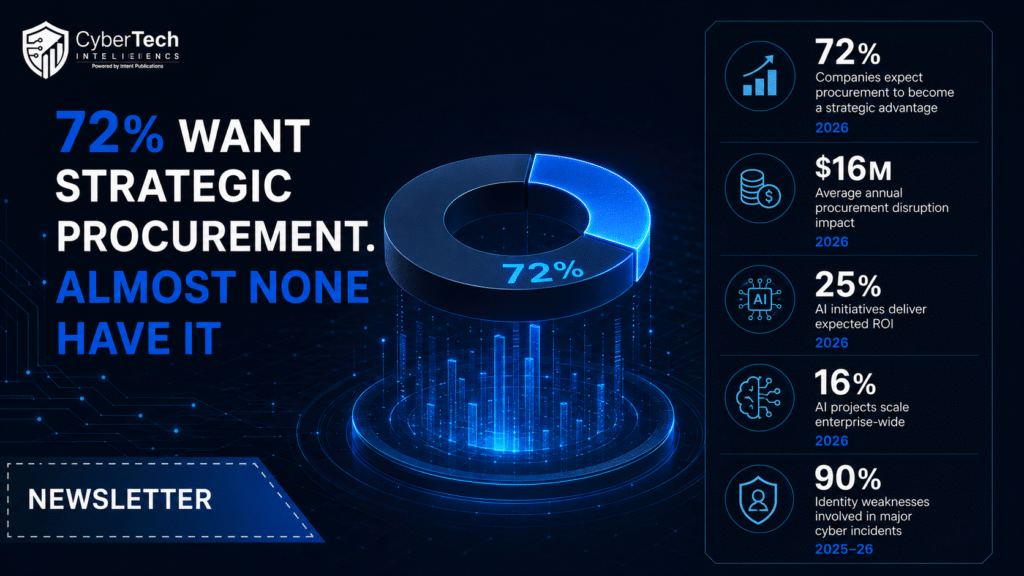
The aspiration is universal. 72% of companies expect procurement to become a strategic competitive advantage within three years. ¹
The reality is far more concentrated. Only a small fraction of those organisations have built the infrastructure, intelligence, and governance architecture that strategic procurement actually requires. The rest are running the same reactive, fragmented, manually reconciled model they have always run, calling it a transformation because they have added new tools to an old foundation.
The gap between ambition and delivery is not a budget problem. It is not a talent problem. It is a technology architecture problem. And it is costing organisations an average of $16 million per year in procurement-related disruptions. ¹
Coupa was built to close that gap. Not by adding another layer of software on top of broken infrastructure, but by replacing the infrastructure itself with a native, connected, continuously intelligent procurement platform that transforms direct procurement from a transactional cost centre into the strategic competitive engine that 72% of leaders already believe it should be.
Supply Chain Now’s upcoming exclusive webinar, The Infrastructure Gap: Why Direct Procurement Is at a Breaking Point, hosted by Scott Luton and Karin Bursa and featuring Mark Schenecker with Coupa, is the session where that transformation becomes concrete, practical, and actionable for the enterprise technology leaders who are responsible for making it happen.
The Ambition Gap Is Getting Wider, Not Narrower
The distance between what organisations want from procurement and what their current infrastructure can actually deliver is not shrinking. The data from 2026’s most credible enterprise technology research confirms it is accelerating.
IBM’s AI ROI research (February 2026) documents the core problem: only 25% of AI initiatives deliver expected ROI, and just 16% scale enterprise-wide. ²
The primary failure mode is not inadequate technology. It is fragmented integration with core business activities, identified by 68% of executives as a critical factor for cross-functional effectiveness. ³
In procurement, fragmented integration is not an abstract governance issue. It is the specific mechanism through which visibility breaks down, disruptions go undetected, and $16 million leaves the organisation every year before anyone notices.
IBM’s own procurement transformation proves what a different architecture delivers. Partnering with IBM Consulting, CCEP achieved more than $40 million in cost savings and avoidance through AI-driven procurement insights. ⁴
IBM’s own internal transformation reduced supply chain costs by $160 million and maintained a 100% order fulfilment rate at peak global disruption. Neither result came from adding more tools. Both came from rebuilding the foundation. ⁵
KEY FIGURES AT A GLANCE
72% of companies expect procurement to become a strategic competitive advantage within three years (Supply Chain Now / Coupa Webinar — June 2026) ¹
$16M average annual financial impact from procurement-related disruptions per organisation (Supply Chain Now / Coupa Webinar — June 2026) ¹
Only 25% of AI initiatives deliver expected ROI and just 16% scale enterprise-wide (IBM — February 2026) ²
What Coupa Builds That Strategic Procurement Actually Requires
Coupa’s platform is not a procurement application. It is the operating infrastructure that transforms procurement from a function that reacts to disruptions into one that anticipates, coordinates, and influences before disruptions become financial events.
The distinction matters for CIOs and CISOs evaluating enterprise architecture because it changes the fundamental question being asked.
A procurement application asks: How do we automate what we already do? Coupa’s infrastructure approach asks: What would procurement look like if it were built as a native, real-time, AI-driven intelligence engine from the ground up?
The answer is the three-pillar framework, which Coupa and Supply Chain Now explore in depth in the June 3rd webinar.
Infrastructure is the data foundation. Coupa unifies direct materials spend, supplier commitments, contract obligations, and supply risk into a single, continuously updated platform that gives finance, operations, and risk leadership a reliable view of procurement reality in real time. This is not a reporting layer. It is the foundation from which every other procurement decision is made.
Intelligence is Coupa’s AI-driven insight layer that converts that foundation into proactive action. Rather than telling teams what happened last week, Coupa’s platform identifies what is about to happen and coordinates the cross-functional response before the cost of delay accumulates. For CIOs building enterprise AI strategy, this is where Coupa’s platform connects to the agentic workflow architecture that the industry’s leading technology providers are scaling across 2026.
Influence is the cross-functional governance that makes procurement decisions visible, defensible, and aligned with enterprise risk management. For CISOs, influence is also where Coupa’s platform intersects directly with the vendor access governance, audit trail requirements, and third-party risk controls that the 2026 threat environment demands.
Coupa’s platform delivers all three from a single, native architecture. Not from a collection of integrated point solutions that each introduce their own data latency, vendor access exposure, and maintenance overhead.
Microsoft: The Organisations Pulling Ahead Have Redesigned the Operating Model
Microsoft’s Dynamics 365 research (May 2026) identifies the precise gap that separates organisations with strategic procurement from those still chasing it: Gartner predicts that 60% of supply chain disruptions will be resolved without human intervention by 2031, but only for organisations that have built the unified data connectivity and agentic workflow foundation that makes autonomous resolution operationally viable. ⁶
Microsoft’s own research on agentic AI confirms the organisational dimension of that gap: the 2026 Work Trend Index shows that organisational factors drive more than 2x the AI impact of individual capability. ⁷
Organisations that redesign workflows around a unified intelligence platform compound their advantage every quarter. Those that layer new AI tools onto fragmented foundations keep hitting the same scale ceiling.
Microsoft’s Supplier Communications Agent in Dynamics 365, launched February 2026, automates routine vendor communications, including purchase order follow-ups and change confirmations, freeing procurement professionals from administrative overhead and directing their capacity toward the strategic supplier relationships that actually reduce risk and build resilience. ⁸
Coupa’s platform is designed to operate within enterprise architectures like these, feeding the agentic workflows, governance frameworks, and cross-functional visibility that CIOs are already building across their organisations.
Palo Alto Networks: Strategic Procurement Requires a Secure Foundation
For CISOs reading this, strategic procurement is not just an operational ambition. It is a security architecture decision. Each of the connections that can be established with a supplier, each connection that involves integration into a vendor ecosystem, each SaaS procurement solution that becomes integrated into the enterprise system, represents a potential avenue for breach, and the threat landscape of 2026 has made that vulnerability clearly quantifiable.
The Unit 42 Global Incident Response Report 2026, produced by Palo Alto Networks, based on over 750 incidents reported in 50 countries from October 2024 to September 2025, highlights the role of software supply chain vulnerabilities as one of the key determinants of the threat landscape in 2026.
Identity weaknesses factored into nearly 90% of Unit 42 investigations, with attackers using vendor access and fragmented identity estates to escalate privileges and move laterally at a speed that conventional defences cannot match. ⁹
Separately, Palo Alto Networks’ State of Cloud Security Report 2025 (December 2025) surfaces a finding that every CISO managing a fragmented technology environment needs to carry into their next architecture review: managing an average of 17 cloud security tools from five vendors creates fragmented data and context gaps that slow incident response, with 97% of respondents prioritising vendor consolidation as a direct result. ¹⁰
The same consolidation logic that improves security posture applies directly to procurement infrastructure. More vendors, more integrations, more exposure. Fewer vendors, native architecture, governed access, reduced attack surface.
Coupa’s approach of building procurement as native infrastructure rather than assembling a collection of vendor integrations is not just an operational architecture decision. It is a security posture decision, and the 2026 threat data makes the case for it in terms that every CISO already understands.
Google Cloud: The Logistics and Procurement Leaders Have Already Made the Platform Shift
Google Cloud’s research on agentic AI in logistics (March 2026) surfaces a market signal that procurement leaders should read as directly applicable to their own function: 74% of shippers say they are likely to switch logistics providers based on a provider’s AI capabilities, and the market is consolidating around partners who deliver strategic intelligence alongside execution rather than commoditised capacity. ¹¹
The parallel inside enterprise procurement is exact. Those companies which can provide continuous procurement intelligence regarding direct materials, supplier risk, and spend optimization from one integrated platform have established a unique advantage which those using disparate tool sets can never be able to replicate, no matter what. Google Cloud’s partnership with EcoVadis (April 2026) demonstrates the architecture: a unified AI foundation built on Gemini, generating consistent, real-time intelligence across procurement, compliance, and sustainability categories that were previously managed in complete isolation from each other. ¹²
That is the platform architecture Coupa enables. A single, coherent procurement intelligence engine that compounds in value with every transaction, every supplier relationship, and every cross-functional decision it informs.
The Webinar That Converts Aspiration Into Architecture
72% of organisations want strategic procurement. Almost none have built the infrastructure that actually delivers it. The distance between those two groups is not closed by better intentions or larger technology budgets.
It is closed by the architectural decisions that Coupa’s platform is designed to support, and by the honest, practitioner-level conversations that Supply Chain Now creates for the leaders who are ready to act.
The Infrastructure Gap webinar, hosted by Scott Luton and Karin Bursa with Mark Schenecker of Coupa, delivers the three-pillar framework of Infrastructure, Intelligence, and Influence with the specificity that CIOs and CISOs need to move from procurement ambition to procurement capability. Not a vendor pitch.
A direct conversation about what it takes to build procurement that performs at enterprise scale, without expanding the security attack surface, without adding to the fragmentation problem, and without continuing to absorb $16 million every year while waiting for the right moment to act.
The right moment is June 3rd.
Register Now: The Infrastructure Gap: Why Direct Procurement Is at a Breaking Point Presented by Coupa | Hosted by Supply Chain Now
Register Here
References
- Supply Chain Now / IntentTechPub — The Infrastructure Gap: Why Direct Procurement Is at a Breaking Point — June 2026
- IBM — How to Maximize AI ROI in 2026 — 19 February 2026
- IBM IBV — IBM Study: AI Poised to Drive Smarter Business Growth Through 2030 — 19 January 2026
- IBM — AI in Procurement — April 2026
- IBM Case Study — IBM Builds Its First Cognitive Supply Chain — 2025
- Microsoft Dynamics 365 Blog — From Intelligence to Impact: How Agentic AI Is Reshaping Today’s Supply Chain — 4 May 2026
- Microsoft Cloud Blog — Agentic AI Is Reshaping Retail and Consumer Goods Economics — 21 May 2026
- Microsoft Dynamics 365 Blog — Agentic AI for Inventory to Deliver: From Procurement to Fulfilment — 2 February 2026
- Palo Alto Networks — 2026 Unit 42 Global Incident Response Report — 17 February 2026
- Palo Alto Networks — State of Cloud Security Report 2025 — 16 December 2025
- Google Cloud Blog — How Agentic AI Is Rewriting the Rules for Logistics Providers — 19 March 2026
- ESG News — Google Cloud Partners with EcoVadis to Scale AI-Driven Supply Chain Insights — 23 April 2026
🔒 Login or Register to continue reading