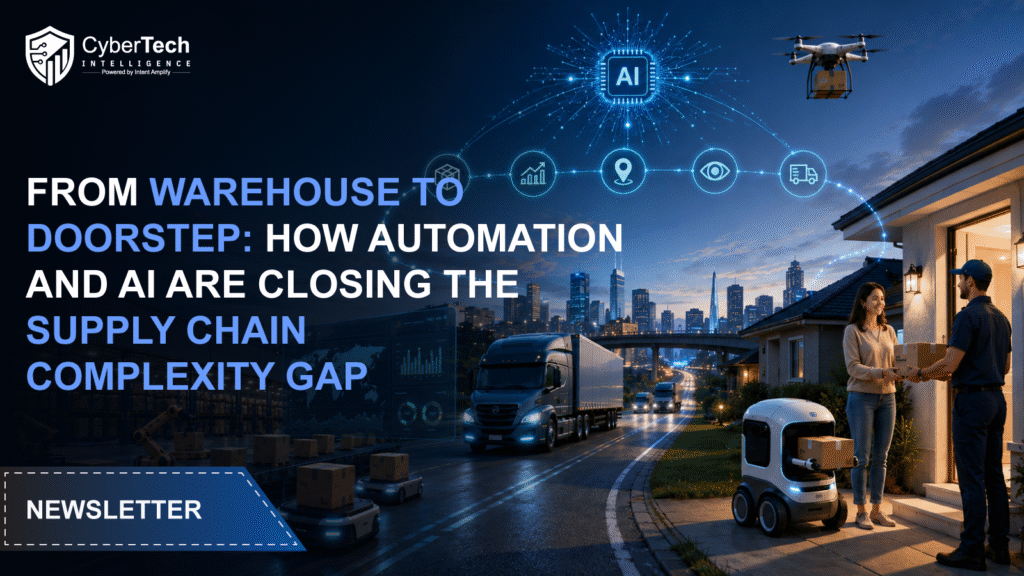
A delivery looks simple only because the customer is not supposed to see the chaos behind it. Someone clicks “buy now,” gets a tracking link, checks it three times a day for no rational reason, and expects the package to arrive when promised. That is the visible part. Behind it sits a much less elegant machine: inventory decisions, warehouse capacity, labor planning, replenishment cycles, route optimization, carrier performance, traffic, fuel costs, supplier delays, and the occasional operational surprise that ruins everyone’s spreadsheet.
This is the real supply chain problem today. Customers expect simplicity. Businesses are managing complexity. The gap between the two is widening.
Every Delivery Depends on More Decisions Than the Customer Sees
A delivery looks simple only because the complexity of it is systematically hidden from the customers.
Someone clicks “buy now,” gets a tracking link, checks it three times a day for no rational reason, and expects the package to arrive when promised. That is the visible part. Behind it sits a much less elegant machine: inventory decisions, warehouse capacity, labor planning, replenishment cycles, route optimization, carrier performance, traffic, fuel costs, supplier delays, and the occasional operational surprise that ruins everyone’s spreadsheet.
This is the real supply chain problem today. Customers expect simplicity. Businesses are managing complexity. The gap between the two is widening.
AI and automation are the silver bullet to this gap. Sometimes that claim is exaggerated, because apparently every business problem now needs to be introduced with the words “AI-powered.” But in supply chains, the case is stronger than usual. 2
So the challenge is not simply moving products faster. It is building supply chains that can keep promises while the underlying system keeps changing.
The Supply Chain Complexity Gap Is Widening
Traditional supply chain models were designed for a more predictable world. Planning happened in cycles. Forecasts relied heavily on historical demand. Teams coordinated manually. Adjustments were possible, but usually slow.
That worked better when demand was more stable, and customers were more patient. Neither condition describes the current market.
Today, companies are expected to deliver speed, visibility, and reliability all at the same time. That combination is expensive. Shipping delays, parts shortages, and transportation constraints have already hit margins hard, with some manufacturers reporting profit impacts as high as 13%. Transport costs also rose sharply during recent disruption cycles, adding more pressure to already stretched operating models..3
Some of the pressure is accommodated by transport. In August 2022, shipping costs were up more than 77% compared to January 2021, and manufacturing compensation costs rose by $42 per hour (6.2%) in Q1 2022.3
This creates an awkward equation: companies are expected to shorten delivery times while the cost of making those delivery promises keeps rising. “Do more with less” is a nice phrase in boardroom presentations.
AI and Automation Are Becoming the New Supply Chain Operating Layer
The answer is not simply “more automation.”
A warehouse robot can move faster than a person in many repetitive tasks. Automated sortation can improve throughput. Computer vision can reduce errors. These are useful capabilities. But they do not solve the bigger problem on their own.
If the inventory data is wrong, the robot just moves the wrong item more efficiently. If demand signals arrive too late, automation only helps execute a bad plan faster. If transportation is poorly coordinated, a perfectly picked order can still sit in the wrong place at the wrong time.
That is the distinction that matters.
Automation Improves Execution. AI improves decision-making.
AI-powered planning allows for more data to be considered both internally and externally compared to conventional forecasting approaches. Apart from considering past demand, it would include changes in consumer behavior, supplier information, changes in the market, weather conditions, transport considerations, and the state of inventories. According to McKinsey, AI-powered planning could lead to a reduction in forecasting errors by up to 30%-50%.1
This is important since forecasting is not simply a matter of internal considerations. A poor forecast turns into inventory buildup, stockouts, expedited deliveries, missed revenues, and disgruntled customers – in other words, it quickly turns into cost.
The most successful supply chains won’t be the ones that are best automated but the ones that allow their automation, artificial intelligence, data, and judgment to all point in the same direction.
The Warehouse Is Where Complexity Becomes Physical
The warehouse is where supply chain complexity stops being theoretical.
Products arrive. Orders change. Inventory moves. Workers coordinate with systems. Robots cross aisles. Picking priorities shift. A small delay in one corner of the warehouse can create problems downstream in packing, dispatch, transport, and customer communication.
This is why warehouse automation has become so important. Robotics, automated sortation, computer vision, and warehouse management systems can reduce repetitive manual work and improve consistency. But the real value is not the machine itself. The real value is whether that machine is connected to the rest of the operation.
A robot that is not connected to accurate inventory data is not a breakthrough. It is just a very expensive intern with wheels.
The modern warehouse is no longer just a storage facility. It is a coordination point. It has to connect inventory, labor, order priorities, transport schedules, and customer expectations. Automation helps turn movement into flow, but only when the surrounding system is intelligent enough to guide it.
The warehouse represents the end of theoretical supply chain complexity.
Products arrive. Orders change. Inventory moves. Workers coordinate with systems. Robots cross aisles. Picking priorities shift. The ripple effect — a one-second delay in one corner of the warehouse cascades down into packing, dispatch, transport, and customer communication.
It is with this in mind that warehouse automation emerges as such an important aspect. To reduce repetitive manual work and ensure consistency, robotics, automated sortation, computer vision, and warehouse management systems can help. This machine is calculating the moon landing, yes — but its real value goes beyond just that. The most important, though, is whether that machine has connectivity to the rest of the operation.
A robot that does not have connected accurate inventory data is not a revolution. It’s simply a very expensive intern on wheels. The present in the modern-day warehouse, it is not simply about storing goods. It is a coordination point. This needs to connect inventory, labor, order priorities, transport schedules, and customer expectations. This requires intelligence from the surrounding system to enable flow, which is why automation can help transform movement into flow.
The Best Delivery Starts Before the Order Exists
One such underappreciated fact in logistics is that the optimal form of transportation and delivery does not necessarily begin after the customer orders the item.
Businesses that can accurately anticipate consumer demand will be able to locate their products in proximity to their customers, allocate labor accordingly, minimize rush replenishments, and save on costly last-minute measures. Here, artificial intelligence proves helpful for the same reason as mentioned above: it receives more information ahead of time than human analysts can.
Advanced digital planning can automate a large share of routine planning work, with estimates suggesting automation potential of 80% to 90% in some planning activities. That does not make planners irrelevant. It changes what planners are needed for.1
But there is a catch. Predictive supply chains depend on trusted data. If the data foundation is weak, AI does not fix the problem. It scales the confusion. Accenture has reported that 67% of companies do not fully trust their data enough to extract meaningful value from it.4
Between Warehouse and Doorstep: AI Is Optimizing Movement
Once goods leave the warehouse, complexity does not decrease. It changes shape.
Vehicle capacity, delivery windows, route constraints, traffic, fuel costs, driver availability, customer updates, and carrier performance all have to be coordinated at once. The last mile is especially unforgiving because it is the part that the customer actually experiences.
AI can help by comparing route options, predicting delays, optimizing loads, and updating plans faster than teams working through calls, emails, and disconnected systems.
The gains are not only theoretical. Companies investing in autonomous supply chain capabilities expect to cut order lead time by 27%, improve labor productivity by 25%, and increase delivery reliability by 5%. 4
That 5% may sound small until it is applied across thousands or millions of deliveries. The last mile is not just logistics. It is trust wearing a delivery label.
Visibility Is the Difference Between Control and Guesswork
Most companies are not suffering from a lack of data. They are suffering from a lack of usable visibility.
Inventory data sits in one system. Supplier updates sit somewhere else. Transportation status may live in another platform entirely. Customer demand signals often arrive too late to influence the original plan, and they end up spending too much time on that instead of solving it.
This is why visibility has become one of the practical foundations of supply chain transformation. In Deloitte’s research, 78% of manufacturing executives said digital solutions and monitoring tools could improve visibility and transparency across the supply network. 3
Control towers are one response to this problem. But a control tower is only useful if it does more than display dashboards. A dashboard that tells a company it is failing in real time is not a transformation. It is just a very polished way to panic.
A strong control tower helps teams identify exceptions, understand trade-offs, and coordinate decisions across functions. Accenture found that 72% of top supply chain companies view control tower capabilities as crucial for customer-experience-led growth. 4
What Businesses Gain When the Complexity Gap Starts to Close
The business case for AI and automation in supply chains is not only faster delivery. Speed is useful, but speed without control can become expensive chaos.
The stronger business case is performance.
Better forecasting reduces excess inventory. Smarter transportation planning lowers cost and improves reliability. Better visibility allows teams to respond before internal problems become customer-facing failures. Mature control tower programs have been linked to revenue increases of up to 1% through reduced lost sales, logistics cost reductions of 3% to 5%, labor-efficiency improvements of 10% to 20%, and inventory reductions of 5% to 15%.6
The broader performance gap is also visible at the enterprise level. Companies with more mature supply chain capabilities generated an average EBIT margin of 11.8%, compared with 9.6% for others. Publicly traded leaders also delivered total shareholder returns of 8.5%, compared with 7.4% for peers.5
That is the part executives should care about. The point is not to make the supply chain look technologically advanced. The point is to protect margin, improve reliability, and build a business that does not collapse every time demand moves.
Intelligent Supply Chains Still Need Human Oversight
There is a risk of making this transformation sound cleaner than it really is.
Supply chains are messy. AI can be messy, too. Put the two together without governance, and the result is not intelligence. It is automated confusion with a nicer interface.
Automation can scale bad decisions if the data is poor, the process design is weak, or accountability is unclear. Human oversight does not become less important as systems become more autonomous. It becomes more important.
The concern is not theoretical. Deloitte found that 88% of manufacturing executives were concerned about legal, financial, privacy, intellectual property, or cybersecurity risks across the supply chain ecosystem, while only 55% said they had a comprehensive cybersecurity strategy in place.3
AI also brings governance risks of its own. Gartner predicts that by the end of 2026, “death by AI” legal claims will exceed 2,000 because of insufficient AI risk guardrails.2
That should make supply chain leaders pause. Not panic — pause. Intelligent systems still need accountable humans. The goal is not blind automation. The goal is controlled autonomy.
How Ready Is Your Supply Chain for What’s Next?
The next phase of supply chain transformation is not fully hands-off automation. It is the adaptability in these models.
Adaptive supply chains can sense change earlier, update plans faster, and coordinate decisions across planning, warehousing, transportation, and customer experience overall, embracing the supply chain.
That future is still early. Only 25% of companies have begun the journey toward supply chain autonomy, and the current median autonomy maturity is just 16%.4
But the direction is clear. Nearly 66% of companies plan to advance supply chain autonomy to the next level by 2035, and around 40% aspire to a model where the system handles most operational decisions.4
Gartner’s procurement forecast points in the same direction: by 2028, 90% of B2B buying will be AI-agent intermediated, pushing more than $15 trillion of spend through AI agent exchanges.7
That is where we are heading on the roads of warehouse-to-doorstep: more signals, more automation, more AI-driven decisions.
Why Resilience Matters More Than Ever
Together, they help close the gap between what customers expect and what traditional supply chains can deliver. From warehouse to doorstep, that is becoming the new standard for speed, resilience, and operational control.
Supply chain complexity is here to stay. Consumers demand more. Networks are constantly evolving. There will continue to be disruptions despite excellent management practices. Companies that will thrive in this environment will be those that try to eliminate complexity in their supply chains. Rather, successful firms will construct supply chains that will be resilient enough to handle such issues. Machines deal with the logistical aspect, while AI deals with making decisions. These are the dynamics responsible for the bridging of the demand vs. feasibility gap.
References
- McKinsey & Company — Supply Chain 4.0: The Next-Generation Digital Supply Chain — 27 October 2016
- McKinsey & Company — Risk, Resilience, and Rebalancing in Global Value Chains — 6 August 2020
- Deloitte Insights / Manufacturers Alliance — Meeting the Challenge of Supply Chain Disruption — 20 September 2022
- Accenture — Making Autonomous Supply Chains Real — 20 May 2025
- Accenture — Next Stop, Next-Gen: Tap into New Value with Advanced Supply Chain Capabilities — 20 June 2024
- Accenture — Supply Chain Control Tower: From Visibility to Value — 15 June 2023
- Gartner — AI’s Influence Runs Deeper Than You Think: 2026 Gartner Strategic Predictions Explain Why — 14 November 2025
🔒 Login or Register to continue reading