AI adoption is accelerating across the enterprise. Faster than governance, security maturity, and than what most organizations can track.
That’s the real problem. Not AI itself, but the fact that most organizations don’t know where it’s being used.
You Can’t Secure What You Can’t See
This is the defining challenge of AI security in 2026.
AI is no longer centralized. It’s not limited to approved tools or controlled environments.
It exists across:
- Employee workflows.
- External tools and APIs.
- AI copilots and assistants.
- Autonomous and agentic systems.
A significant portion of AI activity now exists beyond formal oversight. This is the emergence of shadow AI.
It introduces a new kind of risk. One that is distributed, invisible and rapidly scaling. Before you can secure AI, you need visibility.
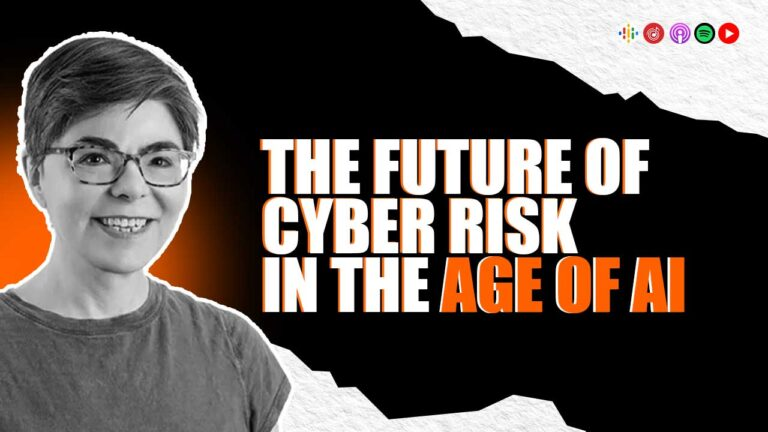
Tune in to hear Diana Kelley, CISO at Noma Security break down the AI security blindspots CISOs can’t afford to ignore.
The Shift From Security to Risk Ownership
The role of the CISO is evolving. This is no longer just about protecting systems. It’s about owning enterprise-wide AI risk.
In today’s environment, CISOs must:
- Understand how AI is used across business units.
- Align security with business outcomes and AI use cases.
- Manage risk introduced by both humans and AI systems.
- Communicate AI risk at the executive and board level.
This is a fundamental shift. From reactive defense to proactive risk leadership
Shift your role before the risk defines it for you.
Move from protecting systems to owning AI-driven decisions.
AI Has Created a New Attack Surface
AI does not fit into traditional security categories.
It introduces entirely new layers of exposure (examples provided):
1. Interaction Risk
A user inputs a crafted prompt that tricks an AI assistant into revealing confidential internal data or system instructions.
2. Model Risk
A compromised dataset introduces hidden biases, causing the model to generate inaccurate financial or medical recommendations.
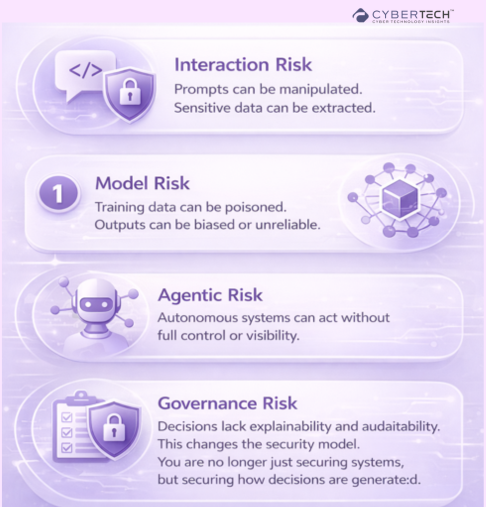
3. Agentic Risk
An AI agent automatically executes a workflow, such as approving transactions or triggering actions, without proper human validation.
4. Governance Risk
An AI system denies a loan or flags a transaction, but cannot clearly explain the reasoning, creating compliance and regulatory risk.
SentinelOne’s acquisition of Prompt Security focuses on real-time visibility into AI usage and preventing data leakage from GenAI tools.
Prompt Security (now part of SentinelOne) was recognized in Gartner’s 2025 “Cool Vendors in AI Security.”
Why Most Organizations Are Still Exposed
Despite growing awareness, most enterprises are early in their AI security journey.
Common gaps include:
- Low visibility into AI usage.
- No enforcement of usage policies.
- Absence of monitoring of AI outputs.
- No structured governance frameworks.
This creates a widening gap:
AI adoption is scaling. Security control is not.
The AI Security Control Stack
Securing AI requires more than isolated tools. It demands a structured, end-to-end approach that brings visibility, control, and accountability into one cohesive framework.
How CISOs Are Regaining Control
To address this, leading CISOs are adopting a structured approach.
1. Visibility
Identify where AI is being used and how it interacts with data.
2. Risk Alignment
Map AI usage to business risk and critical workflows.
3. Control
Define and enforce how AI systems can operate.
4. Monitoring
Track AI behavior, outputs, and anomalies in real time.
5. Governance
Ensure accountability, compliance, and auditability. This is the shift from fragmented security to intentional AI risk management.
The Rise of Agentic AI: A New Control Challenge
One of the most important developments is the emergence of agentic AI.
These systems:
- Take actions autonomously.
- Interact with enterprise systems.
- Operate with increasing independence.
This introduces a new dimension of risk.
Not just users, but non-human identities acting inside your environment.
Controlling these systems requires:
- Identity frameworks.
- Access boundaries.
- Continuous monitoring.
This is where many organizations are unprepared.
Security Must Enable AI, Not Block It
One of the biggest mindset shifts for CISOs:
Security cannot slow AI adoption. It must enable it safely.
Organizations that get this right:
- Move faster with AI initiatives.
- Build stronger trust with customers and stakeholders.
- Reduce long-term risk exposure.
- Gain competitive advantage.
Security is no longer a gatekeeper. It is becoming a growth enabler.
From Insight to Action: What Should CISOs Do Now?
Start with one question:
“Do you have visibility into how AI is being used across your organization?”
If the answer is unclear, that’s your starting point.
From there:
- Map AI usage.
- Align it with business risk.
- Implement control layers.
- Establish governance frameworks.
If you don’t know where AI is being used in your organization. You don’t control the risk.
Listen to the full episode now and learn how to take control of AI security.
The AI Security Blindspot CISOs Can’t Ignore.
Featuring Diana Kelley from Noma Security.
Final Thought
AI is already embedded in how your organization operates. Quietly influencing decisions, workflows, and outcomes at scale.
The real issue is not whether it is secure. It is whether you have the visibility, context, and ownership required to secure it.
AI risk does not fail loudly. It scales silently. Across teams, systems, and decisions. Organizations that recognize this early will move from uncertainty to control. Those who don’t will be left responding to risks they never fully saw.
FAQs
1. What is AI security, and why does it matter for enterprises in 2026?
AI security focuses on protecting AI systems, data, and outputs from misuse, manipulation, and unauthorized access. It matters because AI is now embedded in core business processes, making its risks operational, financial, and strategic.
2. What are the biggest AI security risks organizations face today?
The most critical risks include shadow AI usage, prompt injection attacks, data leakage, model poisoning, and unmanaged agentic AI systems operating without proper controls.
3. How can CISOs gain visibility into AI usage across the organization?
CISOs can improve visibility by mapping AI tools and integrations, monitoring API usage, identifying shadow AI, and implementing discovery mechanisms across endpoints and workflows.
4. What is the role of a CISO in AI risk management?
The CISO is responsible for overseeing AI risk across the enterprise, aligning security with business goals, enforcing governance, and ensuring AI systems are secure, compliant, and auditable.
5. How can organizations secure AI without slowing innovation?
By embedding security into AI workflows, using risk-based controls, enabling real-time monitoring, and aligning governance with business use cases, organizations can secure AI while maintaining speed and agility.
To participate in upcoming interviews, please reach out to our CyberTech Media Room at info@intentamplify.com.