

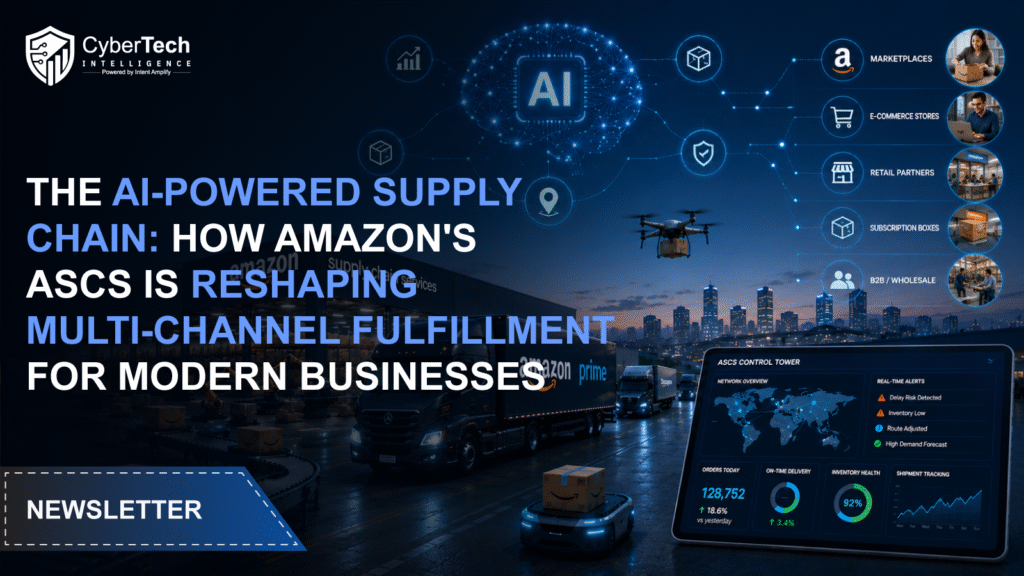
In March 2026, Gartner published research projecting that 60% of supply chain disruption incidents will be resolved autonomously by 2031, not by removing human oversight, but because AI systems will handle the resolution cycle faster and more accurately than manual processes allow.1 For operations leaders still managing fragmented, manually-intensive logistics, that trajectory is less a future ambition than an accelerating competitive gap. 1
The operational friction that builds up inside a fragmented supply chain tends to be specific and mundane rather than dramatic: an order that should have shipped the previous day sitting unfulfilled because the inventory is in the wrong fulfilment centre, a replenishment cycle that missed a demand signal, a carrier handoff that introduced a delay the system had no way to anticipate.
These are not failures of strategy. They are the predictable outputs of infrastructure that was built incrementally and never rationalised.
If this is something you can relate to, then save the date June 16th.
Tuesday, June 16, 2026 · 12:00 Noon ET
Reserve Your Seat
LET’S BE HONEST ABOUT WHERE MOST BUSINESSES ARE RIGHT NOW
Operating a product-based business in 2026 can be truly difficult. However, not the kind of difficulty that comes from crises happening all the time; rather, it’s difficult in the sense that it is always a struggle.
You have developed your business and have established yourself. You have an
According to MHI and Deloitte, 55% of supply chain managers are raising their investments in technologies and innovations, with 60% planning to invest more than $1 million. Additionally, 19% are planning to invest more than $10 million. 2
Tariffs are unpredictable. Carrier capacity tightens without warning. Delivery times have become one of the key expectations for consumers. Against this backdrop, it doesn’t always pay off to invest heavily in the quality of your product or marketing efforts. What wins you the game is the ability to perform consistently despite external conditions.
This webinar will be all about that.
WHAT AMAZON HAS BUILT AND WHY IT NOW BELONGS TO YOU
Here’s something worth sitting with for a moment. The logistics network Amazon operates today wasn’t built overnight, and it wasn’t built for you, at least, not originally. It was built to solve Amazon’s own problems: how do you move billions of items to hundreds of millions of customers, fast and accurately, at a cost that actually makes sense?
The answer took more than two decades to develop. Fulfillment centers placed strategically across the country. AI systems that predict what customers will want before they’ve even searched for it. Carrier relationships built at a scale that most businesses will never reach on their own. Automation that removes human error from the most repetitive and high-volume parts of the operation.
All of that is now available to your business through Amazon Supply Chain Services (ASCS).
This isn’t a marketplace product. It’s not something you can only access if you sell on Amazon.com. ASCS is a full end-to-end logistics solution, including inbound transportation, warehousing, multi-channel fulfillment, and last-mile delivery, designed for businesses that sell anywhere and everywhere.
Think about what that actually means for the way you operate day to day. One network. One view of your inventory. One logistics relationship to manage. The complexity that’s been spreading across your operations team for years, simplified.
WHY THIS WEBINAR IS WORTH AN HOUR OF YOUR TIME
There is genuinely a lot of supply chain content out there. Conferences, whitepapers, and vendor webinars that promise transformation and deliver a slide deck full of buzzwords. We’re not going to pretend this webinar exists in a vacuum.
What makes June 16 different is straightforward: this session is led by the people who actually built and run one of the most sophisticated supply chain networks on the planet, and they’re going to talk to you like a real business owner, not a prospective customer to be sold at.
Amazon’s Mike Schaffer, Principal for Technical Business Development on the Multichannel Commerce and Fulfillment team, will walk you through ASCS from the ground up.
- What the services are
- How they connect
- What the experience looks like for brands already using the network
- Crucially, what it looks like in practice, not just in theory
No fluff. No vague promises. Just a clear, honest look at what ASCS can do and how to think about whether it’s right for your business.
WHAT YOU’LL WALK AWAY WITH
A real understanding of how the network works, end-to-end
ASCS isn’t a single product. It’s a coordinated set of services: Amazon Global Logistics, Amazon Warehousing and Distribution, Fulfillment by Amazon, and Multi-Channel Fulfillment, that work together as a system.
Understanding how they connect is the key to understanding why the whole thing performs the way it does. Mike will map this out clearly so you leave knowing exactly what’s available and how the pieces fit together.
A practical look at AI and automation in action
The words “AI-powered” appear in almost every logistics pitch right now. In this session, you’ll see what it actually means when Amazon says it. Inventory placement that’s optimized continuously.
Demand forecasting built on transaction data at a scale most businesses will never touch. Automated replenishment that reduces stockouts without bloating your carrying costs. This isn’t theoretical; it’s running right now, at scale, and it will be explained in plain language.
Accenture states that the fulfillment process, which includes warehousing, inventory, and transportation, including the last mile, is one of the most costly elements in the supply chain cycle and can consume more than 40% of logistics costs. 3
A real business result, told honestly
One brand using ASCS doubled its year-over-year revenue without adding a single person to its operations team. That’s a number worth stopping on. The session will walk through that story, what changed, how the transition worked, and what the results looked like because outcomes matter more than capabilities. You’ll hear the case made with specifics, not generalities.
A first look at something not yet widely available
The new ASCS management console, a single platform for managing your entire supply chain account across every channel, is getting one of its first public previews on June 16. If you’ve ever wished you could see everything in one place rather than toggling between systems, this is worth seeing.
The chance to ask your actual questions
Following their presentation, the Amazon representatives will answer any questions that you might have on an ad hoc basis, which isn’t just a pre-written Q & A but rather an honest and genuine dialogue about the ASCS system. Do you have any questions on how ASCS can be integrated into your present system? How will the pricing work out?
THE FOUR THINGS ASCS DOES THAT MOST LOGISTICS SOLUTIONS CAN’T
-
It handles every channel from one place
The operational cost of multi-channel commerce is rarely captured in a single line item. It accumulates across disconnected fulfilment processes, separate inventory pools, and multiple logistics relationships that each require independent management.
For operations teams at scaling brands, a meaningful share of capacity goes not toward growth but toward keeping fragmented systems aligned with each other.
ASCS addresses this directly. By routing all channels through a single network, inventory becomes shared rather than siloed, visibility consolidates to a single view, and the reconciliation overhead that typically scales with channel expansion stops scaling.
-
It brings intelligence that would cost a fortune to build yourself
Demand forecasting, inventory optimization, and replenishment automation are hard problems that require enormous amounts of data and serious engineering investment to solve well.
Most businesses don’t have the data volume or the technical resources to do them properly. Amazon does, and it’s been getting better at them for more than twenty years. When you use ASCS, you’re not just accessing a fulfillment network. You’re plugging into an intelligence layer that’s quietly working on your behalf around the clock.
-
It lets your business grow without your operations growing at the same rate
There’s a point in a lot of businesses’ growth trajectories where logistics complexity starts to scale faster than revenue. More orders mean more problems, more headcount, more cost, and suddenly, growth feels less like success and more like chaos.
ASCS breaks that pattern. Because the network absorbs operational complexity at scale, your business can grow its order volume without proportionally growing the team behind it. That’s not a small thing. For many brands, it’s the difference between sustainable growth and a hiring spiral.
As per the report published by IDC titled “Worldwide Artificial Intelligence Systems Spending Guide,” the estimated AI investments made by enterprises globally in 2023 are $166 billion.
This expenditure is anticipated to reach $423 billion by 2027 with an annual compound growth rate (CAGR) of 26.9% for the forecast period 2022-2027. 4
It’s built to keep working when conditions change
Disruption isn’t going away. However, the factors that can lead to instability in the supply chain have become even greater in number and more difficult to predict than before. Amazon’s entire supply chain system was made in such a way that it would be capable of handling disruptions.
Factors like geographic spread, diverse carriers, and artificial intelligence all come together to make an adaptive system. When things happen, and they do, you always want to have your supply chain working from a flexible base.
THE PERSON LEADING THIS SESSION
Mike Schaffer, Principal, Technical Business Development, Multichannel Commerce & Fulfillment at Amazon
Mike works directly with brands to figure out how ASCS can fit into and improve their logistics operations. He’s someone who has had these conversations with businesses across industries and knows what the real questions and real concerns tend to be. He’ll lead the full session on June 16 and stay for the live Q&A, so if you have something specific you want to dig into, he’s the right person to ask.
IS THIS SESSION FOR YOU?
The session is designed for operations leaders, supply chain directors, logistics managers, and founders with operational responsibility, anyone accountable for how a product-based business moves goods to customers.
Prior or current presence on Amazon’s marketplace is not a prerequisite; ASCS is built to serve the full operation across all channels, not only the portion that intersects with Amazon’s platform.
The most relevant attendees are those at the point where the current logistics infrastructure is visibly constraining growth, where the question of whether the operation can scale to meet commercial ambition has moved from theoretical to pressing.
SAVE YOUR SPOT
This session is completely free. It runs for about 60 minutes, includes a live Q&A, and requires nothing from you except your attention. Seats are limited, and given how much interest this topic has been generating, registering sooner rather than later is the right call.
Register here: it takes less than a minute.
Date: Tuesday, June 16, 2026 Time: 12:00 Noon ET
We’ll see you on the 16th.
References
- Gartner (2026) Gartner Predicts 60% of Supply Chain Disruptions Will Be Resolved Without Human Intervention by 2031 [Press release]. 18 March. Available at: https://www.gartner.com/en/newsroom/press-releases/2026-03-18-gartner-predicts-60-percent-of-supply-chain-disruptions-will-be-resolved-without-human-intervention-by-2031 (Accessed: 29 May 2026).
- MHI and Deloitte (2025) The Digital Supply Chain Ecosystem: Orchestrating End-to-End Solutions — 2025 MHI Annual Industry Report [Press release via Business Wire]. 19 March. Available at: https://www.businesswire.com/news/home/20250319048739/en/New-MHI-and-Deloitte-Report-Focuses-on-Orchestrating-End-to-End-Digital-Supply-Chain-Solutions (Accessed: 29 May 2026).
- Horvath, R. (2026) ‘A targeted AI approach to maximizing value in fulfillment’, Accenture Supply Chain Blog, 5 February. Available at: https://www.accenture.com/in-en/blogs/supply-chain/maximize-value-ai-fulfillment (Accessed: 29 May 2026).
- Jyoti, R. and Schubmehl, D. (2023) The Business Opportunity of AI: How Leading Organizations Around the World Are Using AI to Drive Impact Across Every Industry [IDC InfoBrief, IDC #US51364223, sponsored by Microsoft]. Needham, MA: International Data Corporation (IDC). November. Available at: https://static1.squarespace.com/static/5ffd6f883ff3ea0604bd4aea/t/65bb4dadd450c37f5834f0c0/1706773952738/IDC+AI+Report.pdf (Accessed: 29 May 2026).
🔒 Login or Register to continue reading









