Across U.S. boardrooms, a structural divide is quietly accelerating. Some enterprises still evaluate direct procurement through savings percentages and sourcing cycle metrics. Others now treat procurement architecture as a strategic operating system capable of influencing resilience, growth velocity, supplier continuity, and competitive positioning simultaneously.
What separates these two camps is not spending power but the deliberate design of their operating architecture.
The recent webinar hosted by Intent Technology Insights, “The Infrastructure Gap: Why Direct Procurement Is at a Breaking Point,” quantified the scale of the challenge: procurement-related disruptions now create an average annual financial impact of $16 million for affected businesses.1
Even with increasing executive-level awareness, too many leadership teams are treating visibility, intelligence, and governance as disparate modernization initiatives rather than tightly related competencies. This disconnect is becoming increasingly expensive.
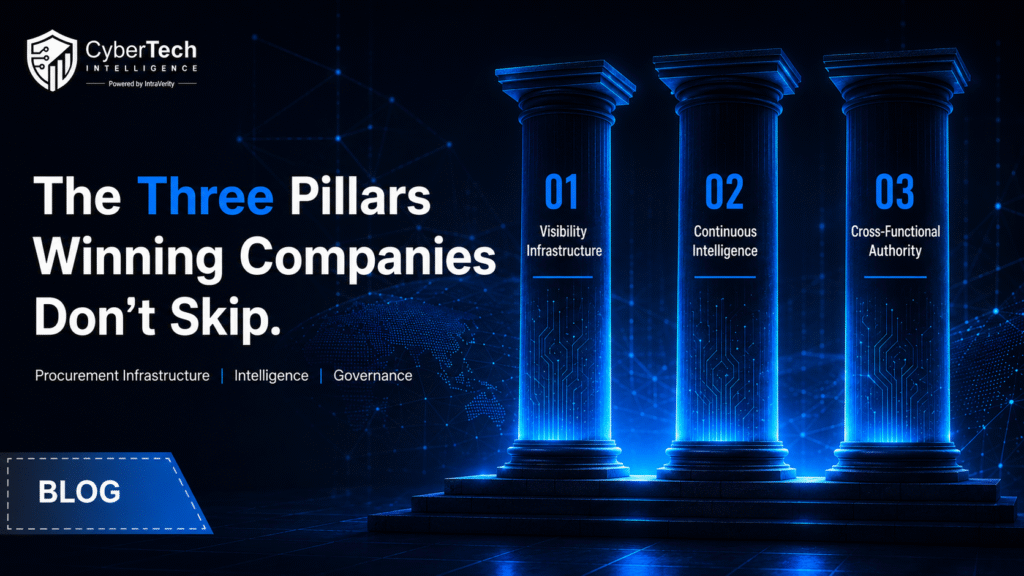
It is now the most forward-looking companies that are coming together around a framework of three core pillars that consistently distinguish the most successful individuals from those who are reacting in a haphazard manner: visibility infrastructure, continuous intelligence, and cross-functionality.
Pillar One: Visibility Infrastructure
Most operational disruptions no longer originate where executive dashboards are focused.
McKinsey’s 2025 survey of 100 global supply chain leaders found that risk awareness beyond tier-one suppliers remains remarkably limited, with visibility across deeper sourcing ecosystems declining compared to 2022 levels.2
That deterioration matters because exposure rarely stops with immediate vendors. Disruption patterns now propagate across logistics providers, raw material producers, semiconductor dependencies, regional manufacturing clusters, and external service networks simultaneously.
The financial consequences are already measurable. McKinsey research additionally found that major supply interruptions lasting longer than one month occur approximately every 3.7 years, while cumulative disruption costs over a decade can equal nearly 45% of one year’s profits.3
For direct materials environments, that level of exposure directly affects revenue continuity, production stability, contractual obligations, and shareholder confidence.
Market leaders are responding differently from traditional operators. Instead of expanding static inventory buffers or increasing manual oversight, advanced procurement functions are prioritizing automated visibility infrastructure capable of monitoring supplier dependencies continuously across multiple tiers.
IBM research reinforces the acceleration behind that transition. Nearly 89% of surveyed executives identified automation integrated with generative AI as a major investment priority for supply chain operations. 4
Operational efficiency is only part of what changes when visibility architecture improves. Enterprises that have deployed real-time frameworks are compressing latency across sourcing, forecasting, supplier assessment, and incident response at the same time. And the cybersecurity implications run just as deep.
Supplier ecosystems lacking operational transparency frequently lack security transparency as well. IBM’s 2025 Cost of a Data Breach findings showed that the average breach impact for U.S.-based businesses reached $10.22 million. 5
Third-party exposure increasingly overlaps with operational exposure, creating environments where procurement architecture and cyber resilience become interconnected board-level priorities rather than isolated departmental concerns. A supplier with weak access controls and a standing ERP integration does not just create operational risk. It creates an entry point. Attackers who compromise a mid-tier vendor’s credentials can move laterally into a buyer’s financial or production systems without ever touching the perimeter. Most procurement contracts and sourcing audits still do not evaluate for this vector, which means the exposure is both real and largely unmeasured.
What distinguishes procurement leaders right now is not digitization. Any company can deploy a platform. The more instructive question is what happens when visibility is absent. During the 2021 semiconductor shortage, several major U.S. automotive manufacturers discovered their Tier-2 supplier exposure only after production lines had already stopped. Because their systems tracked risk only to Tier 1, there was no early signal, no contingency window, and no negotiating leverage. Plants that lost weeks of output could trace the failure not to a missing tool but to an architecture that was never designed to see far enough. Leading procurement functions today are building specifically to prevent that sequence, constructing infrastructure capable of identifying operational friction before disruption reaches production schedules, financial forecasts, or customer commitments. The contrast is visible in how companies with multi-tier visibility responded to the same 2021 disruption period. Those with automated supplier mapping across Tier-2 and Tier-3 networks identified affected nodes within days, activated alternate sourcing agreements, and maintained production continuity while competitors waited weeks for manual assessments to surface the same information. The architecture made the difference, not the response team.
Pillar Two: Continuous Intelligence Instead of Delayed Reporting
Most enterprises are not short on operational data. What they lack is the organizational machinery to act on it before the moment passes. That gap increasingly defines who leads and who follows in procurement maturity. Ask any CPO where their biggest leverage point is in 2026, and the answer is rarely sourcing contracts. It is how fast the organization can act on what it already knows. Deloitte’s 2025 Global CPO Survey found that enhanced decision-making ranked as the top area of generative AI value among procurement executives, ahead of both productivity gains and cost reduction. 6
What that ranking reflects is a change in how executives frame the problem. For years, AI in procurement was justified through cost reduction. Now the conversation has moved to speed. The question is not whether AI can save money. It is whether it can compress the time between a market signal and a sourcing decision from days to hours. Most enterprises have the data to do this. Very few have the workflow design to act on it.
The more extensive State of AI in the Enterprise study conducted by Deloitte, which collected data from more than 3,200 global executives, found that the availability of artificial intelligence technologies among employees had increased by almost 50 percent in one year. But only 34 percent said their companies were designing processes around these technologies.7
It is why so many modernization programs produce reports, dashboards, and pilot results without moving a single operational needle.
The most recent spending forecast by Gartner finds that total global IT spending will reach $6.15 trillion by 2026, while software spending will rise by almost 15%. 8
Every quarter that investment accelerates, the distance between committed adopters and hesitant ones grows. Not just in what their systems can do, but in how far ahead their decision-making sits. McKinsey reinforced this directly in its late-2025 supply chain risk survey, concluding that enterprises resuming digital investment agendas most rapidly would likely outperform peers during future disruption cycles.9
Every capability discussed in this pillar points to the same underlying requirement: data that moves in real time, not in weekly batches. A procurement function that receives weekly spend reports and monthly supplier scorecards is not slow because of its people. It is slow because of its architecture.
Companies still dependent upon static dashboards, spreadsheet-based processes, or even backward-looking supplier evaluations are more often than not managing volatility after financial implications have been realized.
Pillar Three: Executive Cross-Function Authority
Modernization of technology does not solve organizational silos.
Companies continue viewing procurement as a support function, even with increasing evidence that sourcing impacts financial planning, customer commitments, operational sustainability, regulatory exposure, and cybersecurity.
According to Deloitte CPO survey results, siloed operations emerged as the top impediment to procurement value creation, with 57% of leaders identifying it as such. 10
Sophisticated platforms do not fix this on their own. A procurement team using best-in-class software but reporting through a siloed structure will still lose days waiting for approvals, escalations, and cross-functional sign-off that should take hours.
Gartner anticipates that by 2026, 40% of enterprise applications will include specialized AI agents, while at present, fewer than 5% have them.11
As AI agents proliferate across enterprise applications, procurement workflows will collide with finance, legal, operations, and cybersecurity in real time, whether the governance structure is ready for it or not. Organizations that have not yet built the cross-functional authority to manage those intersections will find that faster technology creates faster friction, not faster decisions. Recent trade volatility illustrates exactly what is at stake when that authority is missing. McKinsey’s tariff and disruption analysis found that 39% of surveyed businesses experienced direct increases in supplier and material expenses, while nearly one-third reported weakening customer demand. 9
The response will require a coordinated effort between the sourcing, finance, production, suppliers, legal, and strategy management departments.
What Procurement Leaders Should Do Next
For CPOs and CIOs navigating this environment in 2026, three near-term actions stand out. First, audit supplier visibility depth. If your current systems cannot surface Tier-2 or Tier-3 exposure within 48 hours of a disruption signal, that is a structural gap, not a reporting gap, and it will not close without deliberate infrastructure investment. Second, assess where AI tools have been deployed compared to where they have been integrated into actual decision workflows. Deployment without redesign produces dashboards. It does not produce faster sourcing decisions. Third, evaluate whether procurement holds a standing seat in cross-functional risk reviews alongside finance, legal, and cybersecurity. If the answer is no, that governance gap is already generating delayed response costs, even if they are not yet visible on a single line of the P&L.
Why the Three Pillars Must Operate Together
Infrastructure without intelligence becomes passive data accumulation. Intelligence without operational visibility creates flawed assumptions. Both become strategically ineffective when governance structures cannot execute decisions rapidly across business functions.
This interconnected model sits at the center of the Intent Technology Insights webinar featuring Coupa. The discussion highlights how procurement leaders are building visibility architecture, intelligent automation, and cross-functional alignment simultaneously rather than sequencing them through isolated transformation programs.
That is what separates the companies absorbing disruption from the ones being defined by it. At an average annual disruption impact of $16 million, fragmented procurement ecosystems are no longer creating theoretical risk. They are generating measurable financial exposure affecting growth forecasts, operational continuity, supplier trust, and executive confidence.1
Procurement has a narrow window to redefine its organizational role before the next disruption cycle forces that conversation under pressure. The enterprises that will hold competitive ground through 2027 and beyond are not necessarily the largest or the most heavily funded. They are the ones treating supplier visibility as a board-level infrastructure decision, AI integration as a workflow redesign challenge, and cross-functional authority as a governance investment rather than a cultural aspiration. As the Intent Technology Insights webinar featuring Coupa makes clear, the infrastructure gap is real, but it is also closable. The CPOs and CIOs moving decisively now will be setting the terms of operational resilience for their industries. Those who wait will be responding to the consequences of fragility on someone else’s timeline.
References
- Intent Technology Insights, “The Infrastructure Gap: Why Direct Procurement Is at a Breaking Point,” 2026
- McKinsey & Company, “Decoding Disruption to Reshape Manufacturing Footprints,” 2025
- World Economic Forum / McKinsey & Company, “Supply Chain Disruption: Digital Winners and Losers,” January 2025
- IBM, “Beyond the model: The systems behind enterprise AI adoption success,” 23 February 2026
- IBM, Cost of a Data Breach Report 2025, 2025
- Deloitte, “Procurement at the Tipping Point: Deloitte’s 2025 Chief Procurement Officer Survey Reveals the Pressure and Promise of Technology Disruption,” 19 Aug 2025
- .Deloitte, “State of AI in the Enterprise,” 2026
- Gartner, “Gartner Forecasts Worldwide IT Spending to Grow 10.8% in 2026,” February 2026
- McKinsey & Company, “Supply Chain Risk Survey,” December 2025
- Deloitte, “Global Chief Procurement Officer Survey ” 2025
- .Gartner, “Gartner Predicts 40% of Enterprise Applications Will Feature Task-Specific AI Agents by 2026,” August 2025
🔒 Login or Register to continue reading