Conference presentations tell one story. Enterprise data tells another. In boardrooms and keynote sessions across the US, supply chain AI is portrayed as a function in transformation.
In the actual operational environments where that transformation is supposed to be happening, the picture is considerably more sobering. AI is everywhere as an intention. It is nearly nowhere as a scaled, sustained, business-changing capability.
That gap is not closing on its own. Understanding why it exists, and what specifically separates the organizations that have closed it from those still trying, is the most important strategic conversation supply chain leaders can have right now.
The Pilot Trap Is Not a Niche Problem
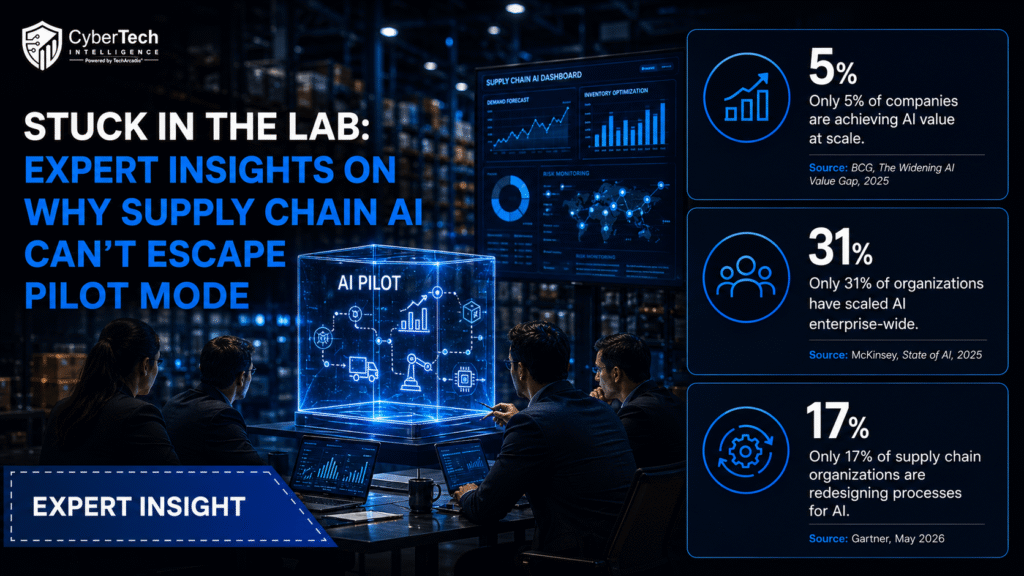
McKinsey’s State of AI research found that nearly two thirds of firms remain stuck in experimentation or piloting, while only 31% report scaling AI enterprise-wide. Over 80% reported no meaningful EBIT impact despite active AI adoption. 1
That is not a fringe group of underfunded operations. Those are well-resourced organizations with active AI programs reporting that the technology has not moved the number that matters to their boards.
BCG’s Widening AI Value Gap report, drawing on 1,250 senior executives across more than 25 sectors, found that only 5% of companies are achieving AI value at scale. A full 60% report minimal revenue and cost gains despite substantial investment. 2
60% did not fail to try. They tried without first building what scaling actually requires.
The Real Friction Is Not the Technology
Gartner’s April 2026 survey of 140 senior supply chain leaders found that more than half, 56% of chief supply chain officers, identify integrating AI with legacy systems and processes as a major challenge, and 50% say they have limited internal expertise or talent to implement and manage AI.
Snigdha Dewal, Director Analyst at Gartner, stated that the greatest friction point in scaling AI is not the technology itself but the legacy environments in which it is deployed, and that bolting AI onto an analog-era foundation only locks in existing inefficiencies.
Local optimization is the defining characteristic of the pilot trap. Pilots are bounded by design, and local optimization is what bounded environments produce. When the boundary expands to enterprise scale, the local optimization does not travel with it. The inefficiency it was built on does.
Gartner’s separate survey on supply chain operating model transformation found that only 17% of supply chain organizations are pursuing immediate transformational redesign of their processes and workflows, while 83% are either applying AI incrementally to specific use cases or gradually scaling it into integrated processes.
Applying AI incrementally to an unredesigned process is exactly why pilots succeed and scaling fails. The foundation was never built to hold more than a controlled experiment.
What the Top Performers Are Actually Doing
Research from GEP and the University of Virginia’s Darden School of Business, covering nearly 200 large enterprise executives, identified a Performance Elite group that has moved beyond pilots to achieve doubled productivity, reduced error rates, and faster response times.
What separates them is not technology sophistication but operating discipline: managing AI initiatives as a structured portfolio, documenting system logic through digital audit trails, and redesigning talent strategy to align incentives with AI-enabled operating models.
The portfolio discipline finding is particularly important. Organizations that treat each AI use case as a standalone experiment are structurally prevented from building the cross-use-case learning, governance, and infrastructure that scaling requires.
The Performance Elite treats AI deployment the way mature product organizations treat product development: with stage gates, defined progression criteria, and a governance layer that sits above individual initiatives.
BCG’s research reinforces this, finding that future-built companies concentrate 70% of their AI value in core business workflows including supply chain, manufacturing, and procurement, and that more than 60% of future-built firms systematically measure and report AI value, compared with only 17% of stagnating companies. Measurement discipline is not a reporting function. It is the feedback loop that tells an organization whether it is scaling or cycling through a more expensive version of the same pilot. 3
The Talent Dimension Most Organizations Underestimate
GEP and UVA Darden research found that organizations that have successfully scaled AI are two to three times more likely to have modernized elements of their talent strategy, redefining roles and aligning incentives to AI-enabled operating models.
This is the dimension that technology-first AI strategies consistently underinvest in, and it is where the distance between pilot performance and enterprise performance is most clearly explained. A pilot is staffed by the most motivated, technically capable members of the organization.
Enterprise scale requires the entire workforce to operate differently. That transition does not happen through training programs alone. It requires role redesign, incentive realignment, and the organizational signal that the old operating model is not coming back.
Gartner has also warned that supply chain organizations pausing entry-level hiring in favor of AI will face talent pipeline gaps and hiring pay premiums upward of 15% for early-career professionals by 2030, with the firm noting that AI is not a plug-and-play replacement for people and that organizations that stop hiring will face employee dissatisfaction and elevated costs for AI-native talent. 4
The organizations most likely to scale AI sustainably are those building human capability alongside it, not in spite of it.
The Strategic Inflection Point
Gartner’s 2025 Hype Cycle for Supply Chain Strategy placed generative AI in the trough of disillusionment, the phase where implementation failures outnumber success stories and organizations question whether their pilots will ever reach production
The trough is not a permanent destination. It is the phase that separates organizations building on real foundations from those building on assumptions. The path through it is not a better model or a larger budget.
It is the organizational decision to treat process redesign, portfolio governance, and talent alignment as the primary work, with technology selection as the downstream consequence of getting those three things right.
The 1-in-10 that have scaled supply chain AI are not waiting on the industry to resolve the pilot problem for them. They resolved it by treating it as a leadership and architecture challenge rather than a technology procurement challenge. That reframing is available to every supply chain organization right now. The question is whether the urgency is there to act on it before the value gap widens further.
References
- GEP and University of Virginia Darden School of Business (2026) Why Operational Discipline Determines Agentic AI Success: Supply Chain AI Readiness Report. Clark, NJ: GEP. Available at: https://www.gep.com/research-reports/supply-chain-ai-readiness-report-why-operational-discipline-determines-agentic-ai (Accessed: 28 May 2026).
- McKinsey and Company (2025) State of AI 2025. Available at: https://www.mckinsey.com/capabilities/quantumblack/our-insights/the-state-of-ai (Accessed: 28 May 2026).
- Boston Consulting Group (2025) The Widening AI Value Gap: Build for the Future 2025. Boston, MA: BCG. Available at: https://media-publications.bcg.com/The-Widening-AI-Value-Gap-October-2025.pdf (Accessed: 28 May 2026).
- Gartner (2026) ‘Gartner Survey Finds Technology Integration and Talent Perceived as Key Roadblocks to Scaling AI in Supply Chain’, Gartner Newsroom, 29 April. Available at: https://www.gartner.com/en/newsroom/press-releases/2026-04-29-gartner-survey-finds-technology-integration-and-talent-perceived-as-key-roadblocks-to-scaling-ai-in-supply-chain (Accessed: 28 May 2026).
🔒 Login or Register to continue reading