Across the manufacturing, energy, pharmaceutical, and retail sectors, the same scene plays out with frustrating regularity: a supply chain AI initiative launches with genuine momentum, delivers encouraging results within a contained pilot, and then quietly loses altitude on its way to enterprise scale. The budget stays approved. The enthusiasm does not.
This is not a fringe problem. It is the dominant reality of supply chain AI in 2026.
The Scaling Gap Is Structural, Not Situational
New joint research from GEP and the University of Virginia’s Darden School of Business, drawing on surveys and interviews with nearly 200 large enterprise executives, puts hard numbers around what many supply chain leaders have sensed intuitively.
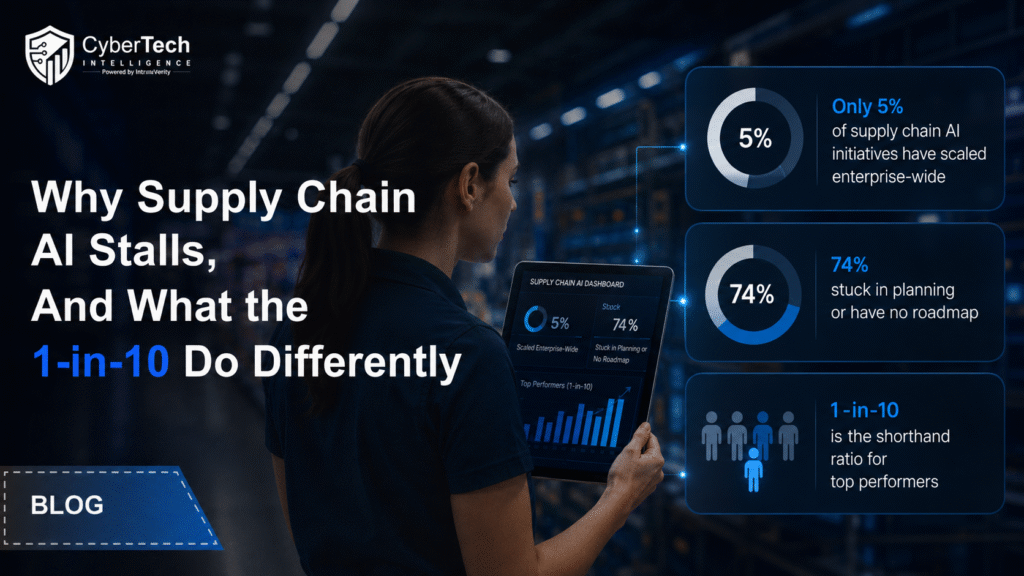
While AI experimentation is nearly universal, only about 5% of supply chain AI initiatives have successfully moved beyond experimentation to enterprise-wide scale. Specifically, 22% are caught in the pilot phase, and 74% are either stuck in planning or have no formal roadmap for execution. 1
Read that again. Three quarters of supply chain AI programs have not progressed beyond planning. The problem is not access to technology. It is not budget. The data makes clear that the bottleneck sits upstream of both: in governance, process design, and organizational alignment.
Gartner’s survey of 140 senior supply chain leaders found that only 17% of supply chain organizations are pursuing immediate transformational redesign of their processes and workflows, while 83% are either applying AI incrementally to specific use cases or gradually scaling it into integrated processes. That incremental approach is precisely what traps organizations in pilot purgatory. 2
“Persistent volatility is driving interest in evaluating AI‑orchestrated capabilities, but investment remains constrained by foundational readiness,” said Caleb Thomson, Senior Director Analyst in Gartner’s Supply Chain practice.
Gartner has also predicted that by 2028, 60% of supply chain digital adoption efforts will fail to deliver promised value due to insufficient investment in learning and development, with a survey of 579 supply chain practitioners showing that 58% identified rapid tech advancement as a major future challenge and that individual productivity gains from generative AI for desk-based workers have not translated into gains at the team level or for frontline workers.
That last finding deserves to sit with every supply chain executive who has reported strong pilot results: individual productivity gains do not automatically aggregate into organizational performance. Something has to bridge that gap deliberately.
What the 1-in-10 Actually Do
The GEP and UVA Darden research identified a small group of “Performance Elite” organizations that have successfully scaled AI pilots into enterprise-wide operations, achieving remarkable outcomes, including doubled productivity, reduced error rates, and compressed response times.
What separates them is not their technology choices. It is their operating discipline. Rather than approving isolated experiments, successful companies manage AI initiatives as a structured portfolio, progressing use cases deliberately from evaluation to pilot to scale.
They also document system logic through digital audit trails at materially higher rates than their peers, reinforcing trust, compliance, and accuracy. Organizations that have scaled AI are two to three times more likely to modernize elements of their talent strategy, redefining roles and aligning incentives to AI-enabled operating models.
Process redesign first, technology second. That sequencing is not how most organizations approach AI deployment, but it is consistently how the top performers approach it. Budget constraints and raw computing power, often cited as limiting factors, barely appear in the data when researchers examine why initiatives stall. The real constraint is organizational readiness to change the work itself, not just the tools that support it.
Only 23% of supply chain organizations have a formal AI strategy in place, according to Accenture, and only 29% have built the capabilities needed for future readiness. Those two gaps compound each other. Without a strategy, capability investment is unfocused. Without capability, strategy remains aspirational. 3
Where the Value Actually Lives
For enterprises in capital-intensive sectors, including petroleum and gas, industrial manufacturing, aerospace, food production, and retail distribution, the math on scaled AI is compelling. AI-enabled distribution operations see 5 to 20% logistics cost reduction, 20 to 30% inventory reduction, and 5 to 15% procurement spend reduction, according to McKinsey research.
Those numbers represent meaningful margin improvement across businesses where margin is hard-won.
In one documented example from the GEP and UVA Darden research, a standardized purchase requisition validation process enabled approximately 80% of transactions to auto-clear and drove triple-digit productivity improvements within weeks of deployment.
That result did not come from a superior AI model. It came from a redesigned process built to allow the AI to function at full capacity.
The signal here is consistent across every credible data source: the organizations achieving outsized returns from supply chain AI are not the ones with the most sophisticated models. They are the ones with the most disciplined operating frameworks built around those models.
The Strategic Question for Supply Chain Leaders Right Now
Most organizations are sitting at a fork in the road. One path continues the current pattern: isolated use cases, incremental gains, no structural change to process or governance, and eventual stall. The other path requires a harder set of decisions around process redesign, portfolio governance, workforce role evolution, and the willingness to retire the operating assumptions that predate AI-native supply chains.
Deloitte data shows that 85% of organizations increased AI investment in the past year, yet only 6% saw ROI in under a year, with most achieving satisfactory ROI within two to four years. That lag is not an indictment of AI. It is a reflection of how long it takes to redesign the organizational infrastructure that AI needs to deliver sustained returns. 4
The 1-in-10 are not waiting for a better tool. They are building a better system.
Frequently Asked Questions
1. Our pilot results were strong. Why would we expect scaling to be difficult?
Strong pilot results are actually one of the most common precursors to scaling failure. Pilots succeed partly because they are bound, closely managed, and staffed with the people most motivated to make them work.
2. We have a formal AI strategy. Does that put us ahead of the curve?
Having a strategy is necessary but not sufficient. The GEP and UVA Darden research points to portfolio governance, process redesign, auditability, and talent alignment as the distinguishing behaviors of Performance Elite organizations.
3. How should we think about prioritizing which AI use cases to scale first?
The Performance Elite treats this as a portfolio decision, not an individual use case decision. Use cases are evaluated on a consistent framework and moved from evaluation to pilot to scale in a structured sequence rather than being approved on a one-off basis.
4. Is agentic AI a realistic near-term consideration for our supply chain, or still largely aspirational?
The GEP and UVA Darden research, alongside GEP’s webinar with supply chain executives, frames agentic AI not as a distant horizon but as the logical destination of the scaling journey already underway.
5. How does the Performance Elite approach talent and workforce alignment differently from organizations that stall?
Organizations that have successfully scaled supply chain AI are two to three times more likely to have actively modernized their talent strategy alongside their technology investments.
References
- GEP and University of Virginia Darden School of Business (2026) Why Operational Discipline Determines Agentic AI Success: Supply Chain AI Readiness Report. Clark, NJ: GEP. Available at: https://www.gep.com/research-reports/supply-chain-ai-readiness-report-why-operational-discipline-determines-agentic-ai (Accessed: 28 May 2026). [Cited for: 5% of supply chain AI initiatives successfully scaled; 22% trapped in pilot phase; 74% stuck in planning or lacking formal roadmap; Performance Elite outcomes including doubled productivity and reduced error rates; portfolio governance, auditability, and talent alignment as distinguishing behaviors; 80% of requisition transactions auto-clearing with triple-digit productivity gains]
- Gartner (2026) ‘Gartner Survey Shows AI is Not Driving Supply Chain Operating Model Transformation’, Gartner Newsroom, 6 May. Available at: https://www.gartner.com/en/newsroom/press-releases/2026-05-06-gartner-survey-shows-ai-is-not-driving-supply-chain-operating-model-transformation (Accessed: 28 May 2026). [Cited for: only 17% of supply chain organizations pursuing immediate transformational redesign; 83% applying AI incrementally; Thomson, C. analyst quote on foundational readiness constraints]
- Accenture (2024) ‘Companies with Next-Generation Supply Chain Capabilities Achieve 23% Greater Profitability’, Accenture Newsroom, July. Available at: https://newsroom.accenture.com/news/2024/companies-with-next-generation-supply-chain-capabilities-achieve-23-greater-profitability-shows-new-research-from-accenture (Accessed: 28 May 2026). [Cited for: only 23% of supply chain organizations having a formal AI strategy; only 29% having built capabilities needed for future readiness]
- Deloitte (2025) AI ROI: The Paradox of Rising Investment and Elusive Returns. New York: Deloitte Global. Available at: https://www.deloitte.com/global/en/issues/generative-ai/ai-roi-the-paradox-of-rising-investment-and-elusive-returns.html (Accessed: 28 May 2026). [Cited for: 85% of organizations increasing AI investment in the past year; only 6% seeing ROI in under a year; most achieving satisfactory ROI within two to four years]
🔒 Login or Register to continue reading