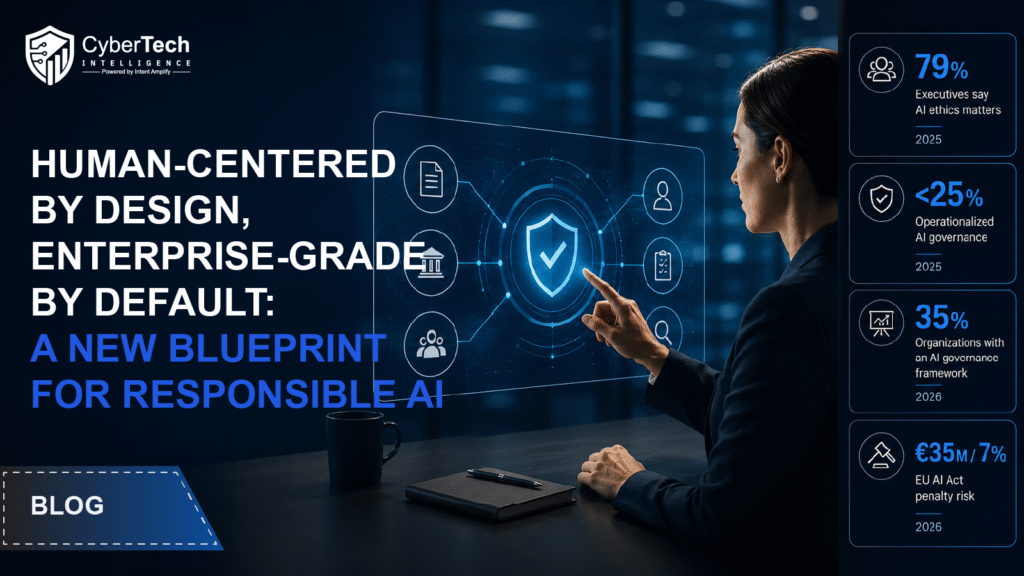
There is a version of responsible AI that lives in policy documents. Five principles, a quarterly governance committee, and an ethics charter in the annual report. It satisfies the optics requirement. It does not change how AI behaves inside the organization.
And then there is the version that works.
Responsible AI that holds under regulatory scrutiny and board accountability is not a set of principles applied after deployment. It is a design requirement embedded before a single model touches production data.
That is the blueprint this blog addresses and the model Turing delivers.
Why the Current Approach Is Not Holding
McKinsey found that nearly half of organizations encountered measurable governance or ethical lapses linked to generative AI projects. ¹ IBM research found that while 79% of executives say AI ethics is important, fewer than 25% have operationalized governance principles. ² Gartner found that only 35% of companies have an AI governance framework in place. ³
The consequences are direct. Article 99 of the EU AI Act indicates that non-compliance would be punished with a penalty of up to 35 million euros or 7% of the annual global turnover.⁴ The lack of control, when AI agents work without boundaries, will become the main issue for 40% of Fortune 1000 companies in 2028. ³
Those companies that cannot justify why their AI acted this way or show human review at the right level of risks are constructing systems destined to fail from the very beginning. ⁵
Organizations that cannot explain why their AI made a decision or demonstrate human review at the appropriate risk threshold are building systems that will fail the first time something goes wrong.
Four Design Requirements for Responsible AI That Actually Works
Requirement 1: Explainability as Input, Not Output
Most organizations treat explainability as something produced after a model runs: a confidence score, a post-hoc justification. That fails under audit. In regulated workflows, including fraud review, compliance documentation, and clinical decisions, the explanation must be available at the point of decision.
Turing builds explainability into the architecture from the start. Every workflow includes trace infrastructure capturing what data was used, which rules applied, what threshold triggered escalation, and who reviewed the outcome. A life sciences organization working with Turing produced complete model decision documentation for a regulatory request within hours, because the infrastructure was built before the request arrived. ⁶
Requirement 2: Structured Human Oversight, Not Optional Review
Unstructured review adds cost without improving outcomes reliably. Structured oversight works: defined risk tiers, documented confidence thresholds, clear approval authorities, and auditable review decisions.
Turing’s human-guided AI framework defines the autonomy envelope by risk tier. Low-risk decisions move at automation speed. High-risk decisions route to documented human review with a full audit trail. This mirrors how mature organizations manage operational risk: defined thresholds, documented rationale, and clear accountability. ⁷
Requirement 3: Continuous Monitoring, Not Periodic Audits
IBM’s AI governance research identifies continuous monitoring as foundational to responsible deployment. ⁴ Fewer than 20% of companies conduct regular AI audits per Harvard Business Review analysis. ²
Data distributions shift. Regulations evolve. A model fair and accurate at deployment may not be so twelve months later.
Turing builds real-time bias monitoring and automated drift detection into every production system. When model behavior deviates from established bounds, the system flags it before producing a consequential output.
Requirement 4: Full Lifecycle Governance, Not Just Deployment
Most governance frameworks address deployment alone. Few address training data provenance, model selection, fine-tuning decisions, integration points, and version lineage. IBM identifies black box models as a direct source of reputational harm, litigation, and regulatory fines. ⁴
Turing’s proprietary intelligence framework governs every layer. Training data carries verified provenance. Model selection and fine-tuning decisions are version-controlled. Integration points carry documented access controls. The full lifecycle is governed. ⁸
Turing Is Built for This
Responsible AI is not a values statement at Turing. It is a delivery model. The human-guided AI architecture that accelerates the path from pilot to production is the same architecture that makes AI defensible under regulatory scrutiny and trusted by boards.
Trusted by 1,000+ enterprise clients. #1 on The Information’s Most Promising B2B Companies. Recognized by Forbes and Fast Company. Leadership from Meta, Google, Microsoft, Apple, Amazon, McKinsey, Bain, Stanford, Caltech, and MIT.
If your AI program cannot answer the question — can we explain every decision this system made in the last 90 days — you have a governance gap.
Visit turing.com to speak with a solutions expert.
FAQS
Q: What is the most common governance problem for enterprise AI?
Less than 25% of companies have implemented an ethics governance framework, according to IBM, and less than 20% do regular AI audits, says Harvard Business Review.
Q: What does the AI act from the EU signify for enterprise AI in 2026?
There are penalties of fines up to 35 million euros or 7% of yearly global revenue for non-compliance. By 2026, 50% of governments around the world will regulate their responsible AI regulations, predicts Gartner. Companies not document explainability and audit logs are exposing themselves to risks.
Q: What is human-guided AI, and how does Turing design it?
Human-Guided AI describes the structured approach by risk category and confidence level. High-risk decisions route to documented human review. Low-risk decisions move at automation speed. Turing builds this into every workflow before deployment.
Q: How does Turing handle bias and drift in production systems?
Turing builds real-time bias monitoring and automated drift detection into every production system. When model behavior deviates from established bounds, it is flagged before producing a consequential output.
Q: Can Turing retrofit governance into existing deployments?
Yes. Turing conducts a governance gap assessment, identifies where explainability, audit trails, and human oversight are absent, and implements the required architecture without full redeployment.
REFERENCES
1. McKinsey via OneReach AI (2026). AI Governance Frameworks and Best Practices.
2. IBM (2025). A Look Into IBM’s AI Ethics Governance Framework.
3. Consilien (2026). AI Governance Frameworks: Guide to Ethical AI Implementation.
4. IBM (2026). Guide for Implementing an AI Governance Framework. Published February 23, 2026.
5. Gartner (2025). AI’s Next Frontier: Why Ethics, Governance and Compliance Must Evolve.
6. Turing (2026). AI in 2026: Five Projections Every Enterprise Must Prepare For. Published January 9, 2026.
7. Turing (2026). Human-Guided AI for Regulated Enterprise Workflows. Published March 18, 2026.
8. Turing (2025). 2025: The Year of Proprietary Intelligence. Published December 30, 2025.
9. Turing (2026). GenAI Transformation for Enterprise.
🔒 Login or Register to continue reading