GEP and Supply Chain Now bring this intelligence to enterprise technology leaders through Cyber Technology Intelligence, where CIOs and CISOs find the data, analysis, and peer perspective they need to make consequential decisions.
The supply chain AI investment cycle has followed a predictable and expensive pattern in 2026. A promising use case is identified. A pilot is scoped, resourced, and run in a controlled environment. Impressive results follow. Executive enthusiasm builds. And then the scale conversation begins, and the whole thing quietly stalls.
This is pilot purgatory. It is where supply chain AI initiatives go when the technology works in theory, but the organization was never built to run it in practice. And based on the latest research, it is where the overwhelming majority of supply chain AI investments currently sit. Fewer than 1 in 10 supply chain leaders have successfully scaled AI across operations. ¹
GEP, in partnership with UVA Darden, has surveyed approximately 200 supply chain executives to understand exactly what separates the organizations that escape pilot purgatory from those that do not. The findings power Supply Chain Now’s upcoming exclusive webinar, From AI Pilots to Performance: How Supply Chain Leaders Are Scaling Agentic AI, on Wednesday, June 10 at 12 noon ET. GEP exists to be on the right side of that line, and this webinar is where that goal becomes a blueprint.
The Scale Gap Is Not Closing. It Is Widening.
The data on why supply chain AI pilots fail to scale has reached a level of precision that eliminates every comfortable explanation. The problem is not the budget. It is not technology. It is the architecture, governance, and operating model.
IBM’s April 2026 analysis delivers the core finding: only 25% of AI initiatives deliver expected ROI, and just 16% scale enterprise-wide, with at least 50% of generative AI projects abandoned after proof of concept due to poor data quality, inadequate risk controls, and the inability to integrate into systems that actually run the business. ²
IBM Chairman and CEO Arvind Krishna stated the implication directly at IBM Think 2026: “The enterprises pulling ahead are not deploying more AI. They are redesigning how their business operates.” IBM’s own CDO named the two failure modes appearing most consistently: data too fragmented and siloed to feed AI at enterprise speed, and governance bolted on too late to matter. ³
For supply chain leaders, both failure modes are structural. They cannot be resolved by running a better pilot. They require a fundamentally different approach to how AI is embedded in operational workflows from day one.
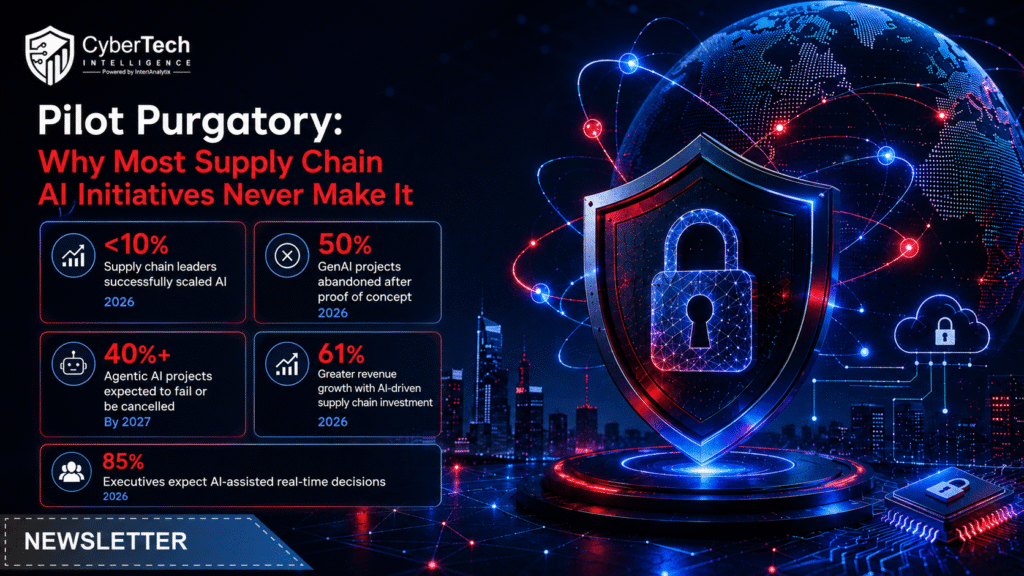
KEY FIGURES AT A GLANCE
Fewer than 1 in 10 supply chain leaders have successfully scaled AI across operations (GEP / UVA Darden Research — June 2026) ¹
50% of generative AI projects are abandoned after proof of concept due to data and integration failure (IBM — April 2026) ²
Over 40% of agentic AI projects will be cancelled by the end of 2027 due to escalating costs and weak risk controls (Gartner via IBM — April 2026) ⁴
61% greater revenue growth for organizations with higher AI-driven supply chain investment versus peers (IBM — January 2026) ⁵
85% of executives anticipate employees relying on AI agent recommendations for real-time decisions by 2026 (Google Cloud — March 2026) ⁶
What GEP’s Research Reveals About the organizations That Break Through
GEP’s research with UVA Darden identifies a specific cohort called the Performance Elite: the small percentage of organizations that have moved beyond AI pilots to deliver real, enterprise-level impact, doubling productivity, reducing errors, and accelerating decision-making across their entire supply chain operation.
What makes GEP’s research uniquely valuable is that it does not stop at identifying what the Performance Elite achieve. It maps precisely how they got there. The answer is consistent: they did not add more AI tools to existing processes. They redesigned the processes themselves around what GEP calls Intelligent Value Streams, end-to-end workflow architectures where AI capability is embedded into the operational model rather than layered on top of it.
This is exactly what GEP’s platform is built to enable. GEP SMART and GEP NEXXE are not AI tools added to procurement and supply chain workflows. They are the native intelligence infrastructure connecting sourcing, procurement, planning, and logistics into a single, continuously intelligent system where agents reason over real operational data, take action across workflows, and generate measurable outcomes without the manual reconciliation that defeats most pilot-to-scale transitions.
62% of supply chain leaders recognise that AI agents embedded into operational workflows accelerate speed to action, hastening decision-making, recommendations, and cross-functional response, yet the majority have not made the platform and process changes that allow that acceleration to happen consistently at scale. GEP closes that gap structurally, not incrementally. ⁵
Microsoft: Frontier Firms Have Stopped Running Pilots
Microsoft’s Dynamics 365 (May 2026) defines the differences between pilot-era organizations and scale-era organizations. The frontier companies have been going past individual uses of AI to concentrate more on connections between decisions and actions within end-to-end processes. The real-time signals will make it possible to proactively manage any risks before they affect orders, manufacturing, and customer promises.
According to Gartner, 60% of all supply chain disruptions will be solved without any human input by 2031, but only for those organizations that have integrated their data and agentic workflow decisions. ⁷
Microsoft’s own deployment data documents what that looks like at scale: Uniper replaced entirely manual component planning with proactive agentic workflows ensuring timely material availability, while a global pharmaceutical company unified fragmented logistics data and unlocked multi-million euro annual productivity gains. ⁸
Neither result came from a better pilot. Both came from a wholesale redesign of how the supply chain operates at the workflow level, which is precisely the architecture GEP’s platform enables.
Google Cloud: Scale Requires a Platform Decision, Not a Tool Decision
Google Cloud’s agentic AI research (March 2026) identifies the defining characteristic of organizations successfully scaling supply chain AI: they have made a platform decision, not a tool decision. Nearly 85% of executives anticipate employees relying on agent recommendations for real-time decisions by 2026, and the organizations capturing that capability are those with unified data environments, giving AI agents the full operational context to act reliably. ⁶
Google Cloud’s Next 2026 documentation provides the production evidence. GE Appliances is deploying more than 800 AI agents with Gemini Enterprise across manufacturing, logistics, and supply chain operations, replacing reactive workflows with a unified digital thread synchronising operations in real time. Macquarie Bank reclaimed more than 100,000 hours of team members’ time through Gemini Enterprise. ⁹
These are structural productivity shifts enabled by platform-level decisions made before the first agent was deployed. GEP’s platform operates on the same architectural principle: unified, continuously available supply chain intelligence giving AI agents the full context to act reliably without the data fragmentation that causes most pilot-to-scale transitions to fail.
Palo Alto Networks: Scaling AI Without Governing the Attack Surface Is Risk Multiplication
For CISOs reading this, pilot purgatory has a security dimension that most supply chain AI conversations never reach. Every supply chain AI agent deployed without a governed security architecture is not just a performance risk. It is an operational liability compounded with every new workflow it touches.
Palo Alto Networks’ 6 Predictions for the AI Economy (November 2025) frames the scale of the problem: 84% of major cyber incidents investigated by Unit 42 resulted in operational downtime, reputational damage, or financial loss, with supply chain vulnerabilities identified as a primary driver of the most severe enterprise-wide disruptions.
In 2026, autonomous agents outnumber human employees by an 82 to 1 ratio inside many enterprise environments, with identity and access governance implications that most organizations have not yet fully mapped. ¹⁰
Palo Alto Networks’ Unit 42 Global Incident Response Report 2026, drawing on over 750 major incidents across 50 countries between October 2024 and September 2025, identifies software supply chain risk as a defining force: attackers exploit SaaS integrations, vendor tools, and application dependencies to bypass enterprise perimeters at scale, with identity weaknesses factoring into nearly 90% of Unit 42 investigations and the fastest attacks reaching data exfiltration in just 72 minutes. ¹¹
Additionally, 47% of AI system breaches involve data exfiltration through assistants or plugins. Every supply chain AI agent operating across vendor integrations and ERP systems without a Zero Trust architecture generates exposure at exactly the speed at which the AI generates operational output. ¹²
Cisco: Governance Gaps That Stall Scale Also Create Security Exposure
Cisco’s State of AI Security 2026 report (February 2026) surfaces the governance dimension of supply chain AI scale from the security architecture perspective: supply chains are growing in complexity, often without proper controls and governance, and autonomous AI agents are proliferating across critical workflows, often without accountability being ensured. ¹³
Cisco’s AI Defense platform, expanded in February 2026 with its largest-ever update, introduces AI Bill of Materials capability, providing centralised visibility and governance over every AI asset across the enterprise. ¹⁴
The Cisco finding frames a decision that GEP’s platform addresses directly. The same data fragmentation and governance gaps that cause AI pilots to stall operationally are the same gaps that create security exposure as AI scale progresses. GEP’s unified platform resolves both simultaneously, from a single, governed, continuously monitored data and workflow architecture that gives CISOs the visibility they need and gives supply chain leaders the operational reliability they require.
What GEP and Supply Chain Will Deliver on June 10
The June 10 webinar is a blueprint session for enterprise technology and supply chain leaders under real pressure to turn AI investment into measurable operational performance.
GEP and UVA Darden share research from approximately 200 supply chain executives covering why most AI initiatives stall, the operational discipline required to scale across supply chain workflows, where AI is actually working today and where it continues to fail, how the Performance Elite are redesigning processes using Intelligent Value Streams, and the practical blueprint to move from experimentation to execution at enterprise scale.
Pilot purgatory is a choice. The organizations on the right side of the scale divide in 2026 did not get there by running better pilots. They got there by making different architectural, governance, and operational decisions from the start. GEP exists to give enterprise leaders the platform, the research, and the practitioner community to make those decisions with confidence.
Register Now: From AI Pilots to Performance: How Supply Chain Leaders Are Scaling Agentic AI Presented by GEP | Hosted by Supply Chain Now | Wednesday, June 10, 12 Noon ET Register Here
References
- Supply Chain Now / IntentTechInsights — From AI Pilots to Performance: How Supply Chain Leaders Are Scaling Agentic AI — June 2026
- IBM — Why Most Enterprise AI Projects Stall Before They Scale — 9 April 2026
- IBM Think 2026 — Shaping the Next Era of Agentic AI — May 2026
- IBM — Agentic AI Governance Playbook — 6 April 2026
- IBM — AI Agents in Supply Chain — 30 January 2026
- Google Cloud Blog — 5 Insights to Build Your Agentic AI Advantage in 2026 — 27 March 2026
- Microsoft Dynamics 365 Blog — From Intelligence to Impact: How Agentic AI Is Reshaping Today’s Supply Chain — 4 May 2026
- Microsoft Cloud Blog — Supply Chain 2.0: How Microsoft Is Powering Simulations, AI Agents, and Physical AI — 24 March 2026
- Google Cloud Blog — Next 26: Building the Agentic Enterprise — April 2026
- Palo Alto Networks — 6 Predictions for the AI Economy: 2026’s New Rules of Cybersecurity — 18 November 2025
- Palo Alto Networks — 2026 Unit 42 Global Incident Response Report — 17 February 2026
- Palo Alto Networks Blog — Where Cloud Security Stands Today and Where AI Breaks It — December 2025
- Cisco Blogs — Cisco State of AI Security 2026 Report — 19 February 2026
- Cisco Newsroom — Cisco Redefines Security for the Agentic Era with AI Defense Expansion and AI-Aware SASE — 10 February 2026
🔒 Login or Register to continue reading