Exclusively curated by RETHINK Retail, the platform trusted by the world’s most forward-thinking retail leaders to cut through noise and deliver what actually matters.
The connected store is no longer a concept on a roadmap. It is a live operational reality for some retailers. But for others, it’s just a group of pilots who have been unable to advance beyond being pilots. The distance between these two sides is only widening every quarter, and it’s the organizations that succeed in bridging this distance in 2026 that will define how retailing will take shape in 2030.
At RETHINK Retail, we bring together the thought leaders and innovators who are defining the future of retailing with the insights and honest conversation required to move forward.
RETHINK Retail’s upcoming exclusive webinar, The Connected Store at Scale: From Tech Hype to Operational Reality, hosted by Martin Bailie with Jerome Hamrit and Thaddeus Segura of VusionGroup, is the session built for leaders who are done waiting for connected store technology to deliver on its promise and ready to hear, from practitioners who have done it, what it actually takes.
The Investment Signal Is Unmistakable
The numbers from the world’s leading IT enterprises make one thing clear: connected store technology is no longer a competitive differentiator. It is becoming the competitive baseline.
According to the IBM Institute for Business Value (January 2026), 80% of retail and consumer products firms now have a long-term AI innovation strategy, which is evidence that AI is not just another side project but a central part of innovation. As per the above-mentioned report, 58% of retail business leaders think that AI boosts customer retention and satisfaction by an average of 31%. ¹
A second IBM survey (January 2026) shows their expectations are much bigger: 79% of business leaders think that AI will make an important contribution to revenue by 2030, rising to 40% today, as well as that AI investment will rise by 150% over the next eight years. Yet 68% worry their AI efforts will fail due to poor integration with core business activities. That is not a technology problem. That is an operational readiness problem and it sits at the heart of what this webinar addresses. ²
KEY FIGURES AT A GLANCE
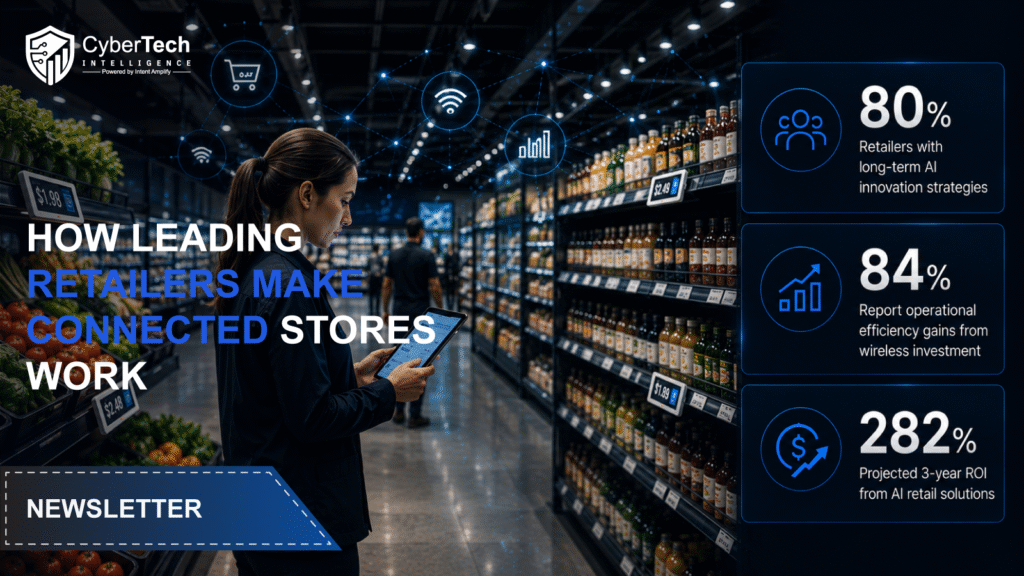
80% of retailers now have a long-term AI innovation strategy (IBM IBV — January 2026) ¹
84% of retail organizations report improved operational efficiency from wireless investment (Cisco State of Wireless — April 2026) ³
282% peak ROI projected over 3 years from Microsoft AI retail solutions (Microsoft / Forrester TEI May 2026) ⁴
Microsoft: Turning Fragmented Workflows into Coordinated Execution
At NRF 2026, Microsoft announced agentic AI solutions designed to bring intelligent automation across every retail function merchandising, marketing, store operations, and fulfillment. The company describes it as a connected layer of intelligence that transforms fragmented workflows into coordinated execution. ⁵
The economics are compelling. The findings of a Forrester Total Economic Impact analysis (May 2026) are expected to be an ROI range of 124% to 282% over three years, along with NPV between $7.7M and $17.6M for a sample $5B retailer. Demand forecasts and inventory management powered by artificial intelligence have already generated returns worth $3M to $6.3M in three years. Retail and consumer goods IT spending is expected to be $113B in 2026, and the new C-level directive is not “innovate” but “prove ROI.” ⁴
The webinar goes beyond these headline numbers. Attendees hear directly from practitioners putting these systems to work not what the technology promises on paper, but what integration looks like inside a real retail organization operating under real pressure.
Cisco: The Network Is Where Connected Store Ambitions Live or Die
No connected store architecture survives contact with reality without a network built for it. Cisco’s inaugural State of Wireless 2026 report, surveying 6,098 wireless decision-makers across 30 markets, makes the performance case clearly: 84% of retail organizations report improved operational efficiency, 80% report improved employee productivity, and 77% report enhanced customer engagement from wireless investment. ³
But complexity is accelerating just as fast. 97% of retail organizations report rising operational complexity driven by IoT, IT, and OT workloads. ³
On the security side, 54% of retail organizations report financial losses from wireless security incidents, with more than 45% of those losses exceeding $1 million annually. The payoff for getting it right: AI-driven automation reclaims 850+ hours per IT practitioner annually, and organizations that resolve complexity, security, and talent together are 4x more likely to achieve strong wireless ROI. ⁶
The practical lessons from this data what decisions led to better outcomes and which assumptions failed in the field are exactly the kind of conversation this webinar is designed to surface.
Palo Alto Networks: Security Is Not Optional at Scale
Every device added to a connected store expands the attack surface. A sensor, smart shelf, and edge node deployed without a security-first approach is only a risk for future exploitation.
According to Palo Alto Networks’ Unit 42 Global Incident Response Report 2026, which analyzed more than 750 significant incidents in more than 50 countries during October 2024 and September 2025, it is clear that the current threats have become 4x faster, where the fastest intrusion happens in just 72 minutes from access to data exfiltration. Identity is the primary entry point, with 65% of initial access driven by identity-based techniques and 87% of attacks unfolding across multiple attack surfaces simultaneously. ⁷
For retail specifically, 72% of retailers report being hit by a cyberattack via one or more IoT devices in the past year. In over 90% of breaches, preventable gaps materially enabled the intrusion limited visibility, inconsistently applied controls, or excessive identity trust. ⁸
Security cannot be retrofitted onto a connected store. It must be engineered from the start, built on a Zero Trust foundation that treats every connected device as a potential risk. The retailers who learned this after a breach paid a far steeper price than those who built it in from day one.
Google Cloud: Real-Time Intelligence Where Retail Actually Happens
Connected store value is generated at the store level. That means intelligence must live at the edge not in a distant data centre hours away from the moment of decision.
Google Cloud’s edge AI infrastructure enables retailers to process real-time inventory and customer interactions locally, ensuring zero latency even when store connectivity is unstable, with data federated into a central warehouse powering the broader commerce engine. ⁹
Google Cloud’s Agentic Commerce Era report (January 2026) frames the shift: people shop across Google more than a billion times a day, and the move to AI agents capable of executing complex, multi-step actions autonomously across every consumer touchpoint represents the industry’s most significant transformation yet. ¹⁰
At the infrastructure level, a top-5 US grocer using Google Cloud and NVIDIA cut recommendation inference time from several seconds to just 100 milliseconds making large-scale, real-time in-store personalization operationally viable for the first time. ¹¹
That kind of result does not come from better technology alone. It comes from architectural decisions made early, with the right partners, against a clear operational brief.
What This Webinar Actually Delivers
The most valuable thing a retail leader can walk away from this session with is not a vendor framework or a technology checklist. It is clarity on what the operational model for a connected store at scale actually looks like, from leaders who have built one.
This session cuts to what most technology conversations skip entirely: the governance decisions, the people readiness gaps, the infrastructure choices that hold up under pressure across hundreds of locations, and the platform thinking that separates retailers compounding their advantage every quarter from those still running the same pilot they launched two years ago.
RETHINK Retail curates these conversations because the retail industry deserves better than panel discussions that never get past the surface. The leaders in RETHINK Retail’s community ask harder questions, share more honestly, and leave with sharper thinking because the peers in the room have actually done the work.
If you have invested in connected store technology and are still waiting for it to deliver, this is the session to attend. Not to hear that the technology works. To understand, specifically and practically, what it takes to make it work across your organization.
Register Now: The Connected Store at Scale: From Tech Hype to Operational Reality Hosted by RETHINK Retail | In partnership with VusionGroup
Register Here: https://intenttechpub.com/webinar/the-connected-store-at-scale-from-tech-hype-to-operational-reality/
References
- IBM Institute for Business Value — The AI Decisions That Will Define Retail for the Next Two Years — 12 January 2026
- IBM Institute for Business Value — IBM Study: AI Poised to Drive Smarter Business Growth Through 2030 — 19 January 2026
- Cisco — 5 Wireless Trends Retail IT Teams Can’t Ignore in 2026 — 15 April 2026
- Microsoft Cloud Blog — Agentic AI Is Reshaping Retail and Consumer Goods Economics — 21 May 2026
- Microsoft — Microsoft Propels Retail Forward with Agentic AI Capabilities — 8 January 2026
- Cisco Newsroom — Cisco Report: Strategic Wireless Investments Are Driving Higher ROI — 2 April 2026
- Palo Alto Networks — 2026 Unit 42 Global Incident Response Report — 17 February 2026
- Palo Alto Networks — IoT Security for the Retail Industry — 2025
- Google Cloud — How Inference at the Edge Unlocks New AI Use Cases for Retailers — 13 January 2025
- Google Cloud — A New Era of Agentic Commerce Is Here — 11 January 2026
- Google Cloud Blog — How Retailers Are Accelerating AI with NVIDIA and Google Cloud — 9 January 2025
🔒 Login or Register to continue reading