Applications are distributed across cloud environments. Users operate outside corporate boundaries. Identities have become the primary attack surface. This is why Zero Trust Network Access (ZTNA) is redefining how access itself is controlled.
Identity Is Now the Primary Attack Vector
Modern threat data makes one reality clear. Attackers are no longer breaking in. They are logging in.
According to Gartner:
- By 2026, 10% of large enterprises will have a mature and measurable Zero Trust program in place, up from less than 1% today.
- Identity-first security is becoming foundational as organizations shift away from perimeter-based models.
- Continuous, context-aware access controls are now a top investment priority for security leaders.
This signals a clear transition.
Traditional controls built around the network are no longer sufficient in environments where access is dynamic, identities are distributed, and trust must be continuously verified.

Identity Risk Snapshot
How exposed is your organization to identity-driven attacks?
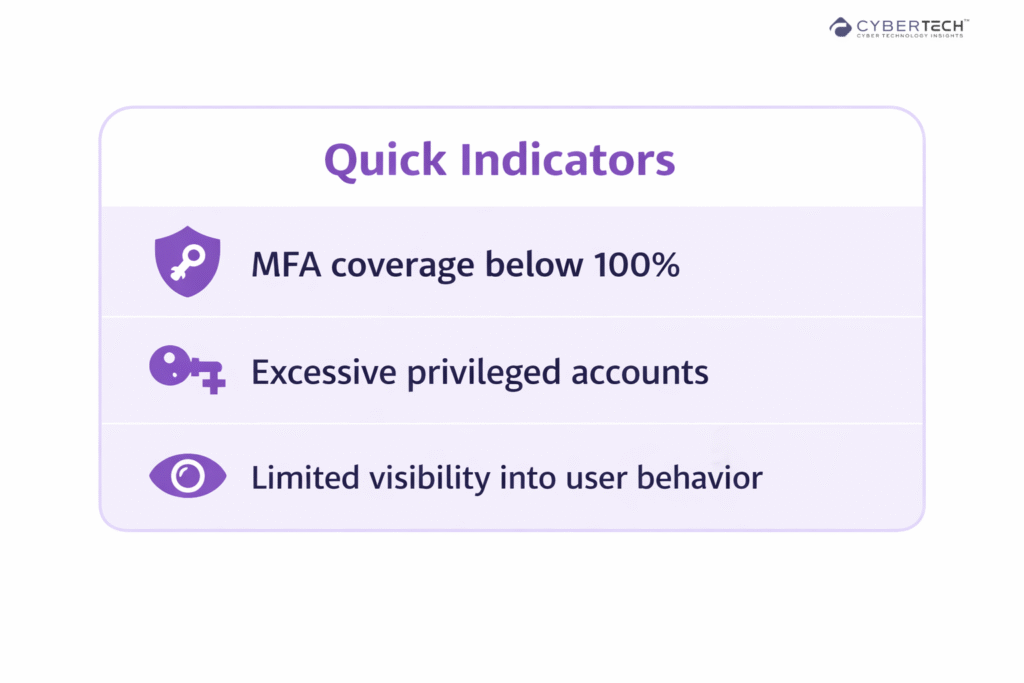
Start with an internal identity risk assessment before evaluating new controls.
Gartner Perspective: Identity Is Reshaping Security Strategy
Gartner highlights a clear shift toward:
- Identity-first security models.
- Continuous, context-aware access.
- Decentralized control environments.
Security is no longer about controlling infrastructure. It is about controlling access dynamically.
If your architecture is still network-centric, your risk model is already outdated.
You Need Strategy Realignment
Align your roadmap with identity-driven access control before scaling new tools.
ZTNA: The Operational Layer of Identity-Based Security
ZTNA translates Zero Trust into execution.
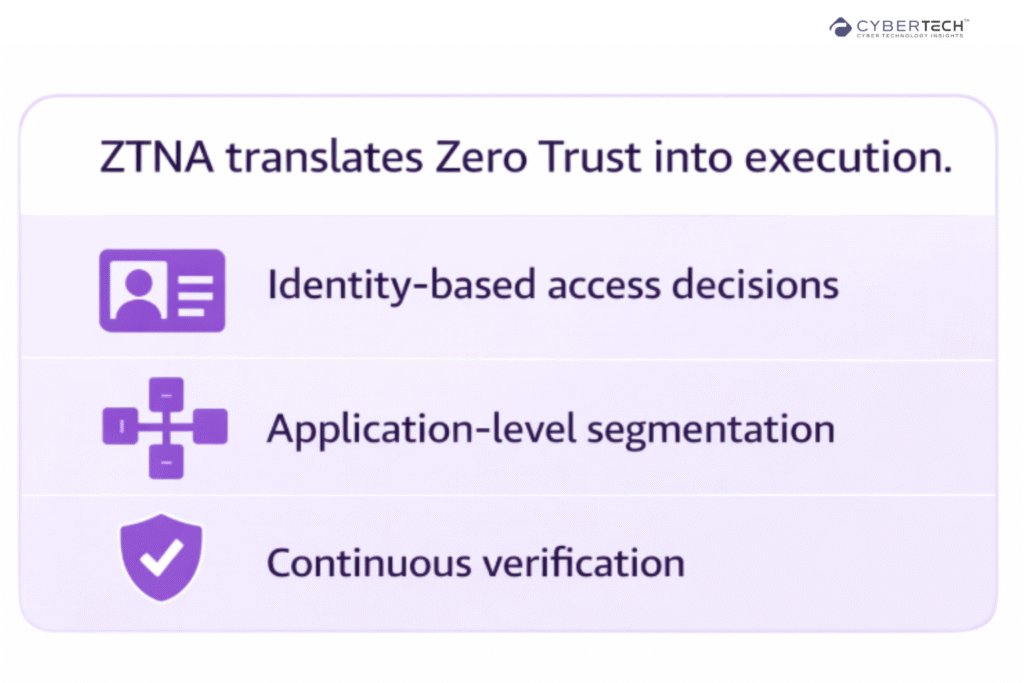
It enables:
- Identity-based access decisions.
- Application-level segmentation.
- Continuous verification.
Users do not access the network. They access only what they are explicitly allowed to.
Start small. Deliver impact fast.
Identify 3 to 5 critical applications and evaluate:
- Who has access.
- How access is granted.
- Whether access is continuously validated.
This is often the fastest path to measurable risk reduction.
Why ZTNA Adoption Is Accelerating
Enterprise pressure is driving adoption:
- IAM weaknesses remain a leading breach vector.
- Security tool sprawl is increasing in complexity.
- Machine identities are growing exponentially.
ZTNA aligns with consolidation and control.
How fragmented is your access control stack today?
If access decisions span multiple disconnected tools, ZTNA can unify and simplify enforcement.
Capability Mapping: What ZTNA Must Deliver
For CISOs evaluating platforms, ZTNA should not be viewed as a single feature. It is a capability stack.
Core Capability Areas:
| Capability | What It Means | Why It Matters |
| Identity Integration | Integration with IAM, SSO, MFA | Ensures accurate identity context |
| Device Posture Assessment | Endpoint health validation | Prevents compromised device access |
| Application Segmentation | App-level access control | Eliminates lateral movement |
| Continuous Authentication | Session-level verification | Detects real-time risk |
| Policy Engine | Context-aware decision making | Enables adaptive security |
| Visibility and Analytics | User and access insights | Supports detection and response |
Are you evaluating ZTNA as a feature or as a capability layer?
Prioritize platforms that deliver across identity, device, and access, not just connectivity.
Vendor Comparison Framework: How Leading Platforms Differ
Rather than a feature checklist, CISOs should evaluate vendors based on architectural approach.
| Vendor | Core Strength | Architectural Approach | Ideal Use Case |
| Zscaler | Cloud-native access control | Proxy-based ZTNA | Large-scale SaaS environments |
| Palo Alto Networks | Integrated security platform | SASE + NGFW convergence | Enterprises consolidating vendors |
| Netskope | Data-centric security | SSE-focused architecture | Data protection + access control |
| Cloudflare | Edge-native access | Global edge network model | Performance-sensitive environments |
| CrowdStrike | Identity + endpoint convergence | Agent-based Zero Trust | Endpoint-driven security models |
Not all ZTNA platforms solve the same problem.
Shortlist vendors based on your priority:
- Access control.
- Data protection.
- Platform consolidation.
- Endpoint-driven security.
What This Means for CISOs
ZTNA is reshaping security architecture:
- Identity becomes the control plane.
- Access replaces connectivity.
- Security becomes adaptive and contextual.
Executive Positioning
ZTNA should be positioned as a business enabler, not just a security upgrade.
Frame it around:
- Reduced risk.
- Simplified access.
- Improved user experience.
Implementation Reality: Where Most Organizations Fail
Common failure points:
- Weak identity hygiene.
- Poor application visibility.
- Treating ZTNA as a VPN replacement.
ZTNA amplifies existing conditions.
Readiness Check
Before deployment, ask:
- Do we trust our identity data?
- Are access policies clearly defined?
- Do we understand application dependencies?
Fix gaps before scaling ZTNA.
A Practical Adoption Framework for CISOs
ZTNA adoption demands a structured shift in how identity, access, and risk are governed across the enterprise. The most effective programs follow a phased approach that delivers early impact while building toward long-term Zero Trust maturity.
1. Strengthen identity foundations
Before access can be secured, identity must be reliable.
Actions:
- Enforcing phishing-resistant MFA across all users.
- Eliminating dormant and overprivileged accounts.
- Establishing clear identity ownership and lifecycle management.
Without this, ZTNA simply enforces flawed assumptions faster.
2. Segment application access
Move from network-level exposure to application-level precision.
Actions:
- Identify business-critical applications and data flows.
- Map user roles to required access, not assumed access.
- Remove implicit access paths created by legacy VPN models.
The goal is to ensure users can only access what they explicitly need, nothing more.
3. Apply context-aware policies
Access decisions should adapt based on real-time signals.
Actions:
- Device posture and compliance status.
- User behavior and risk signals.
- Location, time, and access patterns.
This is where ZTNA shifts from static control to adaptive security.
4. Continuously monitor and optimize
ZTNA is not a one-time implementation. It is an evolving control layer.
Actions:
- Analyze access logs and anomalies.
- Refine policies based on usage patterns.
- Reduce unnecessary access over time.
This ensures security improves as the environment changes.
The Bigger Shift: From Access to Trust Orchestration
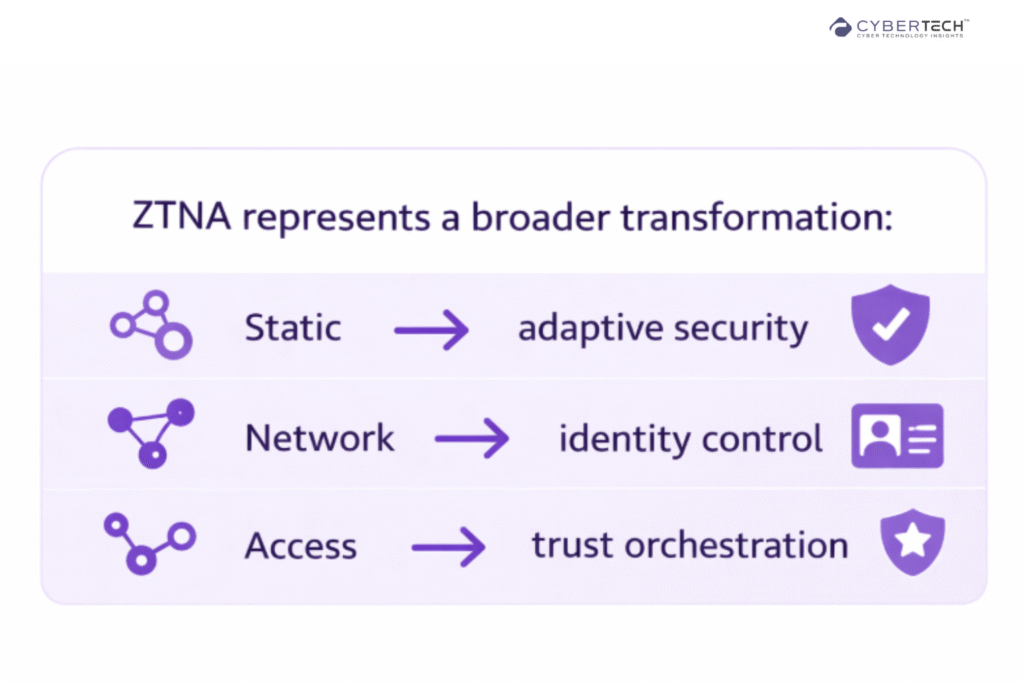
The shift to identity-based security is already underway. The real question is how quickly your organization can adapt.
Identity Is Now the Security Control Plane
ZTNA does not just secure access. It redefines it.
In a world where:
- Work is distributed.
- Applications are decentralized.
- Threats are identity-driven.
Identity becomes the only reliable control point.
Identity Is Now the Control Plane
ZTNA is not just another layer in the security stack. It is a shift in how security decisions are made.
For years, access was granted based on where users were. Today, it is determined by who they are, what they need, and the risk they carry in that moment.
This is the inflection point for security leadership.
Organizations that continue to anchor access around the network will find themselves compensating with more tools, more complexity, and less control. Organizations that move toward identity-based access gain something fundamentally different. Precision.
FAQs
1. What business problem does ZTNA actually solve for enterprises?
ZTNA addresses the growing risk of identity-based attacks by eliminating broad network access and enforcing application-level access controls. It reduces lateral movement, limits overprivileged access, and aligns security with distributed work and cloud environments.
2. How is ZTNA different from VPN in terms of risk reduction?
VPNs grant users access to the network, increasing exposure if credentials are compromised. ZTNA restricts access to specific applications and continuously verifies identity and context, significantly reducing attack surface and breach impact.
3. When should an enterprise consider replacing VPN with ZTNA?
Organizations should consider ZTNA when they experience increased remote access, cloud adoption, identity-related security incidents, or operational complexity from managing VPN infrastructure and fragmented access controls.
4. What capabilities should CISOs prioritize when evaluating ZTNA solutions?
Key capabilities include strong identity integration, device posture assessment, application-level segmentation, continuous authentication, policy-based access control, and real-time visibility into user behavior and access patterns.
5. How does ZTNA support a broader Zero Trust strategy?
ZTNA operationalizes Zero Trust by enforcing identity-based, context-aware access at the application level. It serves as a foundational control layer that enables least-privilege access, continuous verification, and reduced reliance on network-based trust.
To participate in upcoming interviews, please reach out to our CyberTech Media Room at info@intentamplify.com