In the era of the Internet of Things (IoT), Monitoring as a Service (MaaS) has emerged as a crucial solution for managing the ever-growing network of connected devices. MaaS has emerged as a result of the increasingly growing use and innovation of IoT. The complexity and scope of monitoring requirements have significantly increased as businesses expand the use of IoT technology in their operational practices. With the help of MaaS’s unified platform, organizations can monitor the security, availability, and performance of their IoT assets in real-time. MaaS enables scalable and adaptable monitoring systems without requiring large upfront infrastructure investments by utilizing cloud computing.
This integration allows organizations to identify irregularities and anticipate possible malfunctions before they affect operations, lowering costs and downtime. Additionally, automatic reactions and alerts expedite problem-solving, enhancing overall service dependability. MaaS will be crucial to ensuring that companies can efficiently manage their ever-more complex settings as the number of IoT devices continues to grow. MaaS is an essential part of the future of linked operations because of this evolution, which not only maximizes resource usage but also promotes sustainable behaviors.
Recommended: Cyber Insurance: Risks and Trends 2025
Overview of MaaS in the Era of IoT
The convergence of MaaS and the IoT has revolutionized how organizations manage and oversee their assets. IoT and MaaS integration improves operational efficiency by facilitating real-time data analytics and preventive maintenance. Moreover, this integration facilitates real-time operational monitoring, thereby enhancing decision-making processes and operational efficiency in diverse sectors. As the deployment of IoT devices expands, effective monitoring becomes crucial for optimizing performance, safeguarding security, and sustaining operational effectiveness.
Key Features of IoT Monitoring
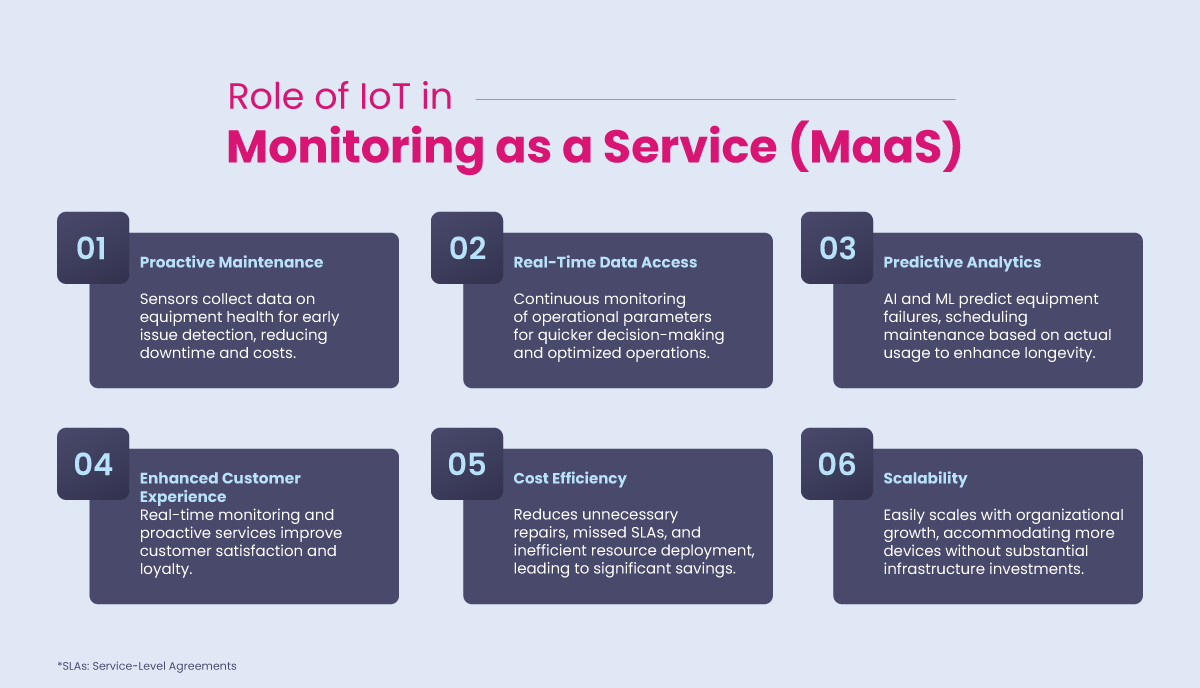
- Real-Time Data Collection: IoT monitoring solutions collect data from connected devices through sensors. This data is critical in monitoring performance indicators and possible issues before they escalate further.
- Predictive Maintenance: By analyzing historical data, IoT monitoring can determine when a device may fail or need maintenance. By minimizing downtime and extending equipment durability, this proactive strategy lowers operating expenses in the long run.
- Centralized Management: With MaaS solutions, organizations can manage all of their IoT devices from a single interface. This centralization makes supervision easier and improves visibility into device performance in multiple places.
- Automated Alerts: When performance thresholds are achieved, monitoring systems can automatically send notifications, which can allow for prompt action. This automated alert mechanism allows organizations to focus on strategic goals, enabling them to reduce the need for continuous manual oversight.
Benefits of MaaS in IoT
- Cost Efficiency: Organizations outsource their monitoring responsibilities to reduce the operational costs associated with maintaining an internal monitoring system.
- Enhanced Security: Real-time security threat detection is possible with continuous monitoring, allowing organizations to react swiftly to potential threats or breaches.
- Improved Resource Utilization: Critical insights found from monitoring can help in resource optimization and better service delivery.

Challenges in Implementing MaaS
MaaS with IoT does come with a set of advantages, but its implementation poses various challenges that need to be overcome for effective monitoring and management of connected devices. Organizations need to invest in strong security measures and choose flexible solutions that can adapt to a changing technology landscape.
Recommended: Top AI Security Tools for Financial Services Industry
Below are the key challenges in implementing MaaS:
1. Complexity of Infrastructure
The diverse and distributed nature of IoT environments makes monitoring more challenging. On-premises systems, cloud services, and other types of devices are commonly used in combination by organizations; each has specific monitoring needs. Data aggregation, tool compatibility, and maintaining a consistent performance image across all components may become problematic as a result of this complexity.
2. Integration with Legacy Systems
Several organizations continue to utilize legacy systems that may not be compatible with modern monitoring technologies. Closing technological gaps, ensuring synchronized data flows, and fixing any security vulnerabilities brought about by these integrations are all essential to integrating these historical systems with contemporary MaaS platforms.
3. Security and Compliance
To safeguard sensitive data and maintain system integrity, it is essential to have strong security while keeping an eye on IoT devices. Organizations must follow regulations like GDPR and HIPAA and establish robust security measures in place, like encryption and access limits. This makes the monitoring process even more complicated.
4. Data Unification and Alert Management
Large volumes of data are generated by various monitoring instruments, making it difficult to combine this data for coherent analysis. When organizations are overloaded with notifications from several sources, they face the risk of experiencing alert fatigue, which makes it challenging to prioritize important issues.
5. Scalability Issues
It is crucial to make sure that monitoring systems can scale efficiently as businesses and IoT networks develop. Blind spots in monitoring may result from many traditional technologies’ inability to handle the growing amount of data produced by more connected devices.
Innovation driving MaaS
Significant developments that improve monitoring capacities across multiple sectors are being fostered by the integration of MaaS with the IoT. To handle the increasing complexity and size of connected devices, continuous innovations are crucial in MaaS.
Recent innovations in technology are further enhancing MaaS capabilities:
1. Cloud Computing Integration
MaaS offers scalable and adaptable monitoring solutions by utilizing cloud-based technologies. This enables organizations to use effective monitoring tools without significant upfront infrastructure investments. Organizations can enhance their monitoring capabilities when necessary, given the cloud-based MaaS’s ability to quickly adjust to shifting business needs.
Recommended: Cybersecurity Simplified: LLMjacking Attacks
2. Real-Time Analytics and Insights
Advanced analytics driven by artificial intelligence (AI) and machine learning enable real-time data processing from IoT devices. These advanced technologies enable organizations to monitor performance data, identify anomalies, and forecast potential failures before they occur, reducing downtime and increasing operational efficiency.
3. Automated Alerts and Responses
Automation advancements enable MaaS platforms to generate automated alerts when performance thresholds are breached. Organizations may react to problems promptly due to this feature, which lowers the mean time to resolution (MTTR) and increases overall service reliability.
4. Enhanced Security Measures
Advanced security features such as end-to-end encryption, access controls, and ongoing vulnerability monitoring are increasingly incorporated into MaaS solutions as security concerns escalate with the number of connected devices. These security measures assist in maintaining the integrity of IoT systems and safeguarding sensitive data.
5. Interoperability and Integration Capabilities
Interoperability across various systems is ensured by the smooth integration of modern MaaS solutions with a range of IoT platforms and devices. This adaptability enables organizations to combine their monitoring activities onto a single platform, streamlining administration and enhancing operational visibility.
6. User-Friendly Dashboards
Improvements in user interface design are at the forefront of the development of intuitive dashboards that provide thorough perspectives of system performance. These dashboards allow users to monitor device health, detect data patterns, and respond to warnings in an efficient manner, all of which help users make better decisions.
Key Trends Shaping the Future of MaaS
A number of trends and technological developments will shape the future of MaaS in the IoT landscape. In the context of the IoT, MaaS has a promising future because of technological advancements that improve sustainability, security, and operational efficiency.
Here are a few key trends shaping the MaaS landscape:
1. Integration of Artificial Intelligence (AI)
IoT monitoring is poised to experience a revolution driven by AI, which makes predictive analytics possible and can spot any problems before they become serious. Through proactive monitoring and anomaly detection, organizations can reduce downtime and optimize the use of resources by utilizing machine learning algorithms.
2. Enhanced Security Measures
Security issues are growing in parallel with the expansion of IoT networks, leading to requirements for enhanced security measures. To safeguard sensitive data and preserve system integrity, future MaaS solutions will progressively integrate sophisticated security features such as end-to-end encryption and continuous assessment of vulnerabilities.
3. Edge Computing
Edge computing will bring data processing closer to the source, lowering latency and bandwidth utilization. This transition will enhance real-time monitoring capabilities and response times, allowing organizations to act on insights as they arise.
Recommended: Cybersecurity Simplified: What is Cloud Infrastructure Security?
4. Augmented Reality (AR) and Virtual Reality (VR)
By incorporating AR and VR-like advanced technologies into MaaS, users will be able to interact with IoT data more effectively due to immersive visualization capabilities. This can help with remote maintenance, training simulations, and enhancing operators’ situational awareness.
5. Focus on Sustainability
Eco-friendly procedures will be given top priority in future MaaS solutions, which will optimize energy use and reduce their negative environmental effects. Regulations and more general corporate social responsibility objectives are in focus with this emphasis on sustainability.
6. Interoperability and Standardization
Maintaining interoperability across multiple platforms and devices will be essential as the IoT ecosystem expands. Standardized protocols must be implemented by future MaaS solutions in order to enable the smooth integration and administration of diverse IoT systems.
7. Smart Cities Development
Effective traffic, utility, and public service monitoring will improve urban infrastructure management when MaaS is implemented in smart city projects. This will result in better resource management and a higher standard of living for locals.
Conclusion
MaaS will be essential in assisting organizations in efficiently managing their connected devices as IoT continues to grow. In an increasingly connected world, organizations can improve security, streamline operations, and spur sustainable growth by utilizing real-time data and predictive analytics. MaaS deployment success will eventually result in improved service delivery across several industries and more effective use of resources. In order to successfully deploy MaaS in an IoT environment, obstacles must be overcome by careful planning, strong security protocols, and the use of adaptable solutions that can change to meet changing technological demands. Organizations can use MaaS to improve operational efficiency and obtain insightful data from their connected devices by overcoming challenges in implementing MaaS. For organizations using connected devices, the integration of strong IoT monitoring features into the MaaS architecture significantly enhances operational capabilities and offers major advantages in terms of cost-effectiveness, dependability, and decision-making.
To share your insights, please write to us at Salesintentamplify.com