Curated exclusively by RETHINK Retail, where the world’s most consequential retail leaders find the intelligence, peer perspective, and honest conversation they need to lead what comes next in retail performance.
Most retailers believe their checkout is performing reasonably well. The data disagrees.
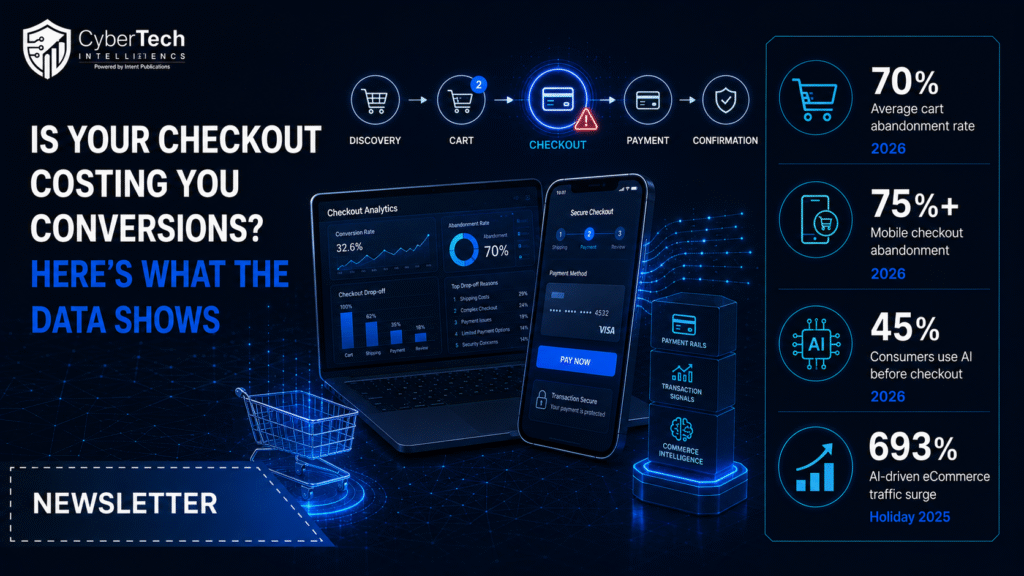
The average cart abandonment rate across retail sits at 70%, rising to more than 75% on mobile devices. ¹
For every ten shoppers who reach the point of payment, seven are walking away before confirming. That is not a minor conversion leak. It is a structural revenue problem sitting at the most critical moment in the entire customer journey, and for most retailers, it is happening thousands of times a day across every channel.
In collaboration with Ingenico, RETHINK Retail is bringing this conversation directly to the retail executives who need it most. The exclusive webinar, Where Checkout Still Breaks and How Retailers Are Fixing It, goes beyond surface-level fixes, into where checkout is actually breaking, why, and what leading retailers are doing to close the gap. , the actual data that shows why, and how leading retailers are already working on solving it. The registration for this webinar includes access to a complimentary copy of the Research Report, The Checkout Performance Gap.
What the Data Is Saying That Most Retailers Are Not Hearing
The 2026 research on checkout performance is not ambiguous. It points to a specific, measurable set of failures happening at the moment of highest purchase intent, and it points to them with a precision that makes every comfortable assumption about checkout health harder to sustain.
IBM‘s global study with the National Retail Federation (January 2026) identifies the consumer reality that makes checkout friction so costly in 2026. 45% of shoppers now use AI during their buying journeys before reaching the point of purchase, arriving at checkout having already researched the product (41%), interpreted reviews (33%), and validated the price (31%). ²
These are not casual browsers. These are decided, buyers. And when the checkout experience does not match the quality of the AI-guided journey that preceded it, the abandonment is immediate and permanent.
IBM further identifies the operational root of that failure: 54% of retail executives report persistent data integration challenges across channels and systems ², and IBM’s IBV research documents that eliminating multisite checkout friction directly increases conversion rates, average order value, and cross-sell performance. ³
These are not experience metrics. They are revenue outcomes, and they are directly accessible to retailers willing to make the right checkout architecture decisions.
KEY FIGURES AT A GLANCE
70% average cart abandonment rate, rising to 75%+ on mobile (Retail Technology Innovation Hub — April 2026) ¹
45% of shoppers use AI during their buying journey before reaching checkout (IBM / NRF Global Study — January 2026) ²
693% surge in AI-driven ecommerce traffic during the 2025 holiday season (Microsoft / Adobe — January 2026) ⁴
72% of merchants report higher failed payment rates for overseas transactions versus domestic (Retail Technology Innovation Hub — April 2026) ¹
$262 billion in retail revenue generated through AI-driven personalized recommendations and engagement during the 2025 holiday season (Google Cloud / US Chamber of Commerce — February 2026) ⁵
Why RETHINK Retail Is the Right Place for This Conversation
Checkout performance sits at an uncomfortable intersection that most organizations struggle to own. It is too operational for marketing, too commercial for IT, and far too consequential to be left to either in isolation.
RETHINK Retail is built for exactly these intersections. As the trusted destination for retail intelligence, peer-level conversation, and practitioner-driven insight, RETHINK Retail brings together the leaders who are responsible for the full retail performance picture and gives them the data, the honest conversation, and the peer context to make better decisions faster.
Every webinar, every research piece, and every conversation RETHINK Retail curates is designed with one purpose: to give retail leaders the intelligence they cannot get from a vendor pitch or an industry panel, sourced from practitioners who have built and operated the systems under discussion and can speak plainly about what the results actually look like.
The webinar developed in partnership with Ingenico is a direct expression of that model. It is not a product presentation. It is a data-backed, practitioner-led examination of where checkout is costing retailers conversions and what the leaders who have fixed it actually did. The free copy of The Checkout Performance Gap report, unlocked on registration, gives attendees a research foundation to carry back into their own organizations.
Ingenico: Turning Checkout Into a Conversion Engine
Ingenico’s partnership with RETHINK Retail reflects the conviction that has defined its platform direction in 2026. Checkout is not the final step in the retail journey. It is the moment where every prior investment in the customer relationship either converts into revenue or evaporates into abandonment.
The retailers closing the checkout performance gap are making a different kind of decision from those still absorbing avoidable losses at the point of sale. They are treating checkout as a conversion architecture decision, a system designed from the payment layer up to maximize flexibility, minimize friction, meet customers at their preferred payment method, and generate the operational data that makes continuous improvement possible across every channel and market.
Ingenico’s platform is built to enable exactly that model. Across physical and digital environments, Ingenico connects payment capability to operational performance in a way that turns checkout from a cost center into a measurable competitive advantage.
The RETHINK Retail webinar makes that architecture concrete through the practitioners who have built it in live environments, sharing what the metrics look like in practice and what the decisions required along the way.
Microsoft: The Conversion Gap Closes When the Checkout Matches the Journey
Microsoft’s January 2026 NRF announcement placed frictionless checkout at the centre of its retail AI strategy, and the data behind that decision is directly applicable to every retailer examining their own conversion performance.
AI-driven ecommerce traffic surged 693% during the 2025 holiday season, meaning the consumers arriving at checkout in 2026 have been through a more sophisticated, personalized, AI-mediated discovery journey than ever before. When checkout does not match that standard, the abandonment reflects not just a payment failure but a trust failure. ⁴
Microsoft’s Copilot Checkout, launched in January 2026, was designed around one commercial truth: connecting authentic brand engagement with frictionless checkout helps retailers capture value at the exact moment of intent. ⁴
No redirect. No friction. Conversations are converted into confirmations instantly. Microsoft Advertising’s own analysis of Copilot Checkout frames the outcome precisely: less friction, greater access, more conversions, with merchants retaining full ownership of the transaction, the customer data, and the relationship. ⁶
The webinar translates that commercial framing into operational decisions retailers can act on immediately.
Google Cloud: The Retailers Fixing Checkout Are Building Intelligence Into the Payment Layer
Google Cloud’s January 2026 NRF announcements document what it looks like when checkout intelligence is built into the platform rather than added on top of it. Google Cloud’s Gemini Enterprise for Customer Experience, announced at NRF 2026, manages the full shopping journey end-to-end.
The agent identifies shopper preferences, surfaces relevant products, recommends carts, and completes the purchase, without friction at any step. The result for retailers, documented by Google Cloud, is increased conversion rates, order sizes, and customer engagement, alongside improved operational efficiency from automated routine interactions. ⁷
Major retailers, including Kroger, Lowe’s, and Woolworths, are already deploying these capabilities across the full shopper journey. ⁸
Google Cloud’s agentic commerce research makes the strategic imperative direct: own the transaction, regardless of where it originates, whether on the retailer’s own site, through a consumer’s personal AI agent, or on a third-party platform. ⁹
Retailers whose checkout infrastructure cannot meet that standard will cede transactions to those who can. The webinar delivers the operational blueprint to close that gap before peak trading.
Palo Alto Networks: A Checkout Breach Is a Conversion Catastrophe
For the retail technology and security leaders in RETHINK Retail’s audience, checkout performance has a security dimension that every data point in this newsletter depends on. Point of sale and payment systems are among the most consistently targeted infrastructure in retail, and Palo Alto Networks‘ 2026 threat data makes the risk quantifiable.
Drawing on 750 major incidents across 50 countries between October 2024 and September 2025, the Unit 42 Global Incident Response Report by Palo Alto Networks 2026 stated that in the fastest breaches, cyberattackers proceeded from gaining initial access to exfiltrating data within only 72 minutes, four times quicker compared to the previous year. ¹⁰
84% of major cyber incidents resulted in operational downtime, reputational damage, or financial loss. For a retailer whose checkout system is compromised during peak trading hours, that downtime is not an IT metric. It is a direct, immediate revenue event. ¹¹
Critically, in over 90% of breaches, preventable gaps materially enabled the intrusion: limited visibility, inconsistently applied controls, or excessive identity trust. ¹⁰
Ingenico’s approach, building payment security and checkout performance from a single architecture, reflects the security-by-design model the 2026 threat environment demands.
Cisco: The Network Under the Checkout Cannot Be an Afterthought
Every checkout interaction depends on network infrastructure that carries the transaction without latency, failure, or security gaps that the customer will never see but will immediately feel as friction.
Cisco’s State of Wireless 2026 report, drawing on 6,098 wireless decision-makers across 30 markets, identifies mobile POS and faster checkout as direct beneficiaries of wireless investment alongside digital signage and real-time inventory. The security stakes are equally concrete: 54% of retail organizations report financial losses from wireless security incidents, with more than 45% of those losses exceeding $1 million annually. ¹²
A network failure at the point of sale does not register as an IT incident in the customer’s experience. It registers as a checkout that did not work, and for most customers in 2026, that is the last interaction they have with that retailer.
Organizations that address complexity, security, and talent together achieve 63% higher average wireless ROI ¹³, and 77% of retail IT leaders report enhanced customer engagement from wireless investments. ¹² For retailers building modern checkout infrastructure with Ingenico, the network decision is as consequential as the payment platform decision itself.
The Session That Answers the Question the Data Is Raising
The data is clear. Checkout is costing retailers conversions. The question every retail leader should be walking into this webinar with is not whether that is true for their organization. It is where specifically it is true, what the highest-value fixes are, and how the retailers that have already closed the gap did it.
RETHINK Retail and Ingenico built this webinar to answer that question with the specificity and the practitioner honesty that only a genuinely peer-level conversation can deliver.
Attendees will leave with a clear view of where checkout performance is breaking, the operational decisions that fix it, and a free copy of The Checkout Performance Gap report to anchor the internal conversation that follows.
The data has already answered the question in the headline. The webinar answers what to do about it.
Register Now: Where Checkout Still Breaks and How Retailers Are Fixing It Presented on behalf of Ingenico | Hosted by RETHINK Retail
Register Here
References
- Retail Technology Innovation Hub — The Hidden Cost of Checkout Friction — 20 April 2026
- IBM Newsroom / NRF — Brands and Retailers Navigate a New Reality as AI Shapes Consumer Decisions Before Shopping Begins — 7 January 2026
- IBM Institute for Business Value — Agentic Commerce Research — May 2025
- Microsoft — Microsoft Propels Retail Forward with Agentic AI Capabilities — 8 January 2026
- US Chamber of Commerce — How Agentic AI Will Transform Consumer-Driven Companies in 2026 — February 2026
- Microsoft Advertising Blog — Conversations That Convert: Copilot Checkout and Brand Agents — 8 January 2026
- Google Cloud — Retail and Commerce Solutions — 2026
- Google Cloud Press Corner — Google Cloud Brings Shopping and Customer Service Together with Gemini Enterprise for Customer Experience — 11 January 2026
- Google Cloud Blog — A New Era of Agentic Commerce Is Here — 11 January 2026
- Palo Alto Networks — 2026 Unit 42 Global Incident Response Report — 17 February 2026
- Palo Alto Networks — 6 Predictions for the AI Economy: 2026’s New Rules of Cybersecurity — 18 November 2025
- Cisco Blogs — 5 Wireless Trends Retail IT Teams Can’t Ignore in 2026 — 15 April 2026
- Cisco — State of Wireless Report 2026 — 2 April 2026
🔒 Login or Register to continue reading