In recent times, as the risk of potential issues or anomalies in the digital system grows, subsequently the need for efficient monitoring solutions has also grown to detect these potential issues or anomalies in the complex digital system. MaaS, or Monitoring as a Service, is one such cutting-edge cloud-based solution offering a diverse solution to the growing need for monitoring in complex digital environments. MaaS offers extensive monitoring capabilities for a range of IT infrastructures. Moreover, it provides a comprehensive managed service that includes server, application, database, and network monitoring, guaranteeing excellent availability and performance for every system.
The ability of MaaS to provide real-time insights and alerts is one of its main benefits, allowing organizations to react promptly to any issues that arise and preserve system integrity. In addition to preserving system integrity, this proactive strategy improves the operational effectiveness of organizations. Predictive analytics, which uses historical data to predict potential issues before they arise, is another element that is often included in MaaS solutions. Choosing a MaaS solution requires careful consideration of scalability, integration capabilities, real-time capabilities, comprehensive reporting, customizable interfaces, security features, predictive analytics, and automation.
Recommended: Cybersecurity Simplified: What is Cloud Infrastructure Security?
What is Monitoring as a Service (MaaS)?
MaaS is a cloud-based service that helps organizations to effectively monitor their apps, networks, and IT infrastructure. The service operates on a subscription-based approach that enables organizations to outsource the monitoring of their IT systems to third-party vendors. It integrates on-premise IT infrastructure with cloud computing. Its primary focus is online state monitoring of organizations’ storage instances, network traffic, apps, etc. MaaS solutions allow organizations to maintain high availability and performance without requiring extensive internal resources or hardware as they offer real-time reporting, alerting, monitoring, and analytics.
Components Monitored in MaaS
- Servers
- Networks
- Applications
- Databases
- Cloud services

Key Features of MaaS
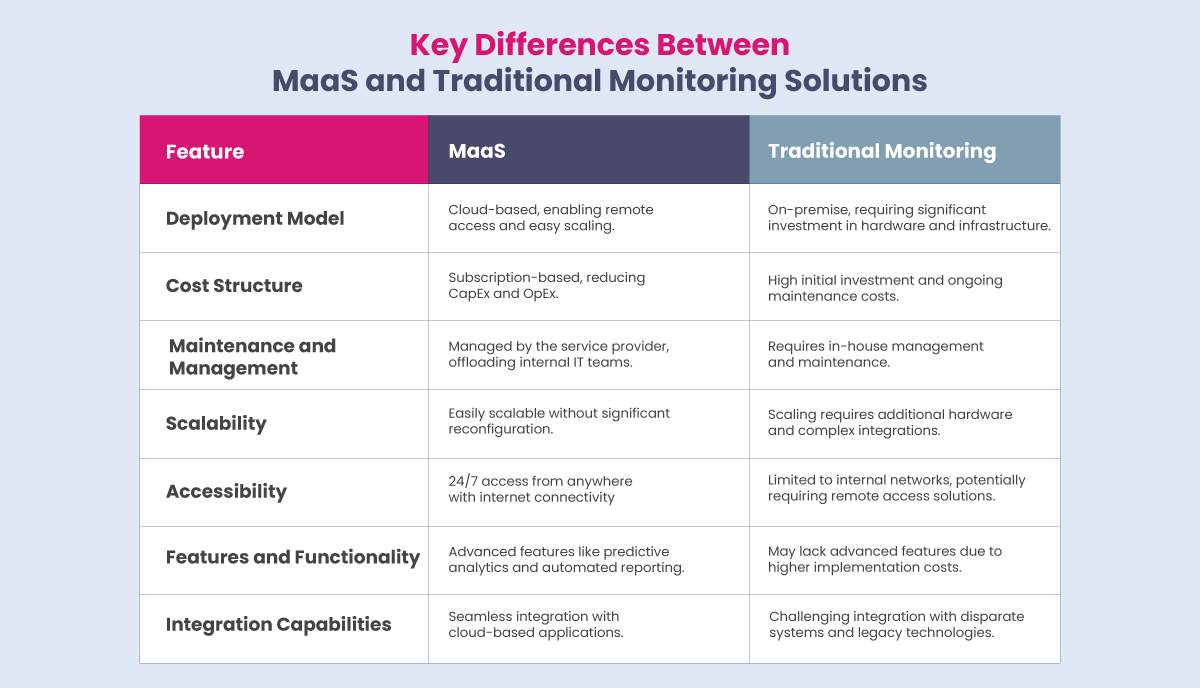
MaaS is a crucial cloud-based solution that offers extensive IT infrastructure monitoring capabilities. Organizations should take into account a number of essential features and functionalities that will improve the administration of their IT infrastructure when choosing a MaaS solution.
Here are some notable key features of MaaS:
Scalability and Flexibility
- Scalability: The ability to easily scale the monitoring service to accommodate growing data volumes and complex network environments is crucial. This ensures that as an organization expands its business, its monitoring capabilities can adapt accordingly.
- Flexible Pricing Models: Look for solutions that offer pricing based on usage, allowing organizations to add or remove services as needed without incurring unnecessary costs.
Recommended: Cybersecurity Simplified: LLMjacking Attacks
Real-time Monitoring and Alerts
- Real-time Insights: Effective MaaS solutions provide continuous monitoring and immediate alerts for any anomalies or issues within the IT infrastructure. This capability aids in the quick detection and resolution of issues, minimizing downtime.
- Alerting Mechanisms: When issues arise, users can be notified through many different types of channels by customizable alerts, which ensures prompt reactions to potential risks.
Predictive Analytics
- Problem Detection: Advanced predictive analytics capabilities allow MaaS solutions to analyze historical data and forecast potential issues before they impact operations. This proactive approach allows organizations to mitigate risks effectively.
Customizable Dashboards
- User-Friendly Interfaces: Custom dashboards enable users to visualize metrics and performance data in a way that suits their monitoring needs. This feature enhances usability for individuals with varying levels of technical expertise.
Comprehensive Reporting
- Detailed Reports: The ability to generate in-depth reports on system performance, trends, and capacity planning is vital for strategic decision-making. These reports help organizations optimize resources and plan for future growth.
Security Features
- Data Protection: Security features such as user authorization, authentication, and data encryption are essential for protecting the sensitive data the service monitors. Preservation of integrity and trust depends on adherence to security standards.
- Threat Prevention: Continuous vulnerability monitoring improves overall system security by enabling organizations to promptly identify and address security threats.
Integration Capabilities
- Compatibility with Existing Tools: In order to enable a unified operational environment, a quality MaaS solution should seamlessly integrate with existing IT tools and procedures, such as ticketing systems or automation tools.
Automated Deployment and Management
- Efficiency in Setup: The time required to set up monitoring across several applications and services can be significantly reduced by features such as auto-discovery and automated deployment utilizing templates.
Recommended: Cyber Threat Intelligence: How to Predict and Prevent Cyberattacks?
When assessing MaaS systems, organizations should prioritize features that improve scalability, real-time monitoring, predictive analytics, customizable reporting, strong security, integration capabilities, and automation. Collectively, these features provide a reliable and effective monitoring environment that promotes operational excellence and business continuity.
Benefits of MaaS
- Cost Reduction: Organizations can cut expenses related to maintaining internal resources and equipment by outsourcing monitoring tasks.
- Focus on Core Operations: Organizations can rely on MaaS for efficient IT management while focusing on their core business operations.
- Enhanced Performance: Maintaining optimal performance levels across IT systems through proactive monitoring reduces downtime and enhances service delivery.
Challenges in Migrating to MaaS
Migrating to MaaS can present several challenges that organizations must navigate to ensure a successful transition. While migrating to MaaS offers significant benefits, organizations must be prepared to address various challenges through careful planning, resource allocation, and ongoing management efforts to ensure a smooth transition.
Here are some key challenges associated with this migration process:
Data Security and Privacy
Ensuring the security of sensitive data during migration is paramount. Organizations must implement robust security measures, such as encryption and access controls, to protect data from breaches or unauthorized access during the transfer process.
Compatibility Issues
Legacy systems may not be fully compatible with modern cloud environments, leading to integration challenges. Organizations need to assess their existing infrastructure and determine how well it can work with the new MaaS solution, which may require additional adjustments or upgrades.
Service Disruption
During the migration process, service continuity must be maintained. Any downtime can cause major interruptions to operations, particularly for organizations that depend on real-time data. To reduce service interruptions, careful planning and execution are needed.
Vendor Lock-In
Organizations may become dependent on a specific MaaS provider, making it difficult and costly to switch to other providers in the future. It’s essential to understand the terms of service and consider multi-cloud strategies to mitigate this risk.
Cost Management
While MaaS can reduce operational costs in the long run, the initial migration can incur unexpected expenses, such as training, software licensing, and potential downtime losses. A clear budget and financial plan are necessary to manage these costs effectively.
Recommended: Top AI Security Tools for Financial Services Industry
Skill Gaps
Migrating to a new monitoring system often requires specialized skills and abilities that the current IT staff might not have. Organizations might choose to spend money on training or bringing on new hires who have the requisite knowledge of cloud computing.
Regulatory Compliance
When transferring sensitive data to the cloud, compliance with industry regulations is crucial. To avoid legal ramifications, organizations must make sure that the MaaS supplier they have selected complies with applicable compliance standards.
Change Management
Employee resistance to change may make the transfer process more difficult. To gain the support of stakeholders and ensure a seamless transition, effective change management techniques are required.
Data Integrity
Ensuring data remains intact and uncorrupted during migration is essential. Organizations need robust data validation processes in place to verify the accuracy of the migrated data.
Time and Resource Commitment
Projects involving cloud migration may take a lot of time and resources, possibly taking focus away from other important business responsibilities. In order to reconcile continuing operations with migration initiatives, careful planning and resource allocation are required.
Conclusion
MaaS is an essential tool for cybersecurity requirements and modern businesses seeking to enhance their IT operations. Its scalability, predictive analytics, real-time capabilities, and comprehensive reporting make it a valuable asset in maintaining system performance and security while allowing organizations to focus on their core activities. Successfully migrating to MaaS involves addressing various challenges related to security, compatibility, service continuity, cost management, skill gaps, compliance, change management, data integrity, and resource commitment. By proactively identifying these challenges and developing strategies to mitigate them, organizations can achieve a smoother transition and leverage the full benefits of MaaS solutions.
Organizations should consider various important aspects such as scalability, dashboard customization, and strong security measures while choosing a MaaS provider. Organizations can ensure they select a monitoring solution that efficiently meets their operational demands and improves overall IT performance by focusing on these factors. While offering useful insights that support well-informed decision-making, the appropriate MaaS solution can significantly reduce the workload associated with maintaining monitoring infrastructure. MaaS stands out as a crucial instrument for preserving the best possible system performance and dependability as organizations continue to adopt evolving technological landscapes.
To share your insights, please write to us at news@intentamplify.com