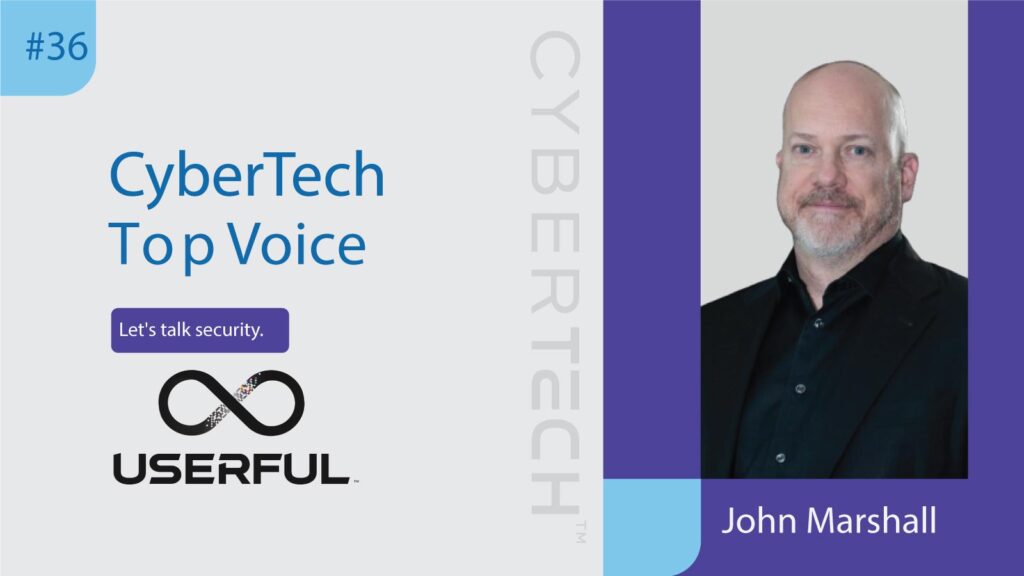
Amid escalating convergence across cyber, physical, and operational threat surfaces, enterprise resilience now hinges less on detection and more on synchronized response. In this CyberTech Top Voice Interview, Intent Amplify’s Head of Global Marketing, Sudipto Ghosh, engages with John Marshall, CEO of Userful, to explore the vision underpinning the Operational Risk Awareness & Response Platform (ORARP) and the Infinity Platform’s emergence as a unifying command stratum for modern enterprise environments. Moving beyond fragmented telemetry and siloed observability stacks, ORARP advances a coordinated, cross-domain orchestration paradigm—enabling security, IT, and operational functions to operate from a harmonized risk perspective and execute with heightened agility, precision, and accountable alignment.
Here’s the full interview with John Marshall.
Userful is positioning the Infinity Platform as a single operational command layer—what core enterprise problem does this unify that traditional security, observability, and IT systems have failed to solve?
Over the last decade, companies have poured a lot of money into monitoring, detection, and observability tools. However, these tools are built to surface information, not to align teams.
The real problem is not a lack of data. It is the lack of a shared operational view. Security, IT, and operations teams often operate within their own environments, each with separate dashboards and workflows, which makes coordinated response harder than it should be.
Infinity focuses on creating a single operational picture. It connects signals across domains and helps ensure that when risk emerges, everyone is working from the same understanding. That alignment is what reduces friction and improves response time.
Recommended CyberTech Interview: CyberTech Top Voice Interview with Bobby Ford, Chief Strategy & Experience Officer at Doppel

You’ve emphasized “orchestration” over simple integration. What does orchestration enable that integration alone cannot in complex enterprise environments?
Integration connects systems. Orchestration connects action.
Most enterprises already have systems talking to each other. The challenge is that data moving between tools does not automatically translate into clear ownership or coordinated response.
Orchestration defines how incidents progress from detection to response. It establishes roles, visibility, and escalation pathways, aligning human and automated workflows. As environments become more AI-enabled, this coordination layer becomes essential to ensure insight translates into measurable impact.
Enterprises often rely on best-of-breed tools across security, IT, and operations. At what point does that model break down, and how does Infinity change the equation?
That model starts to break down at the seams when incidents span multiple domains. A cyber alert can affect production systems. A facilities issue can impact network resilience. A cloud outage can cascade into operational downtime. Once accountability crosses team boundaries, fragmentation becomes a real source of risk.
Infinity shifts the dynamic by serving as a unifying awareness layer across these domains, without forcing organizations to replace the systems they rely on today. ORARP operationalizes specialized tools by ensuring they contribute to a common operational posture. Teams maintain their expertise and preferred platforms, but cross-domain blind spots are reduced.
How do partnerships with Splunk, Genetec, Everbridge, Cisco, Microsoft, and NVIDIA materially change what enterprises can do in real time?
Convergence only works if the ecosystem is strong. By integrating with leaders in observability, physical security, communications, cloud infrastructure, and AI acceleration, Infinity expands the reach of ORARP across the enterprise.
These partnerships allow organizations to correlate digital and physical events in real time and coordinate responses across teams. Decision-making is no longer isolated within a single operations center. It becomes enterprise-wide, with greater speed and coherence.
You’ve stated that Infinity brings together more than $60B in addressable market. What structural shifts in enterprise operations are driving that convergence now?
The environment itself has changed. IT, OT, security, and operations are no longer separate worlds.
The expansion of connected devices, distributed workforces, AI-driven automation, and geopolitical complexity has increased operational exposure and risk itself is systemic. This realization is driving demand for a unifying layer that manages cross-domain risk coherently. ORARP exists because the enterprise environment itself has converged.
Recommended CyberTech Interview: CyberTech Top Voice: Interview with Kev Breen, Senior Director of Cyber Threat Research at Immersive
Edge AI and real-time visualization are central to Infinity. Why is intelligence at the edge becoming mission-critical for modern enterprises?
Modern operations require low latency and resilience. In environments such as manufacturing, healthcare, and transportation, delays in decision-making can have significant consequences.
Infinity extends ORARP awareness to the edge, enabling organizations to act where risk emerges, not after a cloud round-trip. It reduces dependency on centralized infrastructure and enhances continuity during network disruption.
Security and resilience are core to this release. How did you architect Infinity to meet modern requirements like zero-trust, high availability, and air-gapped deployments?
When enterprises face crises, whether cyberattacks, infrastructure failures, or geopolitical events, the convergence platform must remain trusted and available. Infinity was designed with zero trust principles, distributed redundancy, secure APIs, and support for isolated and air-gapped environments.
IT and OT teams have historically operated in silos. How does Infinity practically help these teams align without forcing organizational disruption?
Infinity provides a unified view of enterprise risk while allowing teams to retain control of their respective systems. IT, OT, security, and facilities teams maintain domain authority while gaining visibility into how incidents intersect across the organization. Coordination improves through transparency rather than consolidation.
Many enterprises worry about vendor lock-in with large platforms. How does Userful avoid becoming another legacy system that enterprises can’t easily evolve away from?
Concerns around vendor lock-in are valid. The future belongs to modular, open platforms.
Infinity enhances existing systems rather than replacing them. An API-first approach and open architecture ensure that customers retain flexibility as their environments evolve. Our goal is to serve as a convergence layer that enables choice, not restricts it.
Recommended CyberTech Interview: CyberTech Top Voice: Interview with Roman Kilun, Chief Compliance Officer at ABBYY
Looking ahead, how do you see the definition of “operational awareness” evolving over the next five years, and what role will platforms like Infinity play in that shift?
Operational awareness is moving beyond passive monitoring toward continuous risk posture management. Organizations will want platforms that can visualize data on top of interpreting risk, coordinating response, and providing executive clarity.
Platforms like Infinity will bring together awareness, accountability, response, and executive insight into a continuous operational cycle. Over time, a convergence platform will be as essential to enterprises as ERP or CRM systems are today.
For product developers and security technologists entering AI-led cybersecurity roles, what mindset shifts and skills will be critical to succeed as systems become more autonomous and adversarial?
Technologists must think systemically. Detection alone is insufficient. They must understand orchestration, governance, adversarial resilience, and human-machine collaboration.
As AI becomes embedded in operational systems, professionals must design with accountability and explainability in mind. ORARP emphasizes disciplined coordination over unchecked automation. It’s a mindset that will define the next generation of cybersecurity leadership.
Technologists need to keep in mind that detection is only one part of the equation. They need to understand orchestration, governance, adversarial resilience, and human-machine collaboration.
As AI becomes embedded in enterprise operations, accountability and explainability must be built into system design. ORARP emphasizes disciplined coordination over unchecked automation.
Finally, which industry leader or practitioner would you like to see featured next in the CyberTech Top Voice program?
I would recommend Leo Tilman of Agilion, as he is a leader driving convergence between cyber and operational domains, or a Chief Security or Resilience Officer from a global infrastructure operator who understands cross-domain operational risk at scale.
Recommended CyberTech Interview: CyberTech Top Voice: Interview with Anna Collard, SVP Content Strategy and CISO Advisor, KnowBe4 Africa
To participate in our interviews, please write to our CyberTech Media Room at info@intentamplify.com