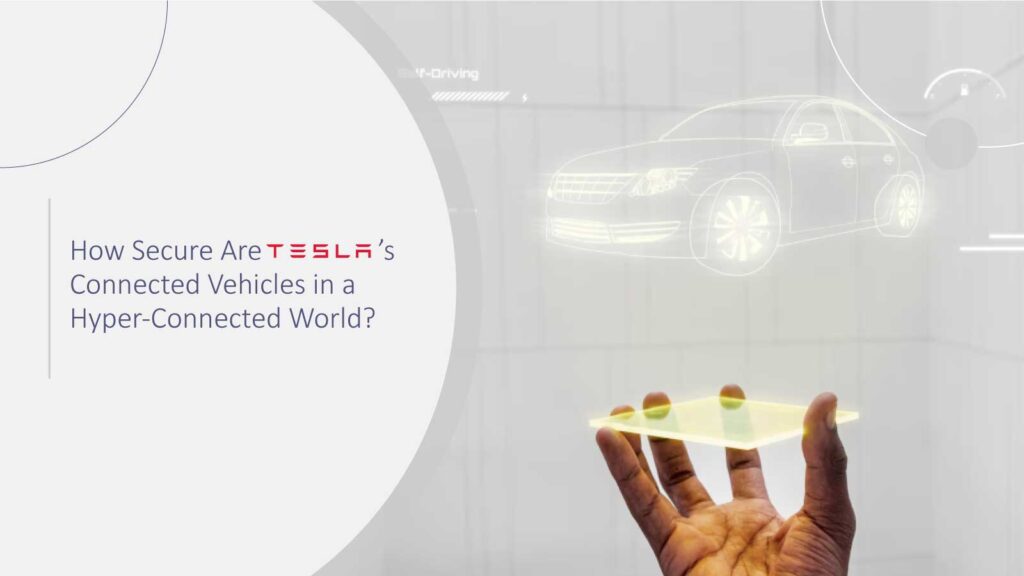
Cars have evolved from mere machines to be digitally connected platforms. Specifically, Tesla cars are closer to being “rolling computers” rather than regular vehicles. Additionally, they are connected to mobile networks, cloud platforms, charging stations, and smartphone apps, most of the time, all at the same time. Connectivity is what makes convenience and innovation possible.
How about we find out the truth? Tesla’s vehicles are connected, but are they well protected against hackers and cybercriminals in today’s interconnected world?
The Reality of Connected Vehicles
Firstly, current vehicles have millions of lines of code. What is even more striking is that software nowadays has a bigger influence on vehicle behavior than the hardware parts. According to McKinsey, modern vehicles can contain 100+ million lines of code, exceeding the complexity of commercial aircraft software systems.
Tesla vehicles perform a lot of functions through the internet, such as:
- Software updates Over-the-Air (OTA)
- Remote diagnostics and monitoring
- Navigation and infotainment
- Mobile app control and vehicle access
Industry research on connected vehicles has led to the assumption that each connected car generates and exchanges up to 25 GB of data per hour; thus, cybersecurity must be there from the very beginning and not as an afterthought.
Statista estimates that connected vehicles can generate up to 25 GB of data per hour, depending on usage and sensor activity.
The internet connection can be turned into a tool that makes the car safer and better. However, it also makes the car a target for cyberattacks since it is now a digital surface.
Tesla’s Security-First Design Philosophy
The security of design philosophy is what characterizes Tesla. Besides that, the company advocates open disclosure of security issues and collaborates with security researchers through structured vulnerability reporting programs. Tesla publicly operates a security reporting framework aligned with industry best practices and participates in coordinated vulnerability disclosure, similar to leading technology firms.
Some of the principal security measures are:
- Regular OTA updates to get rid of security holes
- Use of encrypted communications between the vehicle elements
- Separation of the driving system components from the entertainment system components.
It is this strategy that allows Tesla to fix security loopholes promptly. Thus, if a gap is found, a quick turn of the page will prevent you from needing to visit the service center.
Updating your smartphone while you sleep is a good analogy. The upgrade is done while you’re asleep, and the protection is better when you wake up.
What Security Research Has Revealed
At automotive cybersecurity events, security researchers and ethical hackers regularly put Tesla systems through their paces. These controlled tests have shown that vulnerabilities may be present in areas such as:
- Wireless interfaces
- Charging infrastructure
- External connectivity modules
It is worth noting that these discoveries originate from ethical testing environments and not from the misuse of the systems in the real world. The aim is to make things better, not to expose.
According to IBM Security, organizations that remediate vulnerabilities quickly reduce long-term cyber risk exposure by over 50%.
Tesla, in several instances, responded to the vulnerabilities that were reported by issuing fixes promptly. Such a fast response cycle consolidates the long-term resilience.
There is no complex software system that is flawless. What is important is the speed with which the issues are being solved.
The Role of the Broader Ecosystem
Not all the dangers come from inside the car.
Third-party tools, open-source dashboards, and unsecured integrations may unintentionally reveal vehicle data if the configuration is wrong. In quite a few instances, the information related to the vehicles was available just because the users had left the systems open to the internet.
This underlines the main fact of contemporary cybersecurity:
- Security of vehicles is a shared responsibility between the manufacturer and the user.
- Strong defaults are important. So is knowledgeable usage.
Why This Matters to Professionals and Consumers
Tesla cars, to professionals and tech enthusiasts, might be considered the mobility of the future- software-defined, data-driven, and constantly evolving.
The point for the average driver is even easier:
- Keep vehicle software updated
- Use trusted applications
- Secure third-party tools properly
Would you install unknown software on your work laptop without checking permissions? A connected vehicle deserves the same care.
Conclusion
Tesla’s connected vehicles are an example of modern cybersecurity practices in place. The company is using OTA updates, encryption, and collaboration with security researchers as a means to continuously strengthen its platform.
However, the security of the broadly connected ecosystem–networks, integrations, and user behavior–is just as important.
Connectivity itself is not the risk. Unmanaged connectivity is.
In a world that is extremely connected, informed users and responsive platforms make safer digital mobility possible.
FAQs
1. Are Tesla vehicles fully secure from cyber threats?
Tesla vehicles execute layered security measures, and they are regularly updated to minimize vulnerabilities. However, no system that is connected can be completely immune.
2. Do software updates improve vehicle security?
Certainly, OTA updates give Tesla a chance to quickly do the fixes that are needed without the need for a physical visit.
3. Can hackers remotely control a Tesla?
Public research demonstrations occur in controlled environments. There is no evidence of widespread real-world misuse.
4. Are third-party Tesla tools safe to use?
Yes, if they are securely configured. If the setup is poor, it can make your data vulnerable.
5. What is the biggest security advantage Tesla has?
It is the ability to very quickly, at a large scale, update vehicles that keeps security in line with the changing threats.
Stay informed with the latest CyberTech insights and expert analysis, and real-world CyberTech strategies at CyberTechnology Insights.
To participate in upcoming interviews, please reach out to our CyberTech Media Room at info@intentamplify.com.