In today’s rapidly transforming digital landscape, the integration of Artificial Intelligence (AI) and Machine Learning (ML) into cybersecurity has emerged as a significant technology in the landscape of cybersecurity. With advancements in technologies, they are revolutionizing cybersecurity by enhancing threat detection, prevention, and response. Moreover, these advanced technologies significantly bolster defenses by enabling organizations to analyze vast amounts of data for threat detection and predict potential attacks. A more resilient infrastructure is made by this proactive strategy, which improves the capacity to identify cyber threats before they become more serious.
However, as technology evolves, cybercriminals are increasingly leveraging these advanced technologies to optimize their attacks in a more sophisticated manner by employing sophisticated techniques such as automated phishing campaigns and advanced malware development. While AI and ML can enhance security measures, they can also introduce vulnerabilities if not managed properly. As organizations navigate this landscape, understanding both the benefits and risks associated with AI and ML in cybersecurity becomes crucial for developing effective strategies that safeguard against evolving cyber threats.
Overview: AI and Machine Learning in Cybersecurity
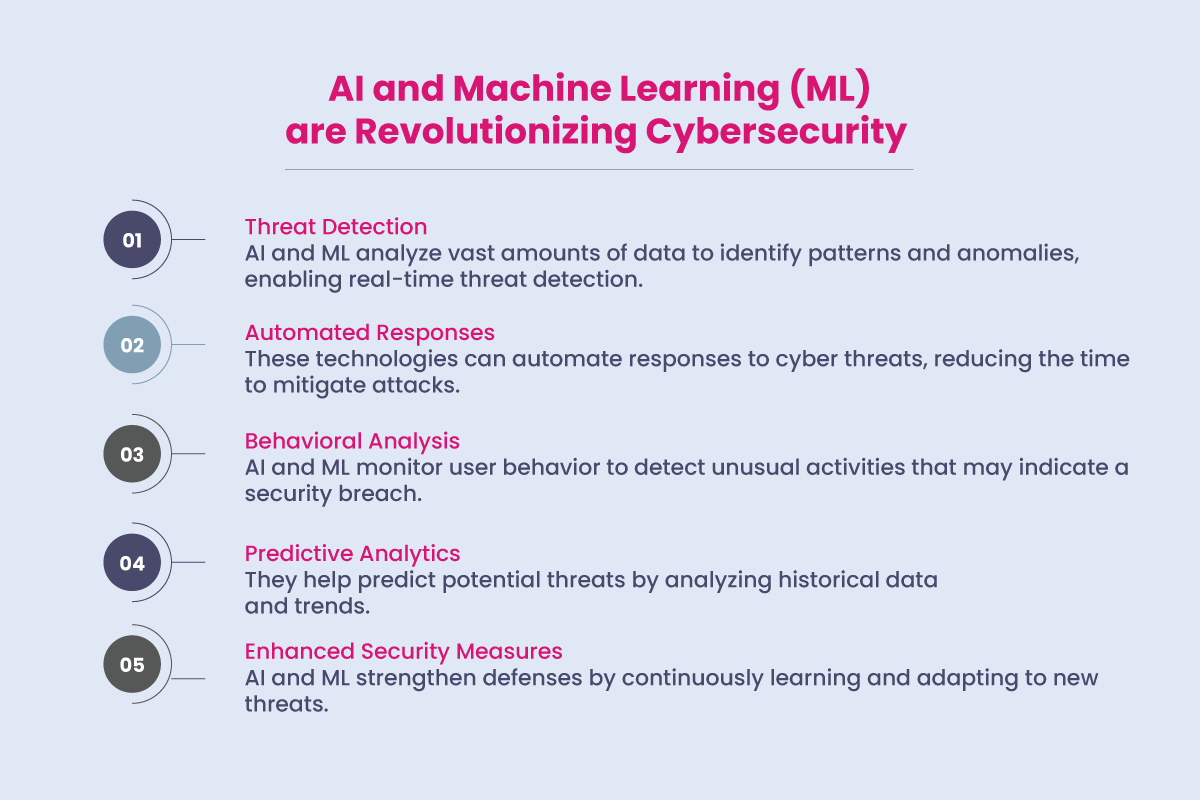
AI and ML are increasingly pivotal in enhancing cybersecurity measures, including threat detection, response, and overall risk management. AI encompasses a range of technologies that simulate human intelligence, while ML specifically focuses on training algorithms to learn from data patterns. These advanced technologies enable organizations to detect, analyze, and respond to cyber threats effectively compared to traditional methods. Furthermore, these technologies allow computers to evaluate massive amounts of data in order to detect trends and anomalies that could suggest cyber dangers. This integration is reshaping the landscape of cybersecurity by leveraging vast amounts of data to identify patterns, predict threats, and automate responses.
Recommended: Data Quality: The Unseen Barrier to AI’s ROI and Sustainability in 2025
Key Applications of AI and ML in Cybersecurity
1. Threat Detection and Response
The increasing sophistication of cyber threats often proves traditional security methods inadequate for cybersecurity. AI and ML technologies offer advanced techniques that enhance the ability to detect, analyze, and respond to these threats in real time. Meanwhile, ML algorithms can learn normal behavior patterns within a system and identify deviations that may indicate potential threats. This includes monitoring user behavior and network traffic to flag suspicious activities.
2. Intrusion Detection Systems (IDS)
IDS are key components of cybersecurity that monitor network and system activity for malicious behavior or policy violations. AI enhances IDS by analyzing logs and network traffic for signs of unauthorized access or anomalies, significantly improving detection capabilities, and allowing for more proactive and adaptive security measures. The incorporation of AI and ML transformed IDS by enabling traditional IDS to learn from historical data and adapt to new threats dynamically.
3. Phishing and Fraud Detection
ML models can analyze email content and URLs (Uniform Resource Locators) to detect phishing attempts by recognizing patterns from known attacks. This proactive strategy aids in filtering fraudulent emails before they reach users. Through historical data learning, these systems can identify typical user behavior and identify variations that can indicate a phishing attempt. The integration of AI and ML into phishing detection systems represents a significant advancement in combating these threats, enhancing the ability to identify and mitigate phishing attempts effectively.
Recommended: Cybersecurity Simplified: LLMjacking Attacks
4. Threat Intelligence Generation
To generate actionable insights for cybersecurity teams, AI automates the analysis of large datasets from various sources, including threat feeds and social media. By leveraging advanced algorithms and data processing capabilities, AI enhances the efficiency and effectiveness of threat intelligence operations. This capability makes it possible to identify new threats in real-time. Leveraging these advanced technologies will be crucial for maintaining robust security postures and effectively mitigating risks.
5. User Entity and Behavior Analytics (UEBA)
UEBA is a cybersecurity strategy that uses AI and ML technology to track and examine how people and things behave inside a company. AI systems utilize UEBA to monitor user activity and detect unusual behavior that could signify insider threats or compromised accounts, enabling faster incident response. This strategy can identify irregularities that might point to possible security risks, such as insider attacks or compromised accounts, by setting baselines of typical activity.
6. Cyberattack Simulations
AI and ML play a pivotal role in enhancing cyberattack simulations, providing tools that allow security teams to test their defenses and improve their incident response strategies effectively. Organizations can use AI to simulate cyberattack scenarios for training purposes, helping security teams prepare for real-world threats. This includes creating realistic attack simulations that test the effectiveness of existing defenses. AI-powered simulation tools enable the creation of highly realistic cyberattack scenarios. Using historical attack data, AI can identify patterns and behaviors associated with different types of cyberattacks.
Recommended: Cybersecurity Simplified: What is Cybersecurity in 2025?
Future Trends in AI and ML for Cybersecurity
The future of AI and ML in cybersecurity is promising and poised for transformative advancement that will redefine how organizations approach threat detection and incident response. With several advancements on the horizon, AI and ML trends for cybersecurity are very promising in the future.
Here are a few notable future trends in AI and ML that might shape the cybersecurity landscape:
1. Self-Healing Networks
These autonomous networks will identify and mitigate threats without human intervention, continuously learning from past attacks to enhance their defenses. Self-healing networks can autonomously adjust protocols, fix flaws, and eliminate threats as they appear by utilizing real-time data and adaptive algorithms.
Additionally, as AI technology takes shape, we can expect an increase in advanced threat intelligence capabilities powered by AI. In order to anticipate such attacks, these systems will evaluate vast datasets. This will enable corporations to proactively fix vulnerabilities before they are used against them.
2. Enhanced Predictive Capabilities
Future systems will increasingly leverage Deep Reinforcement Learning (DRL), a sophisticated subset of ML, to adapt to new attack vectors dynamically, improving their ability to predict and respond to sophisticated threats. DRL allows models to learn from their surroundings and enhance their decision-making abilities over time.
This dynamic adaptability will allow AI systems to recognize and respond to new attack vectors as they emerge, significantly enhancing their predictive accuracy.
Recommended: Cyber Insurance: Risks and Trends 2025
3. Proactive Security Measures
AI-driven systems will anticipate potential threats, allowing organizations to implement preventive measures proactively. This capability allows them to detect anomalies that may signify a breach before it fully materializes.
Moreover, the development of autonomous security systems is on the rise. These systems utilize AI to monitor environments and respond to threats independently without human intervention. They continuously learn from past incidents, adapting their defenses to counter new types of cyber threats effectively.
As AI and ML technologies evolve, their role in fostering a proactive cybersecurity posture will be crucial in safeguarding sensitive data and maintaining organizational resilience against an ever-evolving threat landscape.
Key Challenges and Considerations
Despite the transformative potential of AI and ML in cybersecurity, their integration presents several significant challenges and considerations. Organizations must navigate these complexities to harness the full power of these technologies effectively.
Below are a few key challenges that need to be addressed for the effectiveness of cybersecurity:
1. Data Quality and Availability
The quality of training data has a significant impact on how well AI systems perform. In cybersecurity, data can often be noisy, incomplete, or outdated, which adversely affects the accuracy and reliability of AI models. Inaccurate or inadequate data can result in unsatisfactory performance.
Moreover, adversaries may manipulate data sources to introduce misleading information, complicating data validation efforts. Organizations must prioritize secure data collection, storage, and processing practices to ensure high-quality inputs for AI systems.
Recommended: Daily CyberTech Highlights: Essential News and Analysis
2. Evolving Threat Landscape
As cyber criminals adopt AI tools, the threat landscape becomes more dynamic and complex, necessitating continuous advancements in AI technologies to stay ahead of sophisticated attacks. This evolution demands that cybersecurity measures are not only reactive but also proactive in anticipating new methods of attack.
3. Resource Allocation
Organizations face the challenge of balancing automated processes with the need for human expertise. While AI can automate routine tasks and enhance threat detection capabilities, there remain complex security challenges that require human judgment and intervention. This ensures that skilled professionals are available to address these complex security challenges that AI cannot fully address.
4. Ethical and Legal Implications
The deployment of AI in cybersecurity raises ethical concerns related to bias in decision-making processes. AI systems trained on biased datasets may produce skewed results, leading to false positives or negatives in threat detection. Furthermore, legal frameworks often lag behind technological advancements, creating regulatory complexities that organizations must navigate carefully.
5. Trust and Adoption
Even though AI can improve cybersecurity, stakeholders are frequently reluctant to embrace these technologies since they don’t fully grasp or know about them. Transparency about AI systems’ workings and guarantees that security and privacy won’t be jeopardized are essential for fostering trust in them.
In summary, leveraging the full potential of these technologies in establishing a more secure digital environment would require tackling challenges like improving data quality, increasing threats, ethical considerations, resource allocation, and trust. These technologies offer a more secure online environment as they develop, but they also bring with them new difficulties that businesses must overcome.
Recommended: Top 10 Emerging Cybersecurity Technologies for 2025
Conclusion
In recent times, AI and ML are two advanced technologies that have witnessed rapid growth and integration with other technologies to enhance productivity. In particular, these technologies are increasingly transforming and shaping the cybersecurity landscape with their advanced technologies. However, the integration of AI and ML in cybersecurity presents a complex landscape, characterized by both significant advantages and inherent risks. While AI and ML are revolutionizing cybersecurity by improving threat detection and enabling proactive defense strategies, they also introduce new challenges that organizations must navigate.
On one hand, AI-driven systems excel in real-time threat detection, anomaly recognition, and automated responses, enabling swift action against potential breaches. On the other hand, it allows fraudsters to use the same technology to carry out more effective and focused attacks, such as creating malware that can bypass conventional security measures or creating convincing phishing schemes.
As we move forward, organizations need to adopt a balanced approach that leverages the strengths of AI while remaining vigilant about its risks. Effectively managing the future of cybersecurity will require embracing this contrast. AI and ML can help organizations construct more robust and resilient cybersecurity solutions.
To share your insights, please write to us at news@intentamplify.com