
Adversarial AI is emerging as one of the least understood risks in enterprise machine learning. As organizations increasingly rely on AI systems to make operational decisions, from fraud detection and threat identification to identity verification, the models themselves are becoming part of the security perimeter.
Artificial intelligence is now trusted to make decisions that were once handled by deterministic software rules or human analysts. In many enterprises, machine learning models sit directly inside critical workflows.
That shift introduces a new attack vector. Instead of breaching systems, adversaries manipulate the inputs, training data, or behavior of AI models to influence outcomes.
Instead of breaking into systems, attackers manipulate the data and inputs that machine learning models rely on. A subtle change in an image, a carefully crafted prompt, or poisoned training data can push a model toward the wrong decision.
The implication is becoming difficult to ignore. The model itself is becoming part of the attack surface.

What Is Adversarial AI?
Adversarial AI refers to techniques used to manipulate or deceive machine learning models by introducing carefully crafted inputs designed to alter how the system interprets data.
Unlike traditional cyberattacks that target infrastructure, adversarial attacks target the model itself. Attackers exploit weaknesses in how AI systems classify patterns, recognize images, detect anomalies, or evaluate behavior.
For example, a fraud detection model may be tricked into approving malicious transactions. A security monitoring system may misclassify malicious activity as normal network behavior.
In these scenarios, the system continues to function normally at the infrastructure level. However, the intelligence guiding decisions becomes unreliable.
This makes adversarial AI particularly concerning for enterprises that rely on machine learning in cybersecurity, identity verification, financial fraud detection, and automated decision systems.
The Emerging Threat Landscape for AI Systems
Enterprise adoption of machine learning has expanded rapidly over the past two years. Security analysts now warn that this expansion is creating an entirely new class of cyber threats.
A 2024 report from the Cloud Security Alliance, based on responses from more than 2,000 cybersecurity professionals globally, found that 63% of organizations believe adversarial AI attacks will become a significant security concern within the next two years.
The study focused on enterprises deploying AI systems across cloud environments, security operations, and digital platforms.
Similarly, Gartner’s 2024 AI security analysis estimates that by 2027, more than 40% of AI-related data breaches will originate from misuse or abuse of generative AI technologies, including prompt injection, model manipulation, and training data poisoning.
“Unintended cross-border data transfers often occur due to insufficient oversight, particularly when GenAI is integrated in existing products without clear descriptions or announcement,” said Joerg Fritsch, VP analyst at Gartner.
The combination of rapid deployment and immature security controls is what concerns cybersecurity researchers. Machine learning systems were not originally designed to operate in adversarial environments.
Traditional software security assumes deterministic behavior. Machine learning models behave probabilistically, which means subtle changes in input data can lead to unpredictable outcomes.
How Adversarial AI Changes Enterprise Risk
The consequences of adversarial AI are not limited to technical vulnerabilities. They increasingly affect procurement decisions, operational resilience, and enterprise risk exposure.
In cybersecurity operations, machine learning models now play a central role in threat detection and automated response. Behavioral analytics systems monitor network activity.
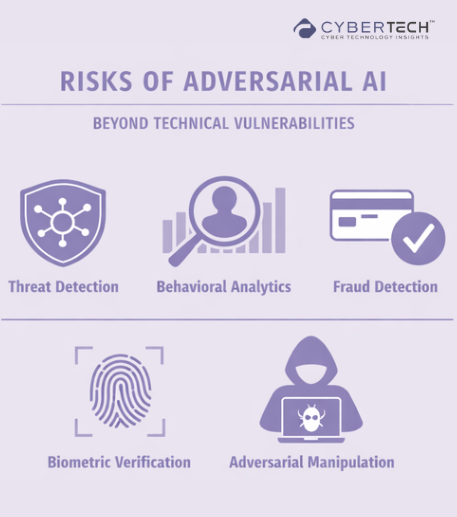
Fraud detection engines evaluate transactions in real time. Identity platforms rely on machine learning for biometric verification and anomaly detection.
If those models can be manipulated, the integrity of the entire security workflow is affected. Attackers can evade AI-based detection systems without compromising the underlying infrastructure.
A New Security Boundary for Enterprise AI
The enterprise conversation about AI security is beginning to shift.
For years, discussions focused on privacy, bias, and explainability. Important issues. But largely governance questions.
Adversarial AI introduces something different. A direct security threat to the reliability of machine learning systems themselves.
As AI becomes embedded in fraud detection, identity verification, cybersecurity analytics, and automated decision systems, the cost of manipulated models will rise sharply.
The organizations that adapt early will treat AI models as critical infrastructure requiring security engineering. Not just data science.
Those who do not may discover an uncomfortable reality. The most sophisticated AI systems can still be fooled. Sometimes, by changes too small for humans to see.
FAQs
1. What is adversarial AI in cybersecurity?
Adversarial AI refers to techniques used to manipulate machine learning systems by altering inputs, training data, or model behavior to produce incorrect outcomes. In cybersecurity, attackers exploit these weaknesses to bypass AI-driven defenses such as fraud detection systems, malware classifiers, and identity verification platforms.
2. Why is adversarial AI becoming a concern for enterprise security leaders?
As AI models become embedded in operational systems such as fraud detection, threat monitoring, and authentication, they become part of the security perimeter. Adversarial attacks can manipulate these models without breaching infrastructure, allowing attackers to influence automated decisions while remaining undetected.
3. How do adversarial attacks work against machine learning systems?
Adversarial attacks typically involve subtle modifications to input data or training datasets. These changes may be nearly invisible to humans but can cause machine learning models to misclassify data, evade detection, or produce incorrect predictions. Common techniques include evasion attacks, data poisoning, and model extraction.
4. What industries face the highest risk from adversarial AI attacks?
Industries that rely heavily on automated decision systems are most exposed. This includes financial services, healthcare, cybersecurity platforms, e-commerce, and identity verification providers. In these sectors, manipulated AI decisions can directly impact fraud detection, risk scoring, and operational security.
5. How can enterprises protect machine learning systems from adversarial AI?
Organizations are beginning to integrate adversarial resilience into AI governance frameworks. Key steps include adversarial testing during model validation, securing training data pipelines, implementing model monitoring for anomalies, and requiring AI vendors to demonstrate robustness against adversarial attacks.
Discover expert analysis and real-world CyberTech strategies at CyberTechnology Insights.
To participate in upcoming interviews, please reach out to our CyberTech Media Room at info@intentamplify.com.