Security investments rarely fail because the tools are weak. They fail because the value isn’t realized in time. That’s the tension behind SIEM vs XDR. Both are capable. Both are widely deployed.
Yet the return looks very different depending on how they’re used, how they’re staffed, and what the organization actually expects from them.
ROI, in this context, is not a clean financial calculation. It’s operational. Measured in time saved, incidents contained, and decisions made faster than the attacker.
Evaluating whether your security investments are delivering real ROI?
Explore expert insights, platform analysis, and security strategy guidance on Cyber Technology Insights.
Architectural Intent: Visibility vs Operational Response
Before comparing platforms, the objective needs to be clear.

SIEM and XDR optimize for different outcomes:
- SIEM leans toward visibility, compliance, and historical analysis
- XDR leans toward speed, prioritization, and response execution
If the goal is audit readiness, SIEM delivers measurable value. If the goal is reducing response time, XDR tends to show impact faster.
Where organizations get stuck is trying to force one system to do both.
Cost Structure Beyond Licensing
On paper, both SIEM and XDR involve licensing, deployment, and integration costs. That’s where the similarity ends.
SIEM carries a heavier ongoing operational burden:
- Continuous rule tuning.
- Data ingestion and storage costs.
- Dedicated engineering resources.
XDR shifts that burden:
- Less tuning, more built-in analytics.
- Lower dependency on custom correlation rules.
- Faster deployment cycles.
The spend may look comparable in year one. Over time, effort becomes the differentiator.
Effort translates directly into cost.
Licensing is only part of the equation. Operational cost is where ROI is won or lost.
Access in-depth analysis on security spend and platform efficiency on Cyber Technology Insights.
Time-to-Value as a Primary ROI Driver
This is where the gap becomes harder to ignore.
SIEM deployments often take months to mature. Data onboarding, rule creation, and false positive reduction. It’s a gradual process.
XDR platforms, particularly those from vendors like Microsoft, CrowdStrike, and SentinelOne, tend to deliver usable detections much earlier.
That shorter path to operational value is one of the clearest contributors to ROI. Especially for teams that don’t have the capacity to build detection logic from scratch.
Where SIEM Continues to Deliver Measurable ROI
There are areas where SIEM continues to justify its investment.
- Compliance and audit requirements
Long-term log retention is not optional in regulated industries. - Forensic investigations
Historical data remains critical for understanding breach timelines. - Customization
Highly specific correlation logic that reflects internal risk models.
In these scenarios, ROI is tied to risk reduction and regulatory alignment, not operational efficiency.
Where XDR Demonstrates Immediate Operational Impact
XDR tends to demonstrate value in day-to-day operations.
- Reduced alert fatigue
Fewer, higher-confidence alerts. - Faster incident response
Automated containment actions. - Lower dependency on specialized resources
Less need for dedicated detection engineers.
The result is not just a faster response. It’s a more sustainable security operation.
And that’s where ROI becomes visible quickly. Not as a report, but as a shift in workload.
Reducing alert fatigue is one of the fastest ways to unlock ROI.
See how modern SOCs are prioritizing signal over noise.
The Trade-Off Most Teams Underestimate
XDR’s efficiency comes with a constraint. You’re relying more on vendor-defined detection models.
For some organizations, that’s acceptable. Even desirable. For others, especially those with mature SOCs, it introduces limitations.
SIEM, despite its overhead, offers control. XDR, despite its speed, introduces abstraction.
The ROI calculation changes depending on which of those you value more.
Comparative ROI Analysis Across Key Operational Dimensions
| Factor | SIEM | XDR |
| Time to Value | Slow | Fast |
| Operational Effort | High | Lower |
| Detection Customization | High | Moderate |
| Automation | Limited | Built-in |
| Compliance Support | Strong | Limited |
| Resource Dependency | High | Lower |
This isn’t a winner-takes-all comparison. It’s a reflection of different priorities.
The Coexistence Model: How Enterprises Actually Realize Value
In practice, the decision is not binary.
SIEM remains in place for:
- Compliance
- Log retention
- Audit requirements
XDR is introduced for:
- Detection
- Investigation
- Response
The ROI comes from how these systems complement each other.
Not from replacing one with the other.
Aligning Security Investments With Organizational Constraints
The question is not which tool is better.
It’s where your current model is inefficient.
- If your team is overwhelmed with alerts, SIEM will not fix that on its own
- If your organization lacks audit visibility, XDR will not close that gap
The highest ROI comes from aligning the tool with the bottleneck.
Not the feature set.
The Broader Shift: From Data-Centric to Outcome-Driven Security
There’s a broader change happening underneath this comparison.
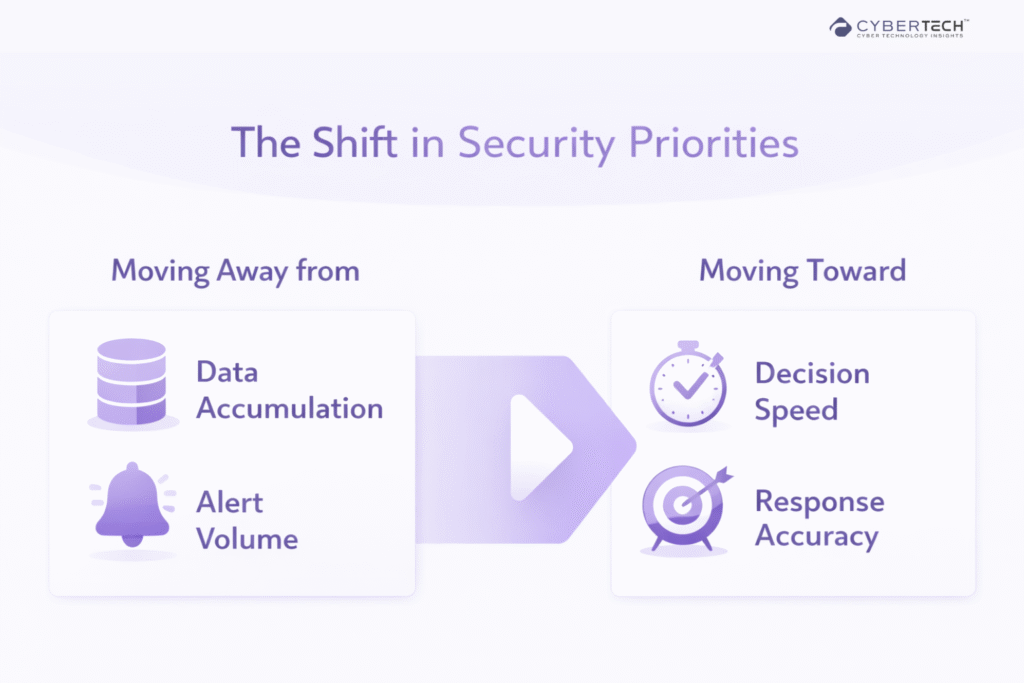
XDR aligns more directly with that shift. SIEM is adapting, but it wasn’t built for it.
That doesn’t make SIEM obsolete. It just changes its role.
The real question isn’t which tool to choose. It’s where your current model breaks.
Identify gaps and opportunities in your security operations.
Final Take
SIEM delivers ROI through control and compliance. XDR delivers ROI through speed and efficiency.
Most organizations need both. However, they shouldn’t expect them to deliver value in the same way.
The teams seeing the strongest outcomes are not choosing between SIEM and XDR. They’re redefining what return actually means in a modern security operation.
FAQs
1. Which delivers better ROI, SIEM or XDR?
XDR typically delivers faster ROI through reduced alert fatigue, quicker response times, and lower operational overhead. SIEM delivers ROI in compliance, audit readiness, and long-term data retention.
2. Why is XDR considered more cost-efficient than SIEM?
XDR reduces the need for manual rule tuning, large data storage, and dedicated engineering resources. This lowers ongoing operational costs compared to SIEM, which often requires continuous maintenance and optimization.
3. When does SIEM provide higher ROI than XDR?
SIEM provides higher ROI in regulated industries where compliance, forensic analysis, and long-term log retention are critical requirements. Its value is tied to governance and audit capabilities.
4. Can enterprises use SIEM and XDR together for better ROI?
Yes. Most enterprises adopt a hybrid model where SIEM handles compliance and log management, while XDR improves detection and response. This combination maximizes both operational efficiency and regulatory coverage.
5. What factors should CISOs consider when evaluating ROI for security tools?
CISOs should assess time to detect and respond, operational overhead, staffing requirements, integration complexity, and how effectively the tool reduces real-world risk, not just alerts.
To participate in upcoming interviews, please reach out to our CyberTech Media Room at info@intentamplify.com