Enterprises are scaling across multi-cloud, hybrid infrastructure, and distributed workforces. Yet most security models are still fragmented.
- Organizations use 20 to 30+ security tools on average, creating visibility gaps
- Threats move across identity, cloud, endpoint, and network layers
Cloud security architecture addresses this fragmentation by unifying how security operates across environments.
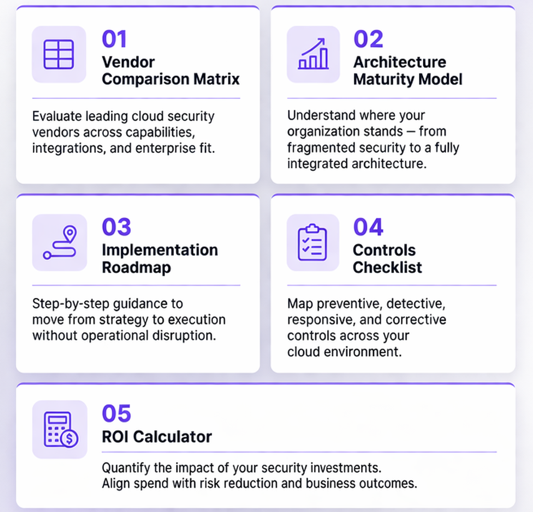
See how leading enterprises are structuring unified cloud security models.
Explore the architecture benchmark kit.
What Is Cloud Security Architecture?
Cloud security architecture is a structured framework that integrates identity, data, workloads, networks, and governance into a unified security model.
It ensures:
- Consistent policy enforcement.
- Real-time visibility.
- Risk-aligned security decisions.
This is not a security layer. It is the operating model of security in modern enterprises.

Download a breakdown of cloud security architecture layers and controls.
Access the full framework guide.
How Cloud Security Architecture Works
Cloud security architecture operates by correlating signals across systems instead of relying on isolated tools.
- Identity signals.
- Workload activity.
- Network traffic.
- Data access patterns.
These are analyzed together to detect threats and enforce policies in real time.
This approach eliminates blind spots created by siloed security stacks. Understand how integrated detection models work across cloud environments.
Core Components of Cloud Security Architecture
1. Identity and Access Management (IAM)
Identity is the primary control layer.
- Enforces least privilege.
- Continuously validates access.
- Detects identity-based threats.
Evaluate how identity controls impact your architecture maturity.
Use the IAM assessment checklist.
2. Data Security
Data remains the core business asset.
- Encryption and key management.
- Data classification.
- DLP strategies.
See how enterprises are prioritizing data-centric security models.
Explore the data protection blueprint.
3. Network Security (Zero Trust Model)
The perimeter is no longer the network.
- Microsegmentation.
- ZTNA.
- Software-defined security.
Map your transition to Zero Trust architecture.
Access the Zero Trust readiness guide.
4. Workload and Application Security
Workloads are dynamic and continuously changing.
- Container security.
- Runtime protection.
- DevSecOps integration.
Identify gaps in workload protection across your cloud stack.
Run the workload security checklist.
5. Security Monitoring and Detection
Detection defines response speed and impact.
- SIEM and XDR.
- Behavioral analytics.
- Threat intelligence.
Benchmark your detection maturity against industry standards.
View the detection capability scorecard.
6. Governance, Risk, and Compliance (GRC)
Security must align with regulatory and business requirements.
- Policy enforcement.
- Continuous compliance.
- Risk prioritization.
Align your cloud security architecture with compliance frameworks.
Access the GRC alignment toolkit.
Key Security Controls in Cloud Architecture
Security controls operate across four layers:
- Preventive
Stops threats before they occur by reducing attack surfaces and enforcing strong access and configuration controls.
- Detective
Identifies suspicious activity early through continuous monitoring, analytics, and threat detection mechanisms.
- Responsive
Contains and mitigates active threats quickly to minimize impact and prevent lateral spread.
- Corrective
Restores systems and strengthens defenses post-incident to reduce future risk and improve resilience.
These controls ensure that security is proactive, adaptive, and resilient.

Cloud Security Architecture vs Traditional Security
Cloud security architecture replaces siloed, perimeter-based models with integrated, identity-driven systems.
| Area | Traditional | Cloud Architecture |
| Perimeter | Network-based | Identity-based |
| Visibility | Fragmented | Unified |
| Detection | Reactive | Real-time |
| Response | Manual | Automated |
Compare your current security model with cloud-native architecture.
Take the architecture maturity assessment.
Vendor Landscape: Who Is Leading Cloud Security Architecture
Security is shifting toward platform-based ecosystems.
Enterprises are evaluating vendors based on:
- Integration
- Visibility
- Automation
- Platform depth
Shortlist the right vendors based on your architecture needs.
Access the vendor comparison matrix.
Vendor Comparison Snapshot (Enterprise Positioning)
| Vendor | Strength | Best Fit | Watch Out |
| Palo Alto Networks | Strong CNAPP + platform depth | Large multi-cloud enterprises | Complexity, cost |
| Microsoft Security | Native ecosystem integration | Microsoft-first environments | Limited outside ecosystem |
| AWS Security | Deep cloud-native controls | AWS-heavy organizations | Multi-cloud limitations |
| Zscaler | Zero Trust access leadership | Distributed workforce | Less workload depth |
| CrowdStrike | Detection + identity convergence | Threat-focused teams | Limited native network controls |
| Netskope | Data-centric SSE | Compliance-heavy industries | Platform breadth evolving |
How to Evaluate Cloud Security Architecture
Decision-makers must assess architecture beyond tools.
Key evaluation areas:
- Visibility across environments.
- Integration between systems.
- Automation capabilities.
- Scalability.
- Risk alignment.
Use a structured evaluation model for vendor and architecture selection.
Download the evaluation framework.
Key Trends Shaping Cloud Security Architecture
- Identity as the new perimeter.
- Platform consolidation (CNAPP, XDR, SSE).
- AI-driven detection.
- Multi-cloud complexity.
- Continuous compliance.
These trends are reshaping how security is designed and deployed.
Stay ahead of evolving cloud security trends.
From Security Stack to Security Architecture
Cloud security architecture defines how enterprises manage risk at scale.
Organizations that build integrated architectures gain:
- Faster detection.
- Reduced complexity.
- Stronger resilience.
Those who rely on fragmented tools continue to face visibility gaps and delayed responses.
Build Your Cloud Security Architecture Blueprint
Designed for enterprise security and technology leaders evaluating real-world adoption.
FAQs
1. What are the core components of cloud security architecture?
Cloud security architecture is built on six core components: identity and access management, data security, network security, workload protection, threat detection, and governance. Together, they create a layered, integrated model that secures cloud environments end-to-end.
2. How is cloud security architecture different from traditional security models?
Traditional security relies on network perimeters, while cloud security architecture is identity-driven and distributed. It focuses on continuous verification, real-time visibility, and integrated controls across cloud environments rather than static defenses.
3. What is the biggest risk in cloud security architecture today?
The biggest risk is misconfiguration combined with weak identity controls. Most cloud breaches stem from excessive permissions, poor access governance, and a lack of visibility across multi-cloud environments.
4. How should enterprises evaluate cloud security vendors?
Enterprises should evaluate vendors based on architecture alignment, integration capabilities, visibility, automation, and scalability. Platform-based solutions that unify multiple security functions are generally more effective than fragmented tools.
5. Why is Zero Trust critical in cloud security architecture?
Zero Trust eliminates implicit trust by continuously validating users, devices, and access requests. In cloud environments where boundaries are fluid, it reduces lateral movement and limits the impact of compromised credentials.
To participate in upcoming interviews, please reach out to our CyberTech Media Room at info@intentamplify.com