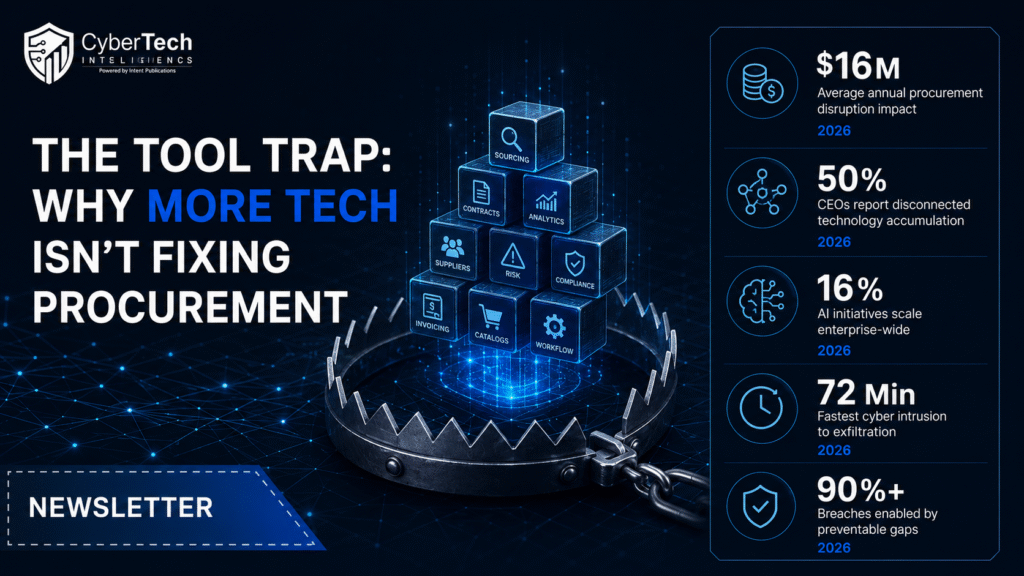
The enterprise procurement stack has never been larger. More tools, more integrations, more vendor contracts, more dashboards. And yet organizations are still absorbing an average of $16 million per year from procurement-related disruptions. ¹ The tools are not the problem. The trap is believing that adding more of them will eventually solve it.
This is the tool trap. The assumption that procurement performance is a function of software volume. The evidence from 2026 says the opposite. Organizations closing the million-dollar gap are not running more technology. They are running more coherent technology, built as native infrastructure rather than accumulated as disconnected applications that cannot share data reliably, cannot integrate cleanly, and cannot generate the continuous intelligence that modern direct procurement demands.
Coupa calls this the infrastructure gap. It is the subject of Supply Chain Now’s upcoming exclusive webinar, The Infrastructure Gap: Why Direct Procurement Is at a Breaking Point, hosted by Scott Luton and Karin Bursa and featuring Mark Schenecker with Coupa. For the CIOs and CISOs reading this, this is the conversation that connects procurement dysfunction to the enterprise architecture decisions you are already responsible for.
Why Tool Sprawl Is Making the Problem Worse
The data on procurement technology investment is striking not because organizations are spending too little, but because they are spending without architectural discipline and getting fragmented results as a direct consequence.
IBM’s IBV research found that 50% of CEOs report accumulating disconnected technology due to rapid investment cycles, with the resulting fragmentation inhibiting cross-functional collaboration, identified by 68% of executives as critical for effective integration. ²
In procurement, that fragmentation is the direct mechanism through which $16 million leaves the organization every year.
IBM’s own transformation proves what consolidation delivers. Standardising and automating source-to-pay on a unified foundation reduced IBM’s supply chain costs by $160 million, maintained a 100% order fulfilment rate at peak disruption, and generated documented savings across regions that fragmented point solutions were structurally incapable of producing.³
IBM’s AI ROI research confirms the broader pattern: only 25% of AI initiatives deliver expected ROI and just 16% scale enterprise-wide, with fragmented integration as the primary failure mode. ⁴
KEY FIGURES AT A GLANCE
$16M average annual financial impact from procurement-related disruptions per organisation (Supply Chain Now / Coupa Webinar — June 2026) ¹
50% of CEOs report accumulating disconnected technology due to rapid investment cycles (IBM IBV — January 2026) ²
Only 4% of procurement teams that piloted generative AI achieved large-scale deployment (AI at Wharton / Hackett Group — 2025) ⁵
Coupa: What Native Infrastructure Actually Looks Like
Coupa’s platform is built on a specific thesis: organizations solving direct procurement at scale have stopped treating procurement as a software layer and started building it as core business infrastructure.
The distinction is architectural. A software layer sits on top of existing systems, extracting data where it can and generating insight from whatever it can access. Native infrastructure is the foundation that other systems connect to, the source of continuous, reliable procurement intelligence that flows to finance, operations, and risk in real time, without manual reconciliation and without the visibility gaps that turn a three-day-old supply signal into a P&L event.
Coupa’s three-pillar framework, explored directly in the Supply Chain Now webinar, maps precisely onto enterprise technology leadership priorities. Infrastructure is the unified data foundation. Intelligence is the AI layer that converts data into action before disruptions become financial events. Influence is the cross-functional governance that makes procurement decisions defensible and auditable at enterprise scale.
For CIOs evaluating architecture and CISOs managing third-party risk, these three pillars are not procurement concepts. They are technology decisions you already own.
Microsoft: The Fragmented Stack Blocks Agentic Intelligence
Microsoft’s Supply Chain 2.0 research (March 2026) documents the core problem with unusual candour: most procurement and logistics operations run on a patchwork of systems that do not connect to each other cleanly, and agentic AI requires data connectivity that the majority of organizations simply do not have yet. ⁶
Dynamics 365 blog from Microsoft (May 2026) captures the potential of a unified platform, according to which Gartner expects 60% of supply chain disruptions to be automatically fixed by 2031, but not without first developing a connectivity and workflow capability through which automatic fix is enabled. ⁷
When the supplier indicates a delay on their component, then the procurement agent at Microsoft’s Dynamics 365 categorizes this message and ties it to the associated purchase order. In a fragmented stack, that agent has nothing reliable to work with.
The reference architecture Microsoft deployed with Celonis at Hannover Messe 2026 transforms fragmented supply chain data into agentic workflows by creating a unified intelligence layer from the raw data up. ⁶
This is architecturally identical to what Coupa does for procurement: consolidating fragmented data into a single, coherent platform from which intelligent automation can actually operate.
Google Cloud: Platform Thinking Separates Leaders from Laggards
Google Cloud’s 2026 research on agentic AI in logistics surfaces a finding every enterprise technology leader managing a procurement stack should sit with: 74% of shippers say they are likely to switch logistics providers based on a provider’s AI capabilities, and the market is shifting decisively toward partners who deliver strategic intelligence alongside execution. ⁸
The same dynamic is playing out inside enterprise procurement. Google Cloud’s partnership with EcoVadis (April 2026) illustrates the platform approach in action: rather than deploying point solutions across procurement, compliance, and sustainability functions separately, the architecture uses a unified AI foundation built on Gemini to generate consistent, real-time intelligence across categories previously managed in isolation. ⁹
That is the operational model that Coupa’s platform enables. A single, coherent procurement intelligence engine rather than a collection of tools each requiring its own integration, maintenance, and governance overhead.
Cisco: Every Procurement Tool Is a Security Integration
For the Cyber Technology Intelligence audience, the tool trap has a dimension that goes beyond operational inefficiency. Every procurement point solution added to the enterprise environment is a new integration, a new vendor access point, and a new potential entry into the security perimeter.
Cisco’s State of AI Security 2026 report is direct: supply chains are growing in complexity, often without proper controls and governance, and autonomous AI agents are proliferating across critical workflows, often without accountability being ensured. ¹⁰
Cisco’s AI Defence platform, expanded in February 2026 with its largest-ever update, introduces AI Bill of Materials capability, providing centralised visibility and governance over the full inventory of AI assets across the enterprise, covering what they are, where they came from, and how they behave in production as agents interact with third-party services. ¹¹
As Chirag Mehta, VP and Principal Analyst at Constellation Research, observed in response to Cisco’s February 2026 announcements: “AI security teams are now being asked three questions at once: what AI assets do we have, where did they come from, and how will they behave in production?” ¹¹
For CISOs managing organizations running a fragmented procurement stack, that question is already live, and the answer is almost certainly incomplete.
Coupa’s native infrastructure approach reduces this exposure by design. A single, governed, continuously monitored procurement platform presents a defined and auditable integration surface, not a sprawling collection of vendor connections each requiring separate security assessment and access governance.
Palo Alto Networks: Fragmented Tools Create Lateral Movement Opportunity
The Palo Alto Network’s Unit 42 Global Incident Response Report 2026, based on data from more than 750 significant cyberattacks in 50 countries over the period from October 2024 to September 2025, highlights the actual threat posed by procurement tool sprawl. Hackers are taking advantage of integration with SaaS platforms, vendor applications, and app dependencies to circumvent enterprise network perimeters and cause wide-scale disruption. ¹²
In a fragmented procurement stack, every point solution vendor relationship is a potential SaaS integration that an attacker can abuse. With attacks now 4x faster and the fastest intrusions reaching data exfiltration in just 72 minutes, the window for detecting lateral movement through a procurement integration is narrower than most security teams’ current detection capabilities can match. ¹²
Critically, in more than 90% of breaches, preventable gaps materially enabled the intrusion, including excessive vendor identity trust and inconsistently applied access controls.¹²
In a fragmented environment, those gaps multiply with every new tool added. In a native infrastructure environment like Coupa’s, they are governed from a single control point.
The Webinar That Changes the Architecture Conversation
The tool trap is not inevitable. The $16 million annual cost of procurement disruption is not a fixed operating expense. And the organizations that have already closed the gap did not do it by adding more tools. They did it by making a different kind of decision, architectural rather than incremental, infrastructure rather than application, platform rather than point solution.
The Infrastructure Gap webinar, hosted by Scott Luton and Karin Bursa with Mark Schenecker of Coupa, delivers the three-pillar framework that those organizations built, with the practitioner-level specificity that CIOs and CISOs need to act on. Not another procurement pitch. A direct conversation about what it actually takes to build procurement as infrastructure that performs at enterprise scale without expanding the security attack surface with every new vendor contract.
Register Now: The Infrastructure Gap: Why Direct Procurement Is at a Breaking Point Presented by Coupa | Hosted by Supply Chain Now Register Here
References
- Supply Chain Now / IntentTech Insights — The Infrastructure Gap: Why Direct Procurement Is at a Breaking Point — June 2026
- IBM IBV — IBM Study: AI Poised to Drive Smarter Business Growth Through 2030 — 19 January 2026
- IBM Case Study — IBM Builds Its First Cognitive Supply Chain — 2025
- IBM — How to Maximize AI ROI in 2026 — 19 February 2026
- Art of Procurement — State of AI in Procurement 2026 — April 2026
- Microsoft Cloud Blog — Supply Chain 2.0: How Microsoft Is Powering Simulations, AI Agents, and Physical AI — 24 March 2026
- Microsoft Dynamics 365 Blog — From Intelligence to Impact: How Agentic AI Is Reshaping Today’s Supply Chain — 4 May 2026
- Google Cloud Blog — How Agentic AI Is Rewriting the Rules for Logistics Providers — 19 March 2026
- ESG News — Google Cloud Partners with EcoVadis to Scale AI-Driven Supply Chain Insights — 23 April 2026
- Cisco Blogs — Cisco State of AI Security 2026 Report — 19 February 2026
- Cisco Newsroom — Cisco Redefines Security for the Agentic Era with AI Defence Expansion and AI-Aware SASE — 10 February 2026
- Palo Alto Networks — 2026 Unit 42 Global Incident Response Report — 17 February 2026
🔒 Login or Register to continue reading